Showing posts with label Reuters. Show all posts

Tuesday, November 26, 2019

Media Wonder: Why Can’t Venezuela Be More Like Bolivia?

JOSHUA CHODaily Beast photo illustration of Latin American leftist leaders

Reuters: Maduro's military stands in the way of a Bolivia repeat in Venezuela
For Reuters (11/11/19), the failure of “Maduro’s” military to launch a coup “stands in the way” of regime change in Venezuela.
Reuters’ report, “Maduro’s Military Stands in the Way of a Bolivia Repeat in Venezuela” (11/11/19), noted that “Venezuelan opposition leaders looking to oust their country’s socialist government” can “take some hope” from the “resignation of its leftist ally in Bolivia, Evo Morales.” There’s just one problem:
But one key factor makes the Bolivia playbook a difficult one to carry out against Venezuelan President Nicolas Maduro: Venezuela’s armed forces have consistently refused to take the side of protesters as Bolivia’s military did on Sunday.
Reuters’ Brian Ellsworth and Vivian Sequera complained that “Venezuela’s barracks have stood by the ruling Socialist Party,” despite a “crippling economic meltdown,” “waves of major protests” and “broad condemnation of Maduro’s 2018 re-election that was widely described as fraudulent.” (Despite such descriptions, which are indeed widespread, there is no reason to question whether President Nicolás Maduro won the May 2018 election, which was largely boycotted by the opposition.)
Reuters lamented that the unpopular US-backed Juan Guaidó’s unconstitutional efforts to “court the armed forces have not been enough to sway their allegiance to Maduro,” despite his being “recognized by more than 50 countries as Venezuela’s legitimate president.” (Note that this means that approximately 75% of the world’s countries don’t recognize Guaido, who lacks UN recognition.) The implication is that the Venezuelan military should stage a coup, just as the Bolivian military did when the armed forces commander William Kaliman
called on Morales to step aside, giving momentum to street protestors alleging fraud at an October presidential election that Morales was judged to have narrowly won.
Morales’ run for the presidency was approved by the Bolivian Supreme Court (whose judges are elected, rather than appointed as in the US), and, as was predicted in pre-election polling, Morales “narrowly won” the October 2019 election by more than 10 percentage points, which is why he did not face a runoff election. The Center for Economic and Policy Research found that there’s no evidence discrediting the legitimacy of Morales’ reelection. Only one US president in the past 50 years—Ronald Reagan in 1984—has won the popular vote by more than 10 percentage points.
Reuters: The Maduro mystery: Why the armed forces still stand by Venezuela’s beleaguered president
Reuters (7/28/19) ponders the “mystery” of why Venezuela’s military hasn’t overthrown the elected government.
But Reuters has a history of lamenting that Venezuela’s military is more loyal to its democratically elected government than the US empire. In another report pondering why the Venezuelan military remains loyal to Maduro and the Socialist Party, Reuters (7/28/19) complained that the Socialists took steps to prevent another coup like the one that temporarily removed Hugo Chávez from power before he was restored by popular support. The piece by Brian Ellsworth and Mayela Armas also criticized the Venezuelan military for assisting in public works programs like refurbishing schools, filling potholes, planting vegetables and clearing garbage; apparently a proper military spends its time preparing to invade other countries.
Reuters (8/22/19) has also presented Venezuelan efforts to prevent a military coup, such as removing disloyal officers, as sinister Cuban-inspired “repression” that has “cowed” the military. “Opposition pleas for a military rebellion have gone unheeded,” as reporter Angus Berwick lamented.
The Daily Beast’s report  “Evo Morales Is Out. Is Nicolás Maduro Next?” (11/13/19) likewise bemoaned the lack of a “domino effect” that would bring a Bolivian-style coup to Venezuela. The Beast’s Eduard Freisler acknowledged:
In Bolivia, it was largely the Bolivian army that forced Evo Morales out. This was the strategy that Venezuelan opposition leader Juan Guaidó tried in order to force Maduro out. But the young leader, who in late January proclaimed himself the interim president here, has never managed to sway the powerful and affluent generals to his side and away from Maduro.
The Daily Beast described Morales as “one of several presidents in Latin America who have claimed to represent the masses in their countries…sometimes helping to raise them from poverty, sometimes plunging them back into it.” The role of US sanctions in punishing the economies of countries that stray from Washington’s agenda was, of course, never mentioned in either of these reports (FAIR.org5/6/19)—as the Beast complained that “concerted economic and political pressure from the United States couldn’t shake” elected left-wing governments in Venezuela, Bolivia and Nicaragua. Neither do these reports mention CEPR’s relevant findings that recognition of Guaidó as Venezuela’s “legitimate president” effectively functions as a devastating oil embargo on the country.
Daily Beast: Venezuela: When a Coup Is Not a Coup, What the Hell Do You Do?
After a “classic military coup” failed to materialize in Venezuela, the Daily Beast (5/2/19)wondered, “How many more disappointments can the Venezuelan people stand?”
Like Reuters, the Daily Beast also has a history of mourning the improbability of the Venezuelan people and military’s supporting a US-backed coup. An earlier piece by Christopher Dickey (Daily Beast5/2/19) mourned the failure of Guaidó to convince the military to overthrow Venezuela’s government, claiming, that “a classic military coup, a quick and decisive golpe de Estado, would have been welcomed by many, and probably most, after years of suffering under Maduro.” Dickey also asserted that “no doubt some Venezuelans would welcome US military intervention,” though he thought that was unlikely. “How many more disappointments can the Venezuelan people stand?” he concluded.
It’s not accidental that both outlets downplayed the fact that a US-supported coup had occurred in Bolivia by acting as if only defiant left-wing governments in Latin America deem what happened in Bolivia to be a coup. Reuters (11/11/19) cited “leftist governments saying [Morales] was victim of a coup,” while the Beast (11/13/19) reported that “Chavista party members…termed Morales’ demise a coup,” even though both reports openly acknowledge, and indeed celebrate, the Bolivian military’s role in forcing Morales out (FAIR.org11/11/19). Section 508 of the Foreign Assistance Act requires that the US must cut off aid to any country “whose duly elected head of government is deposed by military coup or decree.”
FAIR has documented how corporate media consistently criticize the success of left-wing political agendas pursued abroad in countries like Venezuela and Bolivia—in defiance of US imperialism—because they are afraid of the threat of a good example (FAIR.org2/8/19). That might be why corporate media are wondering why Venezuela can’t be more like Bolivia in calling for a repeat coup there—which they won’t call a coup, of course.

Saturday, October 19, 2019

Double Standard: Reuters coverage of nat’l day celebrations in Iran and Saudi Arabia differ dramatically

By Alireza Hashemi

TEHRAN - The overall thrust of the Iran report of Reuters was that the country is ruled by a dangerous government and the people are dealing with numerous problems they blame on the “clerical leaders”. But the Saudi report portrayed a highly popular government and people who are just happy and show “resilience”.
The London-based Reuters appears to adopt a double standard in covering national day celebrations in Saudi Arabia and Iran, with its Saudi report showing a happy country that merely needs some “reforms” and its Iran report presenting an unhappy country that perhaps is in dire need for “regime change”.
Show of “resilience”
Saudi Arabia’s national day is September 23, the day Abdulaziz Ibn Saud announced the formation of the kingdom of Saudi Arabia after his army, assisted by the UK, eliminated several local governments inside the Arabian Peninsula.
As you may know, Saudi Arabia is to large extent a British creation, like other kingdoms in the peninsula.
But the Reuters article avoids mentioning the British role, saying the Saudi national day “marks the unification of the desert kingdom in 1932”.
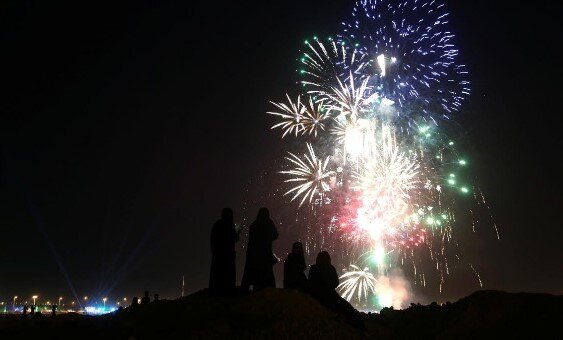
The Reuters piece, titled “Saudis project resolve, flash military might after Aramco attack”, said thousands of Saudis “flocked to” to public celebrations that featured “an air of heightened patriotism” following September 14 attack on “the kingdom’s energy industry”.
Another paragraph said that “nationalism, already on the rise under the powerful Crown Prince Mohammed bin Salman, appeared amplified in the wake of Sept. 14 strikes on Saudi Aramco plants…”.
Here we got lot of glowing text to unpack. The author has seemingly managed to feel “an air of heightened patriotism”, measure that nationalism has been “amplified” and see that the celebrations “project resolve” of Saudis.
Taking a breathless upbeat tone, Reuters wrote “Saudis said they were unfazed by the assault and hailed this year’s celebrations as a show of resilience”.
People contacted by Reuters all appear to be stanch supporters of House of Saud, saying that the celebrations are “a defeat for” enemies, the people and leadership and army are “united”, Saudis “are all together”, those behind Aramco attacks “will not stop us”, Saudis “are not scared of anything”, and they are celebrating with their “heads held high”.
One could come away from reading the initial coverage with the impression that Saudi Arabia is the innocent victim of a pearl-harbor-like attack by alien invaders, which has pushed the nation to unite around their popular folk hero MBS who is bent on taking their revenge.
But in fact Saudi Arabia is one of the world’s most authoritarian regimes, which ranks just above North Korea on political rights, civil liberties and other measures of freedom, according to the democracy watchdog Freedom House
The article also repeats the typical MSM narrative on September 14 attacks, saying Saudi Arabia and the US blame Iran for it. But the report fails to mention no credible evidence proving the allegations have so far been publicized. 
What we know so far is that the attack was carried out by anti-Saudi forces in Yemen, who include Ansarullah and over half of the former Yemeni Army, aiming to push Saudi Arabia to change tack on Yemen and end the bombardment and blockade of the poorest Arab country.
Man of “reform”
The report also uses the dubious “reform” narrative, which has been repeated by the western MSM for a couple of years without verification and reeks more PR than journalism.
The article says that the annual festivities have expanded to include more music and art shows, in line with a “broad reform agenda” that has introduced “once-taboo public entertainment and granted women more rights”.
But one could doubt if the whole process could be called a “reform agenda”, as MBS is part of the same House of Saud that has ruled the country for near a century and is 100% responsible for the current situation.
This is no surprise to astute observers, who for decades have been witnessing the western mainstream media portraying Saudi Arabia as a flourishing country.
A notable example is New York Times, who has taken flattering coverage to new extremes by working for over 70 years to put the House of Saud in a good light.
The routine performance of the brutal Saudi state are portrayed as laws of nature, and those in charge of it are the reformers of the very repression they originally authored.
Show of hatred
screengrab from the Reuters article on national day celebrations in Iran
The Reuters coverage of the latest public celebrations in Iran held on the anniversary of the 1979 Islamic revolution adopts a disapproving tone and paints Iran something in the vein of a garrison state.
The Reuters report on the celebrations held February 11 is titled “militant Iran taunts U.S. on revolution’s 40th birthday”.
Judging from the title and the lede, what we got here is a “militant” Iran who likes to show off “ballistic missiles” and makes Americans upset by burning “U.S. flags”.  And the first group of people who took part in the demonstrations were “soldiers”, who shouted “Death to Israel, Death to America”.
The rest of the article revolves around Iran boosting its military strengths, Iranian generals threatening to raze Israeli cities, and the West working to deal with Iranian “proxies” in Syria, Lebanon and Yemen and Iraq.
Of note, the people in Iran don’t “flock” to celebrations, they do not “project resolve” of Iranians and there is no “air of heightened patriotism” and nationalism is not “amplified” at a time when US President Donald Trump is placing unprecedented pressure on Iran.
Want to know Iranian’s response to the US sanctions? Reuters believes they are frustrated and tired, and they blame the Iranian leadership. 
The Reuters article says “Iranians face mounting economic hardships many blame on the country’s clerical leaders”.
We have also read another paragraph saying Iran has “cracked down” on 2017 protests over poor living standards that posed the “most serious challenge” to its “clerical elite” since a “2009 uprising”.
The Reuters report appeared to play down the annual event itself, just like many other MSM outlets.
The celebrations were frequently referred to by MSM as “state-organized” marches that saw tens of thousands or at best hundreds of thousands of people in the country of 80 million in attendance.
It’s all about the revolution
But people attending the ceremonies probably believed they were commemorating the victory of a revolution that finally brought democracy to Iran in 1979, 26 years after the US and UK toppled a democratically-elected government in Iran. 
The popular revolution toppled the US-backed regime of the despot Mohammad Reza Pahlavi, who was analogues to Saudi kings, creating anxiety among Persian Gulf Arab rulers about their future. 
The Reuters report says Washington and the Arab world have viewed Iran with “great suspicion” since the revolution, fearing “Khomeini’s radical ideology” would inspire “militants” across the Middle East.
Reuters wants us to believe “militants” were to be inspired by this “radical” revolution. But the Saudi crown prince himself confessed in a 2017 interview with the Guardian that the kingdom had been “not normal” for the past 30 years because “people” wanted to copy the Iranian revolution.
“What happened in the last 30 years is not Saudi Arabia. What happened in the region in the last 30 years is not the Middle East. After the Iranian revolution in 1979, people wanted to copy this model in different countries, one of them is Saudi Arabia. We didn’t know how to deal with it.”
Good guys and bad guys
Reuters and other MSM outlets generally followed a line long echoed by anti-Iran figures in the West’s political and media circles, who have periodically asserted the Islamic Republic is months away from collapse.
A February article analyzing the coverage of February 11 celebrations in Iran wrote:
Before the 40th anniversary of the revolution, western media were publishing mountains of commentary and strident headlines raising the familiar theme of Iran’s need for change.
Reuters ran the story of a former judge who is frustrated with the revolution, the Daily Telegraph remembered “horrors” of the post-revolution Iran, and Bloomberg asserted Iranians have endured 40 years of “terror, deprivation and cruelty” under the Islamic Republic.
Moreover, Wall Street Journal said the revolution has failed to fulfil promises, Washington Post believed the “decaying” Islamic Republic is “showing its age” and the Christian Science Monitor claimed the country has reached a turning point.
Likewise, Financial Times reported many of those born since the 1979 revolution want reform, France 24 quoted an expert saying the Iranian state represses its people and deprives them of the country’s wealth, and Deutsche Welle predicted the Islamic Republic is likely to be toppled in near future.
Generally, the western MSM’s audience have been endlessly told that Iranians have grown weary of the regime's corruption and are yearning from within for transformation.
The overall thrust of the Iran report of Reuters was that the country is ruled by a dangerous government and the people are dealing with numerous problems they blame on the “clerical leaders”. But the Saudi report portrayed a highly popular government and people who are just happy and show “resilience”.
People in Iran are often seen in need of “regime change”, but people in Saudi Arabia are just okay and the country merely requires some “reforms”.
This is what western governments like their people to think about Official Enemies like Iran and “allies” like Saudi Arabia.