Showing posts with label Wali Teymouri. Show all posts

Wednesday, December 11, 2019

Foreign tour operators, travel marketers astonished by safe, modern Iran

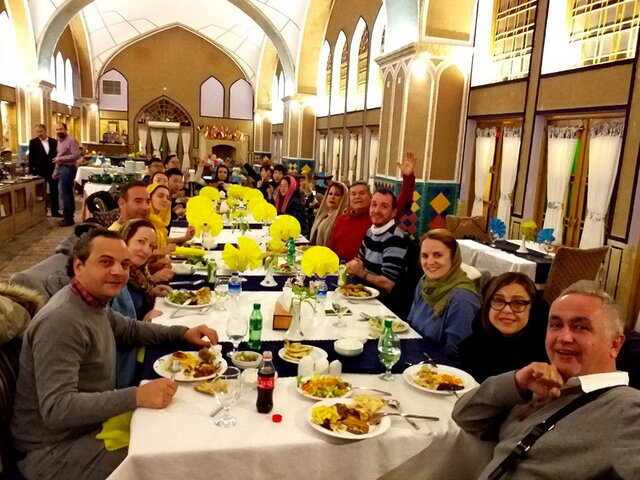
TEHRAN – International tour operators and travel marketers, who have recently made a familiarization tour across Iran, are astonished by seeing a country that is far more safe and modern than that they previously thought.
A weeklong Famtrip organized by an Iranian tour operator brought 17 travelers from Spain, Portugal, Italy, Turkey, Peru and China.
“Iran is more modern, cleaner and even quieter than what the media picture,” ISNA quoted one of the travelers as saying on Monday.
Julian, the representative a Spanish travel agency, reminded recent remonstrations in Iran to saying that protests are not unusual in the world as Spain, France and even Lebanon have experienced protests.
“We all continue life and the tourists are still coming.”
Joao, who presides over a Portuguese travel agency, said to ISNA, “I am in Iran, and my clients are surprised that I have traveled to such a country. They constantly ask me about the safety in here. I have sent some videos from the [Iranian] streets and people to show that everything is safe but they hardly believed that.”
Saeid Fekri, organizer of the Famtrip, noted that 30 people were initially invited to take part in the event, but some of them preferred to exercise caution and postponed their trips, so that 17 people took part in the Famtrip ultimately.
“From the hotels to the restaurants, Iran was beyond the group’s expectations. They did not think Iran to only have a modern city or a single modern hotel.”
Almost everything was incredible for them. Even about news of the unrest that they had heard, they asked where this was happening in such a way that everything is so calm now, Fekri explained.  
“This seemed even strange to their clients how managers of travel agencies could go to Iran under so-called circumstance.”
Deputy tourism minister Vali Teymouri said in October, “We need a good image of Iran to be displayed by the world media, thus, we would pursue any method perceived to be easy or less costly in compliance with the Islamic Republic of Iran’s regulations.”
“We do our best to create a good image of Iran in the minds of the world people,” he noted.
The 2019 Travel Risk Map, which shows the risk level around the world, puts Iran among countries with “insignificant risk”, a category where the UK, Denmark, Switzerland, Norway, and Finland are placed in.
Some 6.7 million foreign nationals have visited the country since the beginning of the current Iranian calendar year, Mojtaba Karimi, who presides over Foreign Ministry’s visa and passport department, was quoted by IRNA as saying on December 4.
Iran welcomed some 7.8 million foreign nationals last year, achieving 52.5 percent increase year on year. According to the World Travel & Tourism Council, Iraq was the main source of tourism for Iran in 2018, constituting 24% of all inbound visitors. Azerbaijan with (17%), Turkey (8%), Pakistan (4%) and Bahrain (2%) constituted other major sources while the remaining 46% came from the rest of the world.
The Islamic Republic expects to reap a bonanza from its numerous tourist spots, including 22 ones that have been placed on the UNESCO World Heritage list.

Sunday, December 01, 2019

Iran proposes a world day for ancient civilizations

TEHRAN – Iranian tourism minister on Friday proposed a world day for ancient civilizations as he was addressing the third ministerial meeting of the Ancient Civilizations Forum in Beijing, China.
“Importance and influence of ancient civilizations over the modern world is so great that I believe it should be marked each year as the world day of ancient civilizations,” CHTN quoted Ali-Asghar Mounesan as saying on Friday.
Chaired by the Chinese Minister of Culture and Tourism Luo Shugang, the forum was also attended by ministers from India, Iraq, Egypt, Armenia, Italy, Bolivia, Peru and Greece, as well as a community of international tourism and cultural heritage officials and experts.
“This forum lays a ground for exchanging our views and ideas. And today, I am going to take this opportunity to share my views on [how to make the best] use of cultural heritage for realization of cultural diplomacy. As we all acknowledge, cultural heritage, tourism, and crafts in today’s challenging world are [considered as] important tools for promoting and consolidating peace between [various] nations and communities.”
The Iranian minister explained how ancient civilizations, which abstained from wars and respected for human values, could ultimately ensure peace and security.
“The history testifies that human beings have always faced challenges of their times. [However], both the emergence and ways of dealing with each challenge has been repeated more or less in all historical periods and in all over the world.”
Mounesan added that though, sometimes, some societies have overruled each other’s rights and challenged their own and others’ peace and security, the true victory was achieved by those societies and nations who abstained from militancy and respected for human values.
“Some [of ancient societies and nations] could ensure peace and security and overcome the spirit of hegemony by the means of [practicing mutual] understanding and cultural interaction.”
Mounesan emphasized that in today world “we” are still witnessing differences of opinion and conflicts of interest.
“Devoting attention to cultural and civilizational commonalities can bring countries closer together and bridge gaps between them. So, in my opinion, the world today needs, most of all, cultural closeness, empathy, discourse, and consultation; ones that ancient societies were also benefited from in the past.”
He said that considering cultural heritage from this perspective would be a right solution because it could linking present generations - especially young people to the dignity and identity they have in common, and it can also play an important role in bringing nations together.
Ancient Civilizations Forum at a glance
The formation and evolution of ancient civilizations and their great achievements, ranging from architecture, philosophy and mathematics to medicine and astronomy, just to name a few, laid the foundation for the modern world as we experience it today.
The heirs of ancient civilizations have an obligation, indeed a mission, to preserve and develop this legacy for the benefit of humanity. This is especially important in a period of rapid changes and great uncertainties when international cooperation for global problems like climate change and growing inequalities is of paramount importance.
The aim of the conference was to discuss the importance of setting up an Ancient Civilization Forum, examine best practices of inter-cultural dialogue, describe initiatives and propose joint actions mainly in the fields of academic and scientific research, cultural diplomacy, cyberspace and the new media with an eye on growth and human-centric development.
The main areas of interest according to the Forum are: the impact of ancient civilizations on the modern era; civilization as a soft and smart power; and civilization as an agent of economic growth.