Showing posts with label Ansarullah (Houthi) movement. Show all posts

Friday, September 20, 2019

The Crisis Over The Attack On Saudi Oil Infrastructure Is Over - We Now Wait For the Next One

The crisis about the Yemeni drone and cruise missile attack on two Saudi oil installations is for now over.

The Saudis and the U.S. accuse Iran of being behind the "act of war" as Secretary of State Pompeo called it. The Saudis have bombed Yemen with U.S. made bombs since 2015. One wonders how Pompeo is calling that.

The Yemeni forces aligned with the Houthi Ansarallah do not deny that their drones and cruise missiles are copies of Iranian designs. But they insist that they are built in Yemen and fired from there.

President Trump will not launch a military attack against Iran. Neither will the Saudis or anyone else. Iran has deterred them by explaining that any attack on Iran will be responded to by waging all out war against the U.S. and its 'allies' around the Persian Gulf.
Trump sent Pompeo to Saudi Arabia to hold hands with the Saudi gangster family who call themselves royals. Pompeo of course tried to sell them more weapons. On his flight back he had an uncharacteristically dovish Q & A with reporters. Pompeo said:
I was here in an act of diplomacy. While the foreign minister of Iran is threatening all-out war and to fight to the last American, we’re here to build out a coalition aimed at achieving peace and a peaceful resolution to this. That’s my mission set, what President Trump certainly wants me to work to achieve, and I hope that the Islamic Republic of Iran sees it the same way. There’s no evidence of that from his statement, but I hope that that’s the case.
The crisis is over and we are back to waiting for the next round. A few days or weeks from now we will see another round of attacks on oil assets on the western side of the Persian Gulf. Iran, with the help of its friends, can play this game again and again and it will do so until the U.S. gives up and lifts the sanctions against that country.

The Houthi will continue to attack the Saudis until they end their war on Yemen and pay reparations.

As long as no U.S. forces get killed the U.S. will not hit back because Trump wants to be reelected. An all out war around the Persian Gulf would drive energy prices into the stratosphere and slump the global economy. His voters would not like that.

In our earlier pieces on the Abqaiq attack we said that the attacked crude oil stabilization plant in Abquaq had no air defense. Some diligent researchers have since found that there was a previously unknown Patriot air-defense unit in the area which was itself protected by several short range air-defense cannons:
Michael Duitsman @DuitsyWasHere - 7:02 UTC · Sep 18, 2019
On paper, the point air defenses at the Abqaiq oil processing facility are rather formidable... by 1995 standards, at least.
A battery of Shahine SAMs (French system from the early 1980's)
3 or 4 anti-aircraft gun sections, each with 2 twin 35mm cannons and a fire control unit

But one Patriot system covers only 120° of the horizon. The attacking drones came from a western directions while Saudi Arabia's enemies are to its east and south. The older Patriot 2 version the Saudis have is also not of much use against low flying drones and cruise missiles.
There is also the oddity that the Patriot unit's radar system was shut off.
Putin is a Virus @PutinIsAVirus - 4:53 UTC · Sep 19, 2019No patriot radars have been active in recent months (at least not consistently) in the vicinity of the plant, not in the short range required to detect low flying cruise missiles or drones. Closest installation is in Barhain.
(using Sentinel 1 CSAR sat for detection)

Satellites with synthetic-aperture radar can 'see' the radar of Patriot and other air-defense system. None was detected around Abqaiq.
The explanation for that is likely rather trivial. Colonel Pat Lang was stationed in Saudi Arabia as a military liaison officer. As he recently remarked:
Never underestimate the feckless laziness of the Saudis. In my experience they turn off all ATC and air defense systems that require manning or watch keeping when they find them inconvenient as on the weekend. IMO if Ansarallah did this they will do something similar soon to prove they are responsible.

Abqaiq was attacked on the night of Friday to Saturday. That is the weekend in Saudi Arabia.

Friday, August 30, 2019

The Houthi-Hezbollah Surrogate Nexus

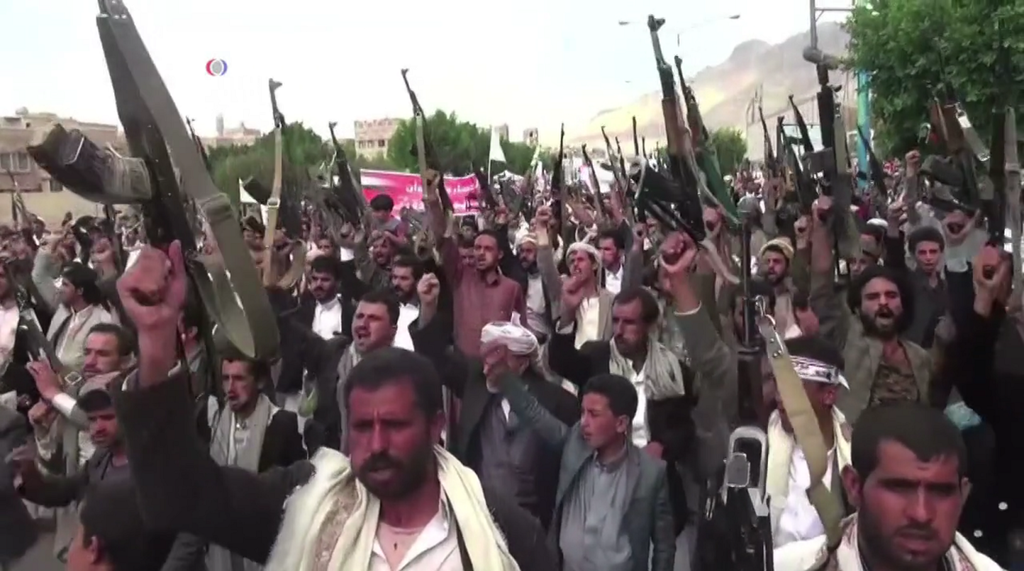
Houthis protesting Saudi airstrikes in Sanaa in 2015 (Wikimedia Commons)
by Giorgio Cafiero and Andreas Krieg
Yemen’s dominant Zaydi Houthi insurgent group—Ansarullah, which in much reporting on the Yemeni crisis is often referred to as “the Houthis”—has demonstrated major advancements in drone and missile capabilities. Ansarullah’s recent attacks against the Saudi-led coalition and strategic targets within the kingdom illustrate the increasing sophistication of its military operations. In recent years, Ansarullah has developed into one of Iran’s most potent surrogates, receiving training, material, and information support from Tehran and its elite Islamic Revolutionary Guard Corps (IRGC)’s oldest franchise, Hezbollah. Yet narratives merely labelling Ansarullah as ‘Yemen’s Hezbollah’ are too simplistic. Despite similar ideological narratives and information operations, the Yemeni militia is far from being an Iranian franchise.
The Saudi government maintains that Iran is arming Ansarullah with the aim of transforming the Zaydi Houthi insurgency into a replica of Hezbollah in order to weaken Saudi Arabia, other Gulf Cooperation Council (GCC) member states, and their Western allies. Officials in Riyadh have also alleged that Tehran is sending Hezbollah military trainers to Yemen, and certain sources have reported that members of the Lebanese Shia group have fought alongside Ansarullah militants in battles along the Yemeni-Saudi border.
In 2016, Yemen’s internationally recognized government, led by President Abdrabbuh Mansur Hadi, accused Hezbollah of intervening in the Arabian country’s civil war. Images of Ansarullah’s leadership meeting with Hezbollah Secretary-General Hassan Nasrallah in Lebanon served only to reaffirm suspicions of the Lebanese militia’s role in Yemen. They also contributed to a popular Saudi narrative that Ansarullah is basically a replica of Hezbollah and that the Houthi insurgents represent just another leg of Iran’s surrogate network.
In fact, the Houthi movement emerged throughout the 1990s as an indigenous Yemeni organization supporting disenfranchised communities of Zaydi Shia in their drive to create a Zaydi imamate. Despite the sectarian dimension of Ansarullah’s narrative, the movement does not have any natural links with Iran’s ‘Islamic Revolution’ and only received assistance from Tehran and Lebanese Hezbollah after 2014. It was only then that Tehran realized the powerful potential of the Houthi militia as a means to attack the Saudi kingdom at its “soft underbelly,” at low cost and with plausible deniability.
Ever since Riyadh began direct military intervention in Yemen in March 2015, the strategic narrative of the Saudi-led coalition, tailored towards a Western audience, was that the kingdom was fighting to prevent a Hezbollah-like Houthi ‘terror state’ along Saudi Arabia’s southern border. This talking point has been propagated extensively in Washington in a Saudi effort to gain greater sympathy from both the Obama and Trump administrations, plus lawmakers on both sides of the aisle, for their anti-Houthi campaign. Such efforts have paid off well with this administration. In December 2017, six months before Trump withdrew Washington from the Iranian nuclear deal, then-U.S. ambassador to the UN Nikki Haley delivered a speech that provided purported evidence of Iranian weapons being used by the Houthis against Saudi Arabia as she was seeking to garner global support for the administration’s anti-Iranian agenda.
Saudi Arabia, which is leading a crumbling Arab military coalition in Yemen against Ansarullah, has vowed not to allow the Iran-allied militia to emerge as the country’s replica of Hezbollah. In fact, when Saudi Arabia’s previous ambassador to Washington, Khalid bin Salman, accused the Islamic Republic of sending Hezbollah military trainers to Yemen to help strengthen the Houthis, he put out a series of tweets alleging that the Arab coalition “uncovered a cache of evidence against Al Houthis, revealed a Hezbollah operative training, advising them on asymmetric warfare, and showed background portrait of Iran ‘Supreme Leader’ on Militia’s computer.” The Saudi ambassador accusedIran’s government of having “subcontracted” Ansarullah to Hezbollah, allegedly a sign that Tehran’s “proxies work in tandem to undermine regional stability and prolong the suffering of countries they are involved in.”
In November 2017, Saudi Foreign Minister Adel al-Jubeir boldly accused Lebanon of declaring war on Saudi Arabia shortly after a ballistic missile from Yemen targeted Riyadh International Airport before the Kingdom’s Patriot defense system shot it down. Jubair asserted, “This was an Iranian missile… launched by Hezbollah.”
It is legitimate to question the veracity of such claims. Sources maintaining that Hezbollah is extremely influential in Yemen are often of questionable credibility or pushing a political agenda that has much to gain from convincing Western statesmen that Saudi Arabia’s fight against Houthi insurgents mirrors Israel’s struggle against Hezbollah. Yet it would disingenuous to fully dismiss Hezbollah’s role in Yemen as merely propaganda from the White House, Riyadh, or Abu Dhabi.
In Yemen—like in Iraq, Syria, and allegedly Bahrain—Hezbollah has served as Iran’s most senior surrogate, serving as the backbone of the Islamic Republic’s regional “axis of resistance.” Both in terms of hard and soft power, Hezbollah has grown from a mere franchise of Iran’s IRGC in the early 1980s into a self-sustaining strategic proxy that enjoys considerable autonomy from its patron’s command and control. Hezbollah has developedinto an important node within Tehran’s vast surrogate network, providing direct franchises such as Kata’ib Hezbollah, as well as indirect surrogates such as the Houthis, with operational support.
Notwithstanding ideological links between Ansarullah and Hezbollah, the main crux of their relationship appears to be operational and rooted in pragmatism. To bog down the Arab coalition in Yemen, the Houthis have sought out training assistance, technological support, and operational direction from Hezbollah to achieve their objectives on the ground. For Hezbollah, the Yemeni civil war has represented an opportunity to humiliate the Saudis at a time in which the Lebanese organization is also struggling against Riyadh’s proxies within Lebanon.
At the risk of exaggerating Hezbollah’s role in the Yemeni civil war, it goes without saying that the Lebanese force, which Tehran has bankrolled for decades, has contributed to Houthi battlefield successes against the Saudi-led coalition. The advancements in Houthi missile and drone capabilities all highlight the extent to which Hezbollah has made a difference in the conflict, which has seen Ansarullah assume de facto control of northern Yemen. Nonetheless, Ansarullah is more than just a mere Iranian franchise outfit. Unlike Hezbollah, Ansarullah—as a homegrown movement—would continue to fight, albeit less effectively, even if its link to Tehran were severed.
Andreas Krieg is an assistant professor at the School of Security and Institute for Middle Eastern Studies at King’s College London.

Monday, January 21, 2019

Why to End the War on Yemen – The Reconstruction the US Ignores

TEHRAN (FNA)- In December, the Senate successfully passed a War Powers Act resolution calling for the end to US support for the Saudi War on Yemen. The House leadership at the time refused to allow a vote, but with the Democrats now the leadership, such a resolution is expected to be voted on in the next six weeks.
It is widely expected that both houses of Congress will successfully pass War Powers challenges to the Yemen War, though they say the exact timing may be unclear because of the government’s shutdown. Even then, there is an expectation that President Trump will veto the measure. This would be a politically difficult veto for the president, as the War Powers Act is explicitly meant to give Congress oversight of US wars, and a veto would effectively be the president overriding Congress on refusing to back a war that was illegally launched in the first place.

This is while the only way out is a renewed call for political negotiations, playing on the fact that the Yemeni factions want peace. For that call to be effective, the US government is required to shift its present course of actions with a three-pronged strategy:
- Back the ceasefire in order to allow humanitarian assistance into the country.

Financing aid while continuing the air campaign is as a cynical manoeuvre by the US and its Saudi allies that do not know where to bomb next. For this aid to reach vulnerable populations, both the US and Saudi Arabia must respect the ceasefire and stop bombing the war-torn country.

- Allow the UN as a mediator and give up on hosting one-sided political talks in Riyadh or elsewhere in Europe. Riyadh is clearly no acceptable destination for Ansarullah, and would likely be contentious for almost all other Yemeni factions. Instead, the US should capitalize on the impartial stance taken by the UN toward the conflict and ask them to facilitate a dialogue – without any interference.

- Take responsibility for the destruction and help the UN in its reconstruction and development vision for Yemen.

If the US wants to truly demonstrate a “Yemen resolve to act alone,” it needs to show that Yemenis can rebuild their country devastated by this illegal conflict - one that, unlike war-torn Libya, Syria, or Iraq, might be salvageable.

The US should build upon the UN resolution to secure and finance a long-term reconstruction plan for Yemen. The plan should be based on the ultimate objective of integrating Yemen within the UN, making use of its human and natural resources and capitalizing on its strategic coastline.

To that end, the US government must not write a check to the Saudis and leave Riyadh to sort Yemen out on their own. Yemen’s experience has shown time and again that Saudi Arabia and its allies are unable to build state capacity or to provide effective long-term development - a failure that helped bring Yemen to the brink of crisis in the first place. Whatever international reconstruction vision emerges, the US is responsible to be part of it, and should remain part of its development and implementation long term.
The US has a particular responsibility at the UN too. The decision by the UN to press forward with a ceasefire resolution, however limited, was a welcome show of determination. But it needs to be carried forward, and supported by national actions, including the ending of all US support for the war strategy and resumption of reconstruction efforts.

In this deliberate man-made crisis there is no firewall between a political process to end the fighting and the humanitarian catastrophe that the world does witness day in, day out. Unless there is outside pressure of a substantial kind on Saudi Arabia and its allies, civilians will continue to endure terrible suffering. While Saudi and Emirati airstrikes are the primary cause of civilian deaths, many more have died from the impact of the US-backed blockade: drought, disease, starvation and preventable deaths.

In summation, those who turned Yemen into a failed state are now required under international law to take responsibility for its reconstruction and peace efforts. They must help the UN to improve humanitarian and commercial access into and around Yemen, including the full functioning of all ports and Sana’a airport. They must help the UN to repair public service infrastructure such as water provision and hospitals, which has been damaged during the US-backed, Saudi-led airstrikes. They must also pay for all the damages they have caused to the country.

Yemen is a complex society, but the choices facing the Saudis, the Americans and their allies now are simple. They cannot continue the failed war, see more people die, and watch malign geopolitical consequences grow. The people of Yemen and all warring factions want peace and unity. The Saudis, the Americans and their allies must stop the protracted war and give international reconstruction efforts a chance to make a difference.

Saturday, December 22, 2018

EXCLUSIVE: Vanessa Beeley interviews Yemen’s Ministry of Health Spokesperson, Dr. Yousef Al-Haidari

Vanessa Beeley, an independent journalist, peace activist, photographer and associate editor at 21st Century Wire, has interviewed Yemen's Ministry of Health Spokesperson, Dr. Yousef Al-Haidari.
Vanessa Beeley: Thank you so much for giving your time. What is the war in Yemen about and where will it end? 
Dr. Yousef Al-Haidari: Since the first revolution in Yemen on 26 September 1962, these great powers in the world have managed to contain the Yemeni people politically, intellectually and economically so they did not fight us as they have during this ugly war. They enslaved us and ruled us through their puppet presidents.
Yemen’s geographical location, the third best in the world, and Yemen’s rich resources, oil, gas, rock, agricultural and fishing abundance and diversity of landscape should make Yemen one of the world’s wealthiest countries but this has not happened because of this policy of “making us poor to keep us under control”.
The movement that originated in northern Yemen, Saada, called Ansarullah or as western media like to say, the Houthis, rose out of the poorest societies and it identified the root cause of Yemen’s poverty – the American system and that is why they adopted the slogan “death to the American regime". Their revolution which succeeded on 21st September 2014 then provoked American agents in the region, Saudi Arabia and the UAE, to try to persuade the new government in Yemen, represented by Ansarullah, to continue the mercenary path of dependence upon the U.S that had been taken by former presidents in Yemen. The Ansarullah movement and leadership rejected this move completely.
When the global powers, represented by the American, British and Saudi regimes saw that the Ansarullah movement was able to eradicate all the terrorist entities in Yemen, such as Al Qaeda, which previous Yemeni regimes had been unable to achieve, they sensed the threat that the Ansarullah movement represented for their colonial projects which had been supported by the deliberate planting of these terrorist groups and they launched the aggression against Yemen on 26th March 2015.
The Saudi-led “Operation Decisive Storm” was launched by the former Saudi Ambassador to Washington (current Saudi Foreign Minister) Adel Al-Jubair from inside the White House. On the first day terrible massacres were carried out among the children of Yemen, one of them in the north of the capital, Sana’a and in the middle of the capital. The same night, children and civilians were deliberately targeted in their homes as they were sleeping. 23 days later on 20 April 2015, a powerful neutron bomb was used in Sanaa and every area of the city was bombarded. Thousands of homes were destroyed. All of these crimes were committed with U.S endorsement and support.
The endgame is clear. After the Saudi coalition was able to bring down a number of Yemen’s provinces in the south – a campaign that was characterized by chaos, murder, assassinations, terror and fear – as witnessed by international NGOs and journalists. We witnessed the establishment of dozens of secret torture and detention centers, similar to those established by the U.S in Iraq, the Abu Ghraib prisons. Even those who support the U.S and its Saudi coalition could not return to Aden, they were refused entry by the U.S, Saudi, Emiratis. The Island of Socotra and the province of Hadramaut were occupied by the U.S. The provinces to the east of Yemen on the border with Oman were occupied by Saudi proxies and forces to open a channel for its oil to the Arabian Sea in the south of the Arabian Peninsula. The Yemeni people living there experienced deepening hunger, poverty and disease, they received no benefits from this occupation.
Today, we are nearing the end of the fourth year of this aggression, which has been mobilized by all the most powerful countries of this world, all the resources of this world and all the armies of this world using all the weapons at their disposal. Weapons that are internationally prohibited like U.S and U.K supplied cluster bombs. The war will not end until the alliance of aggression breaks down and the Saudi regime collapses. The alliance has attempted to weaken us with every weapon in their arsenal – bombing, starvation, disease, cholera, terrorism, diphtheria, malnutrition, malaria – but they do not understand that we will not yield until Yemen is free, we will never surrender even if they occupy our homes and lands.
The cessation of this aggression depends entirely upon the vigilance and humanity of the peoples of this world, not upon their criminal governments who profit from our suffering.
VB: Do you have any hope in the current peace talks in Sweden?
Dr. YaH: There is no hope in the current peace conversation, and the reason is that the other side did not come to dialogue with us, but sent their mercenaries who don't have the ability to make decisions. They do not even have the right to return to their country while they claim they “liberated” which translates as an occupation. When we have American, Saudi and the UAE government representatives at the same table with Ansarullah, we will be able to say there is hope.
VB: Most people in the west have been sold the idea that fugitive/resigned former President Mansour Hadi is the head of the internationally recognized government in Yemen. You are the Health Minister of the current, constitutionally elected Yemeni government. Please describe the government in situ. Does it have popular support?
Dr. YaH: I am the official spokesman of the Ministry of Health in the Yemeni capital Sana’a, which was formed constitutionally through the Constitutional Council of Representatives, which is still in Sana’a, which is more than the quorum. I believe that the continuation of the recognition of Abdu Rabbo Mansour Hadi as president of Yemen is due to American and Saudi money and the UN ruling. Hadi presented his resignation on January 19th 2015 and that was preceded by the end of his presidency of consensus on 21st February 2014. His presidency was extended by one year but he was never constitutionally elected. For me, there is no legitimacy for those who will murder their own people, besiege and starve their own people. He destroys his own people upon instruction from the U.S and the Saudi coalition. 
Everyone can see that the entities that promote American hegemony are effectively besieging or killing their own people or putting economic pressure upon their people or simply ensuring the spread of chaos in their country. We see this in Yemen, Syria and North Korea among many others. Unfortunately, most of the world is subjected to the devastation brought about by American hegemony in varying degrees. The U.S believes, it alone can determine who or what is legitimate or illegal. “Legitimacy” must be determined by the people of sovereign nations not by external and predatory forces.
Hadi’s government has been living, for four years, in the luxury hotels of Riyadh, Dubai, Cairo and Istanbul. It does not exist in Yemen, even in those areas it claims to have “liberated”. It can never go back to Yemen. Our government in Sana’a is recognized by the people of Yemen. It brings stability, freedom and justice. There is no suppression of doctrinal, sectarian or partisan considerations at all.
The number of people living in the areas of Yemen occupied by the Saudi coalition does not exceed 25% of the 27 million Yemenis. 75% live in the areas controlled by the Sana’a’s government and the popularity of this coalition government is evident in the fighting fronts and popular support. They are supported by religious and national factions alike and there is a marked absence of public rejection or uprising against them – something which is a common occurrence in the provinces of the coalition-occupied south.
VB: How many children have died of preventable diseases since the conflict began, because of the blockade on food and medicine? 
Dr. YaH: The statistics are not complete as the Ministry of Health is unable to record accurate figures due to specific issues. There are many children who die silently – they die in their homes after their parents were unable to provide them with hospital because of poverty, siege and lack of money, just for example. 
Malnutrition: – 2,300,000 children with 1/3 suffering from a type of malnutrition, including 400 thousand children with severe acute malnutrition, one child dies every ten minutes.
2890 Yemeni people have been infected with diphtheria since its re-emergence on October 2017, of whom 169 died, children represent 90% of these statistics.
Cholera and associated diarrhea: – About 1,357,998 Yemeni people have been affected during the period 27 April 2017 to date, of whom 2678 died, children represent 70% of those deaths. 
Malaria and dengue: – There are about half a million Yemeni people suffering from malaria and 30 thousand died from the disease, the majority are children.
130 medicines needed to treat chronic diseases and lifesaving medicines are not available in the Ministry of Health because of the economic blockade and the closure of Sana’a airport since 8 August 2016 until today. These drugs include kidneys, renal dialysis, cancer, diabetes, thalassemia, heart, epilepsy. Tens of thousands have died as a result of the lack of these medicines, the majority are children. 
Since the closure of Sana’a airport on August 8th 2016 until today, some 200,000 Yemenis have been unable to travel abroad to receive appropriate medical treatment that is not available in Yemen. So far, 28,000 patients have died, 40% are children.
VB: Have attempts to import necessary lifesaving items been delayed or denied entry and by whom?
Dr. YaH: Oil and basic foodstuffs and 120 pharmaceuticals have been banned from entering Yemen except through very complex conditions and only by the sea not through Sana’a airport which is closed. Because of the U.N Verification and Inspection mechanism imposed on ships entering Djibouti port, medicines remain blockaded there for months and many medicines will have perished by the time they finally enter Yemen, if at all. Wheat, for example, will be rendered inedible after storage in high temperatures. The procedures do nothing more than add cost onto the items for the already poverty-stricken civilians. The closure of Sana’a airport and the transferal of the National Bank to Aden also have a negative effect. For kidney treatment, we can only provide enough for 5% of patients through international organizations.
VB: How are the 5000 kidney patients coping bearing in mind they are unable to receive the necessary dialysis? 
Dr. YaH: Eight thousand dialysis patients receive just 2 washings each week, although it should be minimum 3 washings per week, and instead of 5 hours per wash, we do only 3 hours. Where dialysis machines work 24 hours/7 days – 4 dialysis centers have been closed by the Saudi bombardment. 27 centers are still functioning but we are unable to provide equipment or to repair devices thanks to the blockade. We struggle to have enough of the washing solutions. If we did not have the cooperation of some international organizations and the help of Yemeni society, we would have witnessed another humanitarian catastrophe. Even so, we cannot cover all needs and 1200 patients have died of renal failure as a direct consequence of the blockade. 
VB: Does it still apply that any surgeries for cancer will be performed free of charge? 
Dr. YaH: In Yemen, there is no health insurance for citizens at all. Health care is charged for even in public hospitals although the payment is less than in private hospitals. The new Minister of Health, appointed in June 2018, introduced a policy to reduce the pain and suffering of patients, especially those with cancer and they have access to free procedures in public hospitals in Sana’a. A new law has also been introduced which will enter into legislation in 2019 – the Fund for the care and treatment of cancer. We hope that this will go some way to relieving the suffering of cancer patients.
VB: How many hospitals remain operational across Yemen?
Dr. YaH:  In areas governed by the Sana’a government, 79 hospitals provide health services to 75% of Yemenis and 2,000 health centers throughout Yemen. The Saudi coalition air force destroyed 345 health center hospitals completely destroyed or partially destroyed.  Of these, 4 hospitals are run by Doctors Without Borders and about 45% of hospitals and health centers have stopped working because of the blockade. Health work in Yemen is only 55% operational and they are overwhelmed by the spread of epidemiological, psychological and physical diseases. 
VB: Right before the talks in Sweden, some injured Yemenis were reported to have been allowed to fly out. How many were able to fly out?
Dr. YaH: The 200,000 people who suffer from these physical diseases, such as cancer, heart, kidneys, bone etc. have been collectively punished by the coalition of aggression’s refusal to allow them to travel. 28,000 have died as a result. The World Health Organization and the UN expressed a willingness to conduct two trips per month, 100 patients each trip. Those who managed to travel before the peace talks are the war wounded, whether fighters from the frontlines or the civilians injured in Saudi bombing raids. No more than 50 such patients have been able to leave for treatment and one trip was organized as a prerequisite for the Sana’a delegation to participate in the “peace” talks. 50,000 injured are still waiting for permission to travel for treatment, thousands of them with permanent disabilities. 
VB: What is needed most in terms of Humanitarian Aid?
Dr. YaH: The Yemeni people do not require any assistance actually. They only require that the blockade and siege is lifted and the aggression stopped and that they be allowed to live in peace. We will regulate our own problems peacefully and easily. This is the most important demand from the Yemeni people.
VB: Who is ultimately responsible for the genocide in Yemen? 
Dr. YaH: Those who are officially responsible for the genocide in Yemen are those who own the money of mass destruction with which they buy weapons of mass destruction from the countries of mass destruction endorsed by the United Nations of mass destruction and met with global silence while Yemen is being destroyed. The American regime is mainly responsible, the UN and the Security Council follow closely as legal cover for the crimes committed by the US and its Saudi and UAE partners enabling them to commit the atrocities against the Yemeni people. Saudi Arabia and UAE are number three in the responsibility league table and then you have, as number four, the fugitive, illegitimate President Abdu Rabbo Mansour Hadi and his political team at the UN or working as ambassadors in other countries.
Finally, I always welcome you and your questions at any time and whatever the questions without reservation, and thank you deeply for your constant solidarity with us. People are two types (either your brother in religion or your counterpart in creation) and we live in one land and one race and live one life and our destiny is one … all respect to you and the people of the world.

Friday, November 02, 2018

Why Is Washington Backing Al-Qaeda and ISIL in Syria And Yemen?


TEHRAN (FNA)- Syria’s UN Ambassador Bashar al-Jaafari has once again denounced sanctions imposed on his country by the United States and the European Union, saying the bans are harming the Syrian people.
Jaafari told a Security Council session on Monday that foreign-backed Takfiri terrorists and the sanctions imposed by the US and the EU are inflicting suffering on the Syrian people.
On May 28, the EU extended its restrictive measures against the Damascus government until June 1, 2019. The sanctions currently in place against Syria include an oil embargo, restrictions on certain investments and a freeze of the assets of the Syrian central bank held in the EU. The EU bans are also in place on dozens of companies linked to the Syrian government.

Because of the bans, the US and the EU lack moral and ethical standards while dealing with today’s crises, particularly in the universal war against terrorism. But why should the US be willing to embark on such measures that end up in supporting Al-Qaeda and its offshoots like Nusra Front in Syria? It is not as strange as it may seem:

The US-led war on Syria has admittedly required Washington to partner up with “moderate militants” in pursuit of its colonial and aggressive foreign policy goals, including partitioning Syria and protecting Israel. But the war has produced too much evidence to keep the myth of "moderate militants" alive, even for pro-US experts and media. Though completely clear and globally condemned, this de facto alliance with terrorists and extremist groups, even ISIL, is necessary to facilitate the more long-term goals in the Middle East. This includes regime change in Iran.

That explains why the US is turning a blind eye to Al-Qaeda and ISIL and their crimes, and why President Trump says there will be no arms sales ban for Saudi Arabia despite the fact that its rulers were behind the grisly murder of journalist Jamal Khashoggi in the Saudi consulate in Istanbul on October 2.

As for Syria, and more specifically for the Idlib province, it suffices to state that according to President Trump’s Special Envoy to fight ISIL, “Idlib province is the largest Al-Qaeda safe haven since 9/11.”

US officials – including President Trump himself – keep warning the Syrian government not to re-take its own territory from Al-Qaeda control because if Idlib is re-taken by the Syrian army, Wasington or more specifically the Pentagon loses its major foothold in the country, meaning that the American, Saudi and Israeli dream of “regime change” for Syria will be buried altogether and that will be the last and probably most effective ring in the chain of victories of Syria and its allies, Iran and Russia, in burying the US scheme for Syria.

One of the last groups of ISIL fighters in Syria is around the Al-Tanf US military base which has operated illegally in Southeastern Syria - that is assessed as a strategic juncture at Syria's border with Iraq and Jordan - for the past two years. The US has no permission from the Syrian government to be there. Anytime Russia warns the US military in the region that it is about to launch an assault on ISIL fighters around the illegal US base, the US responds by sending in Marines and conducting live-fire exercises as a warning.

The US is occupying the region while it has turned a blind eye to ISIL and Al-Qaeda in the neighborhood as it helps to prolong the bloodshed, justify occupation, and protect Israel. Syria, Russia and Iran have been protesting at the US for allowing ISIL terrorists to operate in the region freely. The US has warned that it has imposed a no fly zone in the region on the pretext of protecting its military, but this has provided the ISIL with free movement without any worries about Syria and Russian air power.

The base that is also used by the US military troops to train Syrian anti-government militants is adjacent to The Rukban refugee camp, which now hosts about 50,000-60,000 people, at Al-Tanf district (Homs province) near the Jordanian border. The US has been hindering the delivery of UN humanitarian assistance to the area, while tens of thousands of refugees are dying of hunger. UN Undersecretary-General for Humanitarian Affairs Mark Lowcock said on Monday the United Nations is prepared to immediately send a humanitarian convoy to the al-Rukban camp once safe conditions for its passage can be ensured.

"The UN is ready and willing to proceed with the convoy immediately," Lowcock said, just days after a planned aid delivery was delayed due for security reasons. "Please, make the necessary arrangements to ensure the security of the humanitarian personnel and the accompanying convoy so it can proceed without delay".

Lowcock also said reports of insecurity along the planned delivery route had forced the UN and the Syrian Arab Red Crescent to postpone plans to deliver the aid on Saturday. Initially, UN, humanitarian workers along with the Syrian Arab Red Crescent, had planned to deliver aid to some 50,000 people, begin a vaccination campaign for around 10,000 children and conduct a rapid needs assessment during their visit to the camp, Lowcock stressed.

US troops are protecting ISIL and starving tens of thousands of people at Al-Tanf to admittedly train anti-government forces in quest for its regime change fantasies in Syria. Yet, this is not the only case of Washington's detrimental and lethal presence in the country. The United States' military forces have established a much wider presence along Eastern Syria to the North-East.

The same foreign policy game is being played in Yemen. The US-backed, Saudi-led war on the impoverished nation is benefiting Al-Qaeda. Washington and its allies have been fighting the Ansarullah (Houthi) movement that has been the only force fighting the Al-Qaeda terrorists in the country, while the Saudi-backed militants of Mansour Hadi have admittedly been working with Al-Qaeda in a number of regions to fight off Ansarullah popular movement. Again, the US helps Al-Qaeda in Yemen to prolong the war, justify occupation, protect Israel and Saudi Arabia, plunder Yemen’s energy resources, and fight the Iranian influence in the Peninsula.

Long story short, the United States and its regional allies are aiding ISIL and Al-Qaeda, which did attack the West and the region. But they justify such deadly ignorance on the pretext of containing Iran in the region - a country that hasn’t attacked its neighbors for more than two hundred years and is at the forefront of the war on terror in Syria.

Meaning, the US-led warmongers are supporting various terrorist groups for their regime change fantasies, and under international law they are complicit in war crimes and crimes committed against humanity by their terror proxies or due to their direct and indirect protection and support for internationally recognized terrorist groups.

Wednesday, October 31, 2018

Why Is Washington Backing Al-Qaeda and ISIL in Syria And Yemen?


Syria’s UN Ambassador Bashar al-Jaafari has once again denounced sanctions imposed on his country by the United States and the European Union, saying the bans are harming the Syrian people.
Jaafari told a Security Council session on Monday that foreign-backed Takfiri terrorists and the sanctions imposed by the US and the EU are inflicting suffering on the Syrian people.
On May 28, the EU extended its restrictive measures against the Damascus government until June 1, 2019. The sanctions currently in place against Syria include an oil embargo, restrictions on certain investments and a freeze of the assets of the Syrian central bank held in the EU. The EU bans are also in place on dozens of companies linked to the Syrian government.
Because of the bans, the US and the EU lack moral and ethical standards while dealing with today’s crises, particularly in the universal war against terrorism. But why should the US be willing to embark on such measures that end up in supporting Al-Qaeda and its offshoots like Nusra Front in Syria? It is not as strange as it may seem:
The US-led war on Syria has admittedly required Washington to partner up with “moderate militants” in pursuit of its colonial and aggressive foreign policy goals, including partitioning Syria and protecting Israel. But the war has produced too much evidence to keep the myth of "moderate militants" alive, even for pro-US experts and media. Though completely clear and globally condemned, this de facto alliance with terrorists and extremist groups, even ISIL, is necessary to facilitate the more long-term goals in the Middle East. This includes regime change in Iran.
That explains why the US is turning a blind eye to Al-Qaeda and ISIL and their crimes, and why President Trump says there will be no arms sales ban for Saudi Arabia despite the fact that its rulers were behind the grisly murder of journalist Jamal Khashoggi in the Saudi consulate in Istanbul on October 2.
As for Syria, and more specifically for the Idlib province, it suffices to state that according to President Trump’s Special Envoy to fight ISIL, “Idlib province is the largest Al-Qaeda safe haven since 9/11.”
US officials – including President Trump himself – keep warning the Syrian government not to re-take its own territory from Al-Qaeda control because if Idlib is re-taken by the Syrian army, Wasington or more specifically the Pentagon loses its major foothold in the country, meaning that the American, Saudi and Israeli dream of “regime change” for Syria will be buried altogether and that will be the last and probably most effective ring in the chain of victories of Syria and its allies, Iran and Russia, in burying the US scheme for Syria.
One of the last groups of ISIL fighters in Syria is around the Al-Tanf US military base which has operated illegally in Southeastern Syria - that is assessed as a strategic juncture at Syria's border with Iraq and Jordan - for the past two years. The US has no permission from the Syrian government to be there. Anytime Russia warns the US military in the region that it is about to launch an assault on ISIL fighters around the illegal US base, the US responds by sending in Marines and conducting live-fire exercises as a warning.
The US is occupying the region while it has turned a blind eye to ISIL and Al-Qaeda in the neighborhood as it helps to prolong the bloodshed, justify occupation, and protect Israel. Syria, Russia and Iran have been protesting at the US for allowing ISIL terrorists to operate in the region freely. The US has warned that it has imposed a no fly zone in the region on the pretext of protecting its military, but this has provided the ISIL with free movement without any worries about Syria and Russian air power.
The base that is also used by the US military troops to train Syrian anti-government militants is adjacent to The Rukban refugee camp, which now hosts about 50,000-60,000 people, at Al-Tanf district (Homs province) near the Jordanian border. The US has been hindering the delivery of UN humanitarian assistance to the area, while tens of thousands of refugees are dying of hunger. UN Undersecretary-General for Humanitarian Affairs Mark Lowcock said on Monday the United Nations is prepared to immediately send a humanitarian convoy to the al-Rukban camp once safe conditions for its passage can be ensured.
"The UN is ready and willing to proceed with the convoy immediately," Lowcock said, just days after a planned aid delivery was delayed due for security reasons. "Please, make the necessary arrangements to ensure the security of the humanitarian personnel and the accompanying convoy so it can proceed without delay".
Lowcock also said reports of insecurity along the planned delivery route had forced the UN and the Syrian Arab Red Crescent to postpone plans to deliver the aid on Saturday. Initially, UN, humanitarian workers along with the Syrian Arab Red Crescent, had planned to deliver aid to some 50,000 people, begin a vaccination campaign for around 10,000 children and conduct a rapid needs assessment during their visit to the camp, Lowcock stressed.
US troops are protecting ISIL and starving tens of thousands of people at Al-Tanf to admittedly train anti-government forces in quest for its regime change fantasies in Syria. Yet, this is not the only case of Washington's detrimental and lethal presence in the country. The United States' military forces have established a much wider presence along Eastern Syria to the North-East.
The same foreign policy game is being played in Yemen. The US-backed, Saudi-led war on the impoverished nation is benefiting Al-Qaeda. Washington and its allies have been fighting the Ansarullah (Houthi) movement that has been the only force fighting the Al-Qaeda terrorists in the country, while the Saudi-backed militants of Mansour Hadi have admittedly been working with Al-Qaeda in a number of regions to fight off Ansarullah popular movement. Again, the US helps Al-Qaeda in Yemen to prolong the war, justify occupation, protect Israel and Saudi Arabia, plunder Yemen’s energy resources, and fight the Iranian influence in the Peninsula.
Long story short, the United States and its regional allies are aiding ISIL and Al-Qaeda, which did attack the West and the region. But they justify such deadly ignorance on the pretext of containing Iran in the region - a country that hasn’t attacked its neighbors for more than two hundred years and is at the forefront of the war on terror in Syria.
Meaning, the US-led warmongers are supporting various terrorist groups for their regime change fantasies, and under international law they are complicit in war crimes and crimes committed against humanity by their terror proxies or due to their direct and indirect protection and support for internationally recognized terrorist groups.