Showing posts with label Ansarallah Movement. Show all posts

Sunday, November 03, 2019

Yemen’s Technological Superiority Surprises US-Saudi Merchants of War

By:Kayhan Int’l 

Friday’s downing of yet another American drone by the Ansarallah Movement again made military experts monitoring the almost 5-year war wonder whether the Yemenis are in possession of daily improving sophisticated technology or whether the U.S. has supplied obsolete weaponry to Saudi Arabia in return for hundreds of billions of dollars.
Whatever the truth, the fact that cannot be denied that Yemen’s indomitable defenders who on September 14 carried out a spectacular drone attack that crippled the giant Abqaiq oil installations in retaliation for the Riyadh regime’s war crimes, have time and again proved the effectiveness of their homemade projectiles in penetrating the Patriot missile defence system which the U.S. has set up throughout Saudi Arabia.
The Scan Eagle unmanned aircraft was on a spying mission when it was downed in northern Yemen.
The Americans and the Saudis have both been embarrassed by the loss of a costly drone, but instead of coming to their senses, they continue their bombing campaign, which according to the London-based Armed Conflict Location and Event Data project (ACLED), which tracks confirmed fatalities in the conflict and claims to reliable, the number of men, women, and children killed by the Saudis and the Emiratis over the past five years crossed the 100,000 mark.
This year alone, the coalition of criminals, dent the determination to defend their homeland of the Ansarallah fighters, has so far killed 20,000 Yemeni civilians in the mostly cowardly manner.
It is too high a death toll, but the Yemenis, especially the northerners, have refused to bow down to the Saudi-UAE invaders, unlike the people, tribes, and militias of southern Yemen, who seem to have submitted to the aggressors, chiefly because of traitors in their midst like the so-called government led by the fugitive from justice Mansour Hadi.
The Ansarallah have appealed to their brethren in Aden and other parts to stand up, but so far except for a few, the call for national unity has been drowned in the sectarian propaganda of the Wahhabi cult which has tried to depict the Zaydi Shi’a Muslim followers of the School of the Blessed Household (Ahl al-Bayt) of Prophet Muhammad (SAWA), as Iranian agents.
Nothing could be far from the truth, although there is no denying of the fact that Iran, as per the articles of the constitution of the Islamic Republic, is a staunch supporter of the rights of the Muslims and oppressed anywhere in the world, including the southern Yemenis, the moment they decide to throw off the Saudi-UAE yoke from their necks.
Meanwhile, reports speak of deliberate bombing by the desert-dweller Saudis of the fabled terraced farmlands of Yemen, which over the years have suffered thousands of airstrikes, in addition to the 800 bombings that struck local food markets, and about 500 airstrikes that hit silos and other food storage facilities.
These are indeed crimes against humanity by the coalition of the cowards. Unfortunately the UN has turned a blind eye to the destruction of Yemen’s agriculture that is causing malnutrition and famine in a country, which unlike Saudi Arabia and the UAE, was not just self-sufficient in this vital field, but used to export fruits and vegetables to the Persian Gulf markets.
In view of these facts, it should not surprise anyone if the Yemeni decide to carry out a retaliatory operation greater in magnitude than the Abqaiq attack with the technology they have at their disposal which is capable of neutralizing whatever state-of-the-art military hardware the Americans can supply to the Saudis.

Thursday, September 19, 2019

Iran, Iraq Solidarity Augurs Deliverance of Region from U.S. & Agents

By: Kayhan Int’l 

The fast changing situation of the region is a clear indication of the rapid decline of the vested interests of the U.S. and its regional comrades-in-crimes against the Ummah at large, and the Muslims of West Asia in particular.
First was the failure of the Americans and their agents in Syria and Iraq – countries which they had tried to destabilize and plotted to turn into a large Takfiristan stretching from the headwaters of the Persian Gulf to the Levantine shore of the Mediterranean Sea.
Thanks to the wise policies of Iran and the farsightedness of the Leader of the Islamic Revolution, the Wahhabi-Zionist dream of overthrowing the legitimate governments in Damascus and Baghdad and installing American puppets in the two capitals turned into nightmares.
Washington then tried to pose as a friend of Iraq despite having dropped crates of weapons to the Daesh terrorists by pretending to carry out sorties against them.
The emergence of the Hashd ash-Sha’bi or the Popular Mobilization Units (PMU) and their restoration of stability to Iraq, in coordination with the Islamic Republic of Iran, made Uncle Sam’s calculations go awry.
These events rang alarm bells in Riyadh and made the heretical Wahhabi regime to impose a war on Yemen, on the orders of the U.S. on the assumption of routing the popular Ansarallah Movement and taking over the region’s poorest country.
Soon, however, the seditious Saudis became bogged down in the quagmire of their own making, and in spite of the billions of dollars of weapons bought from the U.S. were gradually pushed on the defensive.
Meanwhile, Trump was propelled to the White House and immediately bared his fangs at not just the Islamic Republic of Iran, but at all movements in West Asia inspired by the epic uprising in Karbala of Imam Husain (AS), the grandson of Prophet Muhammad (SAWA).
The dotard launched a campaign of economic terrorism against Iran, and egged by the Zionists, began to rave and rant against the Palestinian Islamic groups such as Hamas, the Ansarallah of Yemen, and Lebanon’s legendary anti-terrorist movement, the Hezbollah.
He thought that be tweeting threats against Iran and flexing the old and aching military muscles of the U.S. in and around the Persian Gulf, would bring the Islamic Republic to his knees.
The timely downing of the world’s most sophisticated and expensive drone by the ever vigilant defenders of Iran, came as a rude shock to this habitual liar, who seems to have realized that it is suicide to pick up a fight with either Iran or its allies – whether in Iraq, Syria, Lebanon, and Yemen.
At the same time, the American propaganda of driving a wedge between Iraq and Iran miserably failed, and to Washington’s shock, the two countries and their people have come closer in every field ranging from industries and culture, to politics and religion.
In the meantime, the Yemenis have proved the sheer weakness of the American-supplied defence system of Saudi Arabia, with the rapidly increasing power of their drones and missiles.
This means the regime in Riyadh is living on borrowed time, similar to the precarious existence of the Aal-e Khalifa pirate regime in Bahrain, as well as the illegitimate Zionists in the usurped land of Palestine.
To sum up, the emerging solidarity between Iran and Iraq, with Syria and Lebanon, as integral parts of the indomitable Resistance Front, the time is not far cleansing of the whole region of the illegal presence CENTCOM terrorists.

Friday, August 30, 2019

The Houthi-Hezbollah Surrogate Nexus

Houthis protesting Saudi airstrikes in Sanaa in 2015 (Wikimedia Commons)
by Giorgio Cafiero and Andreas Krieg
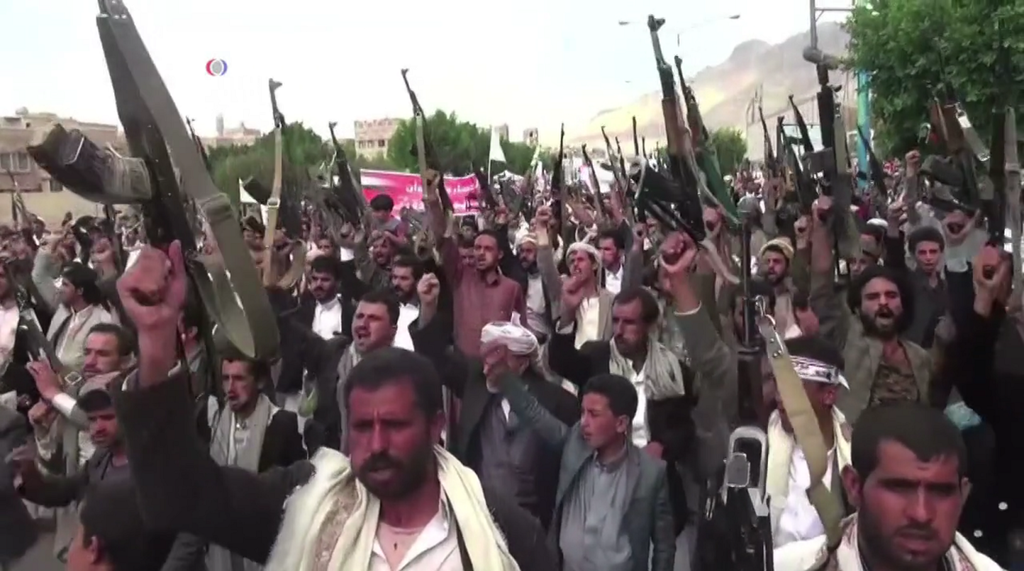
Yemen’s dominant Zaydi Houthi insurgent group—Ansarullah, which in much reporting on the Yemeni crisis is often referred to as “the Houthis”—has demonstrated major advancements in drone and missile capabilities. Ansarullah’s recent attacks against the Saudi-led coalition and strategic targets within the kingdom illustrate the increasing sophistication of its military operations. In recent years, Ansarullah has developed into one of Iran’s most potent surrogates, receiving training, material, and information support from Tehran and its elite Islamic Revolutionary Guard Corps (IRGC)’s oldest franchise, Hezbollah. Yet narratives merely labelling Ansarullah as ‘Yemen’s Hezbollah’ are too simplistic. Despite similar ideological narratives and information operations, the Yemeni militia is far from being an Iranian franchise.
The Saudi government maintains that Iran is arming Ansarullah with the aim of transforming the Zaydi Houthi insurgency into a replica of Hezbollah in order to weaken Saudi Arabia, other Gulf Cooperation Council (GCC) member states, and their Western allies. Officials in Riyadh have also alleged that Tehran is sending Hezbollah military trainers to Yemen, and certain sources have reported that members of the Lebanese Shia group have fought alongside Ansarullah militants in battles along the Yemeni-Saudi border.
In 2016, Yemen’s internationally recognized government, led by President Abdrabbuh Mansur Hadi, accused Hezbollah of intervening in the Arabian country’s civil war. Images of Ansarullah’s leadership meeting with Hezbollah Secretary-General Hassan Nasrallah in Lebanon served only to reaffirm suspicions of the Lebanese militia’s role in Yemen. They also contributed to a popular Saudi narrative that Ansarullah is basically a replica of Hezbollah and that the Houthi insurgents represent just another leg of Iran’s surrogate network.
In fact, the Houthi movement emerged throughout the 1990s as an indigenous Yemeni organization supporting disenfranchised communities of Zaydi Shia in their drive to create a Zaydi imamate. Despite the sectarian dimension of Ansarullah’s narrative, the movement does not have any natural links with Iran’s ‘Islamic Revolution’ and only received assistance from Tehran and Lebanese Hezbollah after 2014. It was only then that Tehran realized the powerful potential of the Houthi militia as a means to attack the Saudi kingdom at its “soft underbelly,” at low cost and with plausible deniability.
Ever since Riyadh began direct military intervention in Yemen in March 2015, the strategic narrative of the Saudi-led coalition, tailored towards a Western audience, was that the kingdom was fighting to prevent a Hezbollah-like Houthi ‘terror state’ along Saudi Arabia’s southern border. This talking point has been propagated extensively in Washington in a Saudi effort to gain greater sympathy from both the Obama and Trump administrations, plus lawmakers on both sides of the aisle, for their anti-Houthi campaign. Such efforts have paid off well with this administration. In December 2017, six months before Trump withdrew Washington from the Iranian nuclear deal, then-U.S. ambassador to the UN Nikki Haley delivered a speech that provided purported evidence of Iranian weapons being used by the Houthis against Saudi Arabia as she was seeking to garner global support for the administration’s anti-Iranian agenda.
Saudi Arabia, which is leading a crumbling Arab military coalition in Yemen against Ansarullah, has vowed not to allow the Iran-allied militia to emerge as the country’s replica of Hezbollah. In fact, when Saudi Arabia’s previous ambassador to Washington, Khalid bin Salman, accused the Islamic Republic of sending Hezbollah military trainers to Yemen to help strengthen the Houthis, he put out a series of tweets alleging that the Arab coalition “uncovered a cache of evidence against Al Houthis, revealed a Hezbollah operative training, advising them on asymmetric warfare, and showed background portrait of Iran ‘Supreme Leader’ on Militia’s computer.” The Saudi ambassador accusedIran’s government of having “subcontracted” Ansarullah to Hezbollah, allegedly a sign that Tehran’s “proxies work in tandem to undermine regional stability and prolong the suffering of countries they are involved in.”
In November 2017, Saudi Foreign Minister Adel al-Jubeir boldly accused Lebanon of declaring war on Saudi Arabia shortly after a ballistic missile from Yemen targeted Riyadh International Airport before the Kingdom’s Patriot defense system shot it down. Jubair asserted, “This was an Iranian missile… launched by Hezbollah.”
It is legitimate to question the veracity of such claims. Sources maintaining that Hezbollah is extremely influential in Yemen are often of questionable credibility or pushing a political agenda that has much to gain from convincing Western statesmen that Saudi Arabia’s fight against Houthi insurgents mirrors Israel’s struggle against Hezbollah. Yet it would disingenuous to fully dismiss Hezbollah’s role in Yemen as merely propaganda from the White House, Riyadh, or Abu Dhabi.
In Yemen—like in Iraq, Syria, and allegedly Bahrain—Hezbollah has served as Iran’s most senior surrogate, serving as the backbone of the Islamic Republic’s regional “axis of resistance.” Both in terms of hard and soft power, Hezbollah has grown from a mere franchise of Iran’s IRGC in the early 1980s into a self-sustaining strategic proxy that enjoys considerable autonomy from its patron’s command and control. Hezbollah has developedinto an important node within Tehran’s vast surrogate network, providing direct franchises such as Kata’ib Hezbollah, as well as indirect surrogates such as the Houthis, with operational support.
Notwithstanding ideological links between Ansarullah and Hezbollah, the main crux of their relationship appears to be operational and rooted in pragmatism. To bog down the Arab coalition in Yemen, the Houthis have sought out training assistance, technological support, and operational direction from Hezbollah to achieve their objectives on the ground. For Hezbollah, the Yemeni civil war has represented an opportunity to humiliate the Saudis at a time in which the Lebanese organization is also struggling against Riyadh’s proxies within Lebanon.
At the risk of exaggerating Hezbollah’s role in the Yemeni civil war, it goes without saying that the Lebanese force, which Tehran has bankrolled for decades, has contributed to Houthi battlefield successes against the Saudi-led coalition. The advancements in Houthi missile and drone capabilities all highlight the extent to which Hezbollah has made a difference in the conflict, which has seen Ansarullah assume de facto control of northern Yemen. Nonetheless, Ansarullah is more than just a mere Iranian franchise outfit. Unlike Hezbollah, Ansarullah—as a homegrown movement—would continue to fight, albeit less effectively, even if its link to Tehran were severed.
Andreas Krieg is an assistant professor at the School of Security and Institute for Middle Eastern Studies at King’s College London.

Wednesday, June 19, 2019

US, Britain Playing Direct Role in Massacre of Yemeni People

 
By: Kayhan Int’l 

The war imposed on Yemen by the Saudi-UAE coalition is getting murkier with the active involvement of the US and European powers.

If the UK is secretly directing the course of the bloody war through military guidelines to the invading forces, in addition to its free flow of lethal arms to both the aggressor countries, the recent shooting down of an advanced US drone by the Yemeni army is indicative of Washington’s direct involvement in the massacre of the people of Yemen.

Reports of the shooting down of a US government drone over Yemen’s port city of Hodeida has angered local residents, who say it is clear evidence of direct US involvement in a war which has resulted in the world’s worst humanitarian crisis, according to the UN, and has left almost 25 million people in need of aid.

Last Sunday, Lieutenant Colonel Earl Brown, a spokesman for the CENTCOM terrorists, sheepishly admitted that a US government MQ-9 Reaper drone using an SA-6 surface-to-air missile, has been shot down by the Ansarallah fighters.

He said that the high altitude at which the sophisticated American drone was shot down indicated rapid improvement by the Ansarallah forces of their mastery of modern technology. 

It is, however, not the first US drone shot by the Ansarallah, who earlier on June 4 had shot down the US-made General Atomics MQ-1 Predator drone, in the service of the Saudis. Last March also, Yemeni forces had shot down an MQ-1 Predator over Yemen’s capital, Sana’a. A few weeks later, an MQ-1C drone was shot down, also over Sana’a.

According to Ansarallah Spokesman, Mohammad Abdus-Salaam: "The US military admitting the downing of the reconnaissance drone on Yemen’s west coast proves that the Saudi-UAE aggression carries an American-Zionist agenda.” 

He pointed out that the US has been involved in various crimes committed over the almost past five years against the people by the Saudi-UAE coalition of the cowards.

This was not the only incident that angered local residents in Yemen. They are furious that Donald Trump has granted the minority Wahhabi cultish regime of Riyadh its very own bomb factory, raising fears that this will enable the Saudis to use more, readily available lethal bombs against the civilian population of Yemen.
 
On August 10, 2018, in a deadly school bus attack in Sadaa, northern Yemen, Saudi warplanes had dropped the US-manufactured Raytheon Mark-82 bomb, killing 40 children. Saudi warplanes also used the US-manufactured Mark-82 in a 2016 attack on a funeral in the capital Sana’a. That attack claimed over 140 lives and injured 525 others.
The people of Yemen, however, remain fully confident that no matter what weapons the Saudis and Emiratis use, or the direct role the American and British stealthily play in the war, the aggressors will eventually lose the war.

The indomitable spirit of the Yemeni people, coupled with their ingenuity in improvising the means of defence they possess, including missiles and drones, have alarmed the Saudis and the Emiratis.

The retaliotary attacks by the Ansarallah forces who have successfully targeted the Jizan and the Abha airports, and have unnerved the Saudis and their backers.

Ansarallah have also warned that airports in Saudi Arabia and the United Arabia Emirates will be targeted as long as the embargo on the Sana’a International Airport remains in place.

The message from Sana’a is crystal clear, and seems to be the only way to bring these countries to the negotiating table.

Monday, May 13, 2019

Fujairah Oil Tanker Blasts Consequence of Playing With Fire

By: Kayhan Int’l 

"Those living in glasshouses shouldn’t throw stones”, runs an old English adage, which continues to hold true in the modern age when towering skyscrapers of steel and concrete are coming up everywhere and large ocean liners transport on the high seas with relative ease such highly combustible substances as oil.
In our bizarre world where might is considered right, those who play with fire by toying with technology including state-of-the-art military hardware to rain down death and destruction on those considered weak, or try to scare iron-willed nations into submission, the above-mentioned adage may seem outdated.
Yet, it is not, as has been proven time and again in Palestine, whose defenders, whenever the Zionist usurpers of their homeland attempt to test new weapons upon them, retaliate with such fury with their constantly improvised rocket volleys that makes Israel sue for peace in a day or two.
Unfortunately, the oil-rich Arab regimes of our region, who live in glasshouses, are not so smart, and as a consequence they suffer greater devastation and higher loss of life for their blind bombardment of the supposedly weak.
Saudi Arabia and the UAE, two miserably wealthy British-created fiefdoms, have for the past five years bombing the Arab world’s poorest country Yemen with billions of dollars of sophisticated weapons bought from the US and West Europe, but have failed to subdue the indomitable spirit of the popular Ansarallah Movement, whose improvised arsenal of drones and missiles continue to take a heavy toll of the aggressors in both men and material.
The projectiles from Yemen have on several occasions zoomed in on industrial installations in Riyadh, Najran, Jizan, the giant oil refinery Aramco in Dhahran, as well as on military bases and airports of the Emirati cites of Abu Dhabi and Dubai, causing extensive damage. 
The other day, the UAE port of Fujairah on the Gulf of Oman and outside the Strait of Hormuz and the Persian Gulf was rocked by a series of huge explosions lasting several hours in the early morning hours.
According to reliable reports, at least 7 to 10 oil tankers, loaded with petroleum flowing through the pipeline from Abu Dhabi, were completely burnt.
Eyewitness accounts said firefighters were trying to extinguish the huge flames on Sunday, while American and French warplanes were seen flying over the port at the time of the incident.
Though the small sheikhdom of Fujairah, which is part of the 7-emirate UAE Confederation, tried to deny the media reports about several heavy explosions, insisting that the port is functioning as usual, there are no reliable reports to suggest that everything is normal.
The cause of the explosions has also been not ascertained. No one has yet claimed responsibility, while speculations range from drone or missile attacks from Yemen, to possible dropping of bombs by the intruding US forces, which are looking for pretexts to ignite tensions in the region.
Nevertheless, reports said, oil exports have been temporarily halted from the UAE, which is building the world’s largest crude oil storage facility in Fujairah, capable of storing up to 14 million barrels of oil, outside the Persian Gulf and the Strait of Hormuz.
Whatever the cause of the explosions and the possibility of forces behind it, the fact cannot be ignored that Saudi Arabia and the UAE are sitting ducks for such attacks which might increase in view of the dangerous policies of these two American client states in terrorizing their own populations and neighbours on behalf of their masters. 

Tuesday, April 09, 2019

Saudis Slaughter Schoolchildren in Sana’a With US Support

By: Kayhan Int’l 

Saudi Arabia, backed by the US and the Zionist regime, committed yet another war crime in Yemen on Monday by killing at least a dozen school girls and injuring scores of other children amongst the 100-plus casualties of the dead and wounded, when its warplanes dropped bombs on a warehouse in Sana’a functioning as a school.
This latest act of state terrorism that involves the super terrorists in Washington and Occupied Palestine as well, was yet another sign of frustration for the regime in Riyadh, which had planned to bomb Yemen into submission in a couple of weeks, but has suffered a loss of several billion dollars as the war has entered its 5th year, thanks to the indomitable nature of the Yemeni people, whose resistance has terrified the Wahhabis and their comrades-in-crimes against humanity.
The popular Ansarallah Movement, which with the support of various Yemeni tribes and the majority of the people of Yemen, has held the Saudi-UAE invasion forces at bay, and has at times taken the war to the enemy camp by targeting military and industrial installations in the two countries, has vowed to defeat the aggressors.
This is no tall talk, given the high spirit of the defenders and their history of resistance against invaders, coupled with the sagging morale in the enemy camps.
It is clear that neither the aerial and naval blockade of Yemen has dented the resolve of the Yemeni people nor the unabated more than four years of deadly bombardment of towns and cities.
The death toll in the Arab World’s most impoverished state now stands at over 22,000 while the wounded number over a hundred thousand, in addition to the hundreds of thousands displaced from their destroyed homes and hearths and the millions affected by starvation and epidemics.
Yet, the world’s worst humanitarian crisis that has exposed to the whole world the ugly terrorist face of the US, shows no signs of abatement. 
It is the height of cowardice for the armed-to-the-teeth Saudi-UAE coalition to bomb residential and commercial areas, while they lack the morale to meet the defenders on the battlefields.
Monday’s strike that killed the schoolchildren was not accidental. As usual, the Saudi warplanes twice bombed the defenseless site, fully knowing that it was functioning as a school.
According to documented reports attacks on schools have been all too common in this war. So far, the Saudis and Yemenis have damaged or completely destroyed over 2,500 schools throughout Yemen.
It is unfortunate that millions Yemeni children must cope with malnutrition and the threat of disease, and even at their schools they are not safe from being killed by the Saudi-UAE airstrikes, in addition to being traumatized by the ongoing war.
Both the mental and physical health of an entire generation of Yemenis is being severely harmed by the effects of this war. The roguish regime of Donald Trump continues to back the Saudis as they bomb hospitals and kill schoolchildren.
The UN for its part has resorted to hypocrisy, and instead of being an impartial arbitrator, it has turned a blind eye to the sufferings of the Yemeni people, and is openly supporting the Saudi terrorism. 
The Ansarallah, however, are made of sterner stuff, and will continue to defend the honour and dignity of the Yemeni people, until the eventual defeat of the aggressors.

Wednesday, January 16, 2019

Yemeni Drones Scaring Daylight Out of Aggressors and Traitors

 By: Kayhan Int’l 

The war that Saudi Arabia in league with the UAE and the support of the US and the Zionist regime, launched on Yemen is approaching the start of its 5th year, but with no victory in sight for the armed-to-the-teeth aggressors who had hoped for a cake-walk over what they thought ragtag militias of the Arab world’s poorest country.
Kudos to the popular Ansarallah Movement for molding the Yemenis into one of the strongest resistant forces capable of blunting the brutal air, sea, and ground assaults of some of the world’s sophisticated war machines.
It is indeed triumph of national resolve with firm faith in God Almighty and the dynamic laws of Islam that have turned the defenders of Yemen’s sovereignty into a formidable force, whose large stockpiles of missiles, coupled with their ingenuity in quickly mastering new technology like drones, have scared the daylights out of the traitors who sold the country to Saudi Arabia and the UAE.
The drone attacks of the past few days on targets in the areas under control of both the traitors in Yemen and in Saudi Arabia, have had telling effect. As casualties mount amongst the aggressors and invaders, their masters are trying to blame the Ansarallah for breach of peace, while it is Saudi Arabia and UAE that have refused to honour the commitments made last month in Sweden during talks with Ansarallah for truce in Hodeidah.
The thundering sound of the drone attack on the al-Anad military base of the traitors near Aden in southern Yemen that killed senior military officers including the intelligence chief, in addition to mercenaries serving the Emiratis and Saudis, seems to have been heard on the other side of the world in the US as well.
This is the reason, a bipartisan resolution of the ruling Republican party and the opposition Democrats is all set to be passed in the House for ending Washington’s or more properly the warmongering Donald Trump’s fanning of the flames of war in Yemen. 

Imagine, millions are on the verge of famine and epidemic diseases, and yet the UN, which is supposed to be a neutral agency, refuses to condemn the aggressors.
In such a case, the Ansarallah defenders of Yemen have no other choice, but to continue their drone and missile attacks on the aggressors, along with the ground operations that have successfully thwarted the advance of the invaders in Hodeidah.
Ansarallah Spokesman Yahya Sarea was absolutely right when he described the operation on enemy bases as a "legitimate”, and disclosed that the defenders have a large stockpile locally manufactured drones and missiles.
He added: "Soon there will be enough in the strategic stockpile to launch more than one drone operation in multiple battle fronts at the same time.” 
Thus in view of these facts, the aggressors should make a face-saving exit from Yemen before it is too late and before the flames of war spread to their own capitals. 
Yemen needs peace, and peace should be worked out through talks between the various tribes and parties by sitting on the negotiating table, without the involvement of the traitors, like Mansour Hadi, or his masters in Riyadh and Abu Dhabi. 

Sunday, January 06, 2019

How the war party lost the Middle East

Patrick J. Buchanan

The faction in the US administration, which in alliance with Saudi Arabia, Turkey, Qatar, Britain, France and the illegal Zionist regime, had tried to destabilize Syria and Iraq through terrorists of all hue and color, in a bid to convert the entire region from the Persian Gulf to the Mediterranean Sea into a Takfiristan, has now clearly been defeated.
Patrick J. Buchanan, the author of “The Unnecessary War” and “How Britain Lost Its Empire”, has written an interesting analysis in this regard for the Antiwar website, titled: “How the War Party Lost the Middle East”.
"Assad must go, Obama says."
So read the headline in The Washington Post, dated Aug. 18, 2011. The story quoted US President Barack Obama directly: “The future of Syria must be determined by its people, but President Bashar al-Assad is standing in their way.”
France’s President Nicolas Sarkozy and Britain’s Prime Minister David Cameron signed on to the Obama ultimatum, demanding: Assad must go!
Seven years later and 500,000 Syrians dead – majority of them killed by US-Saudi backed terrorists – it is Obama, Sarkozy and Cameron who are gone. President Assad still rules in Damascus, and the 2,000 Americans in Syria are coming home. Soon, says President Donald Trump.
But we cannot "leave now," insists Senator Lindsey Graham, or "the Kurds are going to get slaughtered."
Question: Who plunged the Americans into the Syrian crisis, and so managed our intervention that were we to go home after seven years our enemies will be victorious and our allies will "get slaughtered"?
Seventeen years ago, the US invaded Afghanistan to oust the Taliban for granting sanctuary to al-Qaida and Osama bin Laden.
US diplomat Zalmay Khalilzad – an ethnic Pashto Afghan staunchly loyal to Washington – is today negotiating for peace talks with that same Taliban. Yet, according to former CIA director Mike Morell, writing in The Washington Post last Monday, the "remnants of al-Qaeda work closely" with today’s Taliban.
It would appear that 17 years of fighting in Afghanistan has left the US with these alternatives: Stay there, and fight a forever war to keep the Taliban out of Kabul, or withdraw and let the Taliban overrun the place.
Who got the Americans into this debacle?
After Trump stealthily flew without invitation into Iraq over Christmas but was refused a meeting with its president and prime minister, the Iraqi Parliament, calling this a "US disregard for other nations’ sovereignty" and a national insult, began debating whether to expel the 5,000 US troops still in their country.
In 2003 George W. Bush had launched Operation Iraq Freedom to strip Saddam of WMD he did not have and to convert Iraq into a western bastion in the Arab and Islamic world.
Fifteen years later, Iraqis are debating the expulsion of Americans.
Muqtada as-Sadr, the political-religious leader who over a decade ago was wanted dead or alive by the Americans for launching a deadly fight against US soldiers, is leading the charge through the legislature and the legal process to have the American soldiers booted out. He heads the party with the largest number of members in the parliament.
Consider Yemen. For three years, the US has supported with planes, precision-guided munitions, air-to-air refueling and targeting information, a Saudi war on the popular Ansarallah Movement that degenerated into one of the worst humanitarian disasters of the 21st century.
Belatedly, Congress is moving to cut off US support for this war. Its architect, Saudi Heir Apparent Mohamed bin Salman (MBS) – the blue-eyed boy of Trump and his Jewish son-in-law Jared Kushner – has been condemned by Congress for complicity in the murder of journalist Jamal Khashoggi in the Saudi consulate in Istanbul, Turkey. And the US is seeking a truce in the fighting.
Who got the US into this war? And what have years of killing Yemenis, in which we have been collaborators, done to make Americans safer?
Consider Libya. In 2011, the US attacked the forces of Mo’ammar Qadhafi and helped to effect his ouster, which led to his murder.
Told of news reports of Qadhafi’s death, Secretary of State Hillary Clinton joked, "We came, we saw, he died."
The Libyan conflict has since produced tens of thousands of dead. The output of Libya’s crucial oil industry has collapsed to a fraction of what it was. In 2016, Obama said that not preparing for a post-Qadhafi Libya was probably the "worst mistake" of his presidency.
The price of all these interventions for the United States?
Some 7,000 dead, 40,000 wounded and trillions of dollars.
For the Arab and Muslim world, the cost has been far greater. Hundreds of thousands of dead in Afghanistan, Iraq, Syria, Yemen, and Libya, civilian and soldier alike, massacres, and millions uprooted and driven from their homes.
How has all this invading, bombing and killing made the Middle East a better place or Americans more secure? One May 2018 poll of young people in West Asia and North Africa found that more of them felt that Russia was a closer partner than was the United States of America.
What are the fruits of American intervention?
We are told Daesh is not dead but alive in the hearts of several thousand Muslims, that if the US leaves Syria and Afghanistan, our enemies will take over and our friends will be massacred, and that if the US stops helping Saudis and Emiratis kill the Yemenis, Iran will notch a victory.
In his decision to leave Syria and withdraw half of the 14,000 troops in Afghanistan, Trump enraged American foreign policy elites, though millions of Americans cannot get out of there soon enough.
In last Monday’s editorial celebrating major figures of foreign policy in the past half-century, The New York Times wrote, "As these leaders pass from the scene, it will be left to a new generation to find a way forward from the wreckage Mr. Trump inherited."

Monday, December 31, 2018

Year Ends But No End In Sight For Sufferings Of Yemeni People


By: Kayhan Int’l 

The year 2018 has come to its end, and tomorrow will be the start of the new Gregorian calendar year, but there is no end in sight for the wars and crises plaguing the world, mainly because of the devilish designs of the US and its clients.
In France the Yellow Jacket Movement continues to rock Paris and other cities, while there is uneasiness in most European countries. 
On the other side of the world, the US seems to be badly trapped in the wave of migration on its southern borders, with the intransigent Donald Trump (grandson of a German migrant), locked in a deadly duel with the Senate to the extent of ‘government shutdown’ because of the rejection of his absurd demand for financing the erection of a long apartheid wall on the frontier with Mexico.
The most catastrophic crisis, however, is the situation of Yemen, a country of 28 million, of whom 22 million are facing famine and starvation, because of the war imposed upon them by Saudi Arabia and the UAE, at the behest of the US.
A tentative peace was recently reached in Sweden, following UN mediation between the legal Ansarallah-led government in Sana’a and the militias of the south which are backed by the invaders.
The first step in the peace process calls for demilitarization of the strategic Red Sea port of Hodeidah, a plan to which the Ansarallah have given approval and are already in the process of withdrawing their forces, in order to enable the UN to monitor import-export activities that are vital to the survival of the whole nation of Yemen which is in dire need of urgent food supplies and medicines.
Unfortunately, the Saudi-UAE invaders are yet to fulfill their commitments to the peace process by withdrawing their forces from the vicinity of Hodeidah, stopping military activities, ceasing bombardment of Yemen, and lifting their sea and air blockade of the country, including the opening to international relief aid of the Sana’a airport. 
The result has been continuation of the stalemate with no end to the sufferings of the people of Yemen, while the Saudis and Emiratis, steeped in luxuries and unbothered of the catastrophe facing fellow Arab Muslims in Yemen, use poor mercenaries from as far as Darfur in Africa and Colombia in South America to either die on the battlefields of Yemen or kill the Yemeni people.
It is obvious that the invaders have already lost despite their massive military power. Having failed to reach their sinister goals through war they had schemed to take control of Hodeidah through so-called peace talks, but thanks to the vigilance of the people of Yemen, they have failed yet again.
There was no agreement in Sweden on handing over of Hodeidah to the invaders or their militias of the southern tribesmen. The Ansarallah had only said that the UN will be allowed supervision of activities at the port while the Yemeni armed forces will evacuate the city in order to facilitate such operations.
It means, the moment the Yemeni forces see that the clauses of the peace talks are violated by the southern militias and their Saudi-Emirati overlords, the Ansarallah will not hesitate to rally to the defence of the people of Hodeidah.
Thus, the onus is now on the UN to force the invaders and their proxy militias to respect the peace. If the World Body is really interested in peace, it should not hesitate to declare both Riyadh and Abu Dhabi as aggressors and demand complete end to military operations, in order to allow the people of Yemen to get together to resolve the crisis in a democratic manner, without any outside interference. 

Sunday, December 02, 2018

UN negotiations falter as Saudi airstrikes continue on Yemen

“There is no point in negotiations with a party that is looking to obtain through talks what it has failed to achieve through a military campaign,” said Ansarallah chief negotiator Mohammed Abdus-Salaam in response to the illogical demands of the foreign backed forces, coupled with the unabated strikes on Yemen by Saudi Arabia, as part of the pressure tactics to dent the morale of the defenders.
Now we have a report by journalist Ahmed Abdul-Kareem for MintPress titled: “UN negotiations falter as Saudi airstrikes continue on Yemen”
The Ansarallah defenders of Yemen have decided to cancel the UN-backed cease-fire, previously enacted as a goodwill measure to “speed up” the peace process, and resumed ballistic missile and drone attacks against Saudi-led coalition forces. 
In retaliation to the continued crimes of the Riyadh regime, Yemeni forces last Wednesday targeted Apache helicopters as well as a Saudi airbase in Bir Askar in the southwestern region of Saudi-occupied Najran on Wednesday evening, The attack was carried out with a salvo of high-precision ballistic missiles dubbed the Badr P-1. The short-range ballistic missile uses a solid-propellant, an upgrade from its previous iteration, the Badr-1.
Ansarallahs’s Arabic-language al-Masirah that Yemeni missiles successfully struck their designated target in Najran.
Al Masirah’s broadcast station, which was taken off the air by Egyptian satellite company NileSat on Wednesday, said that the attack left an unspecified number of Saudi pilots killed or wounded, destroyed many Apache aircraft, and sparked a large fire in one of the bases’ ammunition stores.
A high-ranking source in Yemen’s military told MintPress that ballistic missile and drones attacks would escalate in coming days and vital facilities in UAE and Saudi Arabia would be targeted.
In a separate attack, a Zelzal-1 (Earthquake-1) missile hit a gathering of Saudi-allied mercenaries near Qais Mountain in Jizan, which is Yemeni territory occupied by Saudi Arabia in 1934. Another missile of the same type hit a group of mercenaries in the Wawa area of Asir – also a Yemeni province under Saudi occupation since 1934.
Yemen’s military said that both projectiles left an unspecified number of Saudi-led forces either killed or wounded. A source in the Yemeni armed forces told Mintpress that the attack on the Saudi air base was in retaliation for deadly Saudi attacks on civilians in Hajjah, in northwestern Yemen, which killed over 15 civilians in a single week.
Last Tuesday, seven civilians were killed, including women and children, and three were injured when Saudi aircraft targeted a home belonging to Hussein al-Yamani in al-Yamnah village in the Haradh directorate. In a separate attack, six civilians were killed and three were injured by Saudi airstrikes in the Ram district of the Mustaba region east of Haradh early Tuesday.
According to a new report by the Armed Conflict Location and Event Data Project (ACLED), a nonprofit conflict-research organization, the Saudi-led war has so far claimed the lives of around 56,000 Yemenis.
Meanwhile, Saudi-led coalition airstrikes against multiple Yemeni provinces — including Hodeidaj, Sada’a, Hajjah, and Sana’a — continue. The invaders have said repeatedly that they target only Ansarallah military positions, yet international organizations say the spate of airstrikes have focused on residential areas where there are no fighters.
Ansarallah, the political wing of Yemen’s resistance movement, says ongoing airstrikes by the Saudi-led coalition will make the next round of UN-sponsored peace talks in Sweden meaningless.
The chief negotiator for Ansarallah, Mohammed Abdus-Salaam told the press: “There is no point in negotiations with a party that is looking to obtain through talks what it has failed to achieve through a military campaign.”
He went on to say that certain indicators — such as non-stop airstrikes, the failure to reopen the Sana’a Airport to commercial air traffic, the refusal to release prisoners and detainees, and the failure to remove sanctions, as well as other confidence-undermining measures — are making Yemenis lose confidence in the United Nations.
Ansarallah criticized the UN envoy to Yemen, Martin Griffiths, saying that Griffiths has not introduced a comprehensive political framework for a solution to the Yemeni conflict. Specifically, he has offered no solution that takes into account a government transition with the inclusion of all Yemeni political parties.
Ansarallah further noted that Griffiths is focusing on issues that are trivial and not fundamental to peace talks.
Abdus-Salaam said about Griffiths’ approach: “He [Martin Griffiths] is only looking at the possibility of bringing the warring parties together, without specifying the most important procedures for negotiations and a framework that needs to be agreed upon by all sides. If he does not offer a clear and comprehensive political framework that would form the nucleus of the next round of peace negotiations, he will not be able to hold any further talks.”
UN Under-Secretary-General for Humanitarian Affairs and Emergency Relief Coordinator Mark Lowcock, who is currently on a three-day visit to Yemen, made an appeal to all sides to cease hostilities, especially around the key Yemeni infrastructure including the port city of Hodeidah. Lowcock made the appeal during a press briefing after arriving in the capital Sana’a on Thursday. UN agencies say the closure of the port in Hodeida would greatly exacerbate the humanitarian crisis in the country.
Lowcock went on to say that the fighting has once again highlighted the ongoing humanitarian tragedy in the war-ravaged country, adding, “the situation in Yemen has deteriorated since I was here last.”
According to the United Nations, shipping operations in Yemen’s port of Hodeidah, a lifeline for the country suffering a Saudi-imposed blockade, have dropped by almost 50 percent over the past two weeks, with shipping companies deterred by insecurity and ongoing Saudi attacks.
The UN’s World Food Program said on Tuesday that a drop in the arrival of wheat and other supplies would affect food stocks in Yemen, where 14 million people are facing possible starvation.
The Red Sea Ports Company confirmed to MintPress that four vessels carrying essential foodstuffs were being held near the Saudi-occupied port of Jizan despite having received a permit to enter Yemen by the United Nations. Four million people in Hodeida live below the poverty line and are on the brink of famine, according to local authorities.
The Saudi-led coalition has killed tens of thousands of Yemeni civilians since 2015, when its war on Yemen began. Moreover, the coalition’s blockade of food and medicine has plagued the country with an unprecedented famine and triggered a deadly outbreak of preventable disease that has cost thousands their lives.

Sunday, October 21, 2018

Emerging Facts of Khashoggi’s Murder Might Shake Thrones and Roll Heads

By: S. Nawabzadeh

After 18 days of lies and denial of facts, Saudi Arabia has finally – following consultations with the US – sheepishly admitted its killing of journalist Jamal Khashoggi, but as expected made a clumsy attempt to absolve the Heir Apparent of the macabre murder in its Istanbul consulate by laying the blame (for possible execution as scapegoats) on "rogue” interrogators, as immediately trumpeted by Trump, although Turkey, which rejected Riyadh’s multi-million dollar bribe to hush up the matter, has yet to announce details of undiplomatic crime on its soil.
The latest preposterous lie from the regime in Riyadh and its blind endorsement by the US president as "credible” not just exposes Mohamed bin Salman (MBS) as a fiendish maniac willing to commit any imaginable crime, but rips the mask of hypocrisy off the face of Donald Trump, whose greed for petro dollars makes him ignore basic human rights as is evident by his refusal to stop the sale of deadly weapons for the killing of more and more Yemeni men, women, and children.
World public opinion, including the American media and many politicians think the dastardly dismemberment of the Washington Post Correspondent with a bone saw could not have been a spontaneous act without the precise orders of MBS and perhaps a green signal from the corridors of power in Washington.
The name of MBS’ bosom pal, Jared Kushner, the Jewish son-in-law of Trump, is already in circulation as the person who wanted Khashoggi to be silenced for good, since his writings were laying bare the totalitarian Saudi system that tolerates not even the slightest dissent, and with it the complicity of the presidential clique in the White House in squeezing scores of billions of dollars from Riyadh.
The questions being raised are: Can MBS get away with his latest act of crude terrorism – glimpses of which the world saw in the crimes against humanity of the Saudi-supported takfiri terrorists in Syria and Iraq?
Would Trump and team remain unscathed from the unfolding scandal whose full dimensions are about to unravel for a shocked civilized world?
The answers to these and related questions will hopefully be found once the Turkish government, ignoring pressures from Washington and bribes from Riyadh, safeguards its integrity and independence by disclosing details of the crime on its soil and the names of persons and governments involved, as well as consequences for the perpetrators, so that such acts of state terrorism does not occur at diplomatic missions anywhere in the world.
Jamal’s case is of vital importance for Turkey, since he is the grandson of Dr. Mohammad Khaled Khashoggi (actual pronunciation Khashoqchi or Spoon-maker) the Turkish citizen from Kayseri in central Anatolia who settled in Mecca after disintegration of the Ottoman Empire, and served as personal physician to Abdul-Aziz Aal-e Saud, the desert brigand of Najd for whom Britain created Saudi Arabia in 1932 after he had seized the dominions of the Istanbul-backed dynasties of the Aal-e Rashid of Ha’el and the Hashemites of Hijaz.
Ankara would be doing a great service to the peace and stability of the region and the American-disturbed international order if it reveals the facts, no matter the heads of certain troublemakers were to fall.
MBS, whose strings of crimes include the martyrdom of the scholar Sheikh Nimr Baqer an-Nimr, the reducing to rubble of the centuries old historic quarters of the city of Awamiyya, the detention and mysterious killing of rival kinsmen of the Saudi clan, the hijacking of Lebanese prime minister, Sa’d al-Hariri, cannot be allowed to go scot-free this time after having destroyed Yemen and killed so far 20,000 of its people, in addition to displacing hundreds of thousands of others and threatening millions with famine and starvation.
Human conscience is thirsty for realities, not myths or dubious accounts, in view of the fact that Jamal Khashoggi, after all, was neither an innocent figure nor a dissident in the real sense of the word.
It was an open secret that he had ties to the CIA as well as to American arms manufacturers through his late uncle the multi-billionaire Adnan Khashoggi, one of Saudi Arabia’s most powerful weapons dealers.
This means his death has deep connections to the CIA, Saudi Intelligence, and the Zionist Mossad, since he represented the shadowy world of collaboration that sometimes exists between journalism and the intelligence agencies.
Indeed, as advisor to Turki bin Faisal Aal-e Saud, the head of Saudi intelligence for 24 years who also served as ambassador to Washington and then London, Jamal, who doubled as a journalist, had become a regime critic and sought asylum in the US only after internal power struggles broke out between Saudi princes.
He was an advocate of the Saudi destruction of Syria and Iraq, and an ardent supporter of MBS’ war in Yemen to stop alleged Iranian influence before he fell out and realizing it was impossible for Riyadh to defeat the well-entrenched popular Ansarallah Movement, constantly called for end of war and dialogue – ideas which did not go well with MBS.
In short, justice demands divulging of the plain truth, whether or not MBS survives as Heir Apparent or Trump trumpets threats, theatrics, and tweets at the free world, in a vain bid to cling on to power he certainly does not deserve.