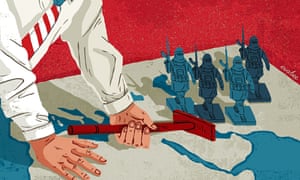
The Washington Post’s Afghanistan Papers, detailing a true history of the nation’s longest official war, reveals nothing new about the war’s futility or about the fact that it was doomed to failure from almost the beginning. The Post fought a legal battle for three years to obtain the documents from the Special Inspector General for Afghanistan Reconstruction (SIGAR), a federal government watchdog agency that interviewed hundreds of officials about their honest assessments of the war.
What the Afghanistan Papers do offer is a confirmation of what critics had already been asserting for nearly two decades: that there is no clearly defined goal or endpoint to the war to help determine when to stop fighting, and that our efforts have been futile at best and deeply destructive at worst.
More than 10 years ago I wrote, together with James Ingalls, a critical assessment of the Afghanistan war. The title of our book was Bleeding Afghanistan: Washington, Warlords, and the Propaganda of Silence (Seven Stories, 2006). Those last three words, “the Propaganda of Silence,” are a direct reference to poor media coverage and the irresponsible manner in which the press took an uncritical view of the war. The evidence was there for all to see that the U.S. war was doomed to failure once you scratched beneath the surface of officials’ rosy rhetoric.
The most important function of the Afghanistan Papers is to confirm that government officials have been utterly dishonest with the public about U.S. achievements and progress in Afghanistan. John Sopko, the Special Inspector General at SIGAR, admitted to the Post that the documents prove that “the American people have constantly been lied to.”
The picture that emerges of how insiders have viewed the war is startlingly similar to how critics have portrayed it over the years. Earlier this year I wrote a “Brief History” of the Afghanistan war for Truthdig in which I assessed the early years of the conflict:
The Bush plan to build a stable Afghan government as a bulwark against the Taliban and al-Qaida failed for reasons that had as much to do with imperial hubris as it did with the practical shortcuts taken by an outsider to patch together a precarious government—as if that were a sufficient substitute for real democracy.
In comparison, one economist told SIGAR, as revealed in the Afghanistan Papers, that he:
… blamed an array of mistakes committed again and again over 18 years — haphazard planning, misguided policies, bureaucratic feuding. Many said the overall nation-building strategy was further undermined by hubris, impatience, ignorance and a belief that money can fix anything.
In my history of the war, I also wrote: “Obama’s strategy included a temporary increase in troops, as if throwing more American soldiers at the problem would help any one of his goals stick.” But, I continued, “The Taliban appears to have had a ‘wait it out’ strategy with respect to Americans, stringing along the U.S. and the Afghan government over several years of talks until it had the upper hand to return to power.”
By comparison, the Afghanistan Papers revealed that “Obama’s strategy was also destined to fail,” as it relied on “a massive counterinsurgency campaign, backed by 150,000 U.S. and NATO troops.” In the end, I concluded: “Obama tried to set artificial dates for ending the war before it was over. All the Taliban had to do was wait him out.”
In 2015 I wrote in another piece for Truthdig titled “We Have Failed Afghanistan Again and Again,” that:
Despite spending billions of dollars—the U.S. offered its largest share of foreign aid to Afghans last year—there is little to show for it. Nearly $10 billion was spent on arming and training Afghan forces. But as the dismal state of the Afghan National Army shows, that money may as well have been poured down the drain.
By comparison, the Afghanistan Papers reveal that officials privately knew they were fueling corruption, and that “Much of the money … ended up in the pockets of overpriced contractors or corrupt Afghan officials, while U.S.-financed schools, clinics and roads fell into disrepair, if they were built at all.”
The U.S. has also been lining the pockets of Afghanistan’s most notorious warlords, who have a long and bloody history going back to the era of Soviet occupation, when the CIA doled out cash to fight its Cold War enemy. In my 2006 book, my co-author and I warned against this practice, devoting a whole chapter to it, titled “Replacing One Brutal Regime With Another.” We suggested that instead of rewarding them with cash and government positions, the U.S. ought to disarm the warlords and help Afghans bring them to justice. The U.S. did the opposite, and the result was entirely predictable.
The Afghanistan Papers confirm that:
According to the interviews, the CIA, the U.S. military, the State Department and other agencies used cash and lucrative contracts to win the allegiance of Afghan warlords in the fight against al-Qaeda and the Taliban. Intended as a short-term tactic, the practice ended up binding the United States to some of the country’s most notorious figures for years.
One senior government official told SIGAR, “We were giving out contracts to pretty nasty people, empowering people we shouldn’t have empowered, in order to achieve our own goals.” American tax dollars have lined the pockets of mass killers to an unimaginable extent. In my 2015 article, I referred specifically to Abdul Rashid Dostum, who was elevated to the position of vice president even though he had been “implicated in numerous atrocities and mass killings.” Among the few new revelations from The Washington Post’s investigative report is the assertion that “the United States and other sources had been giving Dostum $100,000 a month ‘to not cause trouble.’ ”
Now the Trump administration is hoping to resume peace negotiations with the Taliban with a plan to reinstall the very regime the U.S. claimed was harboring terrorists and harming Afghans. If the point of the war was to go from point A to point B and then back to point A, with an unimaginably high death toll in between, then by that measure alone the U.S. war in Afghanistan has been a success.
What American officials and the mainstream media has consistently failed to do in Afghanistan is actually pay attention to what ordinary Afghans say and want. The biggest toll of the failed American war has been the death and destruction of lives in a country that was already torn apart by years of war in 2001. We may never get a full accounting of how many Afghans have died or been maimed for life as a direct result of a war that insiders knew was a mistake.
But what we do know is all armed forces in Afghanistan are implicated in war crimes. In 2018, in a little-covered story, Afghans submitted a whopping 1.17 million complaints to the International Criminal Court that “include accounts of alleged atrocities, not only by groups like the Taliban and the ISIS, but also Afghan Security Forces and government-affiliated warlords, the U.S.-led coalition, and foreign and domestic spy agencies.”
The Post’s investigative series is a welcome addition to mountains of evidence that the Afghanistan war is a failure. But it was clear to those of us who had been paying attention that U.S. officials were lying about the war for nearly two decades. The important question today is: Will the Afghanistan Papers bring about the end of the longest war?
Sonali Kolhatkar
Columnist
Sonali Kolhatkar is a columnist for Truthdig. She also is the founder, host and executive producer of "Rising Up With Sonali," a television and radio show that airs on Free Speech TV (Dish Network, DirecTV,…