Showing posts with label Daesh/ISIS. Show all posts

Tuesday, June 18, 2019

Now the truth emerges: how the US fuelled the rise of Isis in Syria and Iraq

The sectarian terror group won’t be defeated by the western states that incubated it in the first place
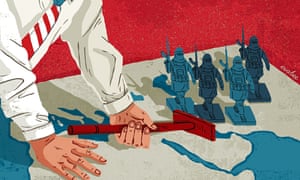
The war on terror, that campaign without end launched 14 years ago by George Bush, is tying itself up in ever more grotesque contortions. On Monday the trial in London of a Swedish man, Bherlin Gildo, accused of terrorism in Syria, collapsed after it became clear British intelligence had been arming the same rebel groups the defendant was charged with supporting.
The prosecution abandoned the case, apparently to avoid embarrassing the intelligence services. The defence argued that going ahead with the trial would have been an “affront to justice” when there was plenty of evidence the British state was itself providing “extensive support” to the armed Syrian opposition.
That didn’t only include the “non-lethal assistance” boasted of by the government (including body armour and military vehicles), but training, logistical support and the secret supply of “arms on a massive scale”. Reports were cited that MI6 had cooperated with the CIA on a “rat line” of arms transfers from Libyan stockpiles to the Syrian rebels in 2012 after the fall of the Gaddafi regime.
Clearly, the absurdity of sending someone to prison for doing what ministers and their security officials were up to themselves became too much. But it’s only the latest of a string of such cases. Less fortunate was a London cab driver Anis Sardar, who was given a life sentence a fortnight earlier for taking part in 2007 in resistance to the occupation of Iraq by US and British forces. Armed opposition to illegal invasion and occupation clearly doesn’t constitute terrorism or murder on most definitions, including the Geneva convention.
But terrorism is now squarely in the eye of the beholder. And nowhere is that more so than in the Middle East, where today’s terrorists are tomorrow’s fighters against tyranny – and allies are enemies – often at the bewildering whim of a western policymaker’s conference call.
For the past year, US, British and other western forces have been back in Iraq, supposedly in the cause of destroying the hyper-sectarian terror group Islamic State (formerly known as al-Qaida in Iraq). This was after Isis overran huge chunks of Iraqi and Syrian territory and proclaimed a self-styled Islamic caliphate.
The campaign isn’t going well. Last month, Isis rolled into the Iraqi city of Ramadi, while on the other side of the now nonexistent border its forces conquered the Syrian town of Palmyra. Al-Qaida’s official franchise, the Nusra Front, has also been making gains in Syria.
Some Iraqis complain that the US sat on its hands while all this was going on. The Americans insist they are trying to avoid civilian casualties, and claim significant successes. Privately, officials say they don’t want to be seen hammering Sunni strongholds in a sectarian war and risk upsetting their Sunni allies in the Gulf.
A revealing light on how we got here has now been shone by a recently declassified secret US intelligence report, written in August 2012, which uncannily predicts – and effectively welcomes – the prospect of a “Salafist principality” in eastern Syria and an al-Qaida-controlled Islamic state in Syria and Iraq. In stark contrast to western claims at the time, the Defense Intelligence Agency document identifies al-Qaida in Iraq (which became Isis) and fellow Salafists as the “major forces driving the insurgency in Syria” – and states that “western countries, the Gulf states and Turkey” were supporting the opposition’s efforts to take control of eastern Syria.
Raising the “possibility of establishing a declared or undeclared Salafist principality”, the Pentagon report goes on, “this is exactly what the supporting powers to the opposition want, in order to isolate the Syrian regime, which is considered the strategic depth of the Shia expansion (Iraq and Iran)”.
Which is pretty well exactly what happened two years later. The report isn’t a policy document. It’s heavily redacted and there are ambiguities in the language. But the implications are clear enough. A year into the Syrian rebellion, the US and its allies weren’t only supporting and arming an opposition they knew to be dominated by extreme sectarian groups; they were prepared to countenance the creation of some sort of “Islamic state” – despite the “grave danger” to Iraq’s unity – as a Sunni buffer to weaken Syria.
That doesn’t mean the US created Isis, of course, though some of its Gulf allies certainly played a role in it – as the US vice-president, Joe Biden, acknowledged last year. But there was no al-Qaida in Iraq until the US and Britain invaded. And the US has certainly exploited the existence of Isis against other forces in the region as part of a wider drive to maintain western control.
The calculus changed when Isis started beheading westerners and posting atrocities online, and the Gulf states are now backing other groups in the Syrian war, such as the Nusra Front. But this US and western habit of playing with jihadi groups, which then come back to bite them, goes back at least to the 1980s war against the Soviet Union in Afghanistan, which fostered the original al-Qaida under CIA tutelage.
It was recalibrated during the occupation of Iraq, when US forces led by General Petraeus sponsored an El Salvador-style dirty war of sectarian death squads to weaken the Iraqi resistance. And it was reprised in 2011 in the Nato-orchestrated war in Libya, where Isis last week took control of Gaddafi’s home town of Sirte.
In reality, US and western policy in the conflagration that is now the Middle East is in the classic mould of imperial divide-and-rule. American forces bomb one set of rebels while backing another in Syria, and mount what are effectively joint military operations with Iran against Isis in Iraq while supporting Saudi Arabia’s military campaign against Iranian-backed Houthi forces in Yemen. However confused US policy may often be, a weak, partitioned Iraq and Syria fit such an approach perfectly.
What’s clear is that Isis and its monstrosities won’t be defeated by the same powers that brought it to Iraq and Syria in the first place, or whose open and covert war-making has fostered it in the years since. Endless western military interventions in the Middle East have brought only destruction and division. It’s the people of the region who can cure this disease – not those who incubated the virus.

Wednesday, February 13, 2019

Four decades of Iranian revolution

By Asif Durrani
ISLAMABAD - Iran is celebrating the 40th anniversary of the Islamic revolution amidst the worst kind of American sanctions. It is a nation under stress economically; considered an interventionist state by its GCC neighbours and their allies; and is in a state of undeclared war with Israel. Being the champion of Shia Islam, the country is deeply involved in Iraq and Syria where Daesh/ISIS have played havoc forcing millions of Iraqis and Syrians to flee their countries.
What is it that keeps the revolution going in Iran despite myriad challenges that the theocratic order faces from day one? The Iranian officials would proffer the strength of the revolution which gave voice to the common man and toppled the monarchical rule of the erstwhile king Reza Shah Pahlavi. The post-revolution history of Iran is quite elaborate about the sacrifices rendered by the people under the leadership of Imam Khomeini. Conspiracies of the Americans to topple the Islamic system and the former dictator Saddam Hussein’s imposed war are the major planks of Iran’s contemporary history.
The Iranian system of governance has evolved in the past four decades. From a pure theocratic order, it has adopted the modern system of governance. Interestingly, conservative and moderate presidents have alternated in the corridors of power to accommodate the ideological divide within the theocratic system, mostly gauged in terms of social freedoms.
President Ahmadinejad represented the conservative ranks, who was accused of curbing social freedoms; irking the West due to his frank and terse remarks over its duplicity on Palestine and, doubting Israel’s exaggerated narrative over holocaust. The incumbent President Hassan Rouhani is considered a moderate who has further relaxed social freedoms, especially dress code for women. He is also credited with signing of the Joint Comprehensive Programme of Action (JCPOA) to limit Iran’s nuclear programme to peaceful purposes. While the agreement brought Iran to global mainstream, President Trump’s decision to withdraw from the nuclear deal on the pretext that the agreement ignored Iran’s missile programme and its interference in the Middle East. US decision has been a clear setback to the international disarmament regime. The nuclear deal has also put President Rouhani under pressure from the conservative camp which blames Rouhani of holding a soft corner towards the West.
Iran’s internal political scene has also evolved over the four decades in which the ruling elite have made substantive progress in providing relief to the masses. Even opponents of the theocracy in the country admit that post-revolution Iran has achieved universal literacy (97 percent); developed the education system on modern lines with emphasis on development of technology. Despite American sanctions since the inception of the Islamic revolution, Iran has focused on encouraging indigenous research; in terms of scientific research and publications, Iran is ranked second after Turkey in the Middle East and North Africa (MENA) region. Poverty in the country has fallen from 13.1 percent to 8.1 percent between 2009 and 2015 although 26 million Iranians still suffer from absolute poverty.
In the health sector, according to the WHO report, Iran tops the list in primary health while it has made tremendous strides in secondary and tertiary health throughout the country. Infrastructure development in the country is exemplary and can be compared to anywhere in the developed world. Most importantly, hygienic standards in the country are par excellence which immensely contribute to raising the health standards.
Pakistan-Iran relations during the past four decades have evolved into a mature and stable partnership. Both countries have always stood by each other despite differences in perceptions in the past on certain regional issues. Pakistanis do not forget that Iran was the first country in the neighbourhood which recognized Pakistan soon after independence. During Shah’s regime, Iran was forthcoming in helping Pakistan in its wars with India in 1965 and 1971. Supreme Leader Ayatollah Ali Khamenei has steadfastly supported right to self-determination of the Kashmiri people.
Similarly, Pakistan stood by Iran in the post-revolution period despite pressures from the Americans and some Arab countries. Whether it was Iran-Iraq war or vote in the IAEA against Iran’s nuclear programme, Pakistan supported Iran. India backed out during the IAEA vote in 2008 ostensibly to gain access to American nuclear technology.  The scorecard of the Iranian revolution’s achievements is still incomplete. In the 21st century when the speed of information transfer is just seconds away, putting carbs on media has not worked in Iran; Twitter or WhatsApp may be officially banned but are widely used throughout the country. The Iranian leadership although mindful of the peoples’ pressure has to grapple with the ensuing challenges.
However, it goes to the credit of the Iranian revolution that it could survive the Arab spring due to existence of a parliament with regular elections. Lively debates amongst the conservatives and moderates over the domestic and foreign policies of the country channelize the collective wisdom into decision-making process at the top level. As compared to the rest of the Middle East, Iran has a vibrant political system which can sustain external pressures; socio-economic freedoms continue to evolve to keep pace with the modern trends in politics and economy. Today’s Iran is much different than two decades ago when slightest dissent would tantamount to conspiracy against the system with grave consequences for the dissenters.
Another important feature of Iran’s political system is the establishment of the Islamic Revolutionary Guard Corps (IRGC) which serves as a parallel force to the country’s armed forces. IRGC has all the three wings-army, air force, and navy-to ensure that no harm comes to the system and also keep a check on the regular armed forces to contemplate staging a coup in the country. Second, IRGC is also involved in the ongoing war against Daesh/ISIS in Iraq and Syria. Its Qods Force commander General Soleimani has attained the legendary status in the country for his daring feats in Iraq and Syria. Third, IRGC’s subsidiary flank, Basij (voluntary force), with a strength of over two million, are available all the time to defend the revolutionary system.
The ongoing tensions in the region, especially Iran’s tussle with Saudi Arabia over Yemen, may have serious implications. It has already generated an arms race compelling the Saudis to spend $300 billion on American weapons. Additionally, Iran’s commitments in Iraq and Syria are costing approximately 9-10 billion dollars per annum which are proving to be onerous on its resources and may become a source of discontent within the country, especially when American sanctions have substantially squeezed Iran’s trade. Meanwhile, the cost of living in the country due to rising inflation and unemployment, estimated at 27 percent, are further compounding the economic problems of the country.
Some American and Western analysts believe that economic crunch may serve as a catalyst to bring a change in the country. American National Security Advisor John Bolton has even claimed a regime change in Iran in 2019. However, ground realities in Iran do not support such claims, at least not in the foreseeable future. There may be some discontent in the country but the general mood is not in favour of another revolution. Concurrently, the Iranian leadership needs to rethink its policy in the region. Being the largest country in the MENA region with second largest economy after Saudi Arabia, Iran has to show leadership by raising the comfort level of its Arab neighbours.
(Source: Daily Times)

Monday, December 24, 2018

Does Trump Lie to Say ‘We Have Defeated ISIS in Syria’?

Does Trump Lie to Say ‘We Have Defeated ISIS in Syria’?
ERIC ZUESSE


At 11:52AM on Wednesday, December 19th, CBS News headlined "White House orders Pentagon to pull troops from Syria immediately”and reported that, “Rep. Adam Kinzinger, a veteran of the US Air Force who served in Iraq and Afghanistan and now serves on the House Foreign Affairs Committee, said it's ‘simply not true’ [which Trump, had said there, that] ISIS is defeated in Syria.” CBS News didn’t indicate which political Party Kinzinger represents, but he is a Republican, and he represents the rural Illinois 16th Congressional District, where Donald Trump had beaten Hillary Clinton by a 17% margin in 2016. So, Kinzinger is an anti-Trump Republican on this matter. He’s credible about that, not partisan about it. 
Who is telling the truth, Trump’s “We have defeated ISIS in Syria” or Kinzinger’s contrary, and what explains the contradiction between the accounts by Trump and Kinzinger?
As the CBS News report says, “Two weeks ago, Special Envoy Brett McGurk said the end of ISIS will be a long-term initiative, and "nobody is declaring mission accomplished.” CBS's report, however, fails to note that McGurk is an Obama appointee and has been consistently dedicated to America’s defeating Russia and replacing the leadership in all nations that are allied with (or even friendly toward) Russia, including, most especially, Syria and Iran.
At a deeper level, the question is: Which nations are primarily the cause of the considerable reduction in ISIS forces in Syria? If ISIS has been defeated in Syria, then, nonetheless, is it true for Trump to claim, “We have defeated ISIS in Syria,” or is the United States not even the main force which has done that?
On 30 September 2015, CNN headlined “Russia launches first airstrikes in Syria” and reported that, “Claiming to target ISIS, Russia conducted its first airstrikes in Syria, while US officials expressed serious doubts Wednesday about what the true intentions behind the move may be.” The next day, on October 1st, PBS bannered "Mike Morell, former deputy director of the CIA, talks about why Russia deployed airstrikes in Syria”, and Morell, who had always been speaking and writing against Russia and against any Government that is at all allied with Russia, said: "President Putin believes that if President Assad were to depart the scene, there would be even more instability in Syria and, with that greater instability, ISIS would have more running room, and you could actually end up with ISIS in Damascus. So that is the primary reason he's doing what he is doing. Now, the question is why doesn’t he just attack [only] ISIS then because President Assad is under attack from a variety of different groups? ISIS is one, al-Nusra [Al Qaeda in Syria] is one, and the moderate opposition is another. So in order to prop up Assad to keep him in control, to make sure you don’t have more instability, he wants to attack all of those groups, right. But his fundamental focus is on ISIS.” But, then, he argued for US President Barack Obama’s position, against Russia’s bombing campaign in Syria: “If we were to have a transition from Assad to another government that everybody can agree on, then we’re actually going to have more stability in Syria. And I think the President probably argued that as long as Assad is around, he is a magnet for fighters to join ISIS, to join al-Nusra to fight Assad. And you can’t ultimately defeat ISIS and defeat al-Nusra without getting rid of President Assad in the process.” So: Morell acknowledged that Putin’s main target was ISIS, but Morell said that Obama was correct to oppose Russia’s bombing campaign there, because “you can't ultimately defeat ISIS and defeat al-Nusra without getting rid of President Assad in the process.” Then, he said, of Putin, “this guy is a thug. This guy is a bully.” But he said that, unfortunately, America must deal with that “bully”: “"first thing we have to convince the Russians of is that you can’t successfully deal with ISIS and al-Nusra without Assad going away. We have to be able to convince them of that. We really believe that. We really believe that. We really believe that he is a magnet for drawing people to ISIS and to al-Nusra.” He was saying that Assad had caused ISIS, which was trying to overthrow and replace him.
Then, on 9 October 2015, investigative journalist Tony Cartalucci bannered “The Mystery of ISIS’ Toyota Army Solved” and he documented that ISIS had gotten its Toyota pickup trucks from the US-backed Free Syrian Army, whom Obama called moderate rebels. Whether the FSA had ever had those trucks wasn’t known.
Then, on 14 October 2015, the Financial Times bannered ”Isis Inc: how oil fuels the jihadi terrorists” and reported that, “Oil is the black gold that funds Isis’ black flag — it fuels its war machine, provides electricity and gives the fanatical jihadis critical leverage against their neighbours. … Selling crude is Isis’ biggest single source of revenue. … While al-Qaeda, the global terrorist network, depended on donations from wealthy foreign sponsors, Isis has derived its financial strength from its status as monopoly producer of an essential commodity consumed in vast quantities throughout the area it controls.”
Then, on 16 November 2015, the New York Times bannered “US Warplanes Strike ISIS Oil Trucks in Syria” and reported that, “United States warplanes for the first time attacked hundreds of trucks on Monday that the extremist group [ISIS] has been using to smuggle the crude oil it has been producing in Syria, American officials said. … Until Monday, the United States refrained from striking the fleet used to transport oil, believed to include more than 1,000 tanker trucks.”
Two days later, on November 18th, the Pentagon said at a press conference, that “This is our first strike against tanker trucks” of ISIS.
Moreover, on November 24th, Zero Hedge bannered “'Get Out Of Your Trucks And Run Away’: US Gives ISIS 45 Minute Warning On Oil Tanker Strikes” and reported that the US Government were doing this oil-tanker-truck bombing only for show, because Russia had actually started the serious effort to conquer ISIS in Syria, and so the US needed to do something, for PR purposes.
Yet, further evidence also exists that the US Government supported ISIS against Syria’s Government: 
On 24 March 2013, the New York Times bannered “Arms Airlift to Syria Rebels Expands, With Aid From C.I.A.”, and reported that “From offices at secret locations, American intelligence officers have helped the Arab governments shop for weapons,” and that “‘A conservative estimate of the payload of these flights would be 3,500 tons of military equipment,’ said Hugh Griffiths, of the Stockholm International Peace Research Institute, who monitors illicit arms transfers.” The US Government tried to hide its involvement in this, by doing it through allied “Arab governments,” which were named in this news-report: “Qatar and Saudi Arabia had been shipping military materials via Turkey,” and all four of these Governments (US, Sauds, Turkey, and Qatar) were trying to overthrow Syria’s Government. Then, on 8 September 2014, AFP headlined “Islamic State fighters using US arms: study”, and they reported that the US Government was supplying ISIS. On 1 September 2017, Russian Television reported that the US Government was secretly supplying weapons to ISIS and that an anti-Assad fighter had even quit the CIA-backed New Syrian Army because of that.
US President Barack Obama started the US policy to arm ISIS, and it was continued under the current US President.
There is considerable other evidence that the US Government has invaded, and been occupying, parts of Syria, solely in order to replace Syria’s Government by one that would be controlled by the Saud family, who own Saudi Arabia.
It is definitely a lie for Trump to say: “We have defeated ISIS in Syria.”
A big turn in these events had been the failed 15 July 2015 coup-attempt, to overthrow Turkey’s Government, and which Turkey’s President, Tayyip Erdogan, says was engineered by the Gulen organization headquartered in the US, which is connected to and protected by the CIA. After July 15th, Turkey increasingly has allied with Russia’s Government, against America’s Government.
The present withdrawal of the US Government from Syria is actually due to the success of Vladimir Putin’s and Tayyip Erdogan’s plan (which I described on 10 September 2018, and which they jointly announced a week later, on September 17th) for Turkey to handle the military task of conquering the jihadists in Syria’s Idlib province and of Turkey’s forces then moving eastward to compel the US Government to end its occupation of northeastern Syria — that nation’s crucial oil-producing region. If Russia’s troops, instead of Turkey’s, were to do that task, it would risk bringing on a US-Russia war, but, since Turkey is still in NATO, that danger doesn’t exist when Turkish troops and armor (backed by Russian air-power) do that highly sensitive job.
Instead of “We have defeated ISIS in Syria,” the truth, from the US Government, would be “We have been defeated in Syria.” However, Putin (and Erdogan, and maybe even Assad) will not be crowing about their victory. Syria’s Government has successfully resisted the US Government’s effort, since 2009, to replace Syria’s Government by one that would be controlled by the Sauds.

ERIC ZUESSE

Eric ZUESSE
American writer and investigative historian

Wednesday, November 21, 2018

Takfiri Terrorists Turn Kabul’s Milad an-Nabi Celebrations Into Bloodbath

By: Kayhan Int’l 


Terrorism again raised its ugly head in US-occupied Afghanistan yesterday when a supposedly suicide bomber struck a gathering of religious scholars in Kabul on a day marking the birth anniversary of the Messenger of Mercy, Prophet Muhammad (SAWA), resulting in the death of scores of people and injury to numerous others.
Although no group has yet claimed responsibility, the attack bore hallmarks of the dastardly Daesh outfit, whose ranks have been swelled because of the airlifting to Afghanistan by the US of several thousand terrorists from Syria and Iraq.
American involvement cannot be ruled out in this latest act of terrorism in view of the importance of the Milad an-Nabi meeting at a wedding hall near the airport, where security ought to be tight, but was breached with ease because of obvious reasons.
The takfiri terrorists, under influence of Saudi Arabia’s heretical Wahhabi or Salafi cult, are known for their hatred of Islamic sanctities and of Muslims holding celebrations for the Prophet and the Saints, as expression of gratitude for their efforts in enlightening people with the light of Islam in accordance with divine commandments.    
It should be noted that the cowardly terrorist elements never risk their life while carrying out such attacks. The term ‘suicide attack’ actually means the handing of explosive-filled bags to unsuspecting persons, often with a hefty fee for the hapless carrier, by seemingly aged and pious-looking elders who give the slip, while their colleagues trigger the remote control blast from a safe distance.
Details of the blast that occurred at 1815 hours local time, including the number of the dead and the wounded as well as identity of the scholars targeted, are still unknown, although local officials have confirmed around 40 deaths and the serious conditions of scores of the injured. This means the casualty figure is likely to rise.
It would be naïve to think that security at a meeting of such magnitude and especially in these days when Afghanistan is in a festive mood of celebrating the birth anniversary of the Prophet of Peace, could be easily breached by any person, unless the American occupiers have not facilitated the entry of some strange uninvited person.
Of course, the US will be among the first countries to condemn Tuesday’s blast in Kabul in a bid to hide its involvement, but no one in his/her right mind believes Washington.
The Afghan people can ill afford to trust the lying Americans, whose agents, the Daesh terrorists, were not invited to Moscow for the Afghan peace talks that featured both the government’s representative and representatives of the Taliban.
This has probably angered the American occupiers, who are in no hurry to leave Afghanistan, until the whole country is totally destroyed, and more and more innocent lives are lost.
Afghanistan’s regular armed forces, poorly trained by the US, are no match for the high quality of training secretly given to the terrorists by these very same Americans. 
The solution should be formation of popular militias, which could be trained in the proper manner, as in the case of similar militias in Syria and Iraq that have routed the Takfiris, and have the national/religious resolve to confront the terrorists and their backers.
The Islamic Republic of Iran, as part of its principled peace-promoting policy is willing to impart training to the people’s popular units for the fight against terrorism. It is worth noting that in all theatres of terrorism in the region, the US trained terrorists and their American weaponry have failed against committed popular forces trained by the Iranian military.
To sum up, the Afghan Muslim people ought to fearlessly mobilize themselves for the long hard battle ahead to cleanse their country of not just the Daesh terrorists, but their backers as well, and only Islamic Unity with focus on the dynamic personality of Prophet Muhammad (SAWA) will bring victories.