Showing posts with label “unjust sanctions”. Show all posts

Thursday, June 27, 2019

An Honorable Course in Iran: End Sanctions, Resume Dialogue

The greatest outlier in terms of possessing nuclear weapons is the U.S. 
Last week, Elham Pourtaher, an Iranian graduate student at the State University of New York in Albany, wrote about how U.S. policies cause suffering and trauma far beyond U.S. borders. Her diabetic father, for example, is in danger of losing access to medicines because sanctions against Iranian banks make it nearly impossible to pay for imported goods, including medicine and food. Shortages could lead to thousands of deaths. Pourtaher described “the collective sense of fear caused by the increased sanctions.”
President Trump expressed concern that 150 people could be killed if U.S. airstrikes against Iran had been carried out last week. We must ask how many people could die because of economic warfare against Iran.
The economic war cripples Iran’s economy and afflicts the most vulnerable Iranian people—the sick, the poor, the elderly and the children.
In more than seventy visits to Iraq from 1991 to 2003, Voices in the Wilderness, a team of peace activists I was part of, reported on deteriorating conditions as people struggled to find desperately needed goods, including medicines and medical relief supplies. By 1996, U.N. officials reported that the economic sanctions directly contributed to the deaths of hundreds of thousands of children.
Wasting away from curable diseases, thousands of children who entered pediatrics wards never left. In Baghdad, Mosul, Babylon, Amara, Nasiriyah, and Basra, we visited wards that became death row for infants. Those children were by no means criminal. They couldn’t possibly have been held accountable for the actions of Saddam Hussein and the ruthless dictatorship ruling Iraq. Their plight seldom appeared in U.S. news reports about Iraq. But they were brutally and lethally punished, ostensibly because Iraq might possess weapons of mass destruction.
By the end of 2002, most Iraqis I knew dreaded a new round of military attacks and invasion. People I’d regarded as having nerves of steel said, “Believe me, Kathy, I am so scared,” or asked, “How can I possibly protect my children?”
On February 5, 2003, colleagues and I huddled over a shortwave radio on the balcony of Baghdad’s Al-Fanar hotel, straining to hear Colin Powell as he presented evidence that he said proved beyond a doubt that Iraq harbored weapons of mass destruction. After the 2003 bombing and invasion, evidence of Colin Powell’s allegations simply couldn’t be found. Now, Iraq is a broken, battered, and traumatized country.
Why should the United States now be punishing Iran?
In its last quarterly report, issued May 31, the International Atomic Energy Agency again verifiedIran’s compliance with the Joint Comprehensive Plan of Action, the so-called nuke deal, even though the United States has reneged on it. Noted analyst Professor Juan Cole emphasizes that Iran’s theocratic government adheres to Islamic teachings, which forbid stockpiling or use of weapons that afflict mass casualties on civilian populations. This surely includes nuclear weapons.
The greatest outlier in terms of possessing nuclear weapons is the United States, which in an alarming new development has granted seven permits for the transfer of sensitive nuclear information by U.S. businesses to the Saudi government. So far, the Saudi government has not shown readiness to abide by safeguards which would prevent it from diverting or misusing nuclear materials to assemble nuclear weapons. Saudi Arabia already has sophisticated ballistic missile delivery systems. Crown Prince Mohammed bin Salman stated on national TV that if Iran acquires a nuclear weapon, so will Saudi Arabia.
In 2016, the United States signed a Memorandum of Understanding to provide Israel with $38 billion in military assistance over a ten-year period. Even though the official Israeli position is neither to confirm nor deny the existence of its nuclear weapons program, it is now estimated that Israel has a nuclear arsenal of at least eighty warheads. However, Israel still is not a state party to the Nuclear Non-Proliferation Treaty.
The double standards in foreign policy maintained by the United States—one standard for U.S. allies Israel and Saudi Arabia and a different standard for Iran—undermine any progress in ending wars and the potential for new wars in the Middle East.
Rather than punish Iran, the United States should immediately return to the Iran nuclear agreement and support proposals regularly advanced at the Nuclear Non-Proliferation treaty conferences for a Nuclear Weapon Free Zone in the Middle East.
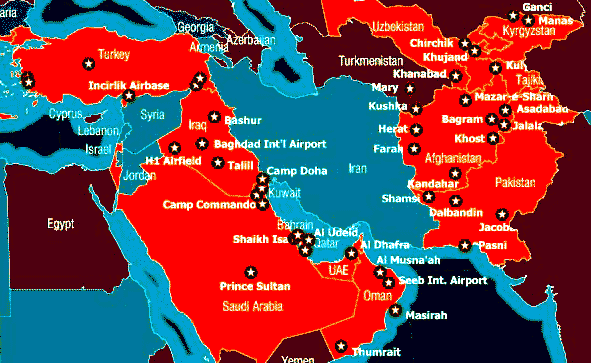
The U.S. government claims it is threatened by Iran. Yet, according to David Stockman writing in Antiwar.com, the United States surrounds Iran with forty-five U.S. bases, and Iran’s defense budget of less than $15 billion amounts to just seven days of money spent by the Pentagon.
The United States, which claims Iran is supporting terrorism, continues to enable Saudi Arabia’s aerial terrorism as it regularly bombs civilians in Yemen. On June 24th, a ship bound for Saudi Arabia departed from Wilmington, North Carolina carrying bombs, grenades, cartridges and defense-related aircraft.  The United States also supplies weapons to Bahrain, the UAE, Sudan and other countries which actively participate in the Saudi-led Coalition making war against Yemen. The Saudi government directly supports the military government in Sudan, which recently killed at least 100 peaceful protesters who were part of Sudan’s Democratic Uprising.
Rather than planning cyberattacks and new means of aggression, the United States should heed calls for dialogue and negotiation, relying on Albert Camus’s conclusion to his profound anti-war essay following World War II: “The only honorable course will be to stake everything on the formidable gamble, that words are more powerful than munitions.”
Kathy Kelly (kathy@vcnv.org) co-coordinates Voices for Creative Nonviolence

Monday, November 12, 2018

Who is Afraid of American Sanctions?

The American administration under Trump has become so addicted to waging economic sanctions; a new form of war, against other countries to a point where it does not hesitate to break international laws, to impose sanctions against its strategic allies, and to face the risk of international condemnation and isolation as a result.
Since his election (selection) as president, Trump has imposed economic sanctions and waged tariff wars against Russia, China, North Korea, Syria, Turkey, Sudan, Canada, Mexico, Venezuela and many European corporations. All have been added to the still going on 58 years old sanctions against the small island of Cuba; an indication that most sanctions fail to achieve planned results.
In May 2018 Trump announced that the US will withdraw from Iran nuclear deal (JCPOA) and will re-impose sanctions against Iran claiming the deal was bad for the US and needs to be replaced with another that includes a ban on Iran’s ballistic missiles. On November 5th, Trump has re-instated economic sanctions against Iran aiming to drive Iranian oil exports to zero.
The JCPOA was signed by Iran, US, Germany, England, France, Russia and China, and was unanimously approved by the UN Security Council Resolution 2231. It must be emphasized that although Iran has been complying with its commitment to the JPCOA as has been confirmed by Director General of the International Atomic energy Agency (IAEA) Yukiya Amano in September 10th2018, the sanctions against Iran have never been lifted. The JCPOA had resolved only Iran’s nuclear program and its oil trade. Iran restricted its nuclear activities and allowed inspections of its nuclear facilities in exchange for the release of its oil money that was held by international banks.
Re-imposing the sanctions was condemned by the whole international community except, of course, by Israel, Saudi Arabia and United Arab Emirates (UAE). The European Union issued a statement regretting the US new sanctions against Iran. It states the following:
“Our aim is to protect European economic actors, who have legitimate commercial exchange with Iran in line with European legislation and the United Nations’ Security Council resolution 2231 … the 2015 agreement is crucial for the security of Europe, the region and the entire world.”
Russia rejected the sanctions and declared them illegal. China declared that it will continue its trade with Iran in confirmation to its commitment to the nuclear deal. South Korean and Indian industries depend greatly on Iranian oil. Iran’s neighbors; Turkey, Iraq, Afghanistan, and Pakistan, consider Iran their major trade partner and their economies would be devastated without such trade.
These particular unilateral American sanctions against Iran are unprecedented illegal and most dangerous events in the American history. For the first time in world history, the US; the host of the United Nations and the Security Council, is violating UNSC resolution 2231. Worst than that, Trump’s administration is threatening to punish other nations; the whole world in fact, who would abide by this particular legal resolution. This constitutes a mockery of international decisions and a criminal blackmail of responsible nations, who seek to uphold international laws and agreements. This American violation of UNSC resolution will marginalize and weaken international organizations such as the UN, SC, ICC, IAEA and others. The present international legal world order would be rendered irrelevant and could be gradually dissolved leading to international chaos.
For the first time in American history, its close allies such as EU, Japan, South Korea, India and even Turkey, firmly opposed the American policies, decided to create new financial and trade mechanism; Special Purpose Vehicle, based on barter system to circumvent American sanctions, and to continue doing business with Iran. Furthermore, the EU declared that its 1969 law would protect all and any European corporation, who wants to do business with Iran, from any lawsuit by non-European courts.
States and corporations started abandoning the use of Petro dollar and American banking systems and are using instead local currencies and local banks to pay for Iranian oil. India and Iran are using Indian currency; the rupees, to trade oil. South Korea is paying for Iranian oil via the Central Bank of Iran’s accounts at Woori Bank and the Industrial Bank of Korea.
All this could usher a new international economic and trade system independent from the hegemonic American financial system. This will gradually isolate the US further and will render its Dollar and its financial banking weaker.
Trump’s “America first” motto is perceived, although not openly expressed, by European leaders as similar to Hitler’s “Deutschland über alles”; “Germany over all” motto, and even more dangerously threatening world peace. Trump called to build the US/Mexico separation wall against “illegal criminal” Hispanic immigrants, imposed unfair trade tariffs against other nations, demanded EU to contribute more money to NATO, withdrew from climate agreement, recognized Jerusalem as capital of Israel in violation of all international agreements,  demanded UN member countries to blindly and automatically adopt American policies because the US is the largest financial contributor to the UN, cut American contributions to world organizations such as UNRWA, threatened to withdraw US from World Trade Organization, sold weapons to Saudi Arabia to continue its terrorist inhumane war against Yemen, is working to cover up the Saudi terrorist support in Syria and its local crimes against its own dissenters and journalists such as Khashoggi’s murder, is imposing unilateral illegal sanctions against other states, and lately but not lastly is withdrawing from nuclear INF treaty to allow the US to deploy advanced nuclear weapons into Europe.
Such policies had caused Donald Tusk; the President of the European Council, to warn of the emergence of “… a new phenomenon; the capricious assertiveness of the American administration … with friends like that who needs enemies… Trump’s doctrine is dangerous for Europe”
In his interview in French with Europe 1 radio Mr. Macron; the French President, criticizing Trump’s move to scrap the INF treaty with Russia that eliminated a whole class of missiles stationed in Europe, had suggested that Europe needs to form its own true European army to defend itself against Russia, China and even the US: “We have to protect ourselves with respect to China, Russia and even the United States of America.” Macron’s sentiment was endorsed by Chancellor Angela Merkel of Germany. Macron has also rebuked Trump’s nationalist policies in his speech during the WWI armistice centenary ceremony this Sunday Nov. 11th.
These strong oppositions from America’s European allies and the international condemnations of the sanctions against Iran had forced Trump’s administration to ease its sanctions by granting oil waivers to eight countries; Japan, South Korea, India, China, Taiwan, Turkey, Greece and Italy, for a period of six months. European Union did not receive such a waiver, which led Bruno Le Maire; the French economy minister, to complain to The Financial Times about Trump’s bullying stating that“Europe refuses to allow the US to be the trade policeman of the world.”
Trump’s administration is under the illusion that what they call “toughest sanctions” would bring Iran to its knees, and they are trying to sell this illusion to the public as John Bolton; the National Security Advisor, was trying to do on fox news. Bolton asserted that:
“sanctions are having enormous economic consequences … Iran is in a depression … the rial currency declined about 70% … inflation had quadrupled … the country is in recession … riots and demonstrations all around the country.”
The facts show that 40 years of real international toughest sanctions against Iran had failed to even weaken Iran’s economy and resolve. On the contrary, after all the devastation Iran had suffered during the eight years Iraq/Iran war, Iran had successfully flourished back to become one of the strongest economic and military country in the Middle East. During the last decade Iran had adopted what was described as a resistant economical plan that had modernized all Iranian industrial and technological avenues leading to self-reliance and self-sufficiency. Finally, the world was convinced that they could not accomplish any results except through negotiations that led to the 2015 JCPOA.
The American unilateral on-going 58 years long economic sanctions against the small island of Cuba had failed to bring Cuba to its knees, yet, Trump’s administration believes that its own unilateral sanctions against large powerful Iran would yield some results!
One may question what made the Trump’s administration risk losing its international political credibility, lose its closest allies, face isolation, and suffer probable economic and financial losses by imposing doomed to failure sanctions. To find the answer one must consider these sanctions as only one small piece in the puzzle of the New Middle East Project.
It is a very well-known fact by now that a Zionist Jewish elite owns and controls the Federal Reserve and almost most of the western banking systems, which fund Jewish lobbies to influence the foreign policies of most of the Western world for Israel’s benefit. It is also a well-known fact that the latest few American presidents, few of whom were not qualified for the position like Trump, would not have attained the presidency except through Jewish money. For such money and prestigious office, the selected president has to follow the dictates of the Jewish lobby, otherwise he would meet a fate similar to that of assassinated president Kennedy.
The Greater Israel Project was planned for the Middle East. The state of Israel was illegally and forcefully established on occupied Palestinian land. Yet, after three successive generations of Zionist Jewish Israeli soldiers got psychologically and emotionally exhausted by continuous wars, terrorist groups were brought into the region to destroy any Arab resistance axis to the project. Syria was the latest victim.
A military coalition of Syria, Russia, Iran, and Hezbollah was able to defeat the terrorist groups. This coalition forms an obstacle to the expansionist Greater Israel Project, and might become the seed of a new world order competing with the old American unilateral world order. Trump exposed this fear when he answered reporters who asked him about the effectiveness of the sanctions. He stated:
“when I came in office it looked like Iran would take over the Middle East, it was a question of literally less than years, very quickly, and now nobody is talking about that.”
Trump’s administration seems to have received Zionist orders to destroy this dangerous seed no matter what the cost is, including the use of economic sanctions and MESA; Arab NATO-like alliance.
The establishment of the illegal expansionist terrorist state of Israel in the heart of the Arab World has been the root of all evil in the region for the last hundred years. Unfortunately, as long as Israel exists more devastating wars are in the future of the Middle East, and the whole world will not be spared of its evil effects.
Dr. Elias Akleh is an Arab American from a Palestinian descent. His family was evicted from Haifa, Palestine, after the 1948 Nakba when the Zionists stole his family’s property. Then the family was evicted again from the West Bank during the 1967 Naksah, after the Zionist, again, occupied the rest of Palestine.

Thursday, November 08, 2018

Tuesday, November 06, 2018

Trump Bullying Will Hurt Millions of Iranians

Iranian government officials want to know how the Trump administration can get away with punishing Iran and other countries for complying with the internationally recognized nuclear deal signed in 2015. “The US is, in effect, threatening states who seek to abide by Resolution 2231 with punitive measures,” said President Rouhani. “This constitutes a mockery of international decisions and the blackmailing of responsible parties who seek to uphold them.”
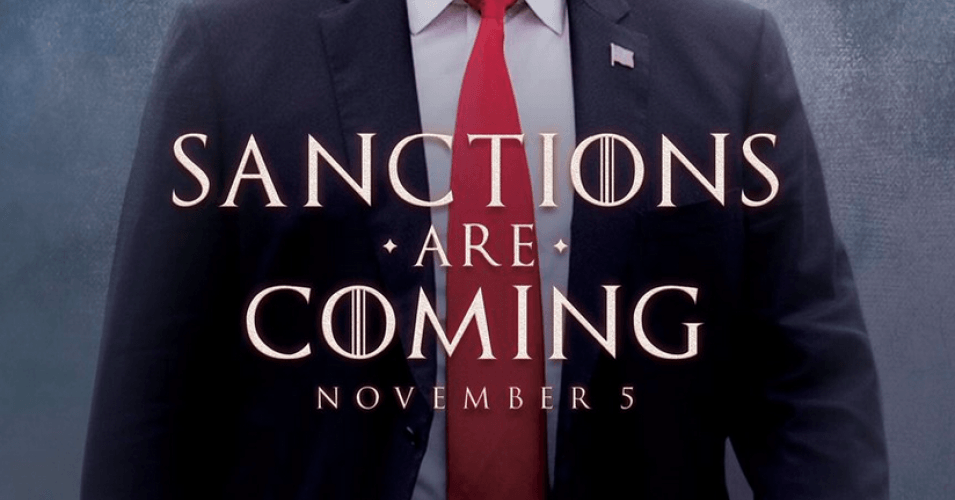
Treating the welfare of the Iranians people like a TV show, Donald Trump used a meme from The Game of Thrones—an arrogant, stylized photo of himself with the tagline: “Sanctions Are Coming November 5”—to announce the new round of crippling sanctions targeting Iran’s oil exports, banks and shipping.
This is the second round of sanctions since Trump pulled out of the Iran nuclear deal, a deal that was signed in 2015 not only by the US and Iran, but also by Germany, England, France, Russia and China—and approved unanimously by the UN Security Council. It’s also a deal that has been working. Iran has been complying with the most intrusive inspections regime ever devised, as the International Atomic Energy Agency has confirmed 13 times.
Trump, always ready to bulldoze international agreements, unilaterally withdrew from the deal and imposed a first round of sanctions in August and the second round now. These sanctions are designed to stop not just US companies from trading with Iran, but all companies—anywhere in the world. According to Treasury Secretary Steve Mnuchin, “Any financial institution, company, or individual who evades our sanctions risks losing access to the U.S. financial system and the ability to do business with the United States or U.S. companies.” In effect, the Trump administration, practicing imperial hubris on steroids, is determined to punish countries abiding by an internationally approved agreement.
Faced with US threats, big Western companies that had recently signed contracts with Iran, such as Total, Eni, Boeing, Airbus, and Peugeot, have cancelled multi-billion dollar deals.
Desperate to counter US sanctions, the European Union is creating a mechanism called the “special purpose vehicle.” It is essentially a barter system, similar to one used by the Soviet Union during the Cold War, to exchange Iranian oil for European goods without money changing hands.The US government has vowed to sabotage this effort. “I have no expectation that there will be any transactions that are significant that go through a special purpose vehicle based upon what I’ve seen,” Treasury Secretary Steve Mnuchin said. “But if there are transactions that have the intent of evading our sanctions, we will aggressively pursue our remedies.”
Secretary of State Mike Pompeo boasted that even before the November 5 sanctions went into effect, the US had already succeeded in reducing Iranian crude oil exports by more than 1 million barrels, and insists that the goal is to stop ALL Iranian oil exports. The administration is granting temporary waivers to eight countries, including India, South Korea and Japan, principally out of concern that withdrawing so much oil from the market at once would lead to a spike in global oil prices. Moreover, they are merely six-month waivers contingent on countries “winding down” their oil business with Iran. A major stipulation for the waivers is that Iran’s revenues must be kept in foreign accounts that can only be used for trade in “nonsanctioned goods and services.”
While this economic stranglehold is officially designed to “stop Iran’s destabilizing activities across the world,” Trump administration officials are known to be gunning for regime change, hoping that distraught Iranians take to the streets to overthrow their government.
Indeed, since last December there have been sporadic protests against the economic hardships. But will unorganized protesters really be capable of toppling a well-armed, tightly controlled regime? Some analysts speculate that what the Trump administration wants in Iran is not even regime change but chaos, with Iranians fighting each other so they won’t be projecting power beyond their borders.
Trump’s wishful thinking aside, the most likely effects of the sanctions will be to further inflame regional conflicts, empower conservative forces in Iran, make other governments resentful of US imperial overreach and worst of all, needlessly cause suffering to millions of Iranian citizens.
The sanctions are already taking a tragic toll. While there are humanitarian exemptions on food and medicines, restrictions on banks and shipping companies make even exempted items difficult to obtain. Asked about humanitarian exemptions, French Ambassador to Washington Gerard Araud said, “The banks are so terrified by the sanctions that they don’t want to do anything with Iran.”
Below is a sampling of the desperate messages we have been getting from people in Iran:
  • We are suffering the sanctions with our bodies and souls. Businesses are closing, workers are losing their jobs, food prices are increasing by the hour. We may not be happy with our government, but this economic situation makes us more dependent on the government.
  • When I sleep at night there is one set of food prices. When I get up in the morning, they have doubled. We are losing our ability to buy food for our children because of Mr. Trump.
  • My grandmother in Iran has gone blind in one eye because she can no longer access her diabetes medicine. Thanks America.
  • I am a teacher in Iran. Before President Trump violated the nuclear deal, my salary was $800 a month. Now I have to work 12 hours a day, six days a week, just to make $250. The harsher the sanctions, the more difficult our lives become.I don’t know why we should suffer the consequences of decisions made by stubborn officials, whether here or in the United States. We just want to live normal lives.
Donald Trump is only too happy to make a mockery of international decisions. It is up to the rest of the world to stop him.

Monday, November 05, 2018

Unstable Sanctions

Unstable Sanctions

By Reza Nasri*

There are a number of differences between the past sanctions imposed on Iran and the current US sanctions that need to be elaborated as the Iranian public faces an outright psychological war.
Firstly, the previous sanctions were multilateral ones, supported by “states” based on binding international resolutions (approved by the United Nations Security Council and the European Union).
The current sanctions, however, are unilateral and illegal ones that the US Treasury Department has “forced” upon private companies by employing the politics of fear and threats. This is while the companies’ respective governments and current laws oppose such measures.
This atmosphere of fear and threats and the forceful nature of the sanctions, that even overshadow the economic benefits of the other countries, can be neutralized by effective measures of European governments and Iran.
Secondly, the previous sanctions had the support of the public in Western countries as well as many other nations. In fact, Iranophobia and enmity towards the Iranian government had reached such a level that some influential countries even misused the mechanisms of international organizations (like the International Atomic Energy Agency and UN-affiliated bodies) against Iran in an unorthodox and illegal manner. The media, civil organizations, and experts did not even raise the slightest objections against such acts at the time.
Today, however, relations between Iran and the West have become so regulated and systematic – because of key legal frameworks like the JCPOA, UN Resolution 2231, and the International Court of Justice orders – that hereafter the imposition of irrational pressures on Iran, by any private or state actor, would not be without any cost.
The abrupt U-turn of public opinion against Saudi Arabia and its fall from grace in the case of Jamal Khashoggi shows the world’s public opinion has the capacity to gradually lean towards Iran and doing business with its government if it is enlightened about its activities.
Let’s not forget that in recent years, issues like corporate moral responsibility and corporate human rights accountability are established rules in business and cannot be renounced by large corporations.
In fact, if these corporations decide to leave the Iranian market because of pressures imposed by the Trump administration, it is very likely that they would revise their decisions later when faced with an international backlash.
Thirdly, the previous sanctions were imposed while there was a complete consensus within the US in favor of them. The current sanctions, however, are opposed by a considerable part of US political movements, media, and experts.
Some reports indicate that technocrats and experts in departments like the Treasury and State are even against the Trump administration’s unilateral moves as they could lead to the collapse of the US dollar monopoly and hegemony on the world’s financial mechanisms.
As a result, any development inside the US, like the mid-term congressional elections, or the replacement of Trump’s key cabinet figures could redress the balance of power, leading to the abrupt collapse of Trump’s unilateral sanctions.
The situation of the current US sanctions imposed on Iran is a far cry from the previous sanctions where all the actors inside the US were competing to harm Iran, something that makes the current sanctions very fragile.
    
*Reza Nasri is an international law expert from Geneva’s Graduate Institute of International and Development Studies.

Thursday, September 27, 2018

Trump’s Bad Manners on Full Display at UN

Crescent International


Donald Trump always travels light. And we are not talking about baggage as in suitcases or brief case.
Completely bereft of manners and with a low IQ, Trump’s rant at the UN General Assembly yesterday (September 25) exposed these traits completely.
When he boasted that his administration had accomplished “more than almost any” other in US history, even the generally polite diplomats at the UN could not suppress their derisive laughter.
Trump looked pathetic as he often does when people don’t buy into his self-aggrandizing claims. He laughed back, saying: “Didn’t expect that reaction.” That evoked even more derision for a man that deserves nothing but contempt.
The compulsive liar went on with his rant of self-praise: “The United States is stronger, richer and safer,” he insisted. Trump does not live in an ivory tower; he is an alien from another planet, perhaps from the Planet of the Apes.
This clueless man does not realize what a beating his army is getting in Afghanistan. Iraq is in shambles as a result of US militarism and America’s terrorist proxies are on the verge of defeat in Syria.
As for America being “richer”, it depends on what group of people he is talking about. If Trump means the top 1 percent, he is right. This bunch of greedy and selfish people has become richer; but America’s poor have become poorer.
This was confirmed in a report released by the British charity, Oxfam earlier this year that found that the one trillion dollar wealth created last year went to the top 300 individuals—most of them Americans. They have accumulated more wealth than the bottom half of the world’s population: 3.5 billion people.
Trump represents the top 1 percent only; he does not care about the poor or the disadvantaged in society.
It was, however, his attack on Iran that reflected his complete detachment from reality.
He accused Iran’s leadership of sowing “chaos, death and destruction” across the Middle East. Iran belongs to the region, not the US.
“They do not respect their neighbours or borders or the sovereign rights of nations,” he went on in his idiotic style. “Instead, Iran’s leaders plunder the nation’s resources to enrich themselves and spread mayhem across the Middle East and far beyond.”
President Hassan Rouhani of Iran who is also attending the UN General Assembly, hit back criticizing the Trump regime for its unrelenting hostility towards Iran.
The Iranian president said dialogue should begin by ending threats and “unjust sanctions”, adding that no nation could be brought to the negotiating table by force.
“The United States’ understanding of international relations is authoritarian. In its estimation might makes right. Its understanding of power, not of legal and legitimate authority, is reflected in bullying and imposition,” President Rouhani said.
Trump’s lies were also exposed in his claim that the US respected other countries’ sovereignty. If so, what are US forces doing in Iraq and Syria?
The Syrian government has not given the US permission to have forces on Syrian territory. America is violating Syria’s sovereignty by maintaining military bases in that country and by supporting terrorists to overthrow a legitimate government there.
“I honour the right of every nation in this room to pursue its own customs, beliefs and traditions,” Trump announced.
“The United States will not tell you how to live or work or worship. We only ask that you honour our sovereignty in return.”
Here was Trump lying in front of the whole world. That is precisely what he and his gangster advisors have been saying to Iran. They demand that Iran change its behavior. And what change do they demand? That Iran must stop being an independent country and abide by US demands.
Mike Pompeo (US Secretary of State) and John Bolton (National Security Advisor) as well as Rudy Giuliani (Trump’s lawyer) have openly threatened to overthrow the government of the Islamic Republic of Iran.
Trump not only threatens but has actually imposed sanctions on countries that refuse to surrender to US demands. The list includes Iran, China, Russia, Syria, Venezuela, Cuba and a host of others.
While the UN has little relevance in bringing about peace in the world, Trump’s appearance undermined its standing even more.
It was a pathetic performance by a clown who should be locked up in a lunatic asylum. He poses a clear and present danger to the world.
Crescent International