"Strike with creativity!" proclaims Raytheon.
by

A Yemeni collects items amidst the rubble of a destroyed funeral hall building following reported airstrikes by Saudi-led coalition air-planes on the capital Sanaa on October 8, 2016. (Photo: MOHAMMED HUWAIS/AFP/Getty Images)
Writing about his visit to the world’s largest weapons bazaar, held in London in October, journalist Arron Merat describes reading the slogan emblazoned above Raytheon’s stall: “Strike With Creativity.” Raytheon manufactures Paveway laser-guided bombs—produced in factories in the United States and the United Kingdom—fragments of which have been found in the wreckage of schools, hospitals, and markets across Yemen.
How, I wonder, can a weapons manufacturer that causes such death, bloodshed, and misery lay claim to creativity?
Consider the Raytheon weapons now demolishing Yemen. Fragments of Raytheon and other U.S.-manufactured weapons dot blast sites where Yemeni survivors collect body parts and scattered bits of clothing, which are needed to compile lists of the dead.
Saudi Arabia and other countries in the Saudi-led coalition bombarding and blockading Yemen have killed tens of thousands of people, wrecking the country’s already enfeebled infrastructure and bringing Yemen to the brink of a famine that may kill millions.
In September, the Kingdom of Saudi Arabia hit a detention center in the Dhamar governorate, in the northern highlands of Yemen with seven airstrikes that killed at least 100 people and “pulverized” the area, according to Bethan McKernan, reporting for The Guardian. “It took five days to remove all the bodies impaled on metalwork ripped from the walls in the blasts,” she wrote.
After the attack, McKernan interviewed Mustafa al-Adel, a twenty-two-year-old security guard employed at the site. His brother, Ahmed, also a guard, was among those killed. Adel pointed to a blanket, visible on the second floor of a building where the guards had slept. “You can see Ahmed’s blue blanket up there,” said Adel. “There were 200 people here but now it’s just ghosts.”
Saudi Arabia and other countries in the Saudi-led coalition bombarding and blockading Yemen have killed tens of thousands of people, wrecking the country’s already enfeebled infrastructure and bringing Yemen to the brink of a famine that may kill millions. President Donald Trump signaled additional support for Saudi Arabia on October 11 when the U.S. military announced it would send thousands more troops to the kingdom, bringing the number of U.S. troops there to 14,000.
For people in the United States to understand why Yemenis would join together to resist the Saudis requires a deepening awareness of how financial institutions, in attempting to gain control of valuable resources, have pushed farmers and villagers across Yemen into debt and desperation. Isa Blumi writes about this sordid history in his 2018 book, Destroying Yemen: What Chaos in Arabia Tells Us about the World.
Blumi details how Yemen’s society, largely independent and agrarian, became a guinea pig for International Monetary Fund (IMF) “development projects” which, based on strikingly colonialist theories of modernization, crushed grassroots institutions, and amounted to “cost-effective ways of prying Yemen’s wealth out of its peoples’ hands.”
Local development associations, for example, were formed during the 1970s to help people cooperatively determine what crops they would grow and how they would use the profits. But U.S. Agency for International Development “experts” pressured these groups to instead produce “cash crops strictly meant for export.”
“After all,” Blumi writes, “with the right kind of cash crop and the use of American labor-saving technology, pesticides and fertilizers included, Yemen’s villagers were no longer needed in the fields. Alternatively, they could work in cities in sweatshops producing clothes for a global market . . . or the soon booming oil and gas projects.”
Blumi’s book documents the fiercely stubborn creativity with which, decade by decade, Yemenis kept surprising the West, exploring and pursuing countermeasures to resist its exploitative control, and risking the West’s destructive anger.
Yemenis kept surprising the West, exploring and pursuing with fiercely stubborn creativity, countermeasures to resist its exploitative control.
When farmers desperate for cash went to work in Saudi Arabia, for instance, “they consistently sent remittances home to families that saved the cash and invested in local projects, using local bank transfers.” Imams and village leaders encouraged people to resist imperialist “modernization” projects, knowing that the West's preferred “modern” role for them was as wage slaves with no hope of developing a better future.
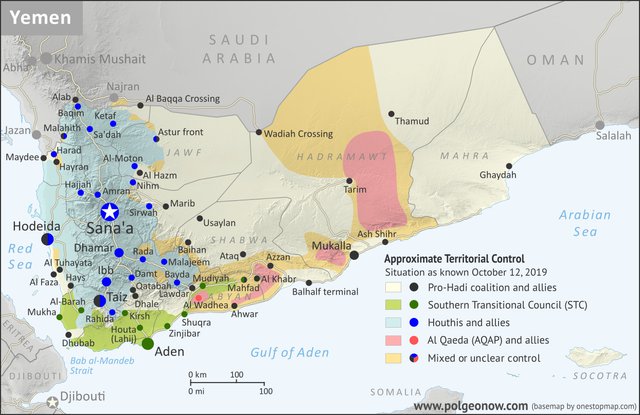
The “Huthi” movement began when Husayn al-Huthi, an opponent of Yemen’s dictatorial (and Western-allied) Saleh regime, tried to defend the water and land rights of locals in the Sa’adah province in northwestern Yemen. Sharing what was then a porous and informal border with the KSA, they often found themselves in disputes with Saudi border patrols. They also resisted ‘structural adjustment’ demands by the International Monetary Fund to privatize some of Yemen’s best farming and grazing land. When the dictator Saleh made criminal concessions to the KSA, al-Huthi and his followers persisted with protests. Each new confrontation won over thousands of people, eventually spreading beyond Sa’adah.
Blumi cites numerous instances in which Yemen’s economic assets were pillaged, with Saleh’s approval, by “well-heeled global financial interests.”
In 2008, an extremely wealthy member of the bin Laden family aimed to build a bridge across the mouth of the Red Sea from Yemen to Djibouti. The project could generate hundreds of billions for investors, and quicken the process of exploitative modernization; but it would also require building railways and roads where there are only villages now. People living along the coastline of the Red Sea would be in the way.
Since 2015, fighting has been concentrated in this area, called the Tihama. Control of the coastline would also allow financial takeover of potentially profitable Yemeni fisheries. Blumi says billions of dollars of annual income are at stake, noting with irony that a war causing starvation is being waged, in part, to gain control over food assets.
A recent United Nations report says that Yemen is now “on course to become the world’s poorest country,” with 79 percent of the population living beneath the poverty line and 65 percent deemed “extremely poor.” The Yemen Data Project estimated in March that 600 civilian structures on average are damaged or destroyed monthly in Yemen, mostly by airstrikes.
“Staple food items are now on average 150 percent higher than before the crisis escalated,” says a 2019 report by the Norwegian Refugee Council. “Teachers, health workers and civil servants in the northern parts of the country haven’t been paid for years,” according to the same report.
Here in the United States, news commentators discussing the Trump impeachment story liken the breaking developments to “bombshell after bombshell.” In Yemen, real bombshells, made in the United States, kill and maim Yemeni civilians, including children, every day.