
By Palestine Chronicle Staff
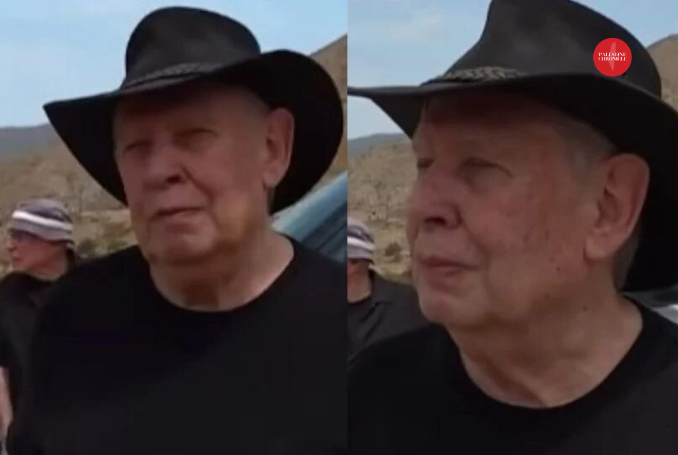 Former Mossad chief Tamir Pardo. (Photo: Video grab)
A former Mossad chief has delivered a stark assessment of Israel’s future, warning that the country’s most serious dangers may be gathering closer to home than many Israelis realize.
Former Mossad chief Tamir Pardo has issued one of the starkest warnings yet from a senior figure within Israel’s security establishment, arguing that the greatest threat facing Israel is no longer Iran, Hezbollah or Hamas, but the country’s deepening internal crisis and its unresolved occupation of Palestinian land.
In a wide-ranging interview with Israel’s Channel 12, Pardo said the October 7 events may prove to be only a “prelude” to a far more dangerous scenario in the occupied West Bank, while also criticizing Israel’s recent war against Iran and warning of a possible internal confrontation within Israeli society itself.
‘We Achieved Nothing’
Pardo, who spent decades involved in Israel’s covert campaign against Iran and later headed the Mossad, argued that Israel emerged from the recent confrontation with Tehran having failed to achieve its objectives.
“We came out of this campaign very badly because we achieved nothing,” he said.
According to Pardo, the military operations carried out against Iran earlier this year may ultimately strengthen rather than weaken Tehran’s nuclear ambitions.
“My feeling is that we made such a wrong move that its result could be an aggressive nuclear arms race in the Middle East,” he said. “I would not be surprised if Iran now tries to run as fast as possible to obtain nuclear weapons.”
He warned that Iranian leaders are likely asking themselves a dangerous question after the attacks.
“If we had nuclear weapons, would anyone have dared do to us what the Israelis and Americans did?” Pardo said. “The answer is that they would not have dared.”
He argued that this conclusion could create a far greater threat than the one Israel claimed it was trying to prevent.
Criticism of Israel’s Strategy
Pardo also criticized what he described as the public exposure of intelligence operations and covert capabilities.
“Any discussion of these operations is a mistake and a serious failure,” he said. “It allows the other side to complete the puzzle and block future operations.”
“The use of exposing capabilities in order to excite the public in real time, as has happened in recent years, is, in my view, a disaster.”
The former intelligence chief further questioned the Israeli-American campaign’s targeting doctrine, arguing that attempts to eliminate political leadership represented a dangerous departure from previous military practice.
“When you decide to take such a dramatic step, you have to think about what happens if you fail,” he said. “If you fail, you enter an event far more serious than the place you were in before.”
Netanyahu and the Surveillance Request
One of the most striking revelations in the interview concerned Prime Minister Benjamin Netanyahu.
Pardo disclosed that during his tenure as Mossad chief he learned that Netanyahu had asked then-Shin Bet chief Yoram Cohen to monitor the phones of both the Mossad director and then-Chief of Staff Benny Gantz.
“I discovered it a few days after the request was submitted,” Pardo said.
“It was a sad event and completely lacking in logic.”
He said the request undermined the relationship between Israel’s political and security institutions.
“The role of the Mossad chief is to serve the state, not anyone else.”
‘You Are Clerks, We Are the Elected Officials’
Pardo described what he sees as a long-term deterioration in relations between Israel’s political leadership and its security establishment.
According to him, discussions between professional and political officials were once conducted “at eye level,” but that changed over the past decade.
“A spirit began blowing that said: ‘You are the clerks, we are the elected officials,'” he recalled.
Today, he argued, the attitude has become institutionalized.
“They tell the attorney general, the Mossad chief and the chief of staff: ‘You are a clerk. Go do what you are told.'”
“It has entered our political DNA.”
Warning of Internal Conflict
A section in Pardo’s interview focused on Israel’s internal divisions.
He said his primary concern is no longer external enemies but growing fractures within Israeli society.
“I told them then that my fear is not Iran, not Hezbollah and not Hamas,” he said.
“The real threat is the internal rift that has been created within the people of Israel.”
Pardo warned that the possibility of internal violence can no longer be dismissed.
“Can the State of Israel reach a civil war today?” he asked. “The answer is yes.”
“Something I never imagined.”
He specifically pointed to the possibility that a future Israeli government could attempt to dismantle settlement outposts in the occupied West Bank.
“If the legitimate government of Israel decides to evacuate the outposts and farms in Judea and Samaria, I am not sure how it will end.”
Asked whether he was referring to armed confrontations, he replied: “Real use of force.”
“The country has changed. Not for the better.”
“And responsibility for that change always lies with leadership.”
‘October 7 Was Only the Prelude’
Pardo’s strongest warning concerned the occupied West Bank.
In his view, the absence of internationally recognized borders and the continued expansion of settlements are creating conditions for a future crisis that could surpass October 7.
“The State of Israel is the only country in the world without a border to its territory,” he said.
“On the day there is no border to territory, there is no border to anything else.”
“We are deteriorating, and this government is leading us toward a disaster of which October 7 was only the prelude.”
“What awaits us in Judea and Samaria is much worse.”
Pardo argued that a major escalation in the West Bank would be fundamentally different from the events of October 7 because it would occur along a vast geographical area stretching next to Israel’s largest population centers.
“October 7 was against the Gaza envelope, a thin belt of communities,” he said.
“The West Bank envelope runs from Afula through the center of the country, from Netanya and Hadera to Tel Aviv and Kfar Saba.”
“An event of this kind would look completely different.”
“This is a different population, a different rear front, a different line of contact.”
“It is heading there.”
Call for Defining Borders
Pardo concluded by arguing that Israel’s unresolved territorial ambitions lie at the heart of the crisis.
“Israel needs to define its borders through a referendum,” he said.
“Whoever lives inside the territory receives full rights.”
“Whoever is outside the border—the army will hold the key until someone emerges on the other side who is prepared to live in peace.”
He also called on Israeli leaders to adopt what he termed a “Vision 2048” and confront the Palestinian issue directly rather than continuing to manage it through military force.
“The Middle East wants cooperation with us,” Pardo said.
“But we insist on not solving our number one problem … It is time for us to begin defining borders, and from there grow forward.”
(Israeli Media, QNN, PC)

No comments:
Post a Comment