
By Palestine Chronicle Staff
 (Image: The Palestine Chronicle)
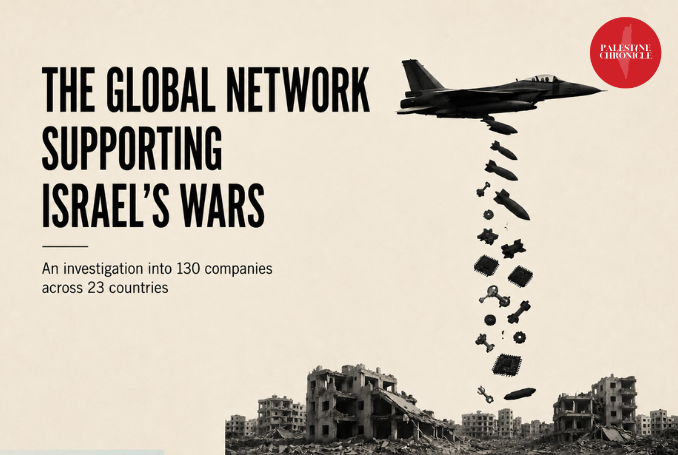
An investigation identified 130 companies across six continents supplying Israel with weapons, technology, logistics and wartime infrastructure.
Key Takeaways
- Investigation identified 130 companies from 23 countries that continued supplying Israel from October 2023 through May 2026.
- Researchers argued that support extended beyond weapons production into logistics, cloud computing, artificial intelligence and energy systems.
- US firms accounted for the largest share of suppliers, while technology giants were identified as central to Israel’s military infrastructure.
Global Corporate Network
An open-source investigation by Arabi Post identified 130 companies from 23 countries across six continents that continued supplying Israel with weapons, technologies, logistical support and industrial services from October 2023 through May 2026.
The report argued that these supply chains remained active despite repeated international calls and UN measures urging states to halt arms transfers linked to Israel’s military operations.
According to the investigation, the support structure extended beyond direct weapons production and represented what researchers described as a broad multinational industrial ecosystem sustaining Israeli operations in Gaza, the occupied West Bank, Lebanon, Syria and Iran.
Researchers said they relied on open-source documentation including official records, institutional reports, company disclosures, investigative reporting and public data. The report stated that company names, ownership structures and supply relationships were cross-checked and categorized according to sector and country.
Beyond Traditional Arms Industries
The investigation argued that military supply chains increasingly operate through systems extending beyond ammunition factories and aircraft production lines.
Researchers said these networks incorporated dual-use technologies and services ranging from electronics and telecommunications to software, logistics systems, industrial materials and cloud infrastructure. Rather than functioning as isolated weapons contracts, the report described these sectors as parts of a continuous support structure sustaining military capabilities over time.
The investigation also emphasized that previous wartime reporting often concentrated on state aid packages or major weapons transactions, while its research sought to map both public and private companies functioning as ongoing suppliers.
US Firms Dominated the Identified Supplier Network
The report found that US companies represented the largest national grouping, accounting for more than one-third of identified firms. Companies listed included Boeing, Lockheed Martin, RTX (Raytheon), Northrop Grumman, General Dynamics, Palantir, Google, Microsoft, Amazon and Caterpillar.
Researchers identified 43 companies operating from the United States alone. Europe accounted for 39 companies across 13 countries, with Germany leading the continent through nine firms, followed by Britain and Serbia.
The report also identified a significant Israeli presence through 22 domestic companies, including Elbit Systems, Israel Aerospace Industries and Rafael Advanced Defense Systems. Meanwhile, India ranked among the largest Asian contributors with seven firms, alongside companies from Japan, South Korea and China.
According to the investigation, this distribution reflected what researchers described as a globalized military support structure extending across North America, Europe, Asia, Africa and Oceania.
Defense Industries Led the Network
The report classified identified firms across several sectors, including defense industries, logistics and shipping, cybersecurity, artificial intelligence, energy, engineering and manufacturing materials. Defense and weapons industries accounted for more than half of the companies identified in the investigation.
Researchers argued, however, that technological support increasingly occupied a critical role in military operations. Cybersecurity, AI systems, cloud services and data processing infrastructure represented approximately ten percent of identified sectors, reflecting growing reliance on digital capabilities in military planning and battlefield operations.
Growing Role of AI, Cloud Infrastructure
The report devoted particular attention to Microsoft, Google and Amazon, describing them as forming the backbone of Israel’s cloud and artificial intelligence infrastructure.
Microsoft’s Azure platform, together with Google Cloud services and Amazon Web Services through Project Nimbus, were identified as major components in a system reportedly used for large-scale data processing and operational support. Project Nimbus, involving Google and Amazon, was cited as a contract reportedly valued at approximately $1.2 billion.
According to the investigation, these systems increasingly serve operational functions by collecting and processing vast amounts of information and accelerating battlefield decision-making. Researchers argued that such systems create what amounts to a digital infrastructure capable of supporting simultaneous operations across multiple fronts.
Long-Term Operational Sustainment
Researchers argued that sustaining military campaigns requires much more than weapons deliveries alone.
The report highlighted Boeing among firms associated with some of the highest-value military programs, including F-15 aircraft projects and broader weapons packages. It also referenced US military financing frameworks and estimates of billions of dollars in support approved since October 2023.
According to the investigation, rapid deliveries of munitions, air defense systems, spare parts and guidance kits enabled continued operational readiness and allowed military systems to function without interruption despite extended campaigns.
Multi-Front Operations
The report concluded that as military operations expanded from Gaza into Lebanon, Syria and Iran, reliance on global supply structures intensified.
Researchers argued that military operations increasingly depend on integrated systems involving logistics, technology, cloud infrastructure, energy networks and weapons production. According to the investigation, these interconnected structures enabled operational continuity and rapid adaptation despite the expansion of military activity across multiple fronts over more than 30 months of conflict.
(Arabi Post, QNN, PC)

No comments:
Post a Comment