
By Robert Inlakesh
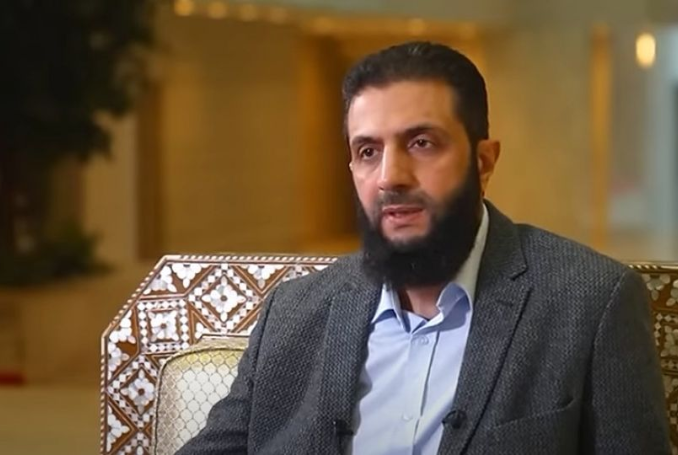 Syrian President Ahmed al-Shara’a. (Photo: via Wikimedia Commons)
It is not impossible for this predicament to change, but the only real road towards this is a Syrian resistance emerging in the south, which could act in a similar way to how Hezbollah does in southern Lebanon.
Car bombs, angry protests, forgotten promises, economic strain, sectarian strife, and Israeli aggression are what have characterized Syria since the fall of Bashar al-Assad in 2024, dragging the nation through a new phase of war that no longer has two distinct sides. A nation now dominated by Western interference is heading towards the unknown.
On Tuesday, a car bomb detonated in the Syrian capital, killing a soldier and injuring 18 others. The attack, which was not immediately claimed by any specific group, was carried out in front of the Defense Ministry building in Damascus. While Syrian security forces attempted to defuse a separate explosive device in the area, another suddenly went off inside a nearby vehicle.
Later that same day, comments made by Syrian leader Ahmed al-Shara’a’s father triggered a wave of protests against the leadership. The controversy kicked off after a video surfaced of Hussein al-Shara’a commenting on what he called the barbarity and intellectual inferiority of Syrians in the eastern Deir Ezzor province. Another clip would later surface of the Syrian leader’s father also stating the same of residents living on the outskirts of Damascus, arguing that the city people were more intelligent.
The anger that hit the streets ended up forcing Ahmed al-Shara’a to issue a public apology to the people of Deir Ezzor, which has been widely covered. A reason why this has been so heavily focused on is due to the clearly tense security predicament inside the country, which has led to a number of alleged assassination attempts against al-Shara’a himself, one of which reportedly lightly injured him.
An apology of this nature is rarely something that comes from the Syrian leadership, past and present, but it indicates that the possibility of more unrest is clearly bothering the authorities in Damascus.
Although the US-led regime change operation in Syria did not end up bearing fruit until after the war itself had all but ended, the aftermath has somewhat resembled the fallout from the toppling of Iraqi President Saddam Hussein. Sectarian warfare, open-air vendetta killings, US domination, poverty, corruption, and a strategy that clearly was not thought out before it was implemented.
In Iraq, the United States decided to construct a confessionalist system whereby the Shia majority would gain the most identity-based representation. In Syria, installed governments were assumed to have had genuine intentions; they would have been attempting to build a house on quicksand and are prohibited from taking the measures necessary to save a sinking ship.
Damascus now faces the growing threat that if it pushes too hard against groups within the Sunni majority, it could face an insurgency. Daesh (ISIS) is still lingering and carrying out sporadic ambush attacks, while other al-Qaeda aligned militias also kill regime-aligned forces. What makes this so dangerous is the ruling Hayat Tahrir al-Sham Party, which the plethora of armed groups who have sided with it, was itself from the al-Qaeda and Daesh stock; both in terms of its rank and file, but also ideologically.
Take, for example, the issue of foreign fighters in Syria. Tens of thousands had entered the country and were armed to overthrow Bashar al-Assad, but are now left in limbo, lobbying for Syrian citizenship in a country that is attempting to push them out.
Ideologically, groups like Al-Qaeda, Daesh, and their affiliated splinter groups don’t care about national identity; instead, they believe in Sunni identity. Meaning that in a country now dominated by such groups and those who previously belonged to them, there is a large amount of sympathy for the cause of the foreign fighters. Enough support to ignite serious fighting if it is not dealt with carefully.
Economically, the country has not recovered, despite the sanctions being lifted and Damascus taking back ownership of its fertile agricultural lands and oil fields in the nation’s north-east. Countless promises were made to the population regarding foreign investments, infrastructure projects, and an overall improvement in living standards. Instead, there have been further government layoffs, ever-rising gas and energy prices, while the Syrian currency has not bounced back as was advertised.
Sectarian groups of the Salafist kind are able not only to march through religious minority neighborhoods to intimidate the local populations but are able to behave in reprehensible ways and even carry out attacks, with little pushback, if any. The sectarian killings on the coast against Alawites have not been replicated in such a way since, but there are still attacks that do happen. Attempts to bring in solutions for the governance of the Alawite areas, like using fighters from what was formerly the Kurdish-led Syrian Democratic Forces (SDF), are yet to come to fruition.
Meanwhile, the Israelis are constantly agitating and demanding that Damascus disarm the south by force, not permitting it to transfer military equipment south of the Capital. Al-Shara’a does not push back against the Israelis at all, simply nodding and respecting their requests. The most the Syrian leader has done is to declare that Israeli goods cannot be traded inside Syria.
In Quneitra and Dara’a, the Israelis continue to construct more military sites, deepening their illegal occupation, with only local militias signaling their intent to oppose them, having been abandoned by the forces aligned with Damascus. The Israelis also continue to back their Druze separatist allies in the southern Sweida Province, directly coordinating with them and supplying arms. Illicit drug trafficking and trade inside the country have also continued, something that has drawn neighboring Jordan into confrontations with gangs.
Uniting the nation under one banner is simply too steep a task for someone like Ahmed al-Shara’a, who has been the face of sectarian killings against the minorities, meaning that there is simply no trust in anyone like him. But, for the groups who were congregating and building power for years in Idlib, prior to taking over Damascus, they would not allow a neutral leader to emerge.
In a way, the only thing preventing Syria from descending into all-out chaos is the fact that Ahmed al-Shara’a remains sitting on his throne; if he is to be assassinated or run out of power, a vacuum will exist that allows for a free-for-all. Which is why the Israelis have such tremendous power, as do the Americans, because launching an assassination strike would be very simple if al-Shara’a were to begin behaving even slightly outside of the guidelines they have set.
Unfortunately, the country has been captured by the US and Israel, with no real options in front of it, so long as it refuses to resist and fight for its sovereignty. Resistance would mean immense suffering, but it is the only way forward. Now that Bashar al-Assad is gone and the sanctions are lifted, there is no excuse that the supporters of the current regime have as to why the country shouldn’t be able to develop economically.
Which means that eventually reality has to be faced. The US and Israel now control Syria, because this was their goal all along. They were behind fueling the rabid sectarianism, just as occurred in Iraq, they sought to make southern Syria Israeli, whether through physical occupation or proxy, and wanted to install a government that was incapable of making decisions without their approval.
It is not impossible for this predicament to change, but the only real road towards this is a Syrian resistance emerging in the south, which could act in a similar way to how Hezbollah does in southern Lebanon. Historically, this is what the US does, like how it installed the Shah in Iran, or why it economically crushes Cuba, because it will not allow any country to achieve sovereignty.
A golden opportunity could end up emerging soon, for the Syrians to begin working towards the liberation of their country, one that they missed during the previous 40-day period, and that is the re-opening of the regional war between Iran and the US-Israeli alliance.
– Robert Inlakesh is a journalist, writer, and documentary filmmaker. He focuses on the Middle East, specializing in Palestine. He contributed this article to The Palestine Chronicle.

No comments:
Post a Comment