
By Michael Leonardi
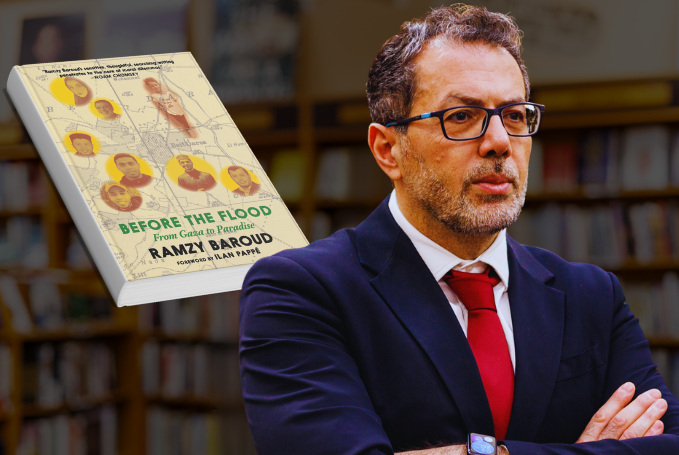 Before the Flood traces multiple generations of the al-Badrasawi family. (Illustration: Palestine Chronicle)
Ramzy Baroud has written the book that this moment demands. Now it is up to us to read it, to share it, and to join the long struggle it so beautifully illuminates.
In Before the Flood, Ramzy Baroud has written not merely a family memoir but a living testament to the Palestinian soul — a work that pulses with the blood of generations, the salt of the Mediterranean, and the unbreakable will of a people who refuse to disappear. This is more than a book. It is an act of defiance, a literary sumud that stands as one of the most powerful indictments of Zionist settler-colonialism and Western complicity ever penned. Across three generations, Baroud traces the al-Badrasawi family from the olive groves of Beit Daras to the refugee camps of Gaza, revealing how colonial invasion, occupation, and genocide have tried — and failed — to erase a people’s history, dignity, and future.
From the very first pages, Baroud’s prose cuts like a blade through the numbness of numbers and statistics that too often reduce Palestinians to abstractions. “One cannot give oneself courage if one does not have it,” he writes, quoting Alessandro Manzoni. Courage, like resistance itself, is not granted from above. It is forged in the long march of history, in the longue durée that French historians understood and that Baroud masterfully deploys here. This is no ordinary family story. It is the story of Palestine itself.
The book opens with the haunting figure of Madallah Abdulnabi, Baroud’s great-aunt, whose “companion” — a jinn, a spiritual presence — arrives at the village well. When her father, Mohammed, is martyred, covered in swallowtail butterflies by the waters of Beit Daras Valley, Madallah falls silent for months. Her pain is not individual; it is collective. “The dreams continued,” Baroud writes, “confined to the intangible world, as the news grew grim.” This merging of the mystical and the brutally material sets the tone for the entire narrative: Palestinians do not merely endure history — they carry it in their bones, their dreams, and their unyielding faith.
Madallah’s son, Abdallah, emerges as a towering figure of quiet resilience. Forced into exile during the Nakba, he becomes the “man of the house” at a heartbreakingly young age. The family’s arrival in Shati refugee camp is rendered with devastating intimacy: “The al-Badrasawi family eventually settled there in a small tent, initially with just a few used blankets and no mattresses.” Baroud does not romanticize poverty. He lays bare the slow death of dignity under siege — the hunger, the disease, the constant humiliation — while showing how the family’s sumud transforms suffering into something transcendent.
One of the book’s most powerful threads is the story of Ehab al-Badrasawi, whose life becomes a living bridge between past and present resistance. From painting revolutionary graffiti as a boy to digging tunnels and fighting in the Al-Aqsa Flood, Ehab embodies the unbroken chain of defiance. Baroud writes of Ehab’s final stand with heartbreaking clarity:
“Ehab didn’t join in. He calmly reloaded his weapon and fired again, striking another tank… ‘Allahu Akbar,’ his voice echoed in the empty neighborhood… He tossed his weapon aside. He took off his green coat and ran towards the personnel carrier. ‘God is great,’ he yelled one last time.”
Ehab’s martyrdom is not glorified for its own sake. It is presented as the inevitable outcome of a life spent refusing submission. In these passages, Baroud achieves something rare: he makes the reader feel the weight of every bullet, every lost child, every demolished home. The personal becomes profoundly political without ever losing its humanity.
Ilan Pappé’s foreword rightly frames the book as a necessary antidote to the “numbness” of numbers. “Too often numbers numb us,” Pappé writes. Baroud’s genius is in restoring flesh, breath, and soul to those statistics. Over 70,000 Palestinians slaughtered since October 2023. Entire bloodlines erased. Hospitals reduced to rubble. Children amputated without anesthesia. Baroud does not let us look away. He forces us to see the grandmother clutching her dead grandson, the father searching for his children’s remains, the mother giving birth under siege to a child named after a martyred aunt.
The book’s treatment of longue durée is particularly brilliant. Baroud rejects the Zionist narrative that reduces Palestinian resistance to “terrorism” or Iranian proxies. Instead, he traces a continuum from ancient defiance against Alexander the Great’s Macedonians through Izz al-Din al-Qassam to the fighters of today. “Batis may seem to be a footnote in this book,” he writes, “but, in fact, if read carefully, you will discover that he is the central character.” This historical depth dismantles the lie that Palestinian resistance is a recent invention. It is as old as the land itself.
What makes Before the Flood essential reading in 2026 is its unflinching confrontation with the ongoing genocide. Baroud does not soften the horror. He documents the deliberate targeting of medical staff (including his own sister, Dr. Soma Baroud), the destruction of entire neighborhoods, and the sadistic cruelty of Israeli officials who speak openly of turning Gaza into a “Riviera” while Palestinians rot in tents. The final chapters read like dispatches from hell — yet they are infused with a stubborn, almost miraculous hope.
“The Palestinian people will eventually win their freedom because they have invested in a long-term trajectory of ideas, memories, and communal aspirations,” Baroud writes, “which often translate to spirituality, or rather, a deep, immovable faith that grows stronger, even during times of genocide.”
This faith is not naive. It is hard-won, tempered in the fire of multiple Nakbas. Baroud shows how each generation — from Madallah’s silence to Ehab’s final charge — adds another layer to the collective refusal to surrender. The tunnels of Gaza are not mere military infrastructure; they are the physical manifestation of a people who have learned to survive beneath the surface of colonial violence, waiting for the moment to rise.
The book’s power lies equally in its tenderness. Baroud writes of love, loss, and ordinary acts of survival with exquisite sensitivity. The small details — a golden bracelet, a jarrah carried on the head, the scent of baklava at weddings — humanize what the world too often reduces to conflict footage. When Madallah loses her voice after her father’s martyrdom, we feel the silence in our own throats. When Asia searches for her son’s body after an Israeli strike, we walk with her through the rubble.
As someone who has spent years immersed in Palestinian solidarity work — coordinating with the Freedom Flotilla Italia’s “100 Ports, 100 Cities” campaign and helping build durable networks of support — I recognize in Baroud’s pages the same spirit that drives dockworkers in Genoa and Livorno to block arms shipments, that fuels the Gaza Generation’s mobilizations in Rome, and that sustains the global BDS movement. This is not abstract solidarity. It is the recognition that the al-Badrasawis’ struggle is our struggle.
Before the Flood arrives at a critical moment. As Israel’s genocidal campaign spreads into Lebanon and Western governments continue their criminal complicity, Baroud reminds us that resistance is not futile — it is inevitable. The book does not end in despair but in a quiet, fierce affirmation of Palestinian agency. “Palestinians are not history’s passive victims,” he writes, “but, over the course of generations, its masters.”
Ramzy Baroud has given us a masterpiece. Before the Flood belongs alongside the great works of Palestinian literature — from Ghassan Kanafani to Mahmoud Darwish — and deserves the widest possible readership. It is a book that will educate, enrage, and inspire in equal measure. For those who have grown numb to the daily horrors from Gaza, it restores feeling. For those already in solidarity, it deepens commitment. For the Palestinian people themselves, it is an act of profound love and historical reclamation.
In the end, Baroud does what only the greatest writers can: he makes the particular universal. The al-Badrasawi family becomes every Palestinian family. Their pain, their resistance, their dreams of return become the shared inheritance of humanity’s conscience. Before the Flood is not just a memoir of one family’s survival. It is a demand that the world finally bear witness — and act.
There can be no peace without justice. There can be no future while Palestine remains dispossessed. Ramzy Baroud has written the book that this moment demands. Now it is up to us to read it, to share it, and to join the long struggle it so beautifully illuminates.
– Michael Leonardi is an Italy-based journalist. Leonardi is the vice president of the Treewater Initiative, a non-profit dedicated to building sustainability in a Free Palestine for over a decade. He contributed this article to the Palestine Chronicle.

No comments:
Post a Comment