
By Palestine Chronicle Editors
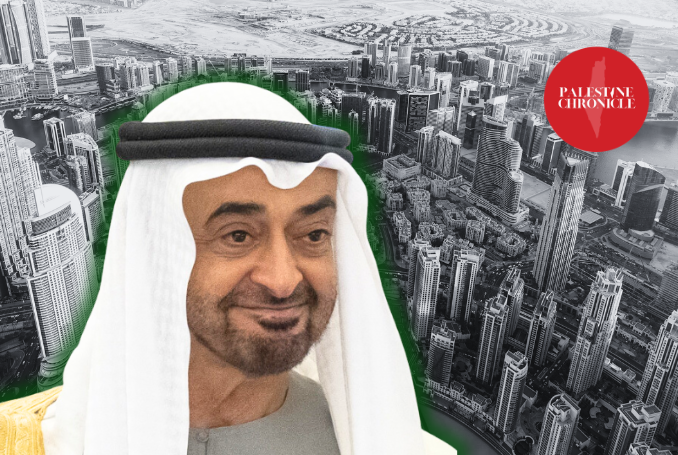
The UAE breaks traditional Arab models by prioritizing a risky US-Israeli alignment, threatening its own federal survival.
The foreign policy behavior of the United Arab Emirates (UAE)—specifically its deep commitment to the US-Israeli alignment in the Middle East—diverges from any traditional Arab geopolitical framework established in the post-WWII era.
Following the rise of the United States as a regional hegemon, the Middle East was broadly split into two camps: anti-imperialist revisionists (traditionally labeled ‘extremists’ by Washington) and US client regimes (labeled ‘moderates,’ like traditional Gulf monarchies).
The UAE fits neither category. Its active, aggressive enthusiasm for the US hegemonic project and its alignment with Israel’s expansionist policies represent a historical anomaly.
This behavior is difficult to classify not only within the Middle East but across the entire Global South, where states typically hedge between superpower rivalries rather than tying their survival to an external, highly polarizing alliance.
The Abu Dhabi Doctrine
Rather than adopting the cautious, defensive posture typical of a small state, the UAE—under the architect of its modern foreign policy, Mohamed bin Zayed Al Nahyan (MBZ), has pursued an interventionist doctrine.
Abu Dhabi has systematically embedded itself in regional conflicts that align with US and Israeli strategic interests. From deployment in Afghanistan alongside NATO to financing counter-revolutionary forces during the Arab Spring, the UAE has acted as a forward operating partner for Western security architecture.
The UAE has increasingly adopted tactical methods pioneered by Israel: violating the sovereignty of neighboring states by projecting power through local proxy militias and mercenaries to engineer chaos, weaken centralized governments, and suppress democratic or Islamist movements.
In Yemen, the UAE funded, trained, and armed the Southern Transitional Council (STC) and various secessionist militias, effectively fracturing the country to seize control of strategic maritime choke points like the Bab al-Mandeb Strait and Socotra Island.
In Sudan, the UAE has faced heavy international scrutiny for its reported logistical and material support for Mohamed Hamdan Dagalo’s (Hemeti) Rapid Support Forces (RSF), which has fueled a devastating civil war to secure agricultural resources and gold, while undercutting Riyadh’s influence.
During the severe humanitarian catastrophe and ongoing Israeli genocide in Gaza, Abu Dhabi maintained its diplomatic and economic ties with Tel Aviv under the Abraham Accords.
Critics argue that by continuing normalization, providing alternative trade corridors to bypass the Ansarallah blockade in the Red Sea, and refusing to use its economic leverage against Israel, the UAE effectively acted as a buffer for the Israeli war effort while simultaneously trying to position itself as a manager of post-war Gazan governance to sideline the Palestinian resistance.
Escalation with Iran
A common, yet flawed, argument among mainstream commentators suggests that the UAE’s appetite for confrontation with Iran is merely a defensive reaction. Proponents of this viewpoint out that Iran and its regional allies have launched intense missile and drone salvos against Emirati territory—striking civilian infrastructure, energy networks, and areas near the Al-Hasn gas field and the Barakah Nuclear Power Plant.
While these strikes heavily targeted US and Israeli military and intelligence assets hosted on Emirati soil, they also devastated local commercial stability. However, recent intelligence disclosures reveal that the UAE is not an innocent bystander; it is an active participant.
Direct Military Involvement
The UAE has moved past the threshold of covert alignment into direct battlefield complicity:
It was recently disclosed by US Ambassador to Israel Mike Huckabee that Israel dispatched Iron Dome air defense batteries and specialized personnel directly to Emirati soil during the height of the conflict to shield the country from Iranian retaliation.
Moreover, reports emerged that Israeli Prime Minister Benjamin Netanyahu and Mossad Director David Barnea conducted unannounced, highly sensitive visits to the UAE—specifically meeting MBZ in the oasis city of Al-Ain—to directly coordinate intelligence sharing and joint military maneuvers against Iranian targets.
While the UAE Ministry of Foreign Affairs publicly denied these “secret visits” to preserve its diplomatic cover, regional security channels confirm that deep, non-transparent military planning has become operational.
The Lavan Island Plot
Escalating the stakes further, reports from The Telegraph revealed that senior figures within the Donald Trump administration explicitly urged the UAE to take a “boots on the ground” initiative by directly seizing Iran’s strategic Lavan Island in the Persian Gulf.
The US calculation was clear: outsource the dangerous front-line warfare to Abu Dhabi to avoid American casualties. Tehran has responded with severe warnings, viewing any such move as an act of absolute war.
The Saudi-Emirati Rift
Iran is far from Abu Dhabi’s only geopolitical headache. A profound and quiet structural rift has opened between the UAE and its massive neighbor, Saudi Arabia.
Riyadh deeply distrusts MBZ’s regional ambitions. The Emirati footprint in southern Yemen, its intervention in Sudan, and its aggressive bidding war for economic dominance in the Gulf are viewed by Saudi Crown Prince Mohammed bin Salman (MBS) as a direct threat to Saudi Arabia’s leadership role and domestic security.
The fragility of this dynamic was exposed following a recent drone strike targeting UAE infrastructure. While no regional group initially claimed responsibility, Emirati authorities pointedly leaked assessments suggesting the hostile drones had traversed Saudi airspace to enter the country.
While stopping short of a direct accusation against Riyadh, the implication was clear: Saudi Arabia either failed to defend its skies or passively permitted the breach. This dynamic underscores that the UAE’s list of adversaries is expanding to include its nominal allies within the Gulf Cooperation Council (GCC).
Grand Strategy or National Suicide?
Instead of seeking a diplomatic exit or attempting to de-escalate—the logical path for a micro-state with limited native military manpower and high vulnerability to economic disruption—the UAE is doubling down on its aggressive posture.
To many serious geopolitical analysts, this behavior looks like a form of national suicide.
The UAE’s global brand relies entirely on being a safe, stable oasis for international capital, luxury tourism, and global shipping. By transforming itself into a frontline launchpad for US-Israeli operations against Iran, it guarantees its own destruction if a full-scale war erupts.
For now, the entire survival strategy of the modern Emirati state relies on a single, binary gamble: a decisive, total, and crushing US-Israeli victory in the Middle East.
Abu Dhabi originally signed the Abraham Accords during a period when the US appeared to be pivoting away from the Middle East. Fearing abandonment, Abu Dhabi calculated that Israel was the only regional techno-military hegemon capable of guaranteeing its security.
Now, the impulsive, perpetual warfare driven by Netanyahu’s government is threatening to drag the UAE into the abyss. Yet, Abu Dhabi has invested too much capital, prestige, and political willpower into this alignment to pull back. It has burnt its bridges with its neighbors.
Overplaying a Weak Hand
The fundamental irony of the UAE’s current predicament lies in the stark contrast between its approach and that of Saudi Arabia.
As a large country with massive strategic depth and resources, Saudi Arabia recognized that a permanent state of war with Iran would destroy its domestic economic transformation plans (Vision 2030).
Consequently, Riyadh has played its cards with extreme care, using columns in Western media and high-level diplomatic statements to demand immediate regional de-escalation and protect its detente with Tehran.
Abu Dhabi, blinded by regional ambitions, assumed it could write the future of the Middle East alongside Washington and Tel Aviv, claiming a massive share of the geopolitical spoils in a post-conflict region.
That total victory has failed to materialize.
If the US and Israel suffer a strategic retreat or defeat, the political map of the Middle East will shift permanently. An empowered Iran and an un-entangled Saudi Arabia are highly unlikely to tolerate MBZ’s interventionist policies moving forward.
Furthermore, it remains to be seen how the other six emirates within the UAE federation—traditionally more risk-averse and commerce-minded than Abu Dhabi—will react as their economic stability is sacrificed.
By operating as the testing ground for the US-Israeli alignment, the ruling elite in Abu Dhabi has dramatically overplayed its hand—and placed the very survival of the Emirati federation at risk.
(The Palestine Chronicle)

No comments:
Post a Comment