Showing posts with label Iran-Japan. Show all posts

Thursday, June 13, 2019

Abe’s Tehran Visit Reminiscent of Japan’s Historic Bypass of UK Bans

By IFP Editorial Staff
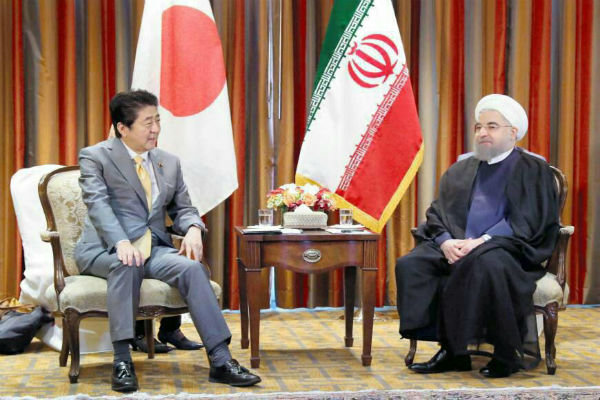
The visit of Japanese Prime Minister Shinzo Abe to Tehran amid the current heightened tensions in Iran-US relations serves as a reminder of a historic move by Japan’s government in the years after the World War II to circumvent the brutal sanctions imposed by the Great Britain on Iran’s national oil industry, an op-ed by Iranian newspaper Shargh said.

The op-ed by Ne’mat Ahmadi, a lawyer in Tehran, has referred to the ongoing visit of Abe to Tehran to discuss the US sanctions on Iran and the possible waivers that the country may receive from the US to purchase Iran’s oil, and argued that Abe’s visit reminds Iranians of a historic move by Tokyo in 1950s to sign a contract with the national government of Iranian Prime Minister Mohammad Mosaddegh to purchase Iran’s oil despite the brutal sanctions put by the Britain.
“In those days, Iran was going through harsh days similar to these days. Britain as the world’s then superpower had sanctioned Iran’s oil industry, putting Iran in a deep trouble to first find customers for its oil and then assigning a maritime transportation firm to transport its oil in the global market,” the op-ed noted.
Like what we see from the US today, the UK at that time had sustained back to back defeats from Iran in various economic, political and legal areas, and thus began to adopt harsh measures against Iran including the imposition of economic sanctions on Iran’s oil industry to hamper the efficiency of the national government of Mosaddegh.
The outrage of the UK with Iran reached its climax in 1951 after members of the Iranian parliament voted to nationalize the oil industry in the country, putting an end to Britain’s 40-year monopoly over the oil in the country. In reaction, the UK government adopted its anti-Iran measures and dispatched its vessels to the Persian Gulf. It also withdrew its nationals from Iran and put its forces stationed in Iran on high alert.
“It seemed Britain was preparing for a military attack on Iran. It planned to occupy oil-rich areas in southern Iran. The US government protested the plan. The second phase of Britain’s anti-Iran measure was waging a psychological war against Iran paving the way for the 1953 coup in the country which led to the overthrow of Mosaddegh government,” the op-ed said.
According to Ahmadi, the most significant anti-Iran measure adopted by the United Kingdom was imposing economic sanctions on Tehran to exert more pressure on the country’s national government.
“To this end, Iran’s properties in London were confiscated and no oil equipment was sold to the country. The UK sanctions had the support of UK’s allies including the US. Meanwhile, to make up for the shortage, the US rushed to expand Saudi Arabia’s oil exports so much so that the Saudi exports were increased by 60 percent. On the other hand, Kuwait and Venezuela raised their exports by 94 and 15 percent respectively.”
As the last blow on Iran, the UK government announced that since Iran owes a huge amount of money to London, any purchase of Iran’s oil amounts to purchase of a stolen good. So, all oil tankers were warned against transporting Iran’s oil into the global market. But Italy and Japan were respectively the first and second ones to purchase Iran’s oil amid international sanctions.
“And now the visit of Japan’s prime minister reminds us of those historic days. During those days, Japan rising from the rubbles of the World War II was in an urgent need of oil. So, the Japanese made a contract with Iran to purchase oil. The contract was made after Italy’s victory to bypass the UK’s sanctions on Iran. The conservative Japanese government sent its oil tankers to purchase Iran’s oil despite the presence of the UK’s military vessels in the Persian Gulf. Iran gave a 50 percent discount to any side daring to bypass the brutal sanctions of the UK.”
According to Ahmadi, the UK sanctions seemed harsher compared with today’s US sanctions on Iran’s oil industry. “If the 1953 coup hadn’t taken place, Japan and Italy as two major losers of the World War II could serve as reliable markets for Iran’s oil and they were ready to play the role due to their animosity with the US and its allies.”
The Iranian lawyer finally concluded that the visit of Abe should be viewed as the repetition of the historical event. Today, Iran can use the visit as a winning card in its dealing with the US and find a way to break the brutal sanctions imposed on the country.

Leader to Japan PM: Trump not worthy of exchanging messages with

Leader of the Islamic Revolution Ayatollah Seyyed Ali Khamenei dismisses US President Donald Trump as a person not worthy of a response.
According to Press TV, Ayatollah Khamenei made the remarks in a Thursday meeting with Japanese Prime Minister Shinzo Abe, who told the Leader he was carrying a message from the US president.
“We have no doubts about your (Japan’s) goodwill and seriousness, but regarding what you quoted from the US president, I personally do not consider Trump worthy of exchanging any messages with, and do not have and will not have any response for him,” the Leader told Abe.
The Leader said Iran has “no trust” in the United States and will not at all “repeat the bitter experience” it gained from the negotiations that led to the conclusion of a 2015 nuclear deal, which Washington later ditched.
“Iran engaged in talks with the US and the Europeans for some five or six years, and achieved a result. The Americans, however, breached a done deal,” said the Leader, emphasizing that no wise man would enter talks with a country that has reneged on all agreements.
Ayatollah Khamenei further rejected as “a lie” Trump’s claim that he was not after regime change in Iran, saying if the US president were able to bring about such a change, he would definitely go for it.
Ayatollah Khamenei dismissed Washington’s claim of readiness for “honest negotiations” with Tehran, saying “honesty is highly scarce among American statesmen.”
The Leader reaffirmed the Islamic Republic’s firm opposition to the development and use of nuclear weapons.
“I have issued a fatwa (religious decree) prohibiting the production of nuclear weapons, but you need to know that if we were after building nuclear arms, the United States could not do anything about it,” Ayatollah Khamenei said.
The Leader emphasized that Washington is in no position to decide which country can be in possession of nuclear arms while it is, itself, stockpiling several thousands of nuclear warheads.

Tuesday, June 11, 2019

The odds of success for Japanese PM's visit to Iran

TEHRAN, Jun. 09 (MNA) –US President’s recent retreat from his previous rhetoric stances towards Iran should not be misinterpreted as the White House’s retreat from its policy of ‘maximum pressure’ on Iran.
In line with its maximum pressure on Iran policy, on Friday the United States imposed new sanctions on Iran that target the country's petrochemical industry, including its largest petrochemical holding group, the Persian Gulf Petrochemical Industries Company (PGPIC).
The main reason behind the changes to Trump administration’s tone against Iran in fact is internal pressure on him. Americans are against a new war in the region. Also opposition from the US allies which will suffer from great losses in case of any war in the region is another reason behind change to Trump’s tone.
Japanese Prime Minister Shinzo Abe is slated to visit Tehran on Wednesday June 12. He hopes to use his warm relation with Iran and the US to mediate between the countries.
Besides Abe’s warm relations with Iranian and the US leaders there are others reasons that potentially make him a proper mediator including Japan’s efforts to have independent Middle East policy and not having imperialistic record in the region which is a good trust building factor for Iran.
Above all, as the third largest economy of the world Japan is very dependent on the energy importing from the region. Japan imports 80 percent of its consuming energy from the Middle East which passes through Hormuz strait, so any war and confrontation in the region will inflict great losses and damages to the country’s economy and consequently to the world economy.
To answer the question that how Mr. Abe’s efforts will be effective to settle the tensions depends on two factors.
First on the ‘real will’ and determination of the US and Iran to solve the ongoing problems especially the US ‘real will’. One cannot ask for talk and at the same time further undermine the trust between the two sides by taking some hostile measures like new sanctions that the US slapped against Iran’s petrochemical section last night on the eve of Mr. Abe’s visit to Tehran. If there is a real will, even no need to mediator.
Second we have to wait to see that how the Japanese PM will be able to affect the US’ decisions. Iran’s Keivan Khosravi spokesman for the Supreme National Security Council said efforts to remove US extraterritorial sanctions against Iran could guarantee the success of Japanese PM’s visit to the Islamic Republic.