Showing posts with label biting sanctions. Show all posts

Wednesday, June 26, 2019

The Hybrid War Against Iran

Sanctions, the information war, and the American sabotage

by
In 1953, the U.S.—with the UK—overthrew the democratically elected government of Mohammed Mossadeq and over the course of the next two decades provided full support to the unpopular government of the shah of Iran. (Photo: Shutterstock)
U.S. President Donald Trump sat in the White House and contemplated a war against Iran. His army had been sending surveillance aircraft along the Iranian coastline, teasing Iranian radar, which tracked these manned and unmanned planes as they skirted the 12 nautical mile limit of Iranian sovereignty. Last week, the United States had two planes alongside Iran’s coast—an unmanned Global Hawk drone and a manned P-8 spy plane.
Iranian air command radioed the U.S. forces to say that both the drone and the spy plane had come inside Iranian territory. The P-8 shifted course to leave Iranian airspace, while the Global Hawk continued. Iranian officials say that it was because the Global Hawk remained in Iranian airspace that it was shot down last Thursday morning at 4 a.m.
Trump and his team threatened to retaliate. They wanted to shoot at Iranian radar and anti-aircraft facilities. At the 11th hour, Trump said, he decided not to fire at Iranian targets. The Pentagon had warned him that this would threaten U.S. troops in the area. It was to protect these troops that Trump did not launch a strike.

Sanctions

Trump might not have sent in a suite of missiles to hit Iran last week, but the United States has—of course—already opened up a certain kind of war against Iran. A few days before the drone was shot down, the head of Iran’s Supreme National Security Council—Ali Shamkhani—gave a talk in Ufa, Russia, on security matters. In his talk, Shamkhani said that the United States had squashed the sovereignty of a number of countries. The U.S. Treasury Department, he said, had become a kind of financial CentCom (Central Command). Shamkhani said that the policies pursued by the United States should be considered to be “economic terrorism.”

Reliance upon the U.S. dollar and on U.S. financial systems means that most countries are unwilling to stand up against U.S. pressure.
U.S. unilateral sanctions are at the heart of this “economic terrorism.” The United States is able to use sanctions as an effective instrument against other countries because it has such enormous power over the world financial and monetary system. The U.S. dollar is the main reserve currency and the main currency of international trade. Reliance upon the U.S. dollar and on U.S. financial systems means that most countries are unwilling to stand up against U.S. pressure.
Sanctions have meant that Iran—reliant upon the export of oil and natural gas—has seen its external revenues collapse. The domination by the United States over the world financial system—including the international financial institutions (the International Monetary Fund and the World Bank) has meant that Iran has not been able to raise credit on the international market. Difficulty in importing medicines and food has produced grave challenges for the Iranian people.

Hybrid War

Since the Western media continues to set the terms of international understanding, Washington’s interpretation of events around Iran predominates. Iran has never attacked the United States, but the U.S. has in fact intervened several times in Iran. In 1953, the U.S.—with the UK—overthrew the democratically elected government of Mohammed Mossadeq and over the course of the next two decades provided full support to the unpopular government of the shah of Iran. When the Gulf Arabs pushed Saddam Hussein to attack Iran in 1980, it was the U.S.—and Western Europe—that provided Iraq with arms and money for a bloody eight-year war. All of this context is lost to the Western media, which hyperventilate about fantasy stories such as Hezbollah in Venezuela or Iranian control over the Houthis. It is always Iran that is the aggressor, even when it has been Iran at the receiving end of U.S. aggression.
Iran is seen as the cause of the problem; the idea that Iran is a rogue or terrorist state is hard to shake off. This is part of the information war that Iran faces, unable—even with a sophisticated foreign minister (Javad Zarif)—to argue its case that it has not been belligerent, but it has been at the receiving end of threats and sanctions from Washington.
Between 2010 and 2012, four Iranian nuclear scientists were killed. These scientists—Masoud Alimohammadi, Darioush Rezaeinejad, Mostafa Ahmadi Roshan and Majid Shahriari—were killed either by Israeli intelligence, the Mojahedin-e Khalq (MEK) or U.S. intelligence, or some combination of all of them. These scientists were killed inside Iran, in broad daylight. It sent a chill through the scientific community. A U.S. and Israeli created computer worm—Stuxnet—hit Iranian computer systems in 2010, creating damage to Iran’s computers that held part of its nuclear work. It was announced that more such attacks were possible. These took place before the nuclear deal was agreed upon in 2015. But the stench of such attacks remains.
Iran’s minister of information and communications technology—Mohammad Javad Azari Jahromi—said that Iran has built a firewall that protects its facilities from any cyber-weapon thrown at it by the U.S. and Israel. This firewall is built by Iranian computer scientists.
It is this combination of attacks—the sanctions, the information war, the sabotage—that comprises the “hybrid war” against Iran (for more on the concept of “hybrid war,” see the dossier on Venezuela from Tricontinental: Institute for Social Research). This hybrid war continues, with the threats of war as part of the arsenal wielded by Washington against Iran. Even Trump’s statement that he withdrew the order to bomb Iran just minutes before the attack began is part of this information war, this attempt to terrify Iranians into the belief that the U.S. is dangerous enough to drop bombs at any time. The hybrid war tightens the noose around Iran.

Group Against Sanctions

It is not easy to untangle the reliance of the world economy to the U.S. dollar and to U.S. financial systems. Even talk of multilateralism is premature. It is one thing to call for it and another to recognize that it will take at least a decade to create the institutions and instruments for multilateralism. Confidence in the Chinese yuan, for instance, will need to be built. So will confidence in alternative systems to transfer money and to reconcile trades. The European Union said openly that it wanted an alternative mechanism to pay Iran for oil, one that would not run through U.S. sanctions. But such an instrument could not be created. It will take time.

On the political plane, about 25 countries have come together to create a platform against sanctions.
Meanwhile, on the political plane, about 25 countries have come together to create a platform against sanctions. These countries, says Iran’s senior parliamentarian Mohammad Ali Pourmokhtar, will stand together against the “inhumane” U.S. sanctions regime. It is not clear what this group will be able to do, but it is certainly the case that they will conduct a political campaign against the kind of harsh sanctions that are currently on Venezuela, Cuba, and Iran.
It is significant that China and Russia will be involved with this club. In Tehran, Russia’s Ambassador Levan Dzhagaryan said that China, Iran and Russia will form a trilateral group to fight against the U.S. unilateral war on Iran.
The group of 25 will struggle against sanctions and the group of three will try to prevent a U.S. war—but whether they can prevail is a serious question. The United States—under Trump—is utterly unreliable, its military arsenal ready to be unleashed, its hybrid war already unfurled. These are dangerous times.
This article was produced by Globetrotter, a project of the Independent Media Institute.

Saturday, January 19, 2019

Iran 40 years after victory of the Islamic Revolution (5)

Since the victory of the Islamic Revolution in 1979, the American ruling system, whether Republicans or Democrats, have used threatening language as the Islamic Republic has severed the US hand from Iran.
With the coming to power of Donald Trump in 2016, questions were raised on the likely change in the US behavior vis-a-vis Iran. Mary Cecil Nav, French sociologist, says on the character of Trump, "Donald Trump, by confrontation with Iran, wants to transform the balance of West Asia not with the aim of geopolitical changes but for attaining economic goals which are compatible with his spirit and personal mindset."
The fact of the matter is that the emergence of Trump is the legacy of the American policies. There is little difference between Trump's conduct and those of his predecessors. This, while Trump knows nothing on politics and world affairs. The American officials, both the past and the present, have left no stone unturned to weaken Iran; but as the Leader of the Islamic Revolution said, "Let everybody, including the sincere friends and those friends whose hearts shake at times, know that the Islamic Republic stands firm and with full might and the enemies cannot slap in the face of the Iranian nation; rather the nation will slap them in the face."
The United States is aware of the capacities and abilities of the Islamic Republic and knows that it can't achieve any success unilaterally. That's why the US makes much effort to ally with the regional and world countries against Tehran to attain legitimacy. In this course, some of the regional Arab regimes like Bahrain, are indulged in daydreams of attaining a position, though insignificant, in consonance with the US hollow allegations against Iran. Thus, the United States of America is relying on forging alliances with some of the Arab regimes and the Zionist regime. Arab News website wrote that although Washington is seeking to forge a global alliance against Iran's system, the American State Department claims that it won't launch this 'global' alliance against the Iranian system but it tries to use it along with the Iranian people. This Arab website continues that the main goal of the US president, after violating the Iran nuclear agreement, is to conclude a new agreement against Tehran with deeper restrictions.
The regional allies of Washington maintain that they can survive only through forging trans-regional crises. The United States makes use of every means to reach its objectives. It considers a good opportunity to have the child-killer regimes on his side. Thus, making alliances with the Saudi regime and the Zionist regime are part of the American strategy in the Trump era. The US measures are concentrated round creation of tensions in West Asia. For several decades, the American policies in support of the fake Zionist regime in Tel Aviv and repressive regimes in the region have caused mayhem, war, bloodshed and terrorism. Today, there is no doubt that the allies and accomplices of Washington are the creators and sponsors of terrorism in the region and the world.
Trump administration has not changed the major US policies towards the Islamic Republic but he has disclosed the real nature of American hostility more than ever. The US Secretary of State, Mike Pompeo, during a speech at Reagan Library in California revealed that the White House seeks to intensify its anti-Iran policies in various domains.    
 South China Morning Post wrote in a report that the US officials have spoken indirectly of a likely consensus resembling the coalition in Iraq and Syria which claimed to act against Daesh while, in reality, it supported and sympathized with the terrorist outfit.
The Iranophobia has always been one of the main axes of the US strategy in the region, though it has been aggravated since Trump's coming to the White House. After failure in the project of sabotaging Iran nuclear deal, the United States pursues two goals. The first US goal is continuation of demonization of the Islamic Republic in West Asia and the second goal is soft opposition against the increase of Iran's regional and global role.
The issue that can be boldly seen in Trump's anti-Iran policies is the hasty move of the Great Satan (the US) to commercially exploit regional and international developments. Donald Trump looks at everything from the eyes of trade and economic profiteering. His first foreign trip proved this claim as he travelled to Riyadh and, hoodwinking the gullible crown prince Bin Salman, singed the sale of 110 billion dollar arms deal with the upstart boy. Thus, the Trump's remarks in accusing Iran of supporting terrorism is not a new issue. For the past three decades, the United States has piled up allegations against the Islamic Republic with the false claims of Iran's effort to gain atomic weapons, its support for terrorism and violation of human rights in Iran. What the US and its accomplices have added to this list of never-proved claims is their "concern" over Iran's missile capability and the powerful and stabilizing presence of the Iranian navy in the waters of the region.
The pressures of the US and its partners-in-crime against the Islamic Republic began with their all-out support for Saddam in the 8-year war they themselves had staged to topple the nascent Islamic Republic system. These supports persisted in the form of equipping Saddam with chemical weapons. Furthermore, the Global Arrogance- spearheaded by Washington- tried to suffocate Iran's economy through illegal sanctions in a bid to disappoint people about realization of the goals of revolution seeking to decrease their participation in various elections. The US has never ceased its enmity against the Islamic Republic. The experiences of recent years in the region, fabrication of terrorist groups like al-Qaeda and Daesh and staging of war and bloodshed in Iraq, Syria and Yemen are part of the joint American-Israeli scheme for West Asia.
It is clear that the Islamic Republic of Iran, with respect to the threats, has based its defensive strategy on high level of deterrence and it enjoys the ability to prevent any likely invasion and adventurism by any aggressor. The doctrine of the Islamic Republic has always been focused on preservation of security and stability of the region via regional capacity and avoidance of tension. The Iranian armed forces, including the Army, the IRGC and Basij have given the message to the enemies and would-be aggressors that the Islamic Republic is completely ready and able to establish security in the region. Meanwhile, Iran believes that cooperation with the neighboring nations is to the benefit of collective security. 

Saturday, December 01, 2018

Iran Sanctions Dead on Arrival

Short-term pain will result in long-term gain

Kevin Barrett


With fierce roars and sharpened claws, the Trump regime announced it would “drive Iran’s oil exports to zero.” That was supposed to have happened by the end of the first week of November 2018.
But as it turned out, like all of Trump’s insane threats, this, too, was meaningless. Shortly before the “most biting sanctions ever imposed” were scheduled to come into effect, Trump exempted Iran’s leading oil customers! The list of countries that buy Iranian oil begins with China, India, and Korea, which together purchase almost half of the total output. Next on the list are Turkey, Italy, and Japan. All six countries — and a few others — have been exempted from Trump’s sanctions.
Why would Trump tear up his own sanctions? Because few if any of Iran’s customers were planning to respect them. As Bloomberg reported on August 2, China — by far Iran’s largest oil recipient — forcefully rebuffed Trump’s request to stop buying Iranian crude.
Tehran’s second biggest oil customer is India. In early October, one month before Iran’s oil trade was supposed to be driven “to zero,” India announced that it too would ignore US sanctions.
In July, before China and India rebuffed Trump, Turkey had led the way in rejecting the American plan to sanction Iran. Turkish Foreign Minister Mevlut Cavusoglu called the planned sanctions “inappropriate.” Then in early November, shortly before Trump issued the exemptions, Turkish President Recep Tayip Erdogan reiterated his country’s refusal to abide by US sanctions, saying “we do not want to live in an imperialist world.” By adding Turkey to its list of exemptions a few days later, the Trump regime seemingly admitted that it was no longer capable of maintaining that imperialist world.
Even US-occupied Europe, which usually plays lapdog to the hectoring American hegemon, has vociferously opposed Trump’s Iran sanctions. Though European governments have not succeeded in forcing their biggest corporations to violate Trump’s sanctions, they have taken steps that threaten to render the sanctions ineffective in the future. The Europeans have begun bundling smaller banks’ and corporations’ transactions with Iran so they can be sent via Europe’s central banks, which are (they assume) too big for Trump to sanction. At the same time the Europeans are initiating their own clearing mechanism outside of the US-dominated SWIFT system. These moves, which parallel efforts of Russia, China, Turkey, and other nations to exit the dollar-denominated international trading system, could finish off an already declining US empire.
The worldwide rebellion against the Trump-Pompeo-Bolton economic war on Iran even extends to the US, where Obama’s former Secretary of State John Kerry enraged the Trump regime by repeatedly meeting with Iranian Foreign Minister Javad Zarif. Current Secretary of State Mike Pompeo called Kerry’s meetings with Zarif “unseemly and unprecedented… beyond inappropriate” while Trump tweeted that “John Kerry had illegal meetings with the very hostile Iranian regime… he told them to wait out the Trump Administration!”
Iranian leaders, of course, do not need John Kerry to tell them that they have absolutely no reason to talk to the gang of lunatics, idiots, and Israeli agents gathered around American moron-in-chief Donald Trump. How can one talk to a president who tweets, “To Iranian President Rouhani: Never, ever threaten the United State again or you will suffer consequences the likes of which few throughout history have ever suffered before. We are no longer a country that will stand for your demented words of violence & death. Be cautious!” Trump’s equally deranged National Security Advisor John Bolton has issued similarly rabid statements, among them a threat to make Iran “pay a price few countries have ever paid.”
The Rahbar of Iran, Imam Seyyed Ali Khamenei is a thoughtful, sincere, spiritual man of his word — the polar opposite of Trump. He knows that Trump is a bloated narcissistic windbag whose words are full of proverbial sound and fury, signifying nothing. One simply cannot imagine these two men meeting, or even being together in the same room; it would be like matter meeting antimatter.
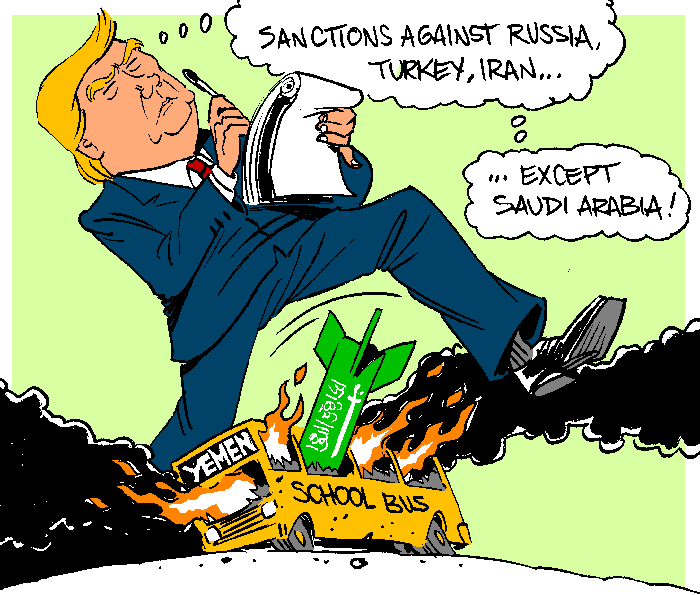
An artist’s rendering of what US sanctions are all about: not principle but national interest at a given moment in time according to the perceptions of the transiently wealthy and powerful. So long as you endorse the expansion of US geopolitical influence and dominance by any means necessary, it doesn’t matter if you starve an entire country to death (Yemen), if you murder one of your own citizens in cold blood at your own embassy (Khashoggi), if you proliferate terror networks all around the world (ISIS, al-Qaeda), if you abandon the indigenous residents of the Holy Land after they were ethnically cleansed (Palestinians), and if you incite sectarian wars in the region in which millions get displaced and hundreds of thousands lose their lives and livelihoods (Syria, Iraq).
But what John Kerry may not understand, or may not wish to understand, is that Iran is not just waiting out Trump, it is waiting out the whole US-Zionist empire. As whistleblowing former World Bank economist Peter Koenig says, “the US dollar is rapidly losing its status as the world’s reserve currency. When some 20 years back more than 90% of all reserves were held in US dollar denominated securities, today that figure has shrunk to less than 60% — and is going down as we speak.” Eventually (perhaps within a 10–15 year time frame) demand for the dollar will crash as dollar-holders realize that America’s debt, which has exploded well past 100% of GDP, is unrepayable — and rush for the exits, hoping to avoid being the last one holding worthless American currency. That moment will mark the end of America’s ability to pay for its military machine, which costs more than the next eight countries’ militaries combined.
When the US is forced to close its foreign military bases and bring its troops home, the Muslim East will change dramatically. Regimes that only exist because they are propped up by the US, notably “Saudi” Arabia and Israel, will likely collapse.
While Islamic Iran waits out Trump and the American empire, it is in some ways being strengthened by the very sanctions designed to hurt it. Though ordinary Iranians do feel the pain of pinched pocketbooks, shortages of medicines, and medical equipment, and less-than-optimally safe airliners, the Iranian nation as a whole is being forced to increase its productivity rather than depend entirely on oil earnings and other raw materials exports. The result is a “resistance economy” geared toward domestic manufacturing rather than raw materials exports exchanged for foreign manufactured goods. That stimulates Iran’s manufacturing sector in the same way that tariffs would. And though European investors pulling out of Iran’s automobile industry this year has been painful, in the medium to long term a more Iranian-run industry, unburdened by debt, could be poised to make big gains, and keep the profits in Iran, when Trump’s sanctions fade.
As it builds its resistance economy, Iran is also accumulating moral capital and worldwide support. Iran’s principled opposition to Trump plays well in a Trump-loathing world. Its courageous refusal to surrender in the face of vicious and criminal sanctions that violate international law is appreciated around the globe. It has been said that the best possible public relations strategy is to choose a deeply unpopular enemy, but Iran has not even had to make such a choice, because the highly unpopular Donald Trump has done the job himself.
When the story of the emerging multipolar world is written, Iran will be cast in a heroic role. And somewhat later, when the story of the 15th century AH Islamic Awakening is written, the Islamic Republic of Iran will likewise be viewed as a nation whose top leadership forged an uncommonly principled example of Muslim self-determination.