Showing posts with label Maryam Rajavi. Show all posts

Sunday, August 04, 2019

The MEK: Illusion vs. Reality


The oddly named People’s Mojahedin Organization of Iran (known as the MKO or MEK), whose sole purpose is the overthrow of the people’s government of Iran, has been busy. Some of their members, who seem to be mainly elderly, are technologically savvy, and use social media to further their disgraceful cause. But they don’t just individually post to Facebook, Twitter and other sites; they establish accounts under a variety of names, and ‘tweet’ and post from them, thus giving the impression that the MEK has widespread support.
It does, however, have some significant support from the United States government, which once designated it a terrorist organization, but now embraces it.
One may wonder why the U.S., which purports to support the self-determination of people everywhere (except in Palestine, Iran, Venezuela, Puerto Rico, Libya, Yemen, Syria, the Philippines, Guam, Cuba, and other places too numerous to name right now), would support an organization responsible for the deaths of many innocent people, that seeks the overthrow of the Iranian government. It really isn’t too much of a mystery. After the U.S. overthrew the democratic government of Prime Minister Mohammad Mosaddegh in 1953, it installed the brutally oppressive Shah of Iran. His disregard for human rights and disdain for his own people was all fine with successive U.S. administrations, but in 1979, the people of Iran had had enough, overthrew him, and established the Islamic Republic of Iran.
The Shah had done the bidding of the U.S. government; if any of its citizens disagreed, they simply disappeared. But once the new Islamic Republic of Iran was created, there was an entirely different set of rules by which the U.S. had to play, and they weren’t rules of the U.S.’s making. And it didn’t like them one bit. No longer did the U.S. have a complacent ally, which posed no threat to Israeli hegemony. No longer could the U.S. call the shots in the Straits of Hormuz. No, things were different now, and the mighty U.S. was no longer in control.
For years, the MEK was officially considered a terrorist organization by much of the world, but the U.S. rescinded that designation in 2012. Why it would endorse an organization whose sole purpose is the overthrow of a foreign government would be puzzling, but this is the hypocritical, terrorist United States we are discussing.
And what of the MEK? It’s current leaders, Maryam Rajavi and her husband, Massoud Rajavi, see themselves as the future rulers of Iran, if they are successful in their quixotic quest to thwart the will of 80,000,000 people. Outside of the repressive, anti-government circles of their own organization, they appear to have little Iranian support, although the U.S. would be happy to establish them as U.S. puppets.
And then there is the MEK’s distinguished journalist, Heshmat Alavi, a prolific anti-Iranian writer, who simply doesn’t exist! Yes, those tech-savvy MEK members created him, so they could write a variety of articles under one name, which would then become ‘prominent’ in anti-Iran circles.
Photographs purporting to be of dedicated MEK members, hard at work at their computer screens, probably writing articles that will be published under the name of a non-existent writer, or busy ‘tweeting’ and posting from accounts of non-existent people, indicate that most of them were probably born early in the terrorist reign of the Shah. This writer reviewed five such photographs, and of the dozens of people shown, perhaps two are under the age of sixty. There is nothing wrong with being older; wisdom often (but certainly now always) comes with years, but youthful optimism and enthusiasm have long since left these people. Even assuming that some Iranians, for some bizarre reason, support the MEK, these pictures represent the group that opposes the will of most of Iran’s 80,000,000 people. It is hard to imagine a dynamic leader emerging from this group of people, one who will inspire the masses to rise up against the very government they selected forty years ago.
So let us summarize: with the support of the United States and a few other governments, the MEK has assembled a group of mainly elderly people who create social media accounts under fictitious names, and ‘tweet’ and post anti-Iranian information. They write articles and submit them, often successfully (one must give them credit for deceiving some major U.S. news outlets) under the name of a non-existent journalist. Like all those social media accounts, said journalist is a figment of MEK’s creative imagination. They take their instructions from a woman who sees herself as Iran’s new savior. They see themselves as being able, with the assistance of the U.S., of course, to defeat the 40-year-old people’s revolution.
When this writer visited Iran in the summer of 2017, he found a modern, vital and exciting nation. Illegal and immoral U.S. sanctions have certainly taken a toll on the economy, but as a friend of his from Iran commented, Iranians are accustomed to sanctions, and manage fine anyway.
The MEK and its criminal members and leaders will not prevail; the Iranian people are proud of what they have accomplished, and will not allow a few disillusioned people, even those who have the support of the United States, to defeat them.
Robert Fantina’s latest book is Empire, Racism and Genocide: a History of US Foreign Policy (Red Pill Press).

Thursday, June 20, 2019

America’s War against Iran: The Insidious Role of the Mojahedin-e-Khalq (MEK) Terrorist Entity

By Robert Fantina

In 2015, the United States, several other nations and the European Union signed an agreement with the government of Iran that limited Iran’s nuclear development program in exchange for the lifting of sanctions against Iran. During the final years of the Obama presidency, and the first year of the bizarre and erratic administration of Donald Trump, all parties were in compliance with the Joint Comprehensive Plan of Action (JCPOA). This was attested to by the United Nation International Atomic Energy Agency (IAEA), which inspected Iran’s nuclear sites regularly, and the fact that many nations were now freely and profitably trading with Iran.
But as Trump attempted to undo everything his popular predecessor had accomplished, he violated the JCPOA by withdrawing from it completely. He reissued sanctions, and threatened the other signatories, including some of the U.S.’s oldest and closest allies, with sanctions if they continued trading with Iran. The deal collapsed, with all the parties except Iran in violation of it.
The U.S. violation was condemned around the world, by nearly every nation on the planet except apartheid Israel, whose racist prime minister, Benjamin Netanyahu, had addressed the U.S. Congress before that body voted, urging its members to defeat the agreement; despite his efforts, Congress agreed to support the JCPOA.
Wanting out of the deal, Trump sought some rationale that he felt would pass muster with the public, to enable him to violate both domestic and international law. His minions located an article by one Heshmat Alavi, saying that the deal allowed Iran to increase its military budget, something to which the U.S. objected.
There are a few things worth exploring a bit more deeply in this. First, since the United States has a bloated military budget that is equal to the military budgets of the next eight countries with the largest such budgets, it is a bit disingenuous for the U.S. to criticize any other country’s military budget. And since Iran is surrounded by U.S. military bases, it is completely understandable for that nation to want to be sure it has what it needs to protect its people from U.S. aggression.
Next, let us look at the ‘journalist’ who wrote the article Trump cited, one Heshmat Alavi. His purported work has appeared in a wide variety of journals over the years. However, on closer scrutiny, we learn that Mr. Alavi simply doesn’t exist! He is a creation of the political wing of the terrorist organization known as Mojahedin-e-Khalq (MEK), which exists for the sole purpose of overthrowing the government of Iran. From 1997 to 2012, the MEK was officially designated a Foreign Terrorist Organization by the United States.
Despite that fact that many articles have appeared under the name Heshmat Alavi, and there are active Faceook and Twitter accounts under that name, a Google search of that name today exposes the fact that there is no such person. Yet the MEK has successfully fooled many journals; for example, at least sixty-one articles under that name appear in Forbes magazine from April of 2017 to April of 2018.
This raises even more questions: why does the U.S. need invented ‘journalists’ to sell its anti-Iran story? Could it be, possibly, because the truth is nothing like the U.S. says, and so relying on a made-up writer for made-up stories is the best it can do?
And what about journalistic integrity? One can imagine Forbes falling for one, or even two articles by a bogus, non-existent journalist, but sixty-one in one year? Does no one question this?
Most journalists (this writer included), don’t hide from the public. In addition to writing, they speak at public forums, and their faces may be almost as well-known as their names. Where has the illusive Mr. Alavi been? Was he too busy writing all those articles for Forbes to crawl out of whatever hole he lived in to speak publicly about issues important to him? No, that is not the case; he was unable to speak at any conference, symposium, rally, etc., because he doesn’t exist.
This is the ‘writer’ whose ‘work’ Donald Trump cited to justify violating international law, and to bring the threat of a devastating war to an area of the world that his predecessor had made significant progress in calming. This is the ‘writer’ that not only Forbes, but The Hill, the Daily Caller, the Diplomat and other so-called responsible news outlets gave a platform to.
And what is MEK? It is a well-organized terrorist group, which gets support from the world’s foremost sponsor of terrorism, the United States, and seeks the overthrow of the Iranian government. It is described as “widely loathed”[1] among Iranians, yet one article ascribed to Alavi says it’s the “main Iranian opposition group”[2]. How ‘he’ purports to speak for Iranians, when ‘he’ heads a group hated by most of them, is beyond rational comprehension.
The MEK has gained influence in U.S. government circles and has paid prominent politicians to speak on its behalf.  The Intercept, on June 9 of this year, further reported that “…the MEK’s messaging has emphasized regime change – and attempted to present the MEK as a viable alternative to the Islamic Republic’s leadership….”[3] Articles under the name Alavi support these positions, and often put forward the name of Maryam Rajavi, MEK’s leader, as the future leader of Iran.
This indicates the level of credibility that the U.S. has. How can anyone take seriously the pronouncements of a government that uses a non-existent journalist to establish policy? How can the U.S. news media be seen as credible, when it publishes numerous articles under the name of a non-existent person?
This is, of course, hardly the first time that the U.S. has increased and justified its aggression and belligerency based on lies, lies that the media heartily endorses. Prior to the Gulf War (1990 – 1991), President George H. W. Bush cited the moving testimony given to the Congressional Human Rights Caucus by a young woman named Nariyah, who claimed to be a teenage volunteer at a Kuwaiti hospital. ‘Nariyah’ said this:
“While I was there, I saw the Iraqi soldiers come into the hospital with guns. They took the babies out of the incubators, took the incubators and left the children to die on the cold floor. It was horrifying.”[4]
Bush and members of Congress cited this testimony repeatedly to gain support for the war. News outlets readily parroted these words. Yet it was all a lie. ‘Nariyah’ was the daughter of the Kuwaiti ambassador. She eventually admitted that she had once briefly visited the hospital in question. Her testimony was arranged by the Hill and Knowlton (H&K) public relations firm, hired by an organization called ‘Citizens for a Free Kuwait’, which was financed mainly by the Kuwaiti government.[5]
Will the MEK have the same success as ‘Citizens for a Free Kuwait’ had nearly thirty years ago? Will it be instrumental in starting yet another unjust war in which countless innocent men, women and children will die by the mighty U.S. war machine? One hopes that cooler heads prevail, but in the Trump White House, there don’t seem to be any. An invasion of Iran by the U.S. or Israel would have disastrous consequences throughout the world. Leaders of all other governments should be doing everything in their power to prevent it.
*
Note to readers: please click the share buttons above or below. Forward this article to your email lists. Crosspost on your blog site, internet forums. etc.
Notes
[3] Ibid.
[4] Michael Kunczik, Images of Nations and International Public Relations (Mahwah, NJ: Lawrence Erlbaum Associates, 1997), 280.
[5] Ted Rowse, “Kuwaitgate,” The Washington Monthly, September 1992

Tuesday, March 19, 2019

MKO’s daydream & change of system in Iran running out of road

Anne and Massoud Khodabandeh
MKO’s Daydream & Change of System in Iran Running Out Of Road The US and the terrorist outfits it is backing in a vain bid to undermine the Islamic Republic on the presumption of changing the system of government in Iran, have run into a dead end.
A report appeared on the Lobelog site in this regard; jointly authored by the husband-and-wife team Anne and Massoud Khodabandeh, and titled: “MKO’s Daydream & Change of System in Iran Running Out Of Road”.
Massoud Khodabandeh is the director of the London-based Middle East Strategy Consultants and has worked with the authorities in post-Saddam Iraq, while Anne is an expert on anti-terrorist activities.
The so-called “regime change in Iran” bandwagon—driven by US warmongers, fueled by false prophesy, and hurtling pell-mell down the road contains various characters, some new and some old.
The bandwagon itself is an ideological construct created 40 years ago in response to the victory of the Islamic Revolution in Iran. It has taken on various incarnations over the years, but its central purpose has always been to destroy the Islamic Republic of Iran and replace it with a compliant pro-American regime.
The drivers of this bandwagon are paid large sums to pursue this agenda at any cost. Others are mere passengers, hoping for a role in case the vehicle reaches the destination. Among these passengers is the MKO terrorist outfit – known in Iran as “monafeqin” or hypocrites for their killing of at least 17,000 Iranian people and their treason in siding with Saddam of the repressive Ba’th minority regime during the 8-year war imposed the US on the Islamic Republic.
MKO, which used to be on the official list of terrorist groups in the US and Europe, has now been delisted and is being called “democratic opposition” – a label which hardly fits this hated cultish outfit.
The MKO has been a passenger for all 40 years of the journey, hanging on by paying the American drivers. These drivers are public persons such as National Security Advisor John Bolton and Trump lawyer Rudi Giuliani, along with a host of other supposedly “influential” persons who steer the bandwagon inexorably toward conflict.
But just as the bandwagon appears to be gathering speed and momentum—in a bid to scare the Trump administration’s opponents—the MKO appears to be running out of road. And that could signal a halt to the whole enterprise.
The first sign of this came in a piece by Eli Clifton, which discussed the provenance of a large payment ($165,000) received by John Bolton in relation to a tweet to “defend a non-governmental anti-Iran pressure group, called UANI or United Against Nuclear Iran.”
Clifton’s own tweet was met by a couple of feeble MKO slave troll posts on his thread spouting the usual “no appeasement” themes. This indicates that the MKO has been outbid by a new bandwagon passenger called UANI, since the MKO only managed $40,000 for one of Bolton’s speeches. Also, the MKO trolls are running out of steam, back in their closed camp in Albania.
Even while Bolton and the Trump administration, along with Zionist Premier Benjamin Netanyahu and Saudi Heir Apparent Mohamed bin Salman (MBS) are pushing for a war with Iran, they are beginning to realize that the MKO is not the stick needed to strike fear into Tehran. Indeed, a look at the recent behaviour of the MKO in Albania reveals a failing group beset by internal crisis.
After a series of critical investigative articles by reporters from Al-Jazeera, The Guardian, The Independent, Channel 4 News, NBC, and others, the recent report in Der Spiegel by Luisa Hommerich was apparently the last straw. The MKO issued a Farsi language statement (written and published in Europe) threatening to assassinate her—for just doing her job.
Hommerich reported that inside the camp in Albania that MKO militants were still practicing the deadly techniques for combat taught them by Saddam’s Republican Guard, such as slitting throats with a knife, breaking hands, gouging out eyes with fingers, and tearing the mouth open.
In 2017, the Trump administration reversed a 2013 plan by former Secretary of State Hillary Clinton to establish a De-Radicalisation Institute to disband and rehabilitate the MKO, allowing the dangerous cult to regroup behind closed doors in a de facto extra-territorial enclave and continue its violent practices.
In spite of this boost, the MKO, beset by exposures and defections, is trying to prevent the total collapse of the terrorist outfit. Around a thousand members have left the group since it relocated to Albania. The front line over which the MKO peers at the Islamic Republic is no longer Iraq but is now represented by a group of 40 former members protesting in Tirana.
The MKO claim that these are all “agents of the Islamic Republic” who want to kill the remaining cult members. So, instead of orchestrating change of the ruling system in Iran, the MKO can’t even deal with 40 destitute former members.
The MKO is engaged in a form of modern slavery by not paying thousands of activists for 30 years or more. Members who leave the group are left destitute because they have nothing but the clothes on their back even after decades of loyal service.
The MKO claims that members offer their services as “volunteers.” But the preamble to the UN Declaration of Human Rights states in its opening sentence that human rights are inalienable—that is, they cannot be disowned by anyone for any reason. MKO leader Maryam Rajavi is responsible for such decisions and treatment.
Not only are the defectors that Hommerich profiles impoverished because they have not had financial recompense for their years of devotion, they are also deliberately left stateless. The UN High Commissioner for Refugees brought the MKO to Albania from Iraq on supposedly “humanitarian grounds.” But on arrival they were not granted UN refugee status, nor have they been issued Albanian identity documents that would allow them to work or travel. Lack of residency rights also means that they cannot register for a bank account. They have no identity papers whatsoever, except the flimsy piece of paper used to fly them through international airspace from Baghdad to Tirana.
In her pursuit of fame and glory, Maryam Rajavi treats her members as, essentially, cannon fodder. In the idealized future she paints for the members, they will one day march on Tehran, as the vanguard of a spontaneous uprising of the Iranian people. So, why would they need money or identity papers?
In the meantime, it suits Rajavi to have her “followers” incarcerated in a closed camp unable to live independent lives, subject to the whims and demands of the struggle that she purports to lead. But that struggle has almost evaporated. Sure, the MKO is still performing propaganda tasks for various Saudis, Israelis, and Americans to advance the anti-Iran push. But even that is becoming more and more irrelevant as the MKO itself begins to fail.

Tuesday, January 29, 2019

The use of terrorism according to John Bolton

by Thierry Meyssan

After having taken back from Daesh the State they had promised, straddling parts of Iraq and Syria, the United States now intend to recuperate some of their mercenaries in order to make use of them in a different manner. National Security Advisor John Bolton has designed new goals, new partners and new methods. Since this new system is secret, we know about it only insofar as parts of the plan have already been implemented. Thierry Meyssan explores this world of violence.
JPEG - 68.6 kb
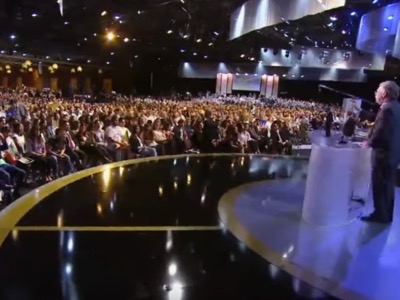
John Bolton speaking in 2017 before the People’s Mujaheddin Organization of Iran.
In 1978, President Carter’s National Security Advisor, Zbignew Brzezinski, decided to use the Muslim Brotherhood against the Soviets, and sent Arab combatants to support the Afghan opposition against the Communist régime. Responding to a call for help from the Afghan government, the Red Army became bogged down in an unwinnable conflict.
In Afghanistan, the Muslim Brotherhood were not armed by the CIA, who were unable to obtain the authorisation from Congress for an operation of that magnitude, but by Israël. In view of their success, the Arab-Afghans were later mobilised in many other theatres of operation. It followed, amongst other things, that the Brotherhood, armed both by Israël and Iraq, took a shot at the Syrian Arab Republic, in 1978-82. One thing leading to another, a representative of the Brotherhood was incorporated into the staff of NATO during the attack in Kosovo against Yugoslavia.
The position of the Muslim Brotherhood as auxiliary troops for NATO was cancelled at the end of the Clinton presidency, but the collaboration of the Brotherhood with the CIA has never been terminated. It was clearly re-instated with the attack on Libya under the Obama presidency, where it furnished almost all of the ground troops for the Atlantic Alliance. One of their representatives was even incorporated into the US National Security Council. Then, during the attack on Syria, NATO’s LandCom, situated in Izmir, coordinated the jihadist troops.
Since the Trump administration opposes on principle the use of terrorist groups by the US Armies, the moment arrived for the White House to redefine the role of the Muslim Brotherhood.
We do not yet know the new strategy defined by National Security Advisor John Bolton. However, several elements enable us to guess its general form.

Daesh

At the beginning of 2018, US Special Forces illegally stationed in Syria exfiltrated thousands of Daesh combatants overseas. In May 2018, General Yahya Rahim Safavi, military advisor to Ayatollah Khamenei, accused the USA of organising the transfer of Daesh combatants to Afghanistan.
Currently, approximately 7,000 of them are still on Afghani soil. Contrary to their past position, they do not support the Taliban, who are currently opposed to all foreign presence, but now oppose them.
JPEG - 30.1 kb
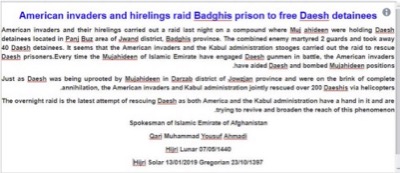
According to the spokesman for the Islamic Emirate of Afghanistan (in other words the Taliban), Qari Muhammad Youssuf Ahmadi -
« The American invaders and their lackeys carried out a raid last night [12 January 2019] against a Mujahedin camp where members of Daesh were being held, situated in Pani Bus in the district of Jwand, Bâdghîs province. The joint enemy forces martyred two guards and left with 40 Daesh-affiliated prisoners. Apparently the American invaders and their henchmen from the Kabul administration launched this raid in order to help the Daesh prisoners. Every time the Mujahedin of the Islamic Emirate [the Taliban] have fought Daesh, the American invaders have assisted Daesh and bombed Mujahedin positions. Exactly the same way that when Daesh was uprooted by the Mujahedin of Darzab, in the district of Jowzjan, and was about to be destroyed [last August], the American invaders and the Kabul administration jointly assisted 200 members of Daesh by helicopter ».
JPEG - 60.5 kb
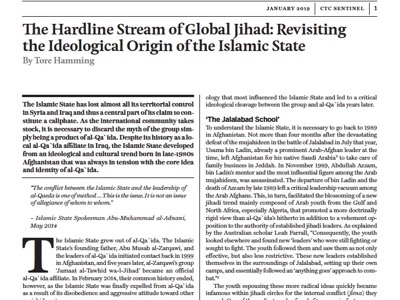
It was at this moment that the Combating Terrorism Centre of the military Academy of West Point published a historical study of the divergences between the Mujahedin during the war against the Soviets. This document noted that in 1989, during the retreat of the Red Army, and when Oussama Ben Laden had returned to Saudi Arabia, certain young members of the Muslim Brotherhood questioned the laxism of their senior officers. They created the « Jalalabad School », which was much more strict, and began to accuse various people of impiety and excommunicated them (takfir). This, they say, is the conflict that blew up again in 2014, provoking the split between Al-Qaïda and Daesh.
This flashback should not blind us to the fact that the Muslim Brotherhood continued to welcome not only the Taliban, but all Afghani resistants, until the assassination of Ahmed Chah Massoud (himself an ex-member of the Muslim Brotherhood), on 9 September 2001 (two days before the attacks of New York and the Pentagon). For two decades, Afghanistan became the training ground for jihadists from all over the world, particularly the combatants from the Russian Caucasus. Today the Taliban are much more careful with their choice of allies and their friends. It is true that today they control 60 % of the territory. They no longer base themselves on theological grounds, but on nationalist criteria.
JPEG - 33.9 kb
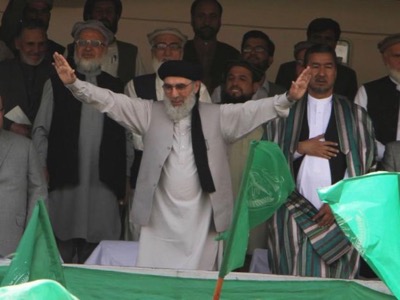
Brother Gulbuddin Hekmatyar is the war commander for Pakistan and Turkey in Afghanistan
During the war against the Soviets, the Muslim Brotherhood were mainly aligned with ex-Prime Minister Gulbuddin Hekmatyar, who was their representative in the country. On 22 September 2016, with the support of the Obama administration, he was awarded the pardon of the new Afghan state and was removed from the UN list of terrorists.
JPEG - 37.5 kb
The siege of the Taliban in Qatar
The arrival of Daesh in Afghanistan occurred at the time when the Trump administration had been trying - since July 2018 - to negotiate with the Taliban. Preliminary contacts took place in Qatar with ambassador Alice Wells, assistant to Mike Pompeo for Central Asia. The negotiations were headed by ambassador Zalmay Khalilzad in September and October, despite the anxiety of the Afghan government, which sent a representative but were not admitted. Khalilzad had fought alongside the Talibans, Pachtuns like himself, against the Soviets, before taking US citizenship. He was trained in neoconservatism and became ambassador to the UNO in 2007, when the Senate opposed the nomination of John Bolton.
JPEG - 34.2 kb
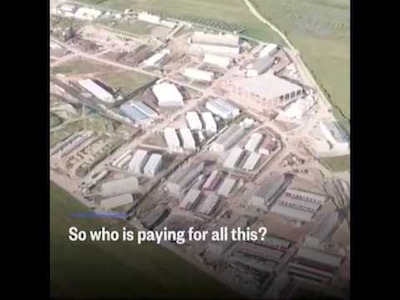
Built by Israël between 2013 and 2015 close to Tirana, the secret town of Manza is the military base for the People’s Mujahedin in Albania.

The People’s Mujaheddin

Last week, the head of the People’s Mujaheddin (MEK) of Iran, Maryam Radjavi, travelled to Kabul on an official visit, from Tirana, where she lives. She met specifically with the President of the National Security Council and ex-ambassador to the United States, Hamdullah Mohib. Within the next few days, she should be travelling to Herat, in the district of Shindand, to establish a military base for her organisation. According to the Pakistani newspaper Ummat, the Pentagon has already trained 2,000 of the People’s Mujahedin there, in October 2012.
Despite their apparent similarity in name, there is no connection between the Mujahedin (with one d) of the Muslim Brotherhood (who are Arabs and Sunnis) and the Mujaheddin (with two d’s) of the MEK (who are Persian and Chiites). The only objective link between the two groups is that they have both been used by the United States and both practise terrorism.
As from 2013, the MEK has been transferred from Iraq to Albania with the support of the United States. A small town has been built for them by Israëli companies. However, on 23 June 2014, Maryam Radjavi, in a long speech given before 80,000 members of the sect and 600 Western personalities, spoke of her satisfaction that Iraq had been conquered by Daesh. We should remember that this victory had been organised with the help of General Ezzat Ibrahim al-Douri, ex-right-hand man for President Saddam Hussein, and as such, protector of the People’s Mujahedin.
John Bolton’s links with the MEK date back to the Bush administration. They were strengthened by his presence - for a price of 40,000 dollars - during their annual meetings at Villepinte (France), in 2010 and 2017. Having become the National Security Advisor, he now unites the jihadists from Daesh and the loyal followers of Maryam Radjavi against their common objective.
The most immediate of the targets of this terrorist alliance should be Iran, with whom Afghanistan shares a long frontier, hard to defend.

Thierry MeyssanPolitical consultant, President-founder of the Réseau Voltaire (Voltaire Network). Latest work in French – Sous nos Yeux. Du 11-Septembre à Donald Trump(Right Before our Eyes. From 9/11 to Donald Trump).

Monday, November 19, 2018

MKO and the bankrupt US policy on Iran


The fact that a group as dubious as the MKO figures so prominently in the Trump administration’s policy on Iran demonstrates the bankruptcy of that policy, says Paul R. Pillar – a contributing editor at the National Interest and the author of “Why America Misunderstands the World”, in his article titled: “MKO and the Bankrupt US Policy on Iran”.
Among the many indicators of misdirection in the Donald Trump administration’s policy toward Iran, one of the clearest is the fondness for the cult-cum-terrorist group known as the MKO – and scoffed by all Iranians as ‘hypocrites’ for its treason against the Islamic Republic and armed collaboration with Saddam’s Ba’th minority regime during the 8-year imposed on Iran by the US.
Among this dubious group’s most prominent cheerleaders are the US national security advisor, John Bolton, and Donald Trump’s attorney, Rudy Giuliani, both having been featured speakers at its rallies. They and other shills for the MKO refer to the group as if it represented what it decidedly is not: an alternative to the current Iranian political system.
Journalist Arron Merat, an experienced Iran-watcher who formerly was the Economist’s Tehran correspondent, has just published a 6,600-word article about the MKO in the Guardian. The piece is well worth reading as it forms a richly informed and up-to-date portrait that leaves no doubt about the nature of the group and the ghastly inappropriateness of using the MKO in any way as a vehicle for US policy in the region.
The MKO originated as a student movement that opposed the Shah and spouted an ideology that weirdly allied with Marxism. Before the Islamic Revolution, its terrorist operations targeted businesses and it reportedly killed six American citizens in addition to its far more numerous Iranian victims.
The MKO tried to exploit the conditions in Iran after the Islamic Revolution, feigning support for the Islamic Republic, but practically opposing its policies. Among other things, following the Algiers Accord between Iran and the US, for the conditional release of the American spies caught red-handed at the so-called US embassy in Tehran when the revolutionary students took it over, the MKO opposed this deal. The group continued its terrorism, targeting both officials and ordinary citizens of Iran.
With the eight-year Iraqi War already underway, the MKO threw in its lot with Saddam. The Iraqi dictator gave the group weapons, cash, and a compound called Camp Ashraf in return for its continuing attacks inside Iran as well as helping Saddam suppress his own domestic opponents. Iranians understandably viewed this phase in the MKO’s history as an unforgivable act of treason, and whatever support the group previously had in Iran was erased.
Merat’s article provides details of the cult-like aspects of how the MKO has functioned, earlier at Camp Ashraf and more recently, after the group had to leave Iraq, at a compound in Albania. As cult leaders, the husband-and-wife duo of Massoud and Maryam Rajavi have resembled the likes of Jim Jones and Shoko Asahara. Families have been broken up, married couples told to divorce, and women threatened with punishment if they did not “marry” Massoud and endure his sexual abuse. (Massoud dropped out of sight after the U.S. invasion of Iraq, and it is not known whether he is dead or alive. Maryam continues as the public face of the group.) Stomach-turning details continue to emerge from the MKO’s current location in Albania, including stories of forced hysterectomies and would-be escapees subjected to solitary confinement. The former head of Albanian military intelligence says that MKO members live in the group’s current compound as “hostages” amid “extraordinary psychological violence and threats of murder.”
The MKO’s efforts over the past two decades to convey a benign public image completely at odds with this internal reality, and to pose as a force for democracy in Iran, have depended on buying the public endorsements of well-known public figures. This has required money—lots of it. Five-figure speaking fees have flowed freely. Public disclosure forms indicate Bolton received $40,000 for a single appearance at an MKO event in Paris last year, and Merat gives an estimate of $180,000 as the total that Bolton has received for his multiple appearances on behalf of the group.
In addition to the generous big-name fees, lobbying for the MKO has apparently included other well-financed techniques. The crowd at the Paris event this year, for example, was supplemented by bussing in young people from Eastern Europe who enjoyed a free weekend in Paris. The group used the same rent-a-crowd technique for a demonstration outside the US State Department when the MKO was ramping up its lobbying a few years ago to be delisted as a foreign terrorist organization. Some of the participants in that event were recruited at a homeless shelter in New York; they admitted knowing very little about the MKO but appreciated the free meals they were given for attending.
Where the money is coming from is still somewhat of a mystery. But some clues point to regional regimes that are hostile to Iran as the most likely source – especially Saudi Arabia and the UAE.
Two further observations flow from this surprisingly successful but wholly unjustified remaking of the MKO’s image. One concerns how some famous—and perhaps supposedly respectable people—evidently have been willing to prostitute themselves to get in on those fat speaking fees. A wide range of political figures have played the game, from Howard Dean on the left to Bolton and many others on the right. Some of the players may have had little more understanding of the MKO when they got involved than did the guys from the homeless shelter in New York.
Ed Rendell, a former Democratic governor of Pennsylvania, freely admitted that he knew little about the group when he accepted an invitation to speak at an event the MKO staged at a downtown Washington hotel. He then told his audience—in a demonstration of the self-sustaining nature of big-name endorsements—that the reputations of the other speakers at the same event persuaded him that it must be for a worthwhile cause.
Not everyone has succumbed to the monetary temptations. Tip your hat, for example, to Elliott Abrams, a card-carrying neoconservative who has had more than his share of misdirection in Middle East policy, for declining an invitation to speak at an MKO event. Abrams cited the fact that the group was still on the foreign terrorist organization list at the time, but the politically and morally inexcusable nature of advocating for such a group does not depend on such a formal list.
The other observation is that, while the shills have taken their fees to the bank, the fact that a group as dubious as the MKO figures so prominently in the administration’s policy on Iran demonstrates the bankruptcy of that policy. If the MKO is in the game, then we know the game is not about democracy, human rights, or doing right by ordinary Iranians. Bolton and at least some of the others who have touted the group are surely smart enough to realize that and to understand the true nature of the group. They appear to be less interested in democracy in Iran than in the capability for sabotage, destruction, and assassination in Iran—a capability that the MKO still has despite its claims to have forsaken violence.
The fact that a group as dubious as the Mujahedin-e Khalq figures so prominently in the Trump administration’s policy on Iran demonstrates the bankruptcy of that policy.
Fostering that capability may serve the objectives of regional regimes which do their own sabotage, destruction, and assassination aimed against Iran and welcome the augmentation of their capabilities for mayhem that the MKO offers. It increases instability and besmirches the reputation of the United States through associating itself with the MKO.

Thursday, September 27, 2018

5 Reasons Why Washington Was the Main Culprit in Ahvaz Terror Attack

5 Reasons Why Washington Was the Main Culprit in Ahvaz Terror Attack
TEHRAN (FNA)- On Sunday, September 23, Iranian President Hassan Rouhani couldn’t be more accurate when he said the United States is a "bully" that wants to create insecurity in the Islamic Republic, following an attack on a military parade that killed 26 people, including members of the country's Islamic Revolution Guards Corps.
Rouhani further accused the US-backed Persian Gulf Arab states of providing financial and military support for anti-government terrorist groups inside Iran.

This is not out of the ordinary. President Trump’s last year visit to Saudi Arabia, during which he loudly pushed for general hostility toward Iran, can’t help but also be noted for being followed so quickly by virtually unheard of terror attacks and unrest in Iran. On balance, the Trump administration isn't eyeing America's safety as much as a regime change:

1) Trump’s personal lawyer, Rudy Giuliani, while addressing a recent rally staged by the anti-Iran terrorist group of Mojahedin-e Khalgh Organization (MKO) in Paris, called for regime change in Tehran. MKO or MEK was once listed as a terrorist organization in the US and Europe and is still widely viewed as a death cult built around the personality of its leader, Maryam Rajavi. During the gathering, Giuliani said, “We are now realistically being able to see an end to the regime in Iran… which must be replaced by a democratic government which Rajavi represents. Next year I want to have this convention in Tehran”!
2) In May, Trump abrogated the 2015 international nuclear deal and ordered a campaign of intense economic pressure, threatening sanctions against any foreign company doing business with Iran and calling for an end to trade in Iranian oil by November. In the Paris convention, Giuliani said the recent wave of protests in Iran was being orchestrated from outside. “Those protests are not happening spontaneously,” Giuliani said. “They are happening because of many of our people in Albania [which hosts an MKO compound] and many of our people here and throughout the world.” “Our people” means the US and the MKO and other terrorist groups, which have no support in Iran and are widely hated for their use of violence and close links to Saudi-Israeli intelligence services.

3) The policy of the Trump administration is not officially to call for regime change, but top officials have often made that clear in public. Outlining his approach in May, Pompeo said it was up to the Iranian people to relieve the pressure on the country by changing their government. However, regime change is on the agenda, as it involves waging economic war against Iran and backing terror attacks within the country, like the one that was carried out in Ahvaz, for which the terrorist groups of ISIL and Al-Ahvazieh with links to the US and Saudi Arabia claimed responsibility.

4) The Trump camp itself is open to the dark arts. Trump has selected John Bolton as his national security adviser. Bolton’s appointment, along with the nomination of Iran deal critic Pompeo as secretary of state, helped to kill and bury the nuclear agreement and pave the way for confrontation with Iran. Bolton has spent the better part of a decade calling for the US to help overthrow the government in Tehran and hand power to the terrorist group of MKO. Also speaking at the Paris convention, Bolton said the Trump administration should embrace the MKO’s goal of immediate regime change in Iran and recognize the group as a “viable” alternative. “The outcome of the president’s policy review should be to determine that the Ayatollah Khomeini’s 1979 revolution will not last until its 40th birthday,” Bolton said. The 40th anniversary of the Iranian revolution will be on February 11, 2019.

5) The Trump administration views terror attacks and protests as the best avenue for regime change in Tehran without a US military intervention. To that end, Pompeo says the US is stepping up its propaganda broadcasts to Iran with help from Persian-language TV channels based in Europe and the US, and portrays the sanctions as targeting the government, even though the unjustified economic pressure ultimately touches Iranians of all walks of life.

Overall, the notion that Iranians are clamoring for the fall of the Islamic Republic and welcome American assistance in precipitating that fall is the same kind of “we will be greeted as liberators” nonsense the Bush administration believed in the lead-up to the illegal Iraq War in 2003. Iranians want a better life, but the Syria-style collapse of their economy, society, and state is surely not the kind of change they have in mind. After all, we now know that their guild-related protests discouraged the US since their numbers never went beyond a few thousand, which never lasted more than a week, despite what had been promised by the US and its puppets. Picking up the MKO and the son of the deposed Shah has been the best service the US could render to the government in Iran as it encouraged even those few thousands to go back home after they came to see the truth.

In addition, the fact that Saudi Arabia, the UAE, and of course Israel are influencing the Trump administration’s anti-Iran strategy is further evidence that Washington didn’t act alone in supporting the terrorists that carried out the September 22 attack in Ahvaz. The aim of their plan is not for Iran to pursue internal reform and external dialogue as Trump would like to claim, but for the Islamic Republic government to collapse entirely so that it can no longer stop their regime-change fantasies and undermine their illicit interests and designs in the region. Little wonder they hardly cared when the Southwestern city of Ahvaz was violently attacked.

Tuesday, July 24, 2018

Who’s Terrorism? The Politics of Terror and Those Terrorists We Label Friends

By Catherine Shakdam


Although ‘terrorism’ has become a term our media, state officials, and politicians have grown accustomed to throw around – an expression, more often than not, of their respective world views, the word has yet to be defined objectively, and more to the point under terms the international community as a whole could get behind.
Terrorism, because of its intrinsec subjective nature sits today a euphemism for political coercion – the covert expression of political thoughts, powers seek to impose through violence and bloodshed while arguing impunity. A political label used to single out those deemed unfit, unworthy, or altogether unwelcomed, the word terrorism has been often grossly misused to reflect opinions as opposed to facts.
Just as beauty lies in the eye of the beholder, terrorism is tied up to one’s subjectivity and political interests.
Admitting to such impartiality in judging what constitutes terrorism, or rather, what makes a group a terrorist entity, does not take away from its nature. Terrorism exists outside moral and ethic. It stands in a space of rationalised violence and crimes to serve hegemonic ambitions. Whomever wields it, stands indeed guilty – particularly those hands which, from behind convenient curtains play patrons to Terror.
The real issue lies not so much in the existence of terrorism – like war, it is a reality the world has had to contend with for as long as memory stretches, but in our inability to recognise Terror for what it is at its core today: a global political tool of oppression, a mean to distort truths, and a weapon used to malign designated enemies by rallying public opinion against them.
Professor Jonathan Matusitz from the Nicholson School of Communication in the United States defines terrorism as follow:
  • It serves ideological or social objectives.
  • It can be committed by governments, non-state actors, or undercover personnel serving on the behalf of their respective governments.
  • It reaches more than the immediate target victims and is also directed at targets consisting of a larger spectrum of society.
  • It is both mala prohibita (i.e., crime that is made illegal by legislation) and mala in se (i.e., crime that is inherently immoral or wrong).
There are many reasons as to why there is no universal consensus regarding the definition of terrorism. Angus Martyn in a briefing paper for the Australian Parliament has stated that “The international community has never succeeded in developing an accepted comprehensive definition of terrorism. During the 1970s and 1980s, the United Nations attempts to define the term foundered mainly due to differences of opinion between various members about the use of violence in the context of conflicts over national liberation and self-determination.”
These divergences have made it impossible to conclude a Comprehensive Convention on International Terrorism that incorporates a single, all-encompassing, legally binding, criminal law definition of terrorism.
This of course has not hindered political powers from actively and vehemently using the term to justify their aggression against certain groups or nations, and of course rationalise their ideology under the premise that they seek to ‘protect’ communities from the ruthlessness of terrorism.
If the word terrorism lacks consensus in its definition, all agree that it remains a violent expression of one’s socio-political or religious thought. One may consider adding: “against the legitimate expression of a nation’s sovereignty, or a group/community’s independence of thought and/or religion.”
While most decry terrorism, few have had the courage to denounce its real expressions – self-interests, and political opportunism have vastly contributed to such reality. Terrorism for the most part has become self-serving since directed to serve geopolitical ambitions, as opposed to denouncing the crimes it has sowed, and identifying its architects.
The case of the MKO serves a perfect example of such manipulation.
Founded in 1965 as a left-wing Muslim group the Mujahideen-e Khalq, also known as the MKO, MEK or PMOI, the group initially landed its support to Iran’s Islamic revolutionary movement to see the regime of the Shah topple. While the group initially endorsed Ayatollah Ruhollah Khomeini’s rule in 1979, it soon retracted after its attempt to grab power was vexed.
The nature of the group would then become defined by its willingness to shed blood – to such an extent that its very existence has been tied to its ability to wield violence as a justifiable political argument.
Having admitted to countless assassinations and other acts of violence against Iran and Iranians, the MKO’s propensity to wield Terror to advance its political agenda has been not only excused, but often rationalised on account its terrorism targets Iran, and Iran’s system of governance.
Such determination to see Iran fall has put the MKO on par with Western powers.
In an article published in CounterPunch, Robert Fantina summarises the paradox of world politics in its approach of terrorism most eloquently. He writes: “The MKO was once listed by the U.S. as a terrorist organization, but that designation was removed in 2012. This was a puzzling move when looked at on the surface. According to one report, by early 2016, “…out of the nearly 17,000 Iranians killed in terrorist assaults since the victory of Iran’s 1979 Islamic Revolution, about 12,000 had fallen victim to MKO’s terrorist attacks.” Some estimates put that number, and the number of MKO victims, much higher. Should an organization that has killed this many people in one country through terrorist activities not be designated a terrorist organization?”
Protected, funded, and hailed a ‘reasonable’ alternative to Iran’s Islamic Republic, the MKO sits comfortably in Paris, the French capital – a new ally to Western capitals’ hunger for regime change in those regions they seek control over.
The MKO is objectively a terrorist organisation. If anything, by the very tools it has used to exert pressure onto Iran’s sovereignty.
Regardless of what governments, and more to the point: western governments may think of Iran’s politics, one should remember that Iran, as an independent and sovereign nation is as much entitled to its views and fashion of governance than any other nation, and that as such, any and all attacks against its integrity fall within the definition of terrorism.
Acts of terrorism cannot exist in convenient political vacuums – we ought to be systematic in our condemnation and honest in our assessments.
The MKO has been used as a convenient platform to front revolting and criminal policies on account its target: Iran, has been declared fair game by the likes of the United States and its allies. In 2006, Saudi Arabia’s former intelligence chief spoke at a MKO conference, clearly signaling that the organisation had now powerful patrons and supporters to its cause.
report published by the RAND Corporation, clearly exposes Washington’s ‘complacency’ towards the MKO as it offered the terror group both financial and political protection while it remained in Iraq so that it could stage attacks against neighboring Iran.
The RAND report noted that from the early weeks of the 2003 invasion of Iraq until January 2009, US forces detained and provided security to MKO terrorists to prevent the Iraqi government from expelling them to Iran.
“Among many resulting complications, this policy conundrum has made the United States vulnerable to charges of hypocrisy in the war on terrorism,” the report read.
It also noted that Washington accepted the MKO’s request for a ceasefire and designated its members as civilian “protected persons” under the terms of the Fourth Geneva Convention.
“It has proven to be extremely controversial because it appeared that the United States selectively chose to apply the Geneva Conventions to a designated terrorist organization and, further, to grant it a special status,” it added.
Terrorism we may learn remains for it has become a convenient asymmetrical weapon of war, more so in the hands of those who claim to stand for Democracy and Freedom.
Catherine Shakdam is the Director of Programs of the Shafaqna Institute for Middle Eastern Studies and a political analyst specializing in radical movements, exclusively for the online magazine “New Eastern Outlook”.