Showing posts with label Mujahedin-e Khalq. Show all posts

Wednesday, December 18, 2019

CIA-Mossad backed MEK resembles ISIS in many ways: analyst

Mohammad Reza Pahlavi, and the leader of the MEK, Masoud Rajavi, formed cults of personality around themselves. Many people are attracted to cults, some of whom are willing to engage in deadly violence for the sake of being a member. One can see this type of behavior among members of Daesh.
Yuram Abdullah Weiler is a former engineer educated in mathematics turned writer and political critic who has written over 130 articles on Islam, social justice, economics, and politics focusing mainly on the Middle East and U.S. policies.  His works have been largley published across the globe. In addition, he has frequently appeared as a guest commentator on Press TV, Al Etejah, and Alalam. A dissenting voice from the “Belly of the Beast”, he currently lives in Las Cruces, New Mexico, USA. In an exclusive interview with Khamenei.ir, Mr. Abdullah elaborates on the U.S.- West support for the notorious MEK terrorist organization. The following is the full text of the interview:
The MEK terrorists assassinated the Iranian President and PM of the time - Muhammad Ali Rajai and Javad Bahonar - on August 30th; how do you evaluate the West and the U.S.’s support effective in the execution of such crimes?

The United States has a long history of state-sponsored terrorism against Iran beginning in 1953 with the CIA-engineered coup of the legitimate government of Iran by covert action.  This was followed by 25 years of rule by the U.S.-supported dictator, Mohammed Reza Pahlavi, whose brutal security force, the SAVAK, was responsible for the death and torture of thousands of Iranians.  U.S. policy since the time of the victory of the Islamic Revolution in February 1979 has been one of recapturing the country that former President Jimmy Carter “lost” on his watch. 

U.S. state-sponsored terrorism directed against Iran has included support of terrorist organizations such as Jundullah based in Pakistan, assassination of senior Iranian nuclear scientists by agents of the terrorist organization Mujahedin-e Khalq (also known by acronyms MeK, MKO, PMOI), a draconian regimen of economic sanctions, and launching proxy wars against Iranian allies such as Syria.  Just as the U.S. used the Afghan mujahedin to fight a proxy war against the Soviet Union in Afghanistan, the U.S. is now using the MKO in conjunction with Mossad to fight a covert war against the government of the Islamic Republic of Iran.  

The relationship of the U.S. and the MKO certainly dates back to the Islamic Revolution, but prior to 1975, when the MKO split into Islamic and Marxist factions and was under severe repression from the shah, it is doubtful that the organization was receiving any support from Washington.  However, there is evidence that the CIA was attempting to infiltrate the MKO by recruiting the first president of Iran, Abol Hassan Bani Sadr, while he was still in Paris in January 1979 when CIA agent Vernon Cassin offered him $5,000 a month to act as a “consultant” for a U.S. company. 

What is certain is that MKO leader Masoud Rajavi, along with twenty members of his organization, paid a visit to Ayatollah Hussein Ali Montazeri on 25 October 1978 in Evin Prison seeking a leading role for the MKO in the post-revolutionary government.  Rajavi explicitly told Montazeri to pass a message to Imam Khomeini in Paris that the MKO would be the only group capable of administering Iran.  Suspiciously enough, on 30 October, Montazeri was released and was “debriefed” by SAVAK chief general Nasser Moqaddam.  It is certainly possible that this was an initial vetting of Rajavi and the MKO by Washington for being an acceptable “Iranian opposition.”

In the days following the 15 June 1981 impeachment of Abol Hassan Bani Sadr, the MKO called for massive demonstrations against the nascent Islamic government of Iran compelling security officials to initiate a crackdown on the group. On June 28, the MKO launched a series of lethal terrorist attacks in an attempt to topple the government beginning with the bombing of the headquarters of the Islamic Republic Party during a meeting of party leaders, killing Ayatollah Mohammed Beheshti along with four cabinet ministers, twenty-seven members of the Majlis and several other government officials for a total of 72 fatalities.   On August 30 just after 2:30 p.m., another bomb planted by an MKO operative, most likely Masoud Kashmiri, detonated killing President Mohammed Ali Rajai and Prime Minister Mohammad Javad Bahonar.

In the aftermath of the attempted overthrow of the government in June 1981 by the MKO that had Bani Sadr’s support, he and MKO leader Masoud Rajavi, whose second wife was Bani Sadr’s daughter, along with other leaders of the organization, fled Iran for Paris on July 29 where they established the National Council of Resistance (NCR). After being evicted from France in 1986, Rajavi relocated the MKO to Iraq, where, receiving asylum and financial support from Iraqi dictator Saddam, he formed the National Liberation Army (NLA), the military wing of the MKO, with himself as commander in chief.  The NLA used Iraq as a base to launch multiple attacks across the border into Iran. In June and July 1988, the NLA participated in a joint invasion into Iran with Iraqi forces, which used chemical weapons against Iranians. 

By 1988 during the Sacred Defense, the MKO had become a U.S. asset as evidenced by National Council of Resistance of Iran (NCRI) mouthpiece Alireza Jafarzadeh’s admission that, by that time, the MKO possessed hundreds of millions of dollars’ worth of tanks, armored personnel carriers and field guns.   The claim that such a huge cache of heavy weaponry was acquired from cross-border raids into Iran simply does not ring true.  Other evidence of U.S. involvement in the 30 August bombing can be gleaned from the fact that Bani Sadr and Rajavi were whisked out of Iran in a Boeing 707 military tanker piloted by Colonel Behzad Moezzi, who was in the cockpit of the shah’s plane when he fled from Iran to Aswan, Egypt on 16 January 1979.

Since then, the U.S. has even trained members of the MKO at the U.S. Department of Energy Nevada Security Site under the auspices of the Joint Operations Special Command between 2005 and 2008.  Additionally, senior U.S. officials have confirmed that the MKO, working through the Zionist spy organization, Mossad, has been responsible for carrying out the assassinations since 2007 of five top Iranian scientists: Mostafa Ahamdi Roshan on Jan. 11, 2012; Darioush Rezaei-Nejad on July 23, 2011; Majid Shahriari on November 29, 2010; Massoud Ali-Mohammadi on January 12, 2010; and, Ardeshir Hosseinpour on January 15, 2007.


Why did MKO terrorists kill both officials as well as ordinary Iranian citizens?

During that reign of terror in 1981, the MKO targeted Friday prayer leaders, including those in Tabriz, Kerman, Shiraz and Yazd, as well as minor government officials, members of the Revolutionary Guard, prison wardens and even ordinary citizens.  Such random violence fits well with the definition of terrorism used by the United States Department of Defense (DoD):
“The calculated use of unlawful violence or threat of unlawful violence to inculcate fear; intended to coerce or to intimidate governments or societies in the pursuit of goals that are generally political, religious, or ideological.”

While I am by no means qualified to voice an opinion on the psychology of terrorism, I would point out that the terrorist engages in violent activities under an assumption that this will cause a political change.  However—and I believe the MKO is a good example of this—political change can, in turn, precipitate terrorism.  While MKO members apparently did contribute to the victory of the Islamic Revolution in Iran, nevertheless following the victory of the Islamic Revolution, because of unfulfilled aspirations of leadership in the new government, ideological disagreement with the direction set by Imam Khomeini and other factors, the MKO mutated into a terrorist organization, and turned viciously against the fledgling Islamic government voted upon by the people of Iran.


Shahid Rajai was severely tortured on the hands of SAVAK and then martyred by MKO in a bomb explosion. What is the common enmity of the thugs of the shah and MKO with Iranian revolutionaries like Shahid Rajai?

To discuss the enmity, one would have to delve into the psychological factors motivating individuals to join with others and resort to extreme violence, whether deemed as terrorist or state-mandated, in order to achieve political goals.  To study such factors scientifically remains a near impossibility, since few legitimate researchers have direct access to terrorist groups over long periods of time to gather data for analysis.  Certainly there is no single causative factor, such as mental illness or low childhood self-esteem that causes the embrace of enmity.

Beyond the psychological factors, the thugs of the shah and the MKO appear to have shared a common goal of suppressing the desire of the Iranian people to have an Islamic form of governance.  The common denominator seems to be the use of extreme violence for the imposition of a political goal.  In the case of the shah, it was the perpetuation of his U.S.-supported regime, and in the case of the MKO, it was instituting an authoritarian Marxist regime.

From another aspect, one can say that the former shah, Mohammad Reza, and the leader of the MKO, Masoud Rajavi, both formed cults of personality around themselves.    Both used media to surround themselves with an idealized, mystical aura, and both pursued and promoted radical ideologies:  the shah with his “White Revolution” of westernization and marginalization of Islam, and Rajavi, with his obsession with toppling the legitimate Islamic government of Iran and assuming the leadership role himself.  Many people are attracted to cults, some of whom are willing to engage in deadly violence for the sake of being a member.  One can see this type of behavior among members of  Daesh.


How do you analyze all the fuss MKO is making these days by meeting with the dictators of certain countries?

On 9 July 2016, former Saudi intelligence chief and former Saudi ambassador to Britain and the United States Prince Turki al-Faisal Al Saud spoke for 30 minutes before a crowd in Paris, France gathered for the annual conference of the MKO.  This is not totally surprising, for there has been a long list of U.S. politicians, including Newt Gingrich, the former speaker of the House, Bill Richardson, a former New Mexico governor and U.N. ambassador under Bill Clinton, and former Vermont governor Howard Dean, have spoken to and received handsome fees from the MKO.  These fees, in the neighborhood of $25,000 each, may have been funded by Saudi Arabia, so covert support of the MKO may not be a recent development.

In contrast, al-Faisal’s overtly inflammatory rhetoric against Ayatollah Khomeini however was indeed shocking.  Crudely stating that Iran was infected with a “Khomeini cancer,” al-Faisal, openly called for regime change by declaring, “I, too, want the downfall of the regime.”  The rhetoric directly threatening the Islamic Republic of Iran may have been for its support of the legitimate government in Syria, Lebanese Hezbollah, and for its support of Houthi resistance fighters in Yemen.  At a minimum, al-Faisal’s announcement certainly chills any further incentive for Tehran to deice diplomatic relations with Riyadh.

The U.S. the Israeli entity and the Saudis appear to have convergent interests in destabilizing Iran with the ultimate goal of toppling the Islamic government and installing a pro-western client regime.  Certainly U.S. and Saudi support for terrorist organizations to fight their proxy wars is nothing new and the symbiotic relationship dates back to the 1980s, when Washington and Riyadh partnered to fund the Afghan mujahedin, which later morphed into the terrorist group al-Qa’idah.

As far as Mahmoud Abbas’ meeting with Maryam Razavi three weeks after al-Faisal’s disclosure, it is not clear what the aging American puppet hoped to accomplish.  As a largely irrelevant figure in the fight for the rights of the oppressed Palestinian people, Abbas may have simply desired to show himself as associating with an opponent of Iran, which is a requirement to remain in the good graces of the U.S. and the Israeli entity.  On the other hand, the Abbas-MKO meeting may signal the reestablishment of a Fatah-MKO coalition, which fought together against Iran during the 1980-1988 Iraq-imposed (and U.S.-backed) war.

Monday, July 22, 2019

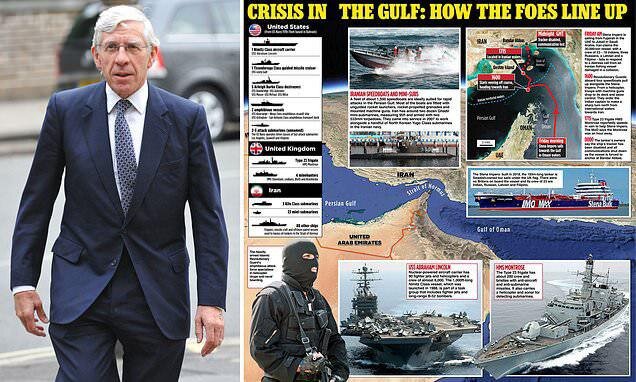
Jack Straw says Iranians have good cause to call Britain ‘cunning, colonial fox’

Jack Straw, the former British foreign secretary, has written an article saying that Iranians have “good cause” to be “resentful” against Britain and call Britons the “cunning, colonial fox”.
In his article published in the Daily Mail on Sunday, Straw gives reasons why the Iranians will never trust Britons.
Following is the text of the article:
In October 2015, my wife Alice and I were visiting Iran on holiday with friends. Rarely seen by Western tourists, the country offers both dramatic scenery and wonderful cultural sites. We’d hired an interpreter and a driver and by the sixth day of our trip had visited the busy capital Tehran and Yazd, a desert city in the south.
Then, on our way to Shiraz, the heart of the country’s rich Persian culture, we stopped halfway to see a celebrated 4,000-year-old cypress tree, the Sarv-e Abarkuh.
That’s when we met the Basij, the volunteer militia attached to Iran’s Revolutionary Guard Corps (IRGC). The black-clad young men were lying in wait for us, ready with a two-page petition.
The whole of the West – America, France, the UK and Russia- backed Iraq in the 1980s.
‘Although it is in our tradition as Iranians to welcome guests, this “welcome” gesture does not apply to you!’ it began. ‘The people of Iran do not have good memories about you and the British regime… ‘You know better than us about the crimes and the ample plots that were orchestrated by your country against the people of this land.’
The document then set out in detail all the terrible things Britain had done to Iran, going back to the 1857 Treaty of Paris and the Anglo-Persian war.
This encounter was the start of a sustained campaign to make our trip as difficult as possible. At one point, we feared we would be kidnapped.
It turned out the men knew our itinerary from the IRGC, which had bugged our vehicle, intercepted our interpreter’s mobile phone and bribed our driver. They knew exactly who I was. So serious was the risk judged to be, in fact, that we were given police protection – not against criminals or terrorists, but against the Basij and other agencies of the Iranian state. In the end, the hardliners won and we felt obliged leave four days early.
Yet I still have huge affection for the Iranian people. I’ve been back since and have now written a book about why Iran so distrusts the West and Britain in particular.
If we are to solve the current Gulf crisis in the Strait of Hormuz, then it is crucial to understand our shared history and why Iran today behaves as it does.
The book is called The English Job, for example, because of a ubiquitous phrase in Persian – ‘it’s always an English job’ – which Iranians use when things go wrong.
They have good cause to be resentful against the ‘cunning, colonial fox’, as they describe us. Iran never was a British colony but that didn’t stop us exploiting the country for treasure and power.
Bolton calculates that by strangling Iran through sanctions, Iran will collapse and the government will come begging for a deal.
At least our colonies got roads, sewers and railways. Quite the opposite was the case in Iran. Britain and Russia, after competing with each other for control of the country, eventually struck a deal which stopped all railway building right up until the 1920s.
We bribed and cajoled Iran to do our will throughout the 19th Century and early part of the 20th Century and, if that didn’t work, we landed troops.
We invaded Iran in the First World War, helping cause a catastrophic famine in the process. In the Second World War, with the Russians, we jointly occupied the country for five years from 1941-6.
We deposed a Shah in 1941 and installed his weaker, more compliant son.
When the Iranian parliament waged an eight-year struggle to nationalise BP’s huge refinery and vast network of oil wells, MI6 and the CIA responded by organising a successful coup against the elected prime minister, Mohammad Mossadegh, in August 1953.
We helped prop up the Shah in the mid and late 1970s, even when it was obvious that he was losing popular support. Catastrophically so, in fact. In 1979, Mohammad Reza Pahlavi was overthrown in a revolution led by Ayatollah Khomeini and that, in turn, led directly to the start of the Islamic Republic of Iran.
But the worst was to come in 1980, when Iraq’s newly appointed president, Saddam Hussein, decided, without any justification, to invade Iran. Millions on both sides lost their lives in the bloody war that followed.
The whole of the West – America, France, the UK and Russia – backed Iraq (with only Israel, improbably, supporting Iran). For eight years, Iran was effectively alone. It managed to avoid abject defeat, but this searing experience has defined everything that has happened since and shaped the attitude of those in power today.
Iran’s Supreme Leader since 1989, Ali Khamenei, never ceases to preach that the West cannot be trusted. In 1980, he came close to being assassinated by a renegade Iranian terrorist group, the Mujahedin-e Khalq – once supported by Saddam and now by John Bolton, President Trump’s national security adviser – and lost the use of his right arm.
The single most powerful military figure in Iran is Major-General Qasem Soleimani, the man behind the Revolutionary Guards’ seizure of the British-flagged tanker. His world view, too, was forged in the crucible of the war with Saddam.
It’s Khamenei and Soleimani who now call the shots, both literally and figuratively. Iran, in their view, is fighting for its very survival.
Bolton calculates that by strangling Iran through sanctions, the Islamic revolutionary regime will collapse and the government, led by President Rouhani, will come begging for a deal.
This approach won’t work. It is based upon a complete misunderstanding of the Iranian psyche. Already, American pressure has strengthened hardliners… and has weakened moderates…. An often discontented population has been unified. After two centuries of humiliation, what Iran seeks above all is respect and recognition.
As I know, having been involved for three years in negotiating the first phase of nuclear talks with Iran (2003-6), if Iran is shown that respect, a deal is possible.
Without that, the cat and mouse game in the Gulf and continued instability in the wider Middle East will continue.
We may not like the way Iran is behaving but comprehending why they do so could prove critical.

Monday, November 19, 2018

MKO and the bankrupt US policy on Iran


The fact that a group as dubious as the MKO figures so prominently in the Trump administration’s policy on Iran demonstrates the bankruptcy of that policy, says Paul R. Pillar – a contributing editor at the National Interest and the author of “Why America Misunderstands the World”, in his article titled: “MKO and the Bankrupt US Policy on Iran”.
Among the many indicators of misdirection in the Donald Trump administration’s policy toward Iran, one of the clearest is the fondness for the cult-cum-terrorist group known as the MKO – and scoffed by all Iranians as ‘hypocrites’ for its treason against the Islamic Republic and armed collaboration with Saddam’s Ba’th minority regime during the 8-year imposed on Iran by the US.
Among this dubious group’s most prominent cheerleaders are the US national security advisor, John Bolton, and Donald Trump’s attorney, Rudy Giuliani, both having been featured speakers at its rallies. They and other shills for the MKO refer to the group as if it represented what it decidedly is not: an alternative to the current Iranian political system.
Journalist Arron Merat, an experienced Iran-watcher who formerly was the Economist’s Tehran correspondent, has just published a 6,600-word article about the MKO in the Guardian. The piece is well worth reading as it forms a richly informed and up-to-date portrait that leaves no doubt about the nature of the group and the ghastly inappropriateness of using the MKO in any way as a vehicle for US policy in the region.
The MKO originated as a student movement that opposed the Shah and spouted an ideology that weirdly allied with Marxism. Before the Islamic Revolution, its terrorist operations targeted businesses and it reportedly killed six American citizens in addition to its far more numerous Iranian victims.
The MKO tried to exploit the conditions in Iran after the Islamic Revolution, feigning support for the Islamic Republic, but practically opposing its policies. Among other things, following the Algiers Accord between Iran and the US, for the conditional release of the American spies caught red-handed at the so-called US embassy in Tehran when the revolutionary students took it over, the MKO opposed this deal. The group continued its terrorism, targeting both officials and ordinary citizens of Iran.
With the eight-year Iraqi War already underway, the MKO threw in its lot with Saddam. The Iraqi dictator gave the group weapons, cash, and a compound called Camp Ashraf in return for its continuing attacks inside Iran as well as helping Saddam suppress his own domestic opponents. Iranians understandably viewed this phase in the MKO’s history as an unforgivable act of treason, and whatever support the group previously had in Iran was erased.
Merat’s article provides details of the cult-like aspects of how the MKO has functioned, earlier at Camp Ashraf and more recently, after the group had to leave Iraq, at a compound in Albania. As cult leaders, the husband-and-wife duo of Massoud and Maryam Rajavi have resembled the likes of Jim Jones and Shoko Asahara. Families have been broken up, married couples told to divorce, and women threatened with punishment if they did not “marry” Massoud and endure his sexual abuse. (Massoud dropped out of sight after the U.S. invasion of Iraq, and it is not known whether he is dead or alive. Maryam continues as the public face of the group.) Stomach-turning details continue to emerge from the MKO’s current location in Albania, including stories of forced hysterectomies and would-be escapees subjected to solitary confinement. The former head of Albanian military intelligence says that MKO members live in the group’s current compound as “hostages” amid “extraordinary psychological violence and threats of murder.”
The MKO’s efforts over the past two decades to convey a benign public image completely at odds with this internal reality, and to pose as a force for democracy in Iran, have depended on buying the public endorsements of well-known public figures. This has required money—lots of it. Five-figure speaking fees have flowed freely. Public disclosure forms indicate Bolton received $40,000 for a single appearance at an MKO event in Paris last year, and Merat gives an estimate of $180,000 as the total that Bolton has received for his multiple appearances on behalf of the group.
In addition to the generous big-name fees, lobbying for the MKO has apparently included other well-financed techniques. The crowd at the Paris event this year, for example, was supplemented by bussing in young people from Eastern Europe who enjoyed a free weekend in Paris. The group used the same rent-a-crowd technique for a demonstration outside the US State Department when the MKO was ramping up its lobbying a few years ago to be delisted as a foreign terrorist organization. Some of the participants in that event were recruited at a homeless shelter in New York; they admitted knowing very little about the MKO but appreciated the free meals they were given for attending.
Where the money is coming from is still somewhat of a mystery. But some clues point to regional regimes that are hostile to Iran as the most likely source – especially Saudi Arabia and the UAE.
Two further observations flow from this surprisingly successful but wholly unjustified remaking of the MKO’s image. One concerns how some famous—and perhaps supposedly respectable people—evidently have been willing to prostitute themselves to get in on those fat speaking fees. A wide range of political figures have played the game, from Howard Dean on the left to Bolton and many others on the right. Some of the players may have had little more understanding of the MKO when they got involved than did the guys from the homeless shelter in New York.
Ed Rendell, a former Democratic governor of Pennsylvania, freely admitted that he knew little about the group when he accepted an invitation to speak at an event the MKO staged at a downtown Washington hotel. He then told his audience—in a demonstration of the self-sustaining nature of big-name endorsements—that the reputations of the other speakers at the same event persuaded him that it must be for a worthwhile cause.
Not everyone has succumbed to the monetary temptations. Tip your hat, for example, to Elliott Abrams, a card-carrying neoconservative who has had more than his share of misdirection in Middle East policy, for declining an invitation to speak at an MKO event. Abrams cited the fact that the group was still on the foreign terrorist organization list at the time, but the politically and morally inexcusable nature of advocating for such a group does not depend on such a formal list.
The other observation is that, while the shills have taken their fees to the bank, the fact that a group as dubious as the MKO figures so prominently in the administration’s policy on Iran demonstrates the bankruptcy of that policy. If the MKO is in the game, then we know the game is not about democracy, human rights, or doing right by ordinary Iranians. Bolton and at least some of the others who have touted the group are surely smart enough to realize that and to understand the true nature of the group. They appear to be less interested in democracy in Iran than in the capability for sabotage, destruction, and assassination in Iran—a capability that the MKO still has despite its claims to have forsaken violence.
The fact that a group as dubious as the Mujahedin-e Khalq figures so prominently in the Trump administration’s policy on Iran demonstrates the bankruptcy of that policy.
Fostering that capability may serve the objectives of regional regimes which do their own sabotage, destruction, and assassination aimed against Iran and welcome the augmentation of their capabilities for mayhem that the MKO offers. It increases instability and besmirches the reputation of the United States through associating itself with the MKO.