Showing posts with label Paul R. Pillar. Show all posts

Monday, September 16, 2019

Stoking Middle East Conflicts Has Just Become More Damaging

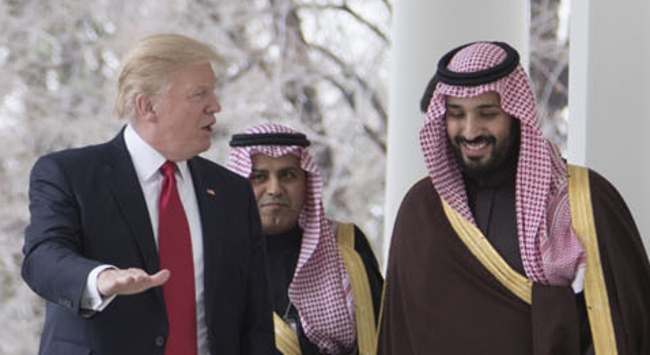
Donald Trump and Saudi Crown Prince Mohammad bin Salman
by Paul R. Pillar
The Abqaiq oil processing facility in Saudi Arabia has always been regarded as a vulnerable choke point in the world petroleum trade. Essential for separating harmful gas and stabilizing crude oil to make it safe to transport on ocean-going tankers, the facility can process some seven million barrels of crude per day, which represents around eight percent of total global oil production. It is thus no surprise that the recent attack on Abqaiq, which temporarily took about half of Saudi Arabia’s oil output off the market, resulted in a sharp upward spike in oil prices.
The Houthi movement in Yemen, which has become the de facto government in most of the northern and western parts of that country, claimed responsibility for the attack, which would mark the Houthis’ latest attempt to retaliate for the devastation that the Saudi air war has inflicted on Yemen. The Saudi assault, which has turned Yemen into the world’s foremost humanitarian disaster, has provided an endless succession of headlines about mass civilian casualties. One day it is the bombing of a hospital, another day it an attack on a wedding, and on other days the Saudi bombs have killed children fleeing the scene of an earlier attack or many innocent civilians of all ages in the streets of the capital city of Sanaa. The most recent mass casualty attack has been a Saudi strike on a prison, with at least 130 confirmed dead.
Although the Houthis’ capabilities to inflict damage at a distance have improved over time, the retaliatory attempts have been pinpricks compared to the enormous human suffering inflicted in the other direction. (There are no reports yet of casualties, if any, from the attack on Abqaiq.)
Given the course of the war in Yemen and its spillover effects, the United Arab Emirates did the right thing recently in deciding to extract itself from further involvement in the war. The U.S. Congress did the right thing in passing a bipartisan resolution that would have extracted the United States from further involvement in the Saudi air war. President Trump did the wrong thing in vetoing that resolution.
Within hours of the attack on Abqaiq, Secretary of State Mike Pompeo reacted the way he always reacts to any bit of trouble in the Middle East, which is to place complete, unequivocal blame on Iran. “There is no evidence the attacks came from Yemen,” he declared—an interesting statement in that it evidently counted neither the Houthis’ rapid claim of responsibility nor their ongoing efforts to retaliate against the Saudis as “evidence,” especially in light of Pompeo providing no evidence for his assertion about Iran.
The secretary of state’s rapid, preemptive declaration brings to mind earlier declarations by U.S. policymakers about an adversary’s activities, which became preludes to U.S. wars. During the Lyndon Johnson administration there was the quick declaration that North Vietnam had attacked U.S. warships in the open waters of the Gulf of Tonkin in August 1964. During the George W. Bush administration there was Vice President Richard Cheney’s declaration, in a speech in August 2002 that was the opening shot in the campaign to sell an offensive war against Iraq, that “there is no doubt that Saddam Hussein now has weapons of mass destruction.”
Each of those declarations was followed by great pressure and priority placed on government analysts to scarf up any evidence that could be found to support what the political stratum had already declared to be so. Given the proclivities and practices of the current administration, there is no doubt that something similar is happening inside the executive branch today.
If the administration wanted to make a legitimate argument that Iran may have perpetrated the attack on Abqaiq, it would not need to rely on questionable interpretations of overhead imagery or whatever other material it is going to make public. It could—but won’t—point to Iran’s motives and intentions in the face of the incentives that the United States has created.
Iran does not have, as Pompeo might like us to believe, some self-generated urge, wired into its DNA, to attack other countries’ oil industries. The only earlier time when the Gulf Arab states’ oil infrastructure became a target for Iran was during the highly destructive Iran-Iraq War in the 1980s. Iraq started the war, Iraq attacked Iran’s oil facilities, and the Gulf Arab states supported Iraq’s war effort. So naturally Iran tried to strike back, and the result was the “tanker war” in the Persian Gulf. At all other times before the last two years, Iran has had strong reason not to play violent games with anyone’s oil infrastructure, lest such a development result in violent backlash that hurts its own oil industry, which has been so important to Iran’s economy.
All that changed last year when the Trump administration totally reneged on U.S. obligations under the Joint Comprehensive Plan of Action, the agreement that restricted Iran’s nuclear program—despite Iran living up to its own stringent obligations under the agreement—and began a “maximum pressure” campaign that has become unrestricted economic warfare against Iran. Iran’s demonstrated its commitment to the agreement by sticking to its obligations for another year despite U.S. noncompliance. But earlier this year Iran’s patience ran out, especially when Trump ended the last of the waivers for countries that were still importing Iranian oil and declared its goal of reducing Iranian oil sales to zero. 
Pompeo asserted in his tweet that “Iran has now launched an unprecedented attack on the world’s energy supply.” No, it would not be unprecedented. For the last year and a half, the United States has been attacking, through economic and political pressure, the part of the world’s energy supply that comes from Iran. Exactly what that means in terms of numbers is uncertain, but for comparison, Iranian oil production reached five million barrels per day during the reign of the shah and was not far below four million barrels per day during most of the nineties and the first decade of the twenty-first century. The U.S. policy aims to keep that oil off the market indefinitely. Initial estimates of the impact of the Abqaiq attack are an interruption of about five million barrels per day, which, depending on the pace of repairs, might be partially restored within days and completely restored within a few weeks.
Iranian leaders have been explicit in warning that if Iran could not export its oil, then other Persian Gulf producers would not be able to either. Was anyone in the Trump administration listening?
To borrow another formulation from Pompeo’s tweet, there is no evidence that in the absence of the administration’s economic warfare against Iran, Iran would do anything like attack the Abqaiq facility or have any incentive to conduct such an attack. If Iran did do the attack, it was a direct and unsurprising result of the administration’s policy of unrelenting hostility and of inflicting economic pain with no apparent end.
Stoking conflicts, through either economic warfare or facilitating aerial bombardment, may seem like a viable policy if one ignores the other side striking back. But neither the Houthis nor the Iranians were ever going to roll over and play dead. Add additional damage to oil infrastructure and energy supplies to all the other damage that the administration’s failed maximum pressure campaign, and its support for Saudi misadventure, have caused. The only way out of the mess is to back off the campaign enough to make diplomacy possible, a path in which President Trump, to his credit, has shown interest. It still is the only way out, notwithstanding the setback to that possibility the incident at Abqaiq represents.

Sunday, August 04, 2019

Paul Pillar: UAE Recognized Failure of Military Intervention in Yemen

TEHRAN - Paul R. Pillar, a retired CIA officer, says the UAE has come to recognize that its military cooperation with the Saudis in war on Yemen has failed to make any achievement.
Speaking in an exclusive interview with FNA, Pillar, who is now a nonresident senior fellow at Georgetown University's Center for Security Studies, said, “There was no sign that the Houthis were being militarily defeated.”
Below is the full text of the interview:
Q: Why has the UAE decided to retreat from Yemen? Does this withdrawal mean the Emirates defeat and failure?
A: Quite simply, the UAE recognized that the military intervention in Yemen was not accomplishing anything. There was no sign that the Houthis were being militarily defeated. The wars costs were adding up without comparable results. The Emiratis also no doubt took notice of how the Saudi-led war in Yemen was coming under increasing criticism in the United States. Insofar as Iran, as a backer of the Houthis, is as another factor in the war, the UAE move probably also reflects a judgment that constantly increasing tension with Iran is in no one's interests.
Q: Saudi Arabia and the United Arab Emirates have started developing differences over Yemen. What do you think is their most important difference?
A: There are several differences in how the two allies were conducting the war and relating to factions inside Yemen. The Saudis were operating mostly in the air, while the Emiratis had more of a presence on the ground. The UAE has been more closely allied with Southern secessionist elements than the Saudis ever were. But probably the most important difference is that the war is closely identified with Saudi leader Mohammed bin Salman as his personal project, in a way that it never was identified with leaders of the UAE.
Q: Does the UAE retreat from Yemen mean neglecting Saudi Arabia and its agenda?
A: There will still be an alliance between Saudi Arabia and the UAE.  Mohammed bin Salman has close relations with UAE leader Mohammed bin Zayed. Expect to see some continuing differences in policy emphasis, however, including in dealings with Iran. Saudi Arabia will be more of an anti-Iranian hardliner than the UAE.
Q: Why does Saudi Arabia insist on continuing the war on Yemen despite its failure in this war of attrition?
A: Mohammed bin Salman cannot just pull out of Yemen as the UAE is doing without suffering a considerable loss of face, due to how much he is personally identified with the war. He will look more than before, however, for some sort of negotiated settlement that would allow Saudi Arabia to get out. 

Friday, July 19, 2019

Drawing Down Diplomacy In Iraq

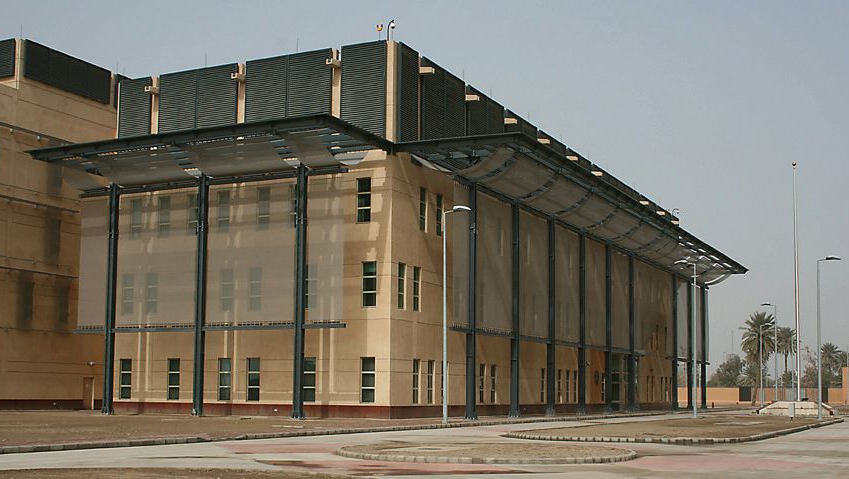
Part of the U.S. embassy compound in Baghdad (State Department via Wikimedia Commons)
Earlier this year the Trump administration, while stoking an atmosphere of crisis with Iran, withdrew “non-emergency” personnel from the U.S. embassy in Baghdad and elsewhere in Iraq. It is not clear what specific development, if any, triggered this move. Insofar as the administration was contemplating a military attack on Iran, and given the certainty that in response to any such attack Iran would strike back at U.S. interests, it may have been prudent to evacuate Americans from the neighboring state of Iraq. But skepticism is appropriate regarding this White House’s interpretation of security hazards in that part of the world. During violent disturbances last September in the southern Iraqi city of Basra, some mortar rounds striking in the neighborhood of the U.S. consulate were enough for National Security Advisor John Bolton to tell the Pentagon to draw up plans to attack Iran. The consulate was unharmed—the shells fell harmlessly in a vacant lot. It was the Iranian consulate in Basra that was set afire during the same disturbances.
Now it appears that the drawdown of U.S. diplomatic personnel in Iraq has in effect become permanent. To the extent the original evacuation was an adjunct to the administration’s saber-rattling against Iran, this latest development is not surprising. To return the evacuated diplomats back to Baghdad would mess up the messaging. It would be taken as a sign that tensions had eased even though the administration’s preferred theme continues to be “maximum pressure” against Iran, saber-rattling and all. This situation is one more respect in which the administration’s Iran policy has pushed it into an unproductive cul-de-sac.
Extending the evacuation means wasting the talents of hastily relocated U.S. diplomats. It means wasting much of that big embassy compound that the United States constructed after its war of choice in Iraq. Most obviously, it means some U.S. business in Iraq will either not get done or not be done as well as it otherwise would have been. 
Amid a fluid political and economic situation in an important Arab state, there is still much business for the U.S. government to do. If one listens to the Trump administration itself, part of that business is to counter Iranian influence in Iraq. Operating an embassy with reduced staff is not an effective way to do that.
This situation is yet another of the many consequences of launching the war in 2003 with little thought to what would come after Saddam Hussein, beyond impossibly rosy expectations that we would have had a peaceful and liberal democratic Zurich-on-the-Tigris long before now. Much of what rocks Iraq today are the aftershocks of that U.S. invasion. These include—among many other things inside and outside Iraq—those disturbances in Basra, the rise and fall of the Islamic State, and the increased opportunities for Iranian influence.
The perpetuation of the diplomatic drawdown in Iraq comes alongside news that the Trump administration, as part of its anti-Iran messaging, is dispatching more troops to Saudi Arabia. These two developments together illustrate a persistent fallacy that is much in evidence in, but by no means limited to, the Trump administration, which is that engagement in a region such as the Middle East is to be equated with a U.S. military presence or U.S. military operations. Too often in discussions back in Washington, the alternative to military involvement is considered to be isolationism. In fact, the most effective alternative is more often a vigorous upholding of U.S. interests using all the instruments of statecraft, with diplomacy being first and foremost among them.
To quote a whimsical Marine Corps twist on an old FedEx advertising slogan, when something absolutely, positively has to be destroyed overnight, military force is the way to do it. But when U.S. interests involve constructing things and not just destroying them, other instruments of statecraft are likely to be more useful. Skillful, vigorous diplomacy is especially useful—indeed, essential—in upholding U.S. interests amid fluid, multidimensional political conflicts such as persist in Iraq today.
The Trump administration’s reductionist attitude involving military force was illustrated on Independence Day, when the president’s idea of celebrating America’s strength was to park a couple of tanks next to the Lincoln Memorial. The administration’s degradation of diplomacy has appeared in multiple ways, including vacancies at the State Department, setting new records for nominating grievously unqualified people for important ambassadorial posts, and the disavowing of agreements carefully negotiated under previous administrations.
The empty positions at the U.S. embassy in Baghdad that are a by-product of the administration’s anti-Iran campaign thus not only make conducting the U.S. government’s business in Iraq more difficult. They also are emblematic of a much larger problem.

Saturday, July 13, 2019

The Administration’s Futile Flailing On Iran

by Paul R. Pillar

Shutterstock
This week the Board of Governors of the International Atomic Energy Agency (IAEA) convened at the request of the Trump administration to discuss Iran’s nuclear activities. There is no action that, according to the IAEA’s charter and terms of reference, can or should come out of this discussion. The IAEA’s board is not the forum to discuss compliance with the Joint Comprehensive Plan of Action (JCPOA), also known as the Iran nuclear deal. That is the role of a joint commission established by the JCPOA. But the United States has not been a part of that body ever since the administration reneged on U.S. obligations under the JCPOA and decided it didn’t want anything to do with the agreement.
The IAEA board would be the proper forum to discuss any problems regarding Iran living up to its commitments to the agency on nuclear safeguards, including providing international inspectors with agreed access. But there are no such problems. All indications are that Iran is in full compliance with its commitments regarding international inspections and monitoring of its program.
The administration went to the IAEA board in order to be seen doing something about an Iranian nuclear issue the administration itself has stirred up, and it has no better ideas on what to do. It is flailing in trying to get out of a box of its own making, and it sees no way to get out—other than the way it refuses to admit, which would be to reverse its own action that built the box in the first place. Everything else that has ensued in what has become perceived as a nuclear crisis with Iran is clearly, wholly, directly, and unsurprisingly the result of the Trump administration reneging on U.S. obligations under the JCPOA. Before that action—and even for a year after that action—Iran was fully complying, as IAEA inspectors have certified, with the agreement’s strict limitations on its nuclear program.
The flailing was reflected in a tweet about Iran from President Trump on the day of the IAEA meeting in which he promised, “Sanctions will soon be increased, substantially!”  Even if more sanctions were somehow to provide a way out of the mess—rather than, as all experience strongly suggests, pushing Iran to ramp up its own counterpressure—the administration already has been pressing on this front so long and so hard that there is hardly anything left in the Iranian economy to sanction. The tweet also contains some of the usual falsehoods about the JCPOA—that Iran is “secretly” enriching uranium, that the “150 billion dollar deal” will “expire in a short number of years,” and so forth. All that responsible observers and organizations can do is patiently point out the falsehoods and restate the truth about the agreement.
It’s not only Trump’s tweets that involve throwing everything up on a wall and seeing what sticks. The White House press secretary issued a statement last week that declared, “We must restore the longstanding nonproliferation standard of no enrichment for Iran.”  There is no such standard. The tight limitations that the JCPOA placed on Iran’s enrichment of uranium are unique to that agreement and Iran and are more restrictive than any other international standard. But that wasn’t even the most absurd sentence in the White House’s statement. Instead it was this line: “There is little doubt that even before the deal’s existence, Iran was violating its terms.”
If there is any strategy in play here, it evidently is to repeat such nonsense enough times to cause people to lose sight of the fact that it was the United States, not Iran, that violated the JCPOA. As the agreement itself makes explicit in paragraphs 26 and 36, failure of one party to live up to the agreed terms is sufficient grounds for other parties to consider themselves released from their own obligations under the deal.
The administration’s most recent exclamations about Iran creeping above some of the JCPOA limits underscore how useful and important the JCPOA’s provisions have been. This is true of the comprehensive and intrusive monitoring by the IAEA, which may be the single most valuable feature of the agreement and is a provision that never expires. Because of this monitoring arrangement, no one has had to trust what the Iranians have said about what they are doing in the way of uranium enrichment. The international inspectors have been able to confirm it within a day.
It is self-contradictory, of course, for an administration that has spared no effort in berating the JCPOA and its terms to start expressing great concern about Iran no longer conforming completely with those same terms. Evidently the limits the JCPOA established are useful and important after all, despite what the administration had long been trying to get people to believe.
There is every indication that Iran’s small, incremental, publicly announced, and very reversible exceeding of enrichment limits is designed as counterpressure aimed at restoring complete compliance with the JCPOA. There is no indication that it reflects any reversal of Iran’s prior strategic decision to seek participation in the community of nations as an unsanctioned, non-nuclear-weapons state. In any event, thanks to the terms of the JCPOA, even the recent exceeding of enrichment limits need not raise any alarms about an Iranian nuclear weapon being imminent. Iran is nowhere close to being able to construct such a weapon even if it chose today to do so, and that is because of how far the JCPOA shoved such a weapon out of reach. Inching over a 300-kilogram limit for low enriched uranium is trivial compared to the far larger stockpile of the stuff Iran had when the JCPOA was negotiated, 98 percent of which Iran had to get rid of as a condition for sanctions relief. And that was only one of the several comparably major steps Iran was required to take under the agreement to close all possible pathways to a nuclear weapon.
Trump can still get out of the mess he created if he admits, even if only to himself, that accepting something very close to the JCPOA is the only way out. Otherwise, expect nothing good to come out of an administration posture based on a desire to destroy whatever Trump’s predecessor did, a subcontracting of the administration’s Middle East policies to regional rivals of Iran who have their own reasons to keep it permanently ostracized, and an obsession about Iran that is blatantly inconsistent with the standards the administration applies to other foreign policy problems.

Friday, June 28, 2019

The JCPOA And Exiting The Iran Crisis


by Paul R. Pillar
“No nuclear weapons,” declares President Trump, identifying that objective as his top priority regarding Iran. The contradiction with Trump’s own policy toward Iran is jarring. The starting point, and a continuing leitmotif, of that policy has been the administration’s reneging on, and effort to destroy, the Joint Comprehensive Plan of Action (JCPOA), the multilateral agreement that has the very purpose of preventing an Iranian nuclear weapon and that closed all possible paths to such a weapon. Among several counterproductive aspects of Trump’s Iran policy, this is probably the most glaring one.
Accompanying the administration’s obfuscation of other elements of the current standoff with Iran has been the promotion of the notion that the JCPOA somehow advanced, rather than set back and constrained, Iran’s nuclear program. Receptivity to that notion, especially within Trump’s political base, was nurtured by Republican opposition to the JCPOA before Trump entered office. Now the nurturing of that false notion continues with assertions by bellicose supporters of the administration’s path that the JCPOA was “smoothing Iran’s path to a nuclear weapon.” If disposing of fissile material, tearing out enrichment centrifuges, filling nuclear reactors with concrete, and all the other things Iran had to do to fulfill its up-front obligations under the JCPOA constitute smoothing, one wonders what roughing it would look like.
Misunderstanding an Agreement
Public understanding of the JCPOA has suffered from an uninformative discourse, again predating Trump, that has exhibited defensiveness on one side and shameless misrepresentation on the other. Even many defenders of the agreement consider it de rigueur to start any defense by acknowledging that the agreement is “flawed.” That’s a truism. Almost every international agreement is the result of give-and-take in negotiation and thus is “flawed” by definition, with no party getting every part of what it would consider a perfect, flawless result.
Although the JCPOA has required Iran to do major program-retrenching steps such as gutting nuclear reactors and enrichment cascades, it required nothing from the United States other than the lifting of sanctions whose very purpose was to induce Iran to take the kind of bomb-precluding measures that the JCPOA incorporates. Lifting those sanctions was a net plus, not a minus, for the United States in terms of not only nuclear nonproliferation but also trade, investment, and other economic considerations. Herein lies a legitimate reason–in addition to the anticipated handling of the issue by Republicans in the Senate—for not making the JCPOA a treaty. The agreement imposed no costs or constraints on Americans, as treaties can do in becoming part of the law of the land. Even without sanctions, no company was required to do any business with Iran if it didn’t want to.
To the extent that continued attacks on the JCPOA, by the administration and others, have any focus, they most often mention the “sunset clauses” according to which some of the limits placed on Iran’s program get relaxed after several years. Misrepresentation is rife here, too, as when the president makes the blatantly false assertion, “In seven years, that deal will have expired, and Iran is free to go ahead and create nuclear weapons.” The most important provisions of the JCPOA never expire. One is the basic prohibition on any creation, acquisition, or possession of nuclear weapons by Iran, thus reinforcing Iran’s pre-existing commitments under the Nuclear Nonproliferation Treaty. Another permanent provision is the highly intrusive and comprehensive inspection regime, which is the international community’s best possible assurance of immediately detecting any Iranian straying from its commitments.
Another common failure in discussion of the sunset clauses is true of much criticism of the JCPOA generally, which is the failure to compare it to the alternative. If you don’t like Iran being able to do things like producing larger quantities of low-enriched uranium six or eight or 10 years from now, how would you like to see Iran being able to do those same things right away? That was the alternative before the JCPOA was negotiated, when Iranians met increased international pressure in the form of economic sanctions by spinning increased numbers of centrifuges and producing increased amounts of fissile material, to an extent well beyond what would become the limits in the JCPOA. Now that same alternative is re-emerging, as Iran responds to the Trump administration’s wrecking of the JCPOA by preparing to pass those same limits.
Getting Out of a Box
The current imbroglio results from a Trumpian foreign policy that is largely about domestic politics and the rhetoric of domestic politics, without any serious thinking at the presidential level that could be called a plan or strategy. Trump got on his current course regarding Iran for two reasons. One was to oppose whatever Barack Obama did. Because the JCPOA was perhaps Obama’s most significant foreign policy achievement, it was automatically a target for destruction. The second reason was that Trump, as Fareed Zakaria has observed, has subcontracted U.S. Middle East policy to Israel and Saudi Arabia, to which one could add the United Arab Emirates. The subcontractors have their own reasons for wanting to keep Iran permanently ostracized, sanctioned, weakened, and loathed, and to prevent the United States from doing any sort of business with Tehran. Both of these drivers of the policy ultimately revolve, certainly for Trump, around domestic politics. Excoriating the JCPOA is the foreign policy equivalent of excoriating the Affordable Care Act in domestic policy. The subcontracting of regional policy to Iran’s regional rivals is intimately related to the money dimension and other dimensions of domestic politics.
Now Trump is in a box. He doesn’t seek a war, but he is where supporters and subordinates who do seek one want him to be. And he doesn’t know how to get out of the box.
The JCPOA was the product of exhaustive negotiations, punctuated by shouting matches between Secretary of State John Kerry and Iranian Foreign Minister Javad Zarif. It represents the most that could have been squeezed out of the bargaining space, given what each side considered its key objectives—even when the United States was backed by an international consensus, which it is not now. As far as nuclear issues are concerned, any exit from the box will have to involve either the JCPOA or something that looks very much like the JCPOA.
Of course, Donald Trump would never acknowledge that. But Trump’s demonstrated technique of describing minor changes as major breakthroughs—such as by replacing the North American Free Trade Agreement (NAFTA) with a renamed and slightly modified version of NAFTA and then claiming it as a major achievement—may suggest a way out.  Trump could claim a renamed and slightly modified version of the JCPOA as an achievement that is “far, far better” than anything Obama did. Getting to that point still would mean surmounting major obstacles, including the Trump administration’s enormous credibility deficit and continued fears in Tehran about being seen to negotiate from weakness.
If Trump had never embarked on his current course and instead had lived up to U.S. obligations under the JCPOA, then Iran also would continue to observe its own obligations under the agreement. There would be no talk about exceeding limits on enriched uranium. Iran would have no reason to seek military confrontation with a vastly superior military power. And if allowed to export oil as promised under the agreement, Iran would have no reason to risk disrupting the oil trade, such as by sabotaging tankers. Iran’s role in the current standoff is entirely a reaction to what the Trump administration is doing to Iran.
There may be a certain symmetry in how Trump’s distinctive brand of braggadocio—of describing minor measures as major achievements—offers what may be the only faint hope of getting him get out of a crisis that is wholly of his own making.

Tuesday, May 07, 2019

Trump’s demolition of arms control

Paul R. Pillar
The damage to U.S. security interests that is likely to linger well beyond the term of Donald Trump includes major setbacks to arms control.
Several characteristics of the current administration’s way of operating contribute to this result. Paul R. Pillar, non-resident Senior Fellow at the Center for Security Studies of Georgetown University and an Associate Fellow of the Geneva Center for Security Policy, has more on this.
One characteristics of the current US administration is the priority the president gives to embellishing his self-styled image as a deal-maker, as distinct from achieving practical results. Related to that is a penchant for disparaging or destroying the accomplishments of previous administrations rather than building on them. Add to that a short attention span, a preference for grand gestures over long-term diplomatic work, and an urge to throw bones to the president’s domestic political base regardless of the overseas consequences.
A further complication is the president’s vulnerability to manipulation by advisors with ideas that are firmer than, and agendas that are different from, his own. This is especially true of National Security Advisor John Bolton, who seems never to have met an arms control agreement that he liked or a war that he didn’t. The overall negative impact on arms control makes the world, and Americans, less safe than they otherwise would be.
The US administration’s handling of the North Korean nuclear issue illustrates some of these characteristics, even though Trump cannot be faulted for failing to come up with a way to crack the very tough nut that his predecessors could not crack either, which is getting Kim Jong-un to give up his nuclear weapons. The “fire and fury” phase of Trump’s handling of the issue was step one in an approach that has sought the grand gesture rather than results that would be meaningful but less spectacular.
Escalation to the summit level with inadequate negotiation and preparation at lower levels flew in the face of a long history of what makes for success and failure in arms control. Reaching for the big goal of early North Korean nuclear disarmament when more achievable partial bargains were within reach was another mistake—one that probably reflected Bolton’s influence.
The damage from the failed experience with North Korea consists not only of missed opportunities regarding North Korea itself but also the unhelpful message that Trump’s approach has sent to other arms control interlocutors. The attention, summit-meeting equivalence, and love-letter relationship that Kim has gotten from Trump sends the message that having nukes pays off. As Barbara Slavin observes regarding Iran, “President Trump has seemed far more eager to engage diplomatically with North Korea—which has nuclear weapons—than Iran, which does not.”
The Trump administration’s assault on the Iran nuclear agreement (the Joint Comprehensive Plan of Action or JCPOA) has been one of its most concentrated and direct efforts to demolish arms control. Several of the factors that underlie other facets of the administration’s foreign policy have driven this assault. One is the urge to destroy a major accomplishment of Trump’s predecessor. Another is the inclination to do the bidding of Iran’s regional adversaries, Saudi Arabia and especially the usurper Zionist regime of Israel, no matter the effects on regional stability or U.S. interests.
Almost a year after the administration reneged on U.S. commitments under the JCPOA, there is no sign of any negotiation of a “better deal.” This result is not surprising, given the damage to U.S. credibility (especially in Iranians’ eyes) from reneging on the JCPOA, the extreme nature of U.S. demands, and the Iranian record (specifically on nuclear matters) of meeting pressure with resistance rather than capitulation.
The Iranians are trying to outwait Trump, and the JCPOA survives for now because the United States, not Iran, is the isolated party. But if Iranian patience with a deal from which they are getting almost no economic benefit runs out and the JCPOA collapses (clearly a high-priority goal of Bolton and Secretary of State Mike Pompeo), the direct setback to arms control would be major and obvious. Tehran would not necessarily start building nuclear weapons right away—a move that would reverse a strategic decision that Iranian leaders made years ago—but Foreign Minister Javad Zarif recently indicated that withdrawal from the Nuclear Nonproliferation Treaty would be one Iranian option. Moreover, other possible arms control measures would have been built on trust and cooperation developed through a successful implementation of the JCPOA. But under the Trump administration’s approach, any such prospects are dead for now.
Another direct setback to arms control is the US administration’s killing of the treaty on intermediate-range nuclear forces (INF), which was a landmark arms control achievement of the late Cold War years. One of Russia’s new weapons systems is claimed by Americans to be a possible violation of the INF treaty, but Russia has similar concerns about the capabilities of a U.S. system deployed in Eastern Europe. A constructive approach to alleged violations would have been not to junk the treaty but instead to press for the fullest possible engagement, explanation, and mutual inspection of suspect hardware. Discarding the INF treaty is especially pointless given that there appears to be no strategic U.S. need for weapons prohibited by the treaty that is not met just as well by other existing systems, including sea-based ones.
The Trump administration is talking an ambitious game about strategic arms control, but its game once again seems to involve discarding the achievements of previous administrations in favor of an impressive-sounding but probably unachievable “better deal.” The highest priority task in strategic arms control at present should be an extension of the New START agreement, which is the last surviving U.S.-Russian agreement to limit nuclear arms and will expire in less than two years.
Instead, the Trump administration is talking about limiting Russian tactical nuclear weapons and including China in any new agreement. The complexity and history of strategic arms control negotiations strongly suggest that both of these objectives are unachievable before the expiration of New START, even with a U.S. administration more focused and experienced than the current one. Daryl Kimball of the Arms Control Association observes, “If Trump team suggests China must join New START or that Russia must agree to limits on tactical nukes as a condition for its extension, that should be recognized as disingenuous proposals designed to create a pretext for killing New START.”
Trump’s most recent act of disdain for arms control was to withdraw theatrically, during a speech to the National Rifle Association (NRA), the U.S. signature from the Arms Trade Treaty, a five-year-old multilateral convention aimed at monitoring the international arms trade and curbing embargo-violating infusions of arms to places of human rights violations or terrorism. The treaty places no new restrictions on the domestic uses of, or trade in, firearms, including in the United States. Nonetheless, the NRA opposed the treaty because it reflexively opposes anything that even remotely sounds like gun control. Trump’s withdrawal of the U.S. signature demonstrated that for him, international arms control has a lower priority than an applause line that appeals to the gun lobby.
The destructive effects that will extend beyond Trump’s presidency are a major part of what administration policymakers want. The objective extends as well to other aspects of foreign policy besides arms control. Aaron David Miller and Richard Sokolsky note that the efforts of Bolton and Pompeo to kill the JCPOA once and for all mirror the administration’s emboldening of the Israeli regime to create more facts on the ground that will kill once and for all the possibility of a solution to the Israeli-Palestinian conflict.
Several factors ensure that the destructive effects on arms control will endure. One is the political and diplomatic friction that makes it difficult to rebuild from scratch an arms control regime that already has been destroyed. Another is the arms control equivalent of facts on the ground—that is, the deployment of new weapons systems after the breakdown of an earlier agreement. It always is a harder sell to destroy something already bought and put in use than it is to preclude what is only a future possibility. A third factor is the damage to U.S. credibility from Trump’s failure to live up to U.S. commitments in agreements such as the JCPOA. Foreign governments cannot just hope for something different after 2020. They look at the American political system that produced Donald Trump and see that the system is still in place. They realize that something similar could happen again.
The end result is that Americans are not only less safe now than they otherwise would have been but also will be less safe for years to come.

Thursday, April 18, 2019

The Corruption of the Terrorist Group List

The Corruption of the Terrorist Group List
Paul R. PILLAR

The ineffectiveness of the Trump administration’s latest move in its anti-Iran campaign—its designation of the Islamic Revolutionary Guard Corps (IRGC) as a Foreign Terrorist Organization (FTO)—are readily apparent and have been ably analyzed by other commentators. The designation does not put any additional economic pressure on an already heavily sanctioned Iran and, among other drawbacks, only makes it harder for Iranian critics of the IRGC to speak up lest they be seen as stooges of the United States.
The Trump administration is running out of ways to demonstrate its unremitting hostility toward Iran. As it strives to contrive new ways, it compromises and undermines other U.S. interests and objectives. The latest move undermines the objective of counterterrorism by placing, for the first time ever, a governmental entity on a list that never was designed for that purpose.
Omnibus counterterrorist legislation known as the Antiterrorism and Effective Death Penalty Act, which Congress enacted in 1996, created the FTO list. That act criminalized material support to terrorist groups, with material support defined broadly to include financial contributions, propagandizing, and almost any other form of cooperation or business dealings with a terrorist group. If support to a foreign terrorist organization was to be made a crime, then it was necessary for the law to specify what counted as a foreign terrorist organization. Hence the 1996 act created a formal list of such organizations, along with criteria for the executive branch to use in determining which groups should be placed on the list.
In short, the FTO list never was intended to be a means of condemning foreign entities that the United States doesn’t like. Instead, it is a tool for prosecutors to go after individuals who, for example, contribute money or facilitate the movement of guns or people on behalf of a terrorist group.
Sweeping Implications
The broad range of activities that the IRGC performs on behalf of the Iranian state also means the material support provision would apply as well as to other foreign governments that do ordinary, decidedly non-terrorist, business with Iran. This is especially true of Iraq, which for this reason strongly opposed the U.S. designation of the IRGC. Iraqi officials deal with the IRGC not only on matters of Iraqi security but also on such mundane business as regulation of cross-border commerce. The IRGC also has been involved in peace negotiations in Afghanistan, making other participants to that process subject to the material support provision as well.
Putting foreign governments’ militaries or security services on the FTO list starts down a slope on which there is no stopping point other than the arbitrary and inconsistent one that the administration prefers. Secretary of State Mike Pompeo’s assertion that “the Iranian regime’s use of terrorism as a tool of statecraft makes it fundamentally different from any other government” is fundamentally incorrect. The public record alone shows that other governments use clandestine violence overseas, including in ways that fully qualify as international terrorism under the terms of the same U.S. law that created the FTO list. Pakistan does it. Russia does it. Israel has a long record of doing it, including nasty operations such as car bombs in urban streets that kill innocent passersby as well as the intended target. One of the very Iran-supported operations that Pompeo mentioned in his bill of particulars against the IRGC was clearly an attempt to retaliate for serial Israeli assassinations of Iranian scientists. The original assassinations were international terrorism every bit as much as the attempted retaliation.
And as a recent reminder, the murder of Jamal Khashoggi shows that Saudi Arabia does it, too.
Actual Objectives
The IRGC designation is one more indicator of how the administration’s campaign of unrelenting hostility against Iran has less to do with countering nefarious behavior than it does with pursuing other objectives. One of those objectives, as the timing of the designation announcement made obvious, was to bestow another gift on Israeli prime minister Benjamin Netanyahu and help him win re-election. Netanyahu publicly thanked President Trump for responding to the prime minister’s “request” to make the designation.
Another objective is to goad Iran into making some move that would provide a spark or an excuse for the war with Iran that National Security Advisor John Bolton has long wanted and that Pompeo evidently wants as well, as reflected in his refusal to acknowledge, in a recent exchange with Sen. Rand Paul, that the administration lacks congressional authority for such a war.
Pompeo clings to the notion that a post–9/11 authorization for the use of force is sufficient because Iran held some Al Qaeda members, under what appears to have been a kind of house arrest, rather than immediately expelling them or prosecuting them. The notion ignores that Sunni extremists of the Al Qaeda sort are adversaries, not allies, of Iran. It also ignores what probably was Iran’s hope in holding the Al Qaeda members, which was to exchange them for members of the terrorist group/cult known as the Mojahedin e-Khalq (MEK), then under U.S. control in a camp in Iraq. As Michael Rubin’s review of that group’s record makes clear, the MEK richly deserved its place on the FTO list, even though money from its well-heeled backers bought enough lobbying to get it removed from the list a few years ago.

To all the other deleterious side-effects of the administration’s obsession with Iran—including diplomatic isolation of the United States and poisoning of U.S. alliances—add the damage to U.S. counterterrorist policy and to U.S. credibility in the fight against terrorism.

Friday, January 18, 2019

Pompeo in Cairo: Anti-Obama, anti-Iran, and little else

By Paul R. Pillar
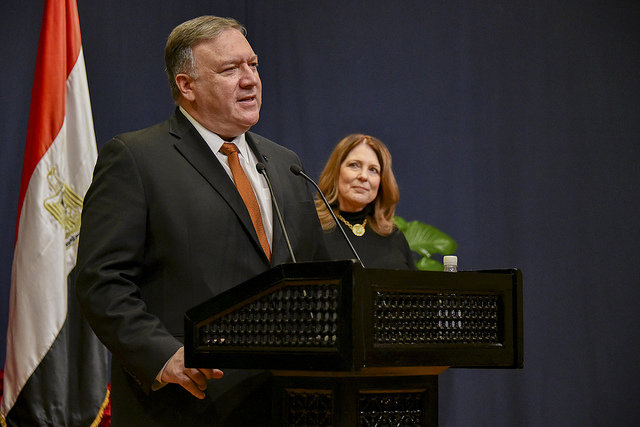
Secretary of State Mike Pompeo delivered a campaign speech in Cairo that seemed written to please an audience of one—President Donald Trump—along with the domestic political base to which Trump’s own rhetoric is designed to appeal.
The main theme was the familiar one that U.S. policy before the Trump presidency was uniformly awful and, since then, the current administration has spectacularly turned everything around for the good. Another familiar theme is that nearly everything in U.S. foreign policy ought to be subordinated to confronting Iran. Whatever the speech may have accomplished for Pompeo back home, as a statement to Middle Eastern listeners it was remarkably tone-deaf.
The speech invited comparison with the speech Barack Obama delivered in the same city during the first year of his presidency and that was carefully crafted for Middle Eastern ears. Obama’s main message was that the Muslim world and the West can enjoy better relations than their history would suggest, but that improvement will require frank recognition of both the positive attributes and the shortcomings that each side brings to the relationship. While respectful toward Islam, Obama, as veteran Al-Arabiya journalist Hisham Melhem observed at the time, “boldly discussed some thorny, tough, sensitive issues that sometimes Muslim leaders and Arab leaders don’t like to hear.” Obama made a strong statement of the positive values that America has brought to Middle Eastern affairs while honestly acknowledging mistakes the West has made in its encounter with the Muslim world, from conduct during the Crusades to present-day Islamophobia. He also laid out a comprehensive positive agenda for a better relationship, covering topics from control of nuclear weapons to expansion of democracy, religious freedom, women’s rights, and economic development. Obama’s speech was favorably received and widely recognized as an important statement.
Pompeo himself explicitly invited comparison with the Obama speech—evidently believing that 10 years is enough time for people to have forgotten what Obama said—and denigrated it as filled with “fundamental misunderstandings” that have had “dire” results. According to Pompeo, Obama “told you that radical Islamist terrorism does not stem from an ideology.” No, Obama didn’t say that. He did discuss the main factors, such as political oppression and some of the economic consequences of globalization, that help to build an audience for such ideologies. As Bruce Riedel of the Brookings Institution commented after Obama’s address, one of the most important aspects of the speech was “to attack directly the narrative and ideology of al Qaeda. For too long the war of ideas was ceded to al Qaeda. By explaining his view of Islam, his vision of Arab-Israeli peace and other key issues the President took on al Qaeda’s argument for terror.”
Also, according to Pompeo, before the current administration took office the United States “grossly underestimated the tenacity and viciousness of radical Islamism.” That assertion certainly does not reflect the Obama speech in Cairo, in which Obama expressed determination to “relentlessly confront violent extremists who pose a grave threat to our security.”
Erroneous Claims
Like typical campaign rhetoric, Pompeo’s speech baselessly claimed credit for any positive result that has been achieved by anyone, even before the current administration took office. Referring to the fight against the Islamic State (ISIS or IS), for example, Pompeo talked about what has been done “just last year” in the same breath as a reference to 99 percent of IS territory having been liberated, without mentioning that most of that liberation occurred during the previous administration.
Pompeo made multiple references to the Syrian regime’s use of chemical weapons, contrasting a previous approach of doing “nothing” in response with how “President Trump unleashed the fury of the U.S. military not once, but twice, with allied support. And he’s willing to do it again, although we do hope that he does not have to.” The secretary will need to keep hoping, because the very fact that the Assad regime has kept doing what it was doing despite the U.S. military strikes indicates that the strikes are not working. By the measure of how much time transpires between chemical weapons incidents, the strikes have worked less well than the diplomacy-centered approach used earlier.
The speech’s lengthy excoriation of Iran also was written in a tone suggesting great accomplishment, even though nothing has been accomplished in the last two years. Despite all the pressure the Trump administration has exerted on Iran, there is still no sign of any “better deal” on nuclear matters or anything else to replace the Joint Comprehensive Plan of Action and Security Council Resolution 2231, of which the United States is in material breach following Trump’s reneging on U.S. obligations. Pompeo tried to claim accomplishment by asserting that the pressure campaign had “cut off the revenues the regime uses to spread terror and destruction throughout the world,” but such assertions do not reflect any positive results. As recent analyses by both the International Crisis Group and the Congressional Research Service have concluded, there has been no correlation between more sanctions being imposed on Iran and any retrenchment in Iran’s regional activities.
Some passages of Pompeo’s speech that supposedly describe past policies can only be met with a bemused shaking of the head and the question, “Where did he get this?” One such passage is “Our eagerness to address only Muslims and not nations ignored the rich diversity of the Middle East and frayed old bonds. It undermined the concept of the nation-state, the building block of international stability.” Previous administrations did not “address nations”?
There will be similar head-shaking among most Arabs and most Muslims who heard or read the speech. They will see almost nothing positive in it, from the standpoint of undercutting radical agendas, resolving conflicts within the region, or anything else. It is almost all negative and all about conflict and confrontation, especially with a military emphasis. Many will interpret the speech as a combination of domestic U.S. political combat overlaid on the Trump administration’s penchant for drawing rigid lines of conflict within the Middle East, of which the obsession with stoking hostility to Iran is a part.
 Significant Omissions
Most listeners in the Middle East will be struck by the omission of some major current regional concerns. Yemen, for example, is mentioned primarily as a supposed front for confronting Iran, with no mention of how the Saudi-led war has generated the humanitarian disaster there.
Or consider the Israeli-Palestinian conflict. Obama’s speech included a significant and carefully balanced segment on this subject, which paired a strong defense of the “unbreakable” U.S. bonds with Israel (and a review of the history of persecution of Jews) with a recognition that Palestinians “have suffered in pursuit of a homeland.”
Pompeo offered just a single line promising to “press for a real and lasting peace between Israel and the Palestinians” and made no reference at all to any rights for Palestinians. He instead spent several lines defending the moving of the U.S. embassy in Israel to Jerusalem, saying that this honored “a bipartisan congressional resolution from more than two decades ago,” not addressing why several presidents of both parties wisely did not try to implement this congressional gesture.
In an even lengthier passage, Pompeo talked about how an Israeli judo champion was crowned the winner of a tournament in the United Arab Emirates and how the Israeli sports and culture minister shed tears of joy over Israeli participation in the meet. Don’t expect the average Middle Eastern man in the street to get as overcome with emotion about this as the minister did.
Pompeo referred to “truth” at both the beginning and end of his speech, which is enough to raise eyebrows coming from a senior official working for a president as truth-challenged as Donald Trump. A major credibility deficit exists for this administration on the issues the speech addressed, and the speech itself did nothing to reduce the deficit.
(Source: Lobelog)

Tuesday, December 25, 2018

Intelligence and Trump’s war against truth

The Trump administration’s tendency to disregard conclusions of the U.S. intelligence community has become, as the Washington Post’s Greg Miller has reported, a habit.
Paul R. Pillar is Non-resident Senior Fellow at the Center for Security Studies of Georgetown University and an Associate Fellow of the Geneva Center for Security Policy. He is a Vietnam War veteran and a retired officer in the U.S. Army Reserve. Pillar has written an article on the issue under the heading of “Intelligence and Trump’s war against truth.”
Initially, Trump’s shoving aside of the intelligence agencies’ assessments was all about his refusal to acknowledge the role that Russia played in his election victory in 2016. During the subsequent two years, the administration’s rejection of those agencies’ analysis has extended to a variety of important topics, from North Korea and Iran to migrant caravans and murder in Istanbul.
Miller quotes comments of an anonymous U.S. intelligence official about how “there is extraordinary frustration” over how the “time, energy, and resources” devoted to providing accurate intelligence to Trump seems to be all “a waste.” What is proper or improper in policy-intelligence relations is more complicated, however, than simply noting how much the current president either heeds or blows off what intelligence officers tell him.
There is no need to feel sorry for intelligence officers more than other public servants, notwithstanding the aforementioned frustration. In some respects, the intelligence agencies are more insulated from Trump’s excesses than are many other federal departments and agencies. The intelligence agencies’ mission involves providing the best possible information and analysis to inform policy decisions; it does not extend to the policy decisions themselves.
The job of intelligence includes leading the policy horse to water and advising whether the water is safe to drink; the job does not include getting the horse to drink it. This principle is not always observed in public perceptions of how well intelligence has done its job, but that’s a problem with the public perceptions, not with the administration of the day.
We should feel sorrier for public servants in those parts of the federal government—such as the Environmental Protection Agency or the Consumer Financial Protection Bureau—whose core missions the Trump administration is negating and are led by people appointed to impede those missions. In such places the government-wide drop in morale under Trump has understandably been especially steep.
For any of several legitimate reasons, foreign and security policy might not take the direction that an intelligence assessment seems to imply. Important foreign policy issues commonly involve multiple U.S. interests and objectives. An assessment on any one question does not speak to all those interests and objectives. Policy-makers must choose among competing national priorities and consider where to pay costs and to assume risks. Intelligence cannot make those priority-setting decisions. Makers of foreign policy also must consider resource constraints and domestic support, and not only the situation overseas that the intelligence agencies describe.
A policy-maker going against what appears to be the implied direction of intelligence assessments should be honest about the reasons for doing so and should respect the legitimacy of the intelligence agencies’ assessments even if they do not ultimately guide the policy. As Miller observes, Trump doesn’t do that. Instead, he attacks the accuracy of the information those agencies provide. This type of reaction is not unprecedented. It prevailed during the George W. Bush administration’s selling of the invasion of Iraq, when that administration denigrated the intelligence agencies’ (accurate) assessment that the Iraqi regime had nothing to do with the operations of al-Qaeda and promoted an alternative (false) notion of an “alliance” between the regime and the terrorist group.
Another unfortunate tactic much in evidence under Trump is to demand an extreme and probably unattainable level of “proof” before accepting a reality. The administration has used this tactic in refusing to acknowledge the role of Saudi crown prince Mohammed bin Salman in the murder of journalist Jamal Khashoggi. Secretary of Defense James Mattis and Secretary of State Mike Pompeo talk about the absence of a “smoking gun” or “direct evidence” implicating the crown prince. Such a tactic, if applied to foreign policy generally, would be a recipe for paralysis, because most situations to which foreign policy must respond do not offer smoking-gun type evidence but are no less a reality because of that.
Again, there is precedent in the Bush administration’s selling of the Iraq War, when policy-makers disregarded probabilities to promote their preferred notions, although in that case the promoted notions more often were that something did occur rather than that it didn’t. Secretary of Defense Donald Rumsfeld preached that “absence of evidence is not evidence of absence,” and Vice President Richard Cheney propounded the “one percent doctrine,” under which we were supposed to treat as a certainty something that was highly unlikely.
Trump’s rejection of reality is nonetheless unprecedented in a couple of respects. One is the sheer scope and magnitude of the lying, with tallies of presidential falsehoods having gone off the charts. Another is Trump’s persistent repetition of lies even after their falsity has been conclusively and publicly demonstrated. Already overworked fact-checkers in the media have had to develop new scoring systems to track this Trumpian habit. The habit resembles nothing in previous American history as much as it resembles the Big Lie technique that totalitarian regimes have perfected. In Trump’s case the idea evidently is that if he repeats a falsehood often enough and long enough, it will replace reality at least in the minds of his cherished political base.
Intelligence agencies are seemingly in the truth business, and so it is natural to think of them when contemplating Trump’s war against truth. But the agencies are not central to what is at stake in most of this war. We don’t need intelligence agencies to know how much of this presidency is based on falsehoods, even in foreign affairs. For example, acknowledging the Saudi crown prince’s role in the Khashoggi murder depends less on some juicy bit of reporting from an intelligence agency than on an understanding of how the current Saudi regime operates.
Americans certainly should be attuned to misrepresentations of reality that involve misuse of intelligence. Such abuse is most likely to involve cherry-picking, in which a few bits of intelligence reporting are publicly highlighted to make a case while disregarding other information that fully and more accurately portrays reality. Such cherry-picking in the selling of the Iraq War is echoed in much of the Trump administration’s promotion of hostility toward Iran. For example, Pompeo’s most recent statement about Iranian defensive missiles was a highly selective treatment that left unsaid anything about other missile activity in the region, the threats and aggression to which Iran is responding, and who is and is not respecting obligations in multilateral agreements and United Nations Security Council resolutions.
Yes, it would be better if Trump heeded the intelligence agencies’ assessments more than he does. But defending American democracy in the face of Trump’s war against truth and trying to prevent more such damage to that democracy in the future go beyond the role of those agencies. The defense includes somehow instilling in the general population not only the ability but also the duty to distinguish between truth and lies.