Showing posts with label Iranian FM Javad Zarif. Show all posts

Tuesday, December 10, 2019

Iran's FM: Foreign presence paves way for extremism in region

Iran's foreign minister has slammed presence of foreign troops in Afghanistan, saying history shows that foreign presence in the region has only “provided a recruiting ground for extremists.”
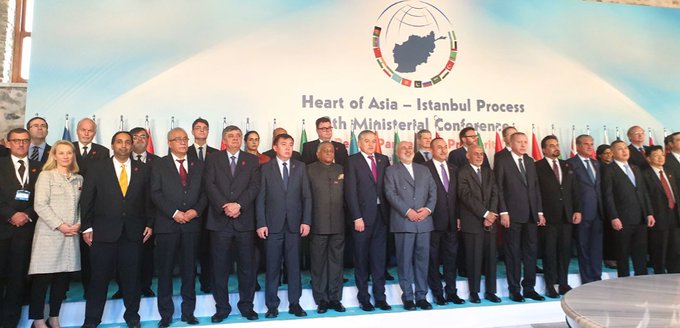
Mohammad Javad Zarif made the remarks in a Monday speech delivered at the Ministerial Conference of Heart of Asia Countries, which was held in the Turkish port city of Istanbul.
The Heart of Asia - Istanbul Process was established to provide a platform to discuss regional issues, particularly encouraging security, political, and economic cooperation among Afghanistan and its neighbors. This region-led dialogue was launched in November 2011 to expand practical coordination between Afghanistan and its neighbors and regional partners in facing common threats.
Addressing the conference, Zarif said, “There is no military solution in Afghanistan. The presence of foreign forces has never brought stability in our region and has historically provided a recruiting ground for extremists.”
He mentioned withdrawal of foreign forces from Afghanistan as prerequisite for restoration of peace to the war-torn country, saying, “Announcement of a timetable for a responsible exit of foreign troops from Afghanistan would prepare the necessary ground for the Afghan government to promote peace and reconciliation process at the national level.”
Zarif noted that Iran believed any peace initiative for Afghanistan should be launched by domestic groups and parties, adding, “In that regard, we support an Afghan-owned and Afghan-led peace process with the participation of all political groups and factions including the Taliban with the Afghan government in the center.”
Stressing the role of neighboring countries and the UN in the establishment of peace in Afghanistan, Iran's top diplomat said, “Taking the views of neighboring countries and considering their legitimate concerns during the process would guarantee that the peace agreement has stronger supports regionally. We believe the United Nations could become active to bring all domestic groups as well as international partners of Afghan government under one umbrella to facilitate this process.”
Zarif also warned about “the increasing threat of Daesh in Afghanistan, which has led to more bloodshed and introduced dangerous sectarian tendencies,” noting that using such terror groups to achieve one’s own political goals would not be beneficial to parties involved in Afghanistan’s developments.

“As no one gained from introducing and supporting Daesh and other extremists in Syria and Iraq, no one will gain from introducing them to Afghanistan and Central Asia,” he said.

Friday, September 20, 2019

Locked and Loaded’ for War on Iran?

Patrick BUCHANAN
“Iran has launched an unprecedented attack on the world’s energy supply,” declared Secretary of State Mike Pompeo.
Putting America’s credibility on the line, Pompeo accused Iran of carrying out the devastating attack on Saudi oil facilities that halted half of the kingdom’s oil production, 5.7 million barrels a day.
On Sunday, President Donald Trump did not identify Iran as the attacking nation, but did appear, in a tweet, to back up the secretary of state:
“There is reason to believe that we know the culprit, are locked and loaded depending on verification, but are waiting to hear from the Kingdom (of Saudi Arabia) as to who they believe was the cause of this attack and under what terms we would proceed!”
Yemen’s Houthi rebels, who have been fighting Saudi Arabia for four years and have used drones to strike Saudi airport and oil facilities, claim they fired 10 drones from 500 kilometers away to carry out the strikes in retaliation for Saudi air and missile attacks.
Pompeo dismissed their claim, “There is no evidence the attacks came from Yemen.”
But while the Houthis claim credit, Iran denies all responsibility.
Foreign Minister Mohammad Zarif says of Pompeo’s charge, that the U.S. has simply replaced a policy of “maximum pressure” with a policy of “maximum deceit.” Tehran is calling us liars.
And, indeed, a direct assault on Saudi Arabia by Iran, a Pearl Harbor-type surprise attack on the Saudis’ crucial oil production facility, would be an act of war requiring Saudi retaliation, leading to a Persian Gulf war in which the United States could be forced to participate.
Tehran being behind Saturday’s strike would contradict Iranian policy since the U.S. pulled out of the nuclear deal. That policy has been to avoid a military clash with the United States and pursue a measured response to tightening American sanctions.
U.S. and Saudi officials are investigating the sites of the attacks, the oil production facility at Abqaiq and the Khurais oil field.
According to U.S. sources, 17 missiles or drones were fired, not the 10 the Houthis claim, and cruise missiles may have been used. Some targets were hit on the west-northwest facing sides, which suggests they were fired from the north, from Iran or Iraq.
But according to The New York Times, some targets were hit on the west side, pointing away from Iraq or Iraq as the source. But as some projectiles did not explode and fragments of those that did explode are identifiable, establishing the likely source of the attacks should be only a matter of time. It is here that the rubber meets the road.
Given Pompeo’s public accusation that Iran was behind the attack, a Trump meeting with Iranian President Hassan Rouhani at the U.N. General Assembly’s annual gathering next week may be a dead letter.
The real question now is what do the Americans do when the source of the attack is known and the call for a commensurate response is put directly to our “locked-and-loaded” president.
If the perpetrators were the Houthis, how would Trump respond?
For the Houthis, who are native to Yemen and whose country has been attacked by the Saudis for four years, would, under the rules of war, seem to be entitled to launch attacks on the country attacking them.
Indeed, Congress has repeatedly sought to have Trump terminate U.S. support of the Saudi war in Yemen.
If the attack on the Saudi oil field and oil facility at Abqaiq proves to be the work of Shiite militia from inside Iraq, would the United States attack that militia whose numbers in Iraq have been estimated as high as 150,000 fighters, as compared with our 5,000 troops in-country?
What about Iran itself?
If a dozen drones or missiles can do the kind of damage to the world economy as did those fired on Saturday — shutting down about 6% of world oil production — imagine what a U.S.-Iran-Saudi war would do to the world economy.
In recent decades, the U.S. has sold the Saudis hundreds of billions of dollars of military equipment. Did our weapons sales carry a guarantee that we will also come and fight alongside the kingdom if it gets into a war with its neighbors?
Before Trump orders any strike on Iran, would he go to Congress for authorization for his act of war?
Sen. Lindsey Graham is already urging an attack on Iran’s oil refineries to “break the regime’s back,” while Sen. Rand Paul contends that “there’s no reason the superpower of the United States needs to be getting into bombing mainland Iran.”
Divided again: The War Party is giddy with excitement over the prospect of war with Iran, while the nation does not want another war.
How we avoid it, however, is becoming difficult to see.
John Bolton may be gone from the West Wing, but his soul is marching on.
Patrick J. Buchanan is the author of “Nixon’s White House Wars: The Battles That Made and Broke a President and Divided America Forever.” To find out more about Patrick Buchanan and read features by other Creators writers and cartoonists, visit the Creators website at www.creators.com.

Thursday, September 19, 2019

Oiling for War: The Houthi Attack on Abqaiq

Saudi Aramco’s core area which includes the headquarters and office buildings in Dhahran city. Photograph Source: Eagleamn – Public Domain


The attack on the world’s largest oil processing facili
ty at Abqaiq in Saudi Arabia southwest of Aramco’s headquarters in Dhahran had a few predictable responses. Given that the facility has a daily output of some 5.7 million barrels, damaging it was bound to cause a spike in the price of oil.

The question troubling the security chatterers was whether the party claiming responsibility – in this case, the Yemen-based Houthi rebels – had managed to engineer the feat. Drones, it is claimed, were used, striking at some 17 points. But such copyright is being denied to the rebels.  For one, Riyadh is considering the possibility that the attack might have come from Iraqi soil, involving another group armed with cruise missiles. The direction of the attack, it is claimed by US sources, was from the north or northwest, suggesting the direction of the Persian Gulf, Iran or Iraq.
The US Secretary of State Mike Pompeo has decided to pour cold water on any suggestion that the Houthis were competently responsible.  Having displaced John Bolton as hawk-in-chief, he is preparing the ground for possible retaliation.  In his view, there is only one state responsible for the attacks. “We call on all nations to publicly and unequivocally condemn Iran’s attacks. The United States will work with our partners and allies to ensure that energy markets remain well supplied and Iran is held accountable for its aggression.”
In another tweet posted on Saturday, the convinced Pompeo accused Iran of being behind some 100 attacks on Saudi Arabia “while [Hassan] Rouhani and [Iranian Foreign Minister Javad] Zarif pretend to engage in diplomacy.”  He ruled out Yemen as a base for the assault. Iran had “launched an unprecedented attack on the world’s energy supply.”
President Donald Trump, for his part, is venting and waiting.  “There is reason to believe that we know the culprit, are locked and loaded depending on verification, but are waiting to hear from the Kingdom as to who they believe was the cause of this attack, and under what terms we should proceed!”  The more immediate concerns for the president are economic: releasing oil from the Strategic Petroleum Reserve and expediting “approvals of the oil pipelines currently in the permitting process in Texas and various States.”  Many thanks to be had, it seems, for such strikes.
The machinery behind a military strike on Iran is being put in motion, one that was already being readied with claims of Iranian attacks on maritime shipping in the Persian Gulf and the shooting down of a US drone.  (The latter led to a flirtation with the use of force by Trump.)  Generally speaking, the legal basis of any such attack is questionable, despite Pompeo’s airy contention that, “We have always had the authorisation to defend American interests”.  Trump, however, has been briefed by a few warring enthusiasts in Congress suggesting that any assault on Iran can be brought within the purview of the 2001 Authorization for Use of Military Force (AUMF).
Republican Senator Lindsey Graham is not troubled by legal niceties, happy to entertain the prospect of a regional apocalypse in the name of punishing the mullahs.  Having called the attacks “yet another example of how Iran is wreaking havoc in the Middle East” he considered it important “to put on the table an attack on Iranian oil refineries if they continue their provocations or increase nuclear enrichment.”  Like a delinquent of international relations, Iran, he tweeted over the weekend, “will not stop their misbehaviour till the consequences become more real, like attacking their refineries, which will break the regime’s back.”
Accepting Iranian responsibility for such attacks has been an easy matter for many on the Hill.  There are those, like Democratic chairman of the House Intelligence Committee, US Representative Adam Schiff, who are already satisfied that Tehran’s less than subtle hand is heavily involved.  “I think it’s safe to say that the Houthis don’t have the capability to do a strike like this without Iranian assistance.”
Speculation and invention remain a foreign policy stable in Middle Eastern politics.  The region still labours with legacy of a US-led invasion of Iraq inspired by fictional Weapons of Mass Destruction supposedly harboured by Saddam Hussein. It involved grotesquely extravagant assessments of Iraq’s destructive prowess; it involved intelligence failures, bureaucratic bungling and venal manipulation of the record in Washington, London and Canberra.
Zarif, for his part, is convinced that Pompeo, having failed in exerting maximum pressure on Iran, has now turned to a program of maximum deceit.  The US and its allies, he tweeted, “are stuck in Yemen because of illusion that weapon superiority will lead to military victory.  Blaming Iran won’t end disaster.”  The question, however, is bigger than Yemen, and bigger than oil. The sole question here is whether Trump takes of the root of madness held out by Graham, or holds out for a meeting with Rouhani at the UN General Assembly.

Binoy Kampmark was a Commonwealth Scholar at Selwyn College, Cambridge. He lectures at RMIT University, Melbourne.

Wednesday, September 18, 2019

Iranian Noose Around Donald Trump’s Neck

7656
A number of American media outlets have stated that U.S. President Donald Trump’s standing is not as good as it could be at present. The latest opinion polls conducted in the United States show that his approval rating reached its lowest levels, and that he could be beaten by any of the four Democratic presidential candidates during the upcoming election in a year’s time. There is an opinion that analyses and plans for formulating a foreign policy were in many cases inadequate, which has caused greater concern among Republicans about the presidential election next year.
Donald Trump started his presidency with a visit to Saudi Arabia, where he signed contracts worth as much as $100 billion, and made Saudis promise to buy American arms for another $300 billion. Then, however, U.S. President’s policies failed on a number of occasions on the global arena.
Washington’s plans to crush the Russian economy with the aid of sanctions did not bear fruit, and, as a result, the whole world is currently laughing at them. Even Donald Trump himself has fully grasped the failure of such a policy and suggested inviting Russia back into the G7, which would transform this elite summit into a G8.
In addition, nothing worked with regards to China either although Donald Trump initiated a trade and economic war against this nation. Any financial gains apparently made by the United States were cancelled out by China’s increased tariffs on American goods.
And what of the DPRK, a country that the American President threatened to wipe off the face of the Earth? Currently, Kim Jong-un, the leader of North Korea, is suddenly regarded as (based on the statements made by Donald Trump himself) a great leader who one could do business with.
Very little has gone right for Donald Trump with respect to the Islamic Republic of Iran after the United States pointedly and inexplicably withdrew from the Joint Comprehensive Plan of Action (JCPOA) agreement on Iran’s nuclear program while at the same time demanding (purely for sport) that Tehran fulfill all the obligations in accordance with this agreement. It is worth reminding our readers that the JCPOA delicately balances interests, obligations and compromises of many nations, which is why it cannot be subdivided into separate sections (for instance, with one binding and another nonbinding part).
Undoubtedly, Donald Trump is a fortunate business man, however, this is clearly not enough to run an enormous nation. The U.S. President did not even express any interest in whether or not sanctions (first imposed against Iran 40 years ago in 1979), which he places great hopes on, had borne any fruit before. At the time the USA first announced sanctions against the Islamic Republic of Iran, the world power seized all of Iran’s assets, including bank deposits, gold and other property in the amount of $12 billion.  In 1987, U.S. President Ronald Reagan imposed new sanctions against Iran. However, when they failed to yield desirable results in Washington’s eyes, in 1995, the sanctions were once again expanded to include foreign companies that collaborated with Iran.  After the United States withdrew from the agreement on the nuclear program on 8 May 2018, the unilateral sanctions against Iran yet again tightened.
Aside from unilateral, unlawful and inhumane sanctions the USA imposed against the Islamic Republic of Iran, Washington has pressured other world nations to put an embargo on Iranian exports. This in itself is a clear example of economic terrorism against the people of Iran.
However, despite the harsh sanctions, over this entire period, Iran has achieved a lot of success in all the spheres, including the military one (i.e. by creating its own weapons on par with their American counterparts).
It would be interesting to know how Washington intends to engage with Iran, with its history and diplomatic endeavors spanning thousands of years, and which was a Great Empire at the time when inhabitants of America walked around wearing animal hides. Does Donald Trump really think that all he needs to do is shake his finger at Iran and impose yet another set of barbaric sanctions against this nation for Iranians to simply cave?
It is quite obvious that Donald Trump is trying to use all the means at his disposal to make Tehran breach the non-proliferation treaty, and thereby undermine its collaboration with the IAEA (the International Atomic Energy Agency) in order to then have the motive to intervene by military means (something that is condemned in the strongest of terms by the international community and that will threaten the stability of the entire region). Many career diplomats have pointed out the resilience of their Iranian counterparts, and their strict adherence to international laws that govern the sphere of non-proliferation of weapons of mass destruction. Russian diplomats, just as many foreign experts and professionals, believe that Iran’s rational behavior would be duly appreciated by all the other signatories of the agreement.
President of Iran Hassan Rouhani clearly expressed his opinion on the possibility of renewing negotiations with Washington. Having highlighted that Iran’s strategy is grounded in resistance from within and effective diplomacy, Hassan Rouhani stated that Tehran had never aimed to engage in bilateral negotiations with the USA. He said that numerous proposals to this effect had been made, but Iran had thus far rejected them. Hassan Rouhani affirmed that without resistance from within and effective diplomacy Iran’s path would be hard.
Mohammad Javad Zarif, the Foreign Affairs Minister of Iran, stated that Iran would “further lower its commitments under the deal” if Europeans failed to protect Iran’s economy from barbaric sanctions imposed on the nation by the United States after the unceremonious withdrawal from the agreement by the Trump administration. After all, in accordance with the JCPOA, Iran agreed to limit its nuclear activities in exchange for the lifting of financial and economic sanctions. The Iranian Minister stated “It is meaningless to continue unilateral commitments to the deal if we don’t enjoy its benefits as promised by the deal’s European parties”. He also ruled out the possibility of renegotiating the JCPOA, and noted that it was perfectly clear for Tehran that it would be impossible to open a Pandora’s box and then close it once again.
With the upcoming presidential election drawing near, Donald Trump really needs to at least achieve some success with regards to Iran. However, it is entirely up to Tehran to act at this point, thanks to Mohammad Javad Zarif’s “iron hand in a velvet glove”. And in the meantime, Iran’s Foreign Affairs Minister continues to give Donald Trump, the leader of the most powerful nation in the world, master classes in diplomacy.
It would be interesting to see what Donald Trump, who appears to have only the threat of force (which, by the way, the USA currently does not have and is unlikely to have in the future) left in his arsenal, does next with regards to Iran. But the election continues to draw near and something needs to be done. And even now, the Iranian noose around Donald Trump’s neck continues to tighten.

Viktor Mikhin, corresponding member of the Russian Academy of Natural Sciencesexclusively for the online magazine “New Eastern Outlook.

Monday, September 09, 2019

INTERESTS VS FEAR? Ft.

 Javad Zarif, Iranian Foreign Minister


Napoleon Bonaparte famously said that there are only two forces that unite men - fear and interest and this is most visible in the Iranian nuclear issue. As the pressure on European countries to adjust their policies in the era of Trump grows, do the Europeans have enough interest to overcome their fear and salvage the deal with Tehran? To discuss this, Oksana is joined by Iran’s Foreign Minister, Javad Zarif.