Showing posts with label Donald Trump and JCPOA. Show all posts

Friday, November 08, 2019

Time Is Running Out to Salvage the Iran Nuclear Deal

By Sarah Abed

This week, Iran’s atomic energy authority confirmed it would commence enriching uranium past the 3.67 percent cap to 5 percent at its Fordow plant starting Wednesday. This is Tehran’s fourth step in scaling back its commitments under the 2015 Iran Nuclear Deal also known as the Joint Comprehensive Plan of Action (JCPOA) in response to the US’s unilateral withdrawal last year, and consequently imposing crippling sanctions, as well as Europe’s inability to offer relief, as was promised.
Tehran plans on continuing to scale back its commitments every sixty days till the United States returns to the deal or European nations can provide adequate sanctions relief. Iranian officials have stated that these steps are entirely reversible. The United States loves to harp on these symbolic moves meant to pressure the United States into returning to the JCPOA, as being grave steps in the wrong direction, when ultimately the first and most serious offense was taken by the Trump administration when they withdrew and started to impose sanctions on Iran.
Although the European members that are part of the deal are still committed to its implementation and have suggested measures to help ease suffering under the sanctions, not enough is being done to pressure the United States into lifting sanctions which is Iran’s requirement prior to negotiations.
The JCPOA is flawed in its inadequate dispute settlement process, when a party leaves the deal (as did the United States) Iran’s only option is to return to the pre-deal situation. Hoping that a better solution would present itself Iran stayed in compliance for an entire year after President Trump unilaterally withdrew.
US Secretary of State Mike Pompeo in his usual hysterical manner is accusing Iran of preparing for a “rapid nuclear breakout”. Completely dismissing how and why we got to his point. The United States set the stage for this downhill escalation by withdrawing from the multinational deal and applying crippling sanctions made to destroy the country’s oil industry and reduce exports to zero.
What did the Trump administration expect to happen by making conditions unbearable, and by trying to collapse Iran’s economy, government, and society and unsuccessfully force “regime change”? Brutal compounded sanctions have been affecting the most vulnerable members of society, with even food and medicine feeling the harsh effects of Washington’s “maximum pressure campaign”.
With tensions high and frustration looming, each scale back raises concern that the European signatories might see it as crossing the red line and therefore killing the deal, which only the United States is in favor of.
President Trump recently signed sanctions waivers for China and Russia and Europe to continue to assist Iran in its peaceful nuclear development. These periodic waivers grant exemptions from US sanctions against Iran and allow foreign companies to collaborate on civilian nuclear programs with Iran’s Atomic Energy Organization. Some believe that this might be a sign that President Trump wants to negotiate a deal with Iran, which he certainly can, if he lifts sanctions first.
On Thursday, Iran claimed that an International Atomic Energy Agency (IAEA) inspector was prohibited from entering the Natanz facility after a detector for explosive nitrates went off. While officials were looking for a female to search her, the inspector went into the bathroom and when she returned, she no longer tested positive, sparking concerns of foul play.
In response to failure by European signatories (Britain, France, and Germany) to fulfill their obligations under the Nuclear Non-Proliferation Treaty (NPT) and countering crippling sanctions imposed by the Trump administration, some influential Iranian figures are advocating for Iran’s departure from NPT. They are stating that these nations have failed to establish an adequate financial structure to enable companies to trade with Iran while US imposes harsh sanctions.
There’s a difference of opinion between Iran’s President Hassan Rouhani and other Iranian figures about whether Iran should remain in the NPT. President Rouhani and the government of Iran are of the opinion that it would not be in Iran’s best interest to withdrawal whereas others say that Iran is not benefiting from its membership in the NPT and point out that India, Pakistan, and Israel are not part of the NPT and North Korea is continuing on a path of acquiring a nuclear arsenal.
It’s worth mentioning that Supreme Leader, Ayatollah Ali Khamenei has issued a fatwa or religious order against the country having nuclear weapons. Iranian figures have also stated numerous times that it is not Iran’s intentions to develop nuclear weapons. Little trust or interest remains in having dialogue with the United States, especially with the open hostility that’s become the norm in Washington towards Iran.
Europe and specifically France has proposed options to help with sanctions relief such as a $15 billion dollar line of credit and INSTEX but neither has been implemented. INSTEX was set up as a payment channel by the UK, Germany and France to help Iran continue to trade and circumvent US sanctions. Without proper implantation, Iran will be taking its fifth step away from the JCPOA commitments, and this is all meant to pressure these nations to resolve the current situation. Each measure that Iran takes is calculated and reversible, but of course with each step comes the risk that other members will follow the US’s move and withdrawal from the deal.
The decision to inject uranium gas into centrifuges in the underground Fordow facility along with the previous three steps taken by Iran are meant as a wakeup call to the signatories. Iran can’t be expected to unilaterally fulfill its obligations while other parties renege on theirs. By taking these measures Iran hopes to send a strong and serious message that all other parties must come back to the deal, before it’s too late.
*Sarah Abed is an independent journalist and political commentator. Focused on exposing the lies and propaganda in mainstream media news, as it relates to domestic and foreign policy with an emphasis on the Middle East. Contributed to various radio shows, news publications and spoken at forums. 

Sunday, September 29, 2019

Broaden Impeachment Probe to Include Trump’s Numerous Crimes

By: Kayhan Int’l 

It seems to be the end of the road for the U.S. president, who now simply cannot anymore get away with his blunders, crimes, and treason, which are dragging him towards his deserving impeachment.
House Leader, Democrat Nancy Pelosi, has officially started the proceedings against Donald Trump, and measures are in fully swing in Washington for his impeachment following emergence of concrete evidence on lawlessness and treason against the nation.
According to reports, an intelligence community whistleblower, who chooses to remain unidentified, recorded a phone call between Trump and his Ukrainian counterpart, President Volodymyr Zelensky – an ethnic Jew – and decided to go public, thereby setting off a political firestorm in the U.S.
The nine-page complaint, released the day after the transcript of the call was made public, shows Trump asking Ukraine’s help in investigating a conspiracy theory related to the cybersecurity firm CrowdStrike. Trump suggested that the Ukrainians investigate allegations of corruption related to former U.S. Vice President and candidate for the 2020 elections, Democrat Joe Biden, and his son, Hunter Biden.
Democrats should not narrow their impeachment proceedings to Ukraine but should widen probe to include this reckless, lawless, racist, tax-dodging and immoral president, who is on a collision course with China over bilateral trade, and after breaching such important international treaties as the Paris Climate Accord and the JCPOA (Joint Comprehensive Plan Of Action), has launched a campaign of economic terrorism against Iran, in addition to aiding and abetting the Saudis to kill over a hundred thousand Yemeni men, women, and children.
In a bid to deflect attention from his crimes and violation of international laws, Trump is threatening the Islamic Republic with war, which would badly boomerang on the U.S.
In view of these facts, the House should not restrict impeachment proceedings to the specific case involving Biden, but should focus on various other issues, such as Trump’s illegal payment of hush money to a porn star, and several other women, whom he sexually exploited.
The overwhelming majority of Americans agree that Trump is a racist and a liar, and that corruption has increased under his rule, besides the violation of human rights, as is evident by his mistreatment of Latin American migrants. These crimes warrant that he should be impeached and kicked out of office, rather than be allowed to complete the rest of his crisis-ridden term, or seek re-election next year.
It should be recalled that in 1868, Andrew Johnson became the first U.S president to be impeached for his attempt to "disgrace” Congress, and over a century later in 1974, the House Judiciary Committee passed three detailed articles of impeachment against President Richard Nixon, covering obstruction of justice, abuse of power, and contempt of Congress.
Nixon promptly resigned and escaped impeachment to avoid disgrace, but observers are of the opinion that that Trump is too shameless a criminal to feel concerned about political ethics, social etiquette, or moral aspects, to leave the office that he has been exploiting for personal gains, unless formally impeached and given due punishment for his crimes.

Wednesday, September 18, 2019

Iranian Noose Around Donald Trump’s Neck

7656
A number of American media outlets have stated that U.S. President Donald Trump’s standing is not as good as it could be at present. The latest opinion polls conducted in the United States show that his approval rating reached its lowest levels, and that he could be beaten by any of the four Democratic presidential candidates during the upcoming election in a year’s time. There is an opinion that analyses and plans for formulating a foreign policy were in many cases inadequate, which has caused greater concern among Republicans about the presidential election next year.
Donald Trump started his presidency with a visit to Saudi Arabia, where he signed contracts worth as much as $100 billion, and made Saudis promise to buy American arms for another $300 billion. Then, however, U.S. President’s policies failed on a number of occasions on the global arena.
Washington’s plans to crush the Russian economy with the aid of sanctions did not bear fruit, and, as a result, the whole world is currently laughing at them. Even Donald Trump himself has fully grasped the failure of such a policy and suggested inviting Russia back into the G7, which would transform this elite summit into a G8.
In addition, nothing worked with regards to China either although Donald Trump initiated a trade and economic war against this nation. Any financial gains apparently made by the United States were cancelled out by China’s increased tariffs on American goods.
And what of the DPRK, a country that the American President threatened to wipe off the face of the Earth? Currently, Kim Jong-un, the leader of North Korea, is suddenly regarded as (based on the statements made by Donald Trump himself) a great leader who one could do business with.
Very little has gone right for Donald Trump with respect to the Islamic Republic of Iran after the United States pointedly and inexplicably withdrew from the Joint Comprehensive Plan of Action (JCPOA) agreement on Iran’s nuclear program while at the same time demanding (purely for sport) that Tehran fulfill all the obligations in accordance with this agreement. It is worth reminding our readers that the JCPOA delicately balances interests, obligations and compromises of many nations, which is why it cannot be subdivided into separate sections (for instance, with one binding and another nonbinding part).
Undoubtedly, Donald Trump is a fortunate business man, however, this is clearly not enough to run an enormous nation. The U.S. President did not even express any interest in whether or not sanctions (first imposed against Iran 40 years ago in 1979), which he places great hopes on, had borne any fruit before. At the time the USA first announced sanctions against the Islamic Republic of Iran, the world power seized all of Iran’s assets, including bank deposits, gold and other property in the amount of $12 billion.  In 1987, U.S. President Ronald Reagan imposed new sanctions against Iran. However, when they failed to yield desirable results in Washington’s eyes, in 1995, the sanctions were once again expanded to include foreign companies that collaborated with Iran.  After the United States withdrew from the agreement on the nuclear program on 8 May 2018, the unilateral sanctions against Iran yet again tightened.
Aside from unilateral, unlawful and inhumane sanctions the USA imposed against the Islamic Republic of Iran, Washington has pressured other world nations to put an embargo on Iranian exports. This in itself is a clear example of economic terrorism against the people of Iran.
However, despite the harsh sanctions, over this entire period, Iran has achieved a lot of success in all the spheres, including the military one (i.e. by creating its own weapons on par with their American counterparts).
It would be interesting to know how Washington intends to engage with Iran, with its history and diplomatic endeavors spanning thousands of years, and which was a Great Empire at the time when inhabitants of America walked around wearing animal hides. Does Donald Trump really think that all he needs to do is shake his finger at Iran and impose yet another set of barbaric sanctions against this nation for Iranians to simply cave?
It is quite obvious that Donald Trump is trying to use all the means at his disposal to make Tehran breach the non-proliferation treaty, and thereby undermine its collaboration with the IAEA (the International Atomic Energy Agency) in order to then have the motive to intervene by military means (something that is condemned in the strongest of terms by the international community and that will threaten the stability of the entire region). Many career diplomats have pointed out the resilience of their Iranian counterparts, and their strict adherence to international laws that govern the sphere of non-proliferation of weapons of mass destruction. Russian diplomats, just as many foreign experts and professionals, believe that Iran’s rational behavior would be duly appreciated by all the other signatories of the agreement.
President of Iran Hassan Rouhani clearly expressed his opinion on the possibility of renewing negotiations with Washington. Having highlighted that Iran’s strategy is grounded in resistance from within and effective diplomacy, Hassan Rouhani stated that Tehran had never aimed to engage in bilateral negotiations with the USA. He said that numerous proposals to this effect had been made, but Iran had thus far rejected them. Hassan Rouhani affirmed that without resistance from within and effective diplomacy Iran’s path would be hard.
Mohammad Javad Zarif, the Foreign Affairs Minister of Iran, stated that Iran would “further lower its commitments under the deal” if Europeans failed to protect Iran’s economy from barbaric sanctions imposed on the nation by the United States after the unceremonious withdrawal from the agreement by the Trump administration. After all, in accordance with the JCPOA, Iran agreed to limit its nuclear activities in exchange for the lifting of financial and economic sanctions. The Iranian Minister stated “It is meaningless to continue unilateral commitments to the deal if we don’t enjoy its benefits as promised by the deal’s European parties”. He also ruled out the possibility of renegotiating the JCPOA, and noted that it was perfectly clear for Tehran that it would be impossible to open a Pandora’s box and then close it once again.
With the upcoming presidential election drawing near, Donald Trump really needs to at least achieve some success with regards to Iran. However, it is entirely up to Tehran to act at this point, thanks to Mohammad Javad Zarif’s “iron hand in a velvet glove”. And in the meantime, Iran’s Foreign Affairs Minister continues to give Donald Trump, the leader of the most powerful nation in the world, master classes in diplomacy.
It would be interesting to see what Donald Trump, who appears to have only the threat of force (which, by the way, the USA currently does not have and is unlikely to have in the future) left in his arsenal, does next with regards to Iran. But the election continues to draw near and something needs to be done. And even now, the Iranian noose around Donald Trump’s neck continues to tighten.

Viktor Mikhin, corresponding member of the Russian Academy of Natural Sciences, exclusively for the online magazine “New Eastern Outlook.”

Tuesday, August 13, 2019

U.S.-China Trade war: What does it mean for Iran?

By Mohammad Eslami

TEHRAN – U.S.-China trade war has been one of the game changers among the geopolitical factors affecting the international political and economic sphere. The 10pc tariff will be imposed on the $300bn/yr of imports from China not yet subject to any duties, Trump announced via Twitter a day after the latest round of talks, which concluded in Shanghai.
 As a result, China’s yuan tumbled to the weaker side of the key 7-per-dollar threshold, hitting its weakest since 2008, against the backdrop of a sharp escalation in the protracted U.S.-Sino trade war. The United States has accused China of manipulating Yuan and the U.S. Treasury Department designated China a currency manipulator, a historic move that no White House had exercised since the Clinton administration.
While Iran is under the pressure of the toughest sanctions policy in international history, Tehran declares the sanctions as "economic terrorism" and China is still buying the Iranian heavy crude oil, Ups and downs of trade negotiations and confronting economic policies had occurred between two world powers, does specific meanings to Iran.
 Political Aspects
The U.S. and China, two UNSC permanent members, are among the signatories of the Joint Comprehensive Plan of Action. The violation of the deal by the Trump administration and the decision to impose more extraterritorial sanctions made an either-with-us-or-against-us dilemma which is not followed by the Chinese government. The Iranian question here refers to two possibilities. Whether China would leave the position to confront the U.S. sanctions and stop buying Iranian oil in order to be more concentrated on the trade war, or consequently got mere serious in bypassing the sanctions against Iran legally and practically.
 After 8th May 2018, China declared that it would stop buying oil from Iran due to the legal and financial concerns over the sanctions. When hopes for an early settlement of the yearlong U.S.-China trade war dimmed, the route changed. While China has not imposed levies on crude oil imports from the United States, it’s purchases of U.S. crude have dropped sharply from record levels last year.
 Simultaneously, it is continuing Iran oil imports. China imported Iranian crude oil in July for the second month since a U.S. sanctions waiver ended, according to research from three data firms, with one estimate showing some oil entered tanks holding the country’s strategic reserves.
 Economic factors
However, the political dimension is not the only important consequence of the trade war. Yuan historic drop affects the cost and benefit of bilateral trade between Iran and China. Iran's revenues from exports (U.S. dollar-based revenue) would expand compared with imports costs (Yuan-based).
 Although the long term effects of the trade war could lead to inflation in the Chinese domestic market and worsening of trade tensions would reduce China’s growth by around 0.8 percentage points over the following 12 months, which would mean the reduction of the demand for crude oil too. The growth reduction and reduction of demand will make the freight costs more important and the competitive price of Iranian oil will be more attractive. 
 Strategic Planning
Above all, the future of the trade war is the fate of the hegemonic U.S., from the Iranian point of view. It can be meant as the end of the age of U.S. dominance. A range of problematic dilemmas both domestic and internationally including the sanction regime, the maritime security and the security of the Strait of Hormuz, Iran's engagement in the international financial and banking system, the flow of foreign investment, and so on would be affected by the future of the U.S.-China trade war more or less.
The dynamics of the crisis shows that Iran would benefit in the either-with-us-or-against-us playground which is designed by the OFAC regulations. Although Iran's policy for engaging the international community as the outcome of the JCPOA is ruined by the destructive policies of the White House, the evidence confirms that Trump's long-term presidential effects will benefit Iran.

Saturday, July 13, 2019

The Administration’s Futile Flailing On Iran

by Paul R. Pillar

Shutterstock
This week the Board of Governors of the International Atomic Energy Agency (IAEA) convened at the request of the Trump administration to discuss Iran’s nuclear activities. There is no action that, according to the IAEA’s charter and terms of reference, can or should come out of this discussion. The IAEA’s board is not the forum to discuss compliance with the Joint Comprehensive Plan of Action (JCPOA), also known as the Iran nuclear deal. That is the role of a joint commission established by the JCPOA. But the United States has not been a part of that body ever since the administration reneged on U.S. obligations under the JCPOA and decided it didn’t want anything to do with the agreement.
The IAEA board would be the proper forum to discuss any problems regarding Iran living up to its commitments to the agency on nuclear safeguards, including providing international inspectors with agreed access. But there are no such problems. All indications are that Iran is in full compliance with its commitments regarding international inspections and monitoring of its program.
The administration went to the IAEA board in order to be seen doing something about an Iranian nuclear issue the administration itself has stirred up, and it has no better ideas on what to do. It is flailing in trying to get out of a box of its own making, and it sees no way to get out—other than the way it refuses to admit, which would be to reverse its own action that built the box in the first place. Everything else that has ensued in what has become perceived as a nuclear crisis with Iran is clearly, wholly, directly, and unsurprisingly the result of the Trump administration reneging on U.S. obligations under the JCPOA. Before that action—and even for a year after that action—Iran was fully complying, as IAEA inspectors have certified, with the agreement’s strict limitations on its nuclear program.
The flailing was reflected in a tweet about Iran from President Trump on the day of the IAEA meeting in which he promised, “Sanctions will soon be increased, substantially!”  Even if more sanctions were somehow to provide a way out of the mess—rather than, as all experience strongly suggests, pushing Iran to ramp up its own counterpressure—the administration already has been pressing on this front so long and so hard that there is hardly anything left in the Iranian economy to sanction. The tweet also contains some of the usual falsehoods about the JCPOA—that Iran is “secretly” enriching uranium, that the “150 billion dollar deal” will “expire in a short number of years,” and so forth. All that responsible observers and organizations can do is patiently point out the falsehoods and restate the truth about the agreement.
It’s not only Trump’s tweets that involve throwing everything up on a wall and seeing what sticks. The White House press secretary issued a statement last week that declared, “We must restore the longstanding nonproliferation standard of no enrichment for Iran.”  There is no such standard. The tight limitations that the JCPOA placed on Iran’s enrichment of uranium are unique to that agreement and Iran and are more restrictive than any other international standard. But that wasn’t even the most absurd sentence in the White House’s statement. Instead it was this line: “There is little doubt that even before the deal’s existence, Iran was violating its terms.”
If there is any strategy in play here, it evidently is to repeat such nonsense enough times to cause people to lose sight of the fact that it was the United States, not Iran, that violated the JCPOA. As the agreement itself makes explicit in paragraphs 26 and 36, failure of one party to live up to the agreed terms is sufficient grounds for other parties to consider themselves released from their own obligations under the deal.
The administration’s most recent exclamations about Iran creeping above some of the JCPOA limits underscore how useful and important the JCPOA’s provisions have been. This is true of the comprehensive and intrusive monitoring by the IAEA, which may be the single most valuable feature of the agreement and is a provision that never expires. Because of this monitoring arrangement, no one has had to trust what the Iranians have said about what they are doing in the way of uranium enrichment. The international inspectors have been able to confirm it within a day.
It is self-contradictory, of course, for an administration that has spared no effort in berating the JCPOA and its terms to start expressing great concern about Iran no longer conforming completely with those same terms. Evidently the limits the JCPOA established are useful and important after all, despite what the administration had long been trying to get people to believe.
There is every indication that Iran’s small, incremental, publicly announced, and very reversible exceeding of enrichment limits is designed as counterpressure aimed at restoring complete compliance with the JCPOA. There is no indication that it reflects any reversal of Iran’s prior strategic decision to seek participation in the community of nations as an unsanctioned, non-nuclear-weapons state. In any event, thanks to the terms of the JCPOA, even the recent exceeding of enrichment limits need not raise any alarms about an Iranian nuclear weapon being imminent. Iran is nowhere close to being able to construct such a weapon even if it chose today to do so, and that is because of how far the JCPOA shoved such a weapon out of reach. Inching over a 300-kilogram limit for low enriched uranium is trivial compared to the far larger stockpile of the stuff Iran had when the JCPOA was negotiated, 98 percent of which Iran had to get rid of as a condition for sanctions relief. And that was only one of the several comparably major steps Iran was required to take under the agreement to close all possible pathways to a nuclear weapon.
Trump can still get out of the mess he created if he admits, even if only to himself, that accepting something very close to the JCPOA is the only way out. Otherwise, expect nothing good to come out of an administration posture based on a desire to destroy whatever Trump’s predecessor did, a subcontracting of the administration’s Middle East policies to regional rivals of Iran who have their own reasons to keep it permanently ostracized, and an obsession about Iran that is blatantly inconsistent with the standards the administration applies to other foreign policy problems.

Friday, June 28, 2019

The JCPOA And Exiting The Iran Crisis


by Paul R. Pillar
“No nuclear weapons,” declares President Trump, identifying that objective as his top priority regarding Iran. The contradiction with Trump’s own policy toward Iran is jarring. The starting point, and a continuing leitmotif, of that policy has been the administration’s reneging on, and effort to destroy, the Joint Comprehensive Plan of Action (JCPOA), the multilateral agreement that has the very purpose of preventing an Iranian nuclear weapon and that closed all possible paths to such a weapon. Among several counterproductive aspects of Trump’s Iran policy, this is probably the most glaring one.
Accompanying the administration’s obfuscation of other elements of the current standoff with Iran has been the promotion of the notion that the JCPOA somehow advanced, rather than set back and constrained, Iran’s nuclear program. Receptivity to that notion, especially within Trump’s political base, was nurtured by Republican opposition to the JCPOA before Trump entered office. Now the nurturing of that false notion continues with assertions by bellicose supporters of the administration’s path that the JCPOA was “smoothing Iran’s path to a nuclear weapon.” If disposing of fissile material, tearing out enrichment centrifuges, filling nuclear reactors with concrete, and all the other things Iran had to do to fulfill its up-front obligations under the JCPOA constitute smoothing, one wonders what roughing it would look like.
Misunderstanding an Agreement
Public understanding of the JCPOA has suffered from an uninformative discourse, again predating Trump, that has exhibited defensiveness on one side and shameless misrepresentation on the other. Even many defenders of the agreement consider it de rigueur to start any defense by acknowledging that the agreement is “flawed.” That’s a truism. Almost every international agreement is the result of give-and-take in negotiation and thus is “flawed” by definition, with no party getting every part of what it would consider a perfect, flawless result.
Although the JCPOA has required Iran to do major program-retrenching steps such as gutting nuclear reactors and enrichment cascades, it required nothing from the United States other than the lifting of sanctions whose very purpose was to induce Iran to take the kind of bomb-precluding measures that the JCPOA incorporates. Lifting those sanctions was a net plus, not a minus, for the United States in terms of not only nuclear nonproliferation but also trade, investment, and other economic considerations. Herein lies a legitimate reason–in addition to the anticipated handling of the issue by Republicans in the Senate—for not making the JCPOA a treaty. The agreement imposed no costs or constraints on Americans, as treaties can do in becoming part of the law of the land. Even without sanctions, no company was required to do any business with Iran if it didn’t want to.
To the extent that continued attacks on the JCPOA, by the administration and others, have any focus, they most often mention the “sunset clauses” according to which some of the limits placed on Iran’s program get relaxed after several years. Misrepresentation is rife here, too, as when the president makes the blatantly false assertion, “In seven years, that deal will have expired, and Iran is free to go ahead and create nuclear weapons.” The most important provisions of the JCPOA never expire. One is the basic prohibition on any creation, acquisition, or possession of nuclear weapons by Iran, thus reinforcing Iran’s pre-existing commitments under the Nuclear Nonproliferation Treaty. Another permanent provision is the highly intrusive and comprehensive inspection regime, which is the international community’s best possible assurance of immediately detecting any Iranian straying from its commitments.
Another common failure in discussion of the sunset clauses is true of much criticism of the JCPOA generally, which is the failure to compare it to the alternative. If you don’t like Iran being able to do things like producing larger quantities of low-enriched uranium six or eight or 10 years from now, how would you like to see Iran being able to do those same things right away? That was the alternative before the JCPOA was negotiated, when Iranians met increased international pressure in the form of economic sanctions by spinning increased numbers of centrifuges and producing increased amounts of fissile material, to an extent well beyond what would become the limits in the JCPOA. Now that same alternative is re-emerging, as Iran responds to the Trump administration’s wrecking of the JCPOA by preparing to pass those same limits.
Getting Out of a Box
The current imbroglio results from a Trumpian foreign policy that is largely about domestic politics and the rhetoric of domestic politics, without any serious thinking at the presidential level that could be called a plan or strategy. Trump got on his current course regarding Iran for two reasons. One was to oppose whatever Barack Obama did. Because the JCPOA was perhaps Obama’s most significant foreign policy achievement, it was automatically a target for destruction. The second reason was that Trump, as Fareed Zakaria has observed, has subcontracted U.S. Middle East policy to Israel and Saudi Arabia, to which one could add the United Arab Emirates. The subcontractors have their own reasons for wanting to keep Iran permanently ostracized, sanctioned, weakened, and loathed, and to prevent the United States from doing any sort of business with Tehran. Both of these drivers of the policy ultimately revolve, certainly for Trump, around domestic politics. Excoriating the JCPOA is the foreign policy equivalent of excoriating the Affordable Care Act in domestic policy. The subcontracting of regional policy to Iran’s regional rivals is intimately related to the money dimension and other dimensions of domestic politics.
Now Trump is in a box. He doesn’t seek a war, but he is where supporters and subordinates who do seek one want him to be. And he doesn’t know how to get out of the box.
The JCPOA was the product of exhaustive negotiations, punctuated by shouting matches between Secretary of State John Kerry and Iranian Foreign Minister Javad Zarif. It represents the most that could have been squeezed out of the bargaining space, given what each side considered its key objectives—even when the United States was backed by an international consensus, which it is not now. As far as nuclear issues are concerned, any exit from the box will have to involve either the JCPOA or something that looks very much like the JCPOA.
Of course, Donald Trump would never acknowledge that. But Trump’s demonstrated technique of describing minor changes as major breakthroughs—such as by replacing the North American Free Trade Agreement (NAFTA) with a renamed and slightly modified version of NAFTA and then claiming it as a major achievement—may suggest a way out.  Trump could claim a renamed and slightly modified version of the JCPOA as an achievement that is “far, far better” than anything Obama did. Getting to that point still would mean surmounting major obstacles, including the Trump administration’s enormous credibility deficit and continued fears in Tehran about being seen to negotiate from weakness.
If Trump had never embarked on his current course and instead had lived up to U.S. obligations under the JCPOA, then Iran also would continue to observe its own obligations under the agreement. There would be no talk about exceeding limits on enriched uranium. Iran would have no reason to seek military confrontation with a vastly superior military power. And if allowed to export oil as promised under the agreement, Iran would have no reason to risk disrupting the oil trade, such as by sabotaging tankers. Iran’s role in the current standoff is entirely a reaction to what the Trump administration is doing to Iran.
There may be a certain symmetry in how Trump’s distinctive brand of braggadocio—of describing minor measures as major achievements—offers what may be the only faint hope of getting him get out of a crisis that is wholly of his own making.

Tuesday, May 21, 2019

US-Iran crisis: A misleading narrative makes conflict more likely

 Edward Wastnidge
Brazen statements that seek to demonise a country have done little to avert this ratcheting of tensions

The recent escalation of tensions between Iran and the United States has led to the now all too predictable wave of commentary and analysis from the Beltway and beyond about the capabilities and intentions of these two erstwhile foes.
Newspaper headlines abound with "drums of war"-type content, with so-called analysts, hacks, and sometimes academics offering their own hot takes, all the while feeding into a narrative dominated by talk of US "interests" and Iranian "proxies".

A 'hot take'

What this current "flare up" shows us is not the unparalleled power of American might, nor the passive acquiescence of certain regional actors to Iranian interests; it is what happens when a US president ties their whole foreign policy to a transactional approach that makes it subservient to the financial clout of its regional allies.  
The US violation of the Iran nuclear deal, agreed as it was between Iran and world powers, is rarely cited as such
This "hot take" is going to start by focusing on language, because this is part of the problem, one that is reinforced by the reproduction of problematic terms by the media and analysts alike.
There needs to be a change of focus and until this happens, the media and academic mainstream will be complicit in the continued abuse of American power.
Any informed reader will know how we got here. It started with Trump’s violation of the Joint Comprehensive Plan of Action (JCPOA), otherwise known as the Iran nuclear deal. And let us just pause a moment here to think of the language used.
The US violation of this deal, agreed as it was between Iran and world powers, is rarely cited as such. Instead, we see repeated use of "withdrawal" "pulling out", "leaving", which all help sanitise a clear international treaty violation by the current US government.
When attention is turned to Iran’s own response of scaling back certain JCPOA obligations, coming as it did a whole year after the US violation, we hear shrill cries of Iran no longer complying and "abandoning" the deal. 

The view from Tehran

The same goes for the next iteration of Trump and his team’s attempts to further pressure Iran through its blacklisting of the Islamic Revolutionary Guards Corps as a "terrorist organisation". 
The IRGC wields considerable power within the Iranian polity in terms of its wide-raging economic interests, and Iranian President Hassan Rouhani has sought to curb this influence. However, the designation by the US merely served to strengthen its domestic legitimacy.
The language employed by US officials, their subservient mouthpieces and their regional allies is one of "threats"
In terms of its foreign activities however, it has been at the vanguard of protecting Iran’s national security from threats, scoring notable victories against the Islamic State group (Daesh) and other groups, often funded by Western countries' regional allies.
Here is where we need to stop and gain some insight into how these conflicts, such as in Iraq and Syria, are viewed by Iran.
Iran’s involvement is seen through a defensive lens. It ties Iraq and Syria to its own national security as a means of protecting itself from the extremist threat it faces. However, defence of Iranian national security becomes "terrorism" when it goes against US interests.  
The language employed by US officials, their subservient mouthpieces and their regional allies is one of "threats". These are threats to US and allies’ interests that are perceived as emanating from the Islamic Republic, and here we come to another problematic term, that of Iranian "proxies".
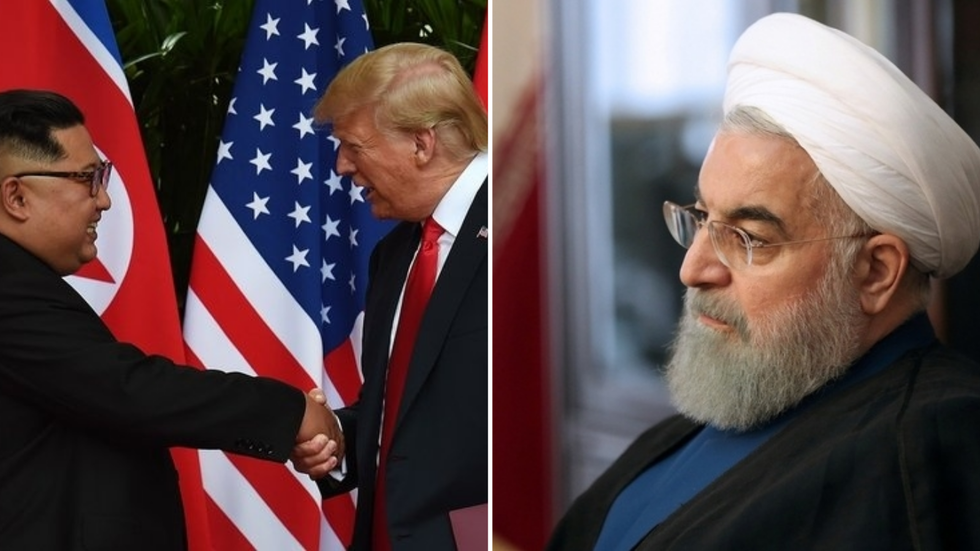
US President Donald Trump and North Korean president (L) and Iranian President Hassan Rouhani (R)
A common refrain is that Iran will utilise so-called proxy forces against US troops stationed in the region, or against its allies. Indeed, some have pinned this latest escalation on such an issue, citing missile deployments amongst Popular Mobilisation Units in Iraq.
However, the use of the term proxy is a misnomer which denies such groups any sense of agency, seeing them as purely subservient to directives coming from Tehran.

Same old fabrications

Any serious analyst of Middle Eastern affairs will tell you that the alleged Iranian support for the Houthis in Yemen is not that of a proxy or client-type relationship, but rather a convenient story to justify one of the most brutal and inhumane conflicts seen in the region, and yet still we see the same old fabrications regurgitated about the levels of Iranian support.
Iran has allies in Iraq and Lebanon, yes, but these are an indelible part of the political fabric in those countries

The PMUs and Hezbollah are political actors in their own right, with their own agency, and while they may be supportive of and receive support from Iran, it does not mean that they are mere proxies – they have their own respective national focuses alongside wider common causes that they share with the Islamic Republic.
Iran has allies in Iraq and Lebanon, yes, but these are an indelible part of the political fabric in those countries.
No one can deny their utility for Iran in helping defend itself, but they are not going to take the sort of pre-emptive action against US troops or interests of which they’ve been accused of preparing for, as this would be a provocation that goes against their own local and wider alliance interests.
They are targeted by the US as a means of pandering to Saudi and Emirati hegemonic desires in the region. Why? Well perhaps we should follow the money.

Transactional Trump

This is what happens when you sell your foreign policy to the highest bidder. It  has been widely reported that high-ranking members of Trump’s team support the Mojahedin-e Khalq, a cult hellbent on overthrowing the Iranian government.
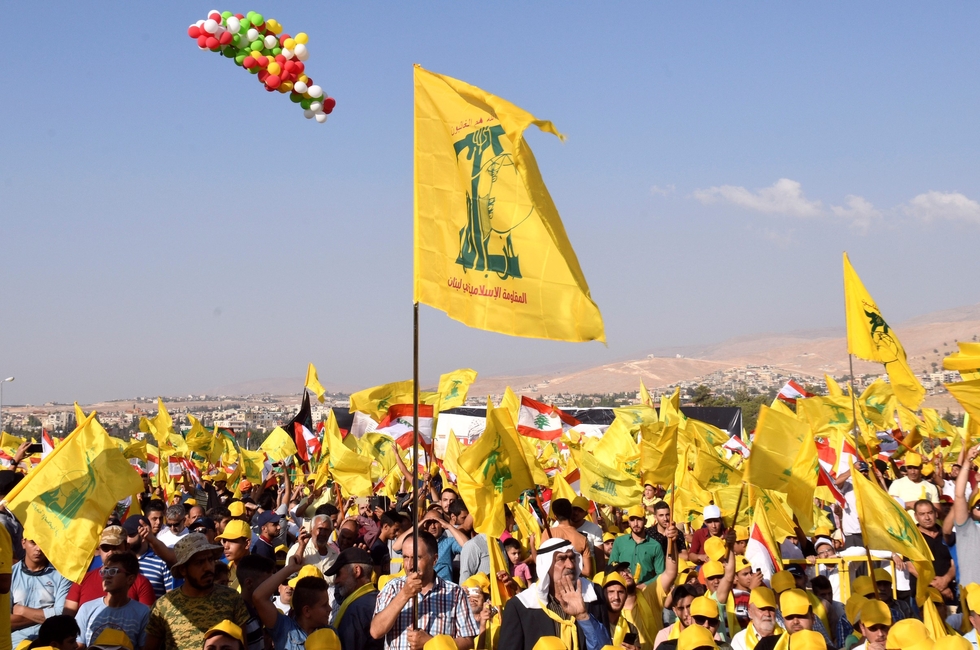
Supporters of Lebanon's Hezbollah display Hezbollah and Lebanese flags in Baalbek in eastern Lebanon, 31 August 2017
Supporters of Lebanon's Hezbollah display Hezbollah and Lebanese flags in Baalbek in eastern Lebanon, 31 August 2017 (AFP)
US thinktanks are awash with money from the Arab side of the Persian Gulf, and still their commentary and partisan analysis pollutes the air waves. The language we see used in the mainstream media is an amplification of these interests.
US foreign policy has become purely transactional under Trump, as his regular boasts about Saudi investment demonstrate.
The result is that the US is in thrall to Saudi and Emirati interests in the region - not that this is anything new of course, but the fact that US allies feel so emboldened as to campaign for US surgical strikes against Iran shows just how entangled their interests have become.
When foreign policy operates in a moral vacuum and reflects the whims and desires of money, there is little room for developing a coherent foreign policy. What we see instead are brazen statements that seek to demonise a country which defends its independence.
It is here where the risk of miscalculation is most fraught, and where the need for sensible mediation by non-compromised actors can help.

A tumultuous chapter

Recent days have seen statements from Iraq and Qatar, Pakistan and Oman about the need to defuse tensions. Europe continues to grapple with ways to salvage the JCPOA, and China has again begun importing Iranian oil, in defiance of enhanced US sanctions against Iran.
Rather, it has utilised multifaceted confessional and cultural linkages and mastered tactful diplomacy as seen with the JCPOA. Its independence necessitates a defensive posture, and any bellicosity from Tehran at this juncture is borne of a desire to defend that independence.These developments shows that far from being the isolated pariah the US wishes it to be seen as, Iran is in fact a normal country with diplomatic allies acting to secure their own national interests. Tehran has not spent 40 years resisting US imperialism in the same way as North Korea, becoming a hermit kingdom in the process.
If world leaders can ride out the tumultuous chapter in US political history that the Trump presidency represents, then we can look forward to sane and reasoned debate when it comes to Iran, hopefully without the constant threat of war. 
Edward Wastnidge
Edward Wastnidge is a Lecturer in politics and international studies at the Open University, UK. His research looks at the politics and international relations of the Middle East with a particular focus on Iranian foreign policy, and cultural diplomacy. He has written widely on Iranian foreign policy and Middle Eastern affairs, and his monograph Diplomacy and Reform in Iran is available through Bloomsbury Press/I.B. Tauris.

Thursday, April 04, 2019

UK's Ex-IAEA Envoy: Trump's Claimed Non-Proliferation Concerns for Discarding JCPOA Just Nonsense

TEHRAN (FNA)- The United Kingdom's former Ambassador to the International Atomic Energy Agency (IAEA) and the UN Peter Jenkins says US President Donald Trump is either intellectually incapable of appreciating the value of the nuclear deal with Iran or has dropped the JCPOA for the sake of personal considerations.
Speaking in an exclusive interview with FNA, Peter Jenkins said Trump's alleged nuclear non-proliferation motive for withdrawing from the Joint Comprehensive Plan of Action (JCPOA) "was and continues to be nonsense".

"What President Trump demonstrated in May 2018 was either that he is intellectually incapable of understanding what the rest of the world understands or that political and personal considerations matter more to him than upholding and preserving international standards," he added.

Following is the full text of the interview, where Trump's plan for transferring nuclear technology to Saudi Arabia alongside his alleged concerns about Iran's nuclear program has come under discussion with Mr. Jenkins:

Q: Democrats express concern that the Trump administration's plan to allow the Saudi regime access "sensitive US nuclear technology" could enable Riyadh "to produce nuclear weapons and further contribute to the proliferation of nuclear arms throughout an already unstable Middle East." How do you evaluate such concerns?

A: One needs to distinguish between different aspects of the nuclear electricity-generation cycle. Saudi acquisition of light water-moderated reactors (LWRs) for electricity production would not in itself allow Saudi Arabia to produce nuclear weapons. Four such reactors are under construction in the United Arab Emirates (UAE) and no one believes that their acquisition will enable the UAE to produce nuclear weapons. What would justify such a fear would be the sale to Saudi-Arabia (KSA) of technology that could be used to extract plutonium from spent fuel (reprocessing technology) (although LWR spent fuel is less rich in plutonium than spent fuel from heavy water-moderated reactors, like the reactor once planned for construction at Arak in Iran). Even more risky would be the sale to KSA of the technology needed to produce the low-enriched uranium that LWRs burn (uranium enrichment technology). This technology can be used, subject only to the rearrangement of centrifuge cascades, to produce the highly enriched uranium that forms the core of one type of nuclear weapon.

If the sale of reactors to KSA goes through, prudence should require that the sale be accompanied not only by appropriate IAEA safeguards provisions but also by a contractual understanding that KSA will rely on the reactor supplier for reactor fuel, and will return all spent fuel to the supplier.

Q: Do you believe that the Trump administration would allow Saudi Arabia to enrich uranium and reprocessing of plutonium by itself?

A: I think it unlikely that the Trump administration will attempt to persuade the US Congress to allow it to sell uranium or reprocessing technology to KSA. One needs to keep in mind the extraordinary influence over U.S. decision-making currently possessed by the government of Israel. It is hard to conceive of Israel viewing KSA acquisition of enrichment or reprocessing technology as anything less than a threat to Israeli security interests. It is much more likely that Israel will bend every sinew to limit any U.S. sale of nuclear technology to KSA to LWRs.

Of course one needs to have in mind that relations between Israel and KSA are currently much warmer than they have ever been. One has to consider the possibility that KSA leaders will try to persuade Israeli leaders that they would have nothing to fear from KSA acquisition of enrichment and/or reprocessing technology. But the love that binds these two rogue states is not blind. Israeli leaders are still capable of realising that their affair may not last and that the day may come when Saudi hearts are once more cold towards Israel. 

Q: In May 2018, Trump withdrew the US from the Iran nuclear agreement for Nuclear Non-Proliferation concerns, while transferring the sensitive US nuclear technology could eventually end up in the acquisition and production of nuclear weapons by Saudi Arabia and trigger nuclear arms race in the Middle East. How could one explain these paradoxical moves?

A: President Trump may have claimed some kind of nuclear non-proliferation motive for withdrawing from the JCPOA, and thereby placing the United States in breach of UN Security Council resolution 2231. But any such claim was and continues to be nonsense. All the other parties to the JCPOA, and an overwhelming number of UN members, see the JCPOA as an agreement that was drawn up to allay concerns about Iran’s commitment to the Nuclear Non-Proliferation Treaty (NPT) and to allow the IAEA to verify that Iran is in full compliance with its NPT obligations. So what President Trump demonstrated in May 2018 was either that he is intellectually incapable of understanding what the rest of the world understands or that political and personal considerations matter more to him than upholding and preserving international standards.

That explains why he might be tempted to sell his KSA friends whatever they want – especially if they are prepared to pay premium prices. However, my guess is that in the end his other close friends, the Israelis, exerting influence directly on administration experts and indirectly through the U.S. Congress, many of whose members rely on pro-Israeli campaign funding, will see to it that this nuclear proliferation risk is averted.