Showing posts with label Iran oil sanctions. Show all posts

Wednesday, May 29, 2019

How the U.S. Regime Uses Sanctions to Soften a Country Up for Invasion

The Wall Street Journal headlined on May 27th, “Iran’s Crude Buyers Jump Ship” and reported that “the country’s direct crude buyers have all but vanished, traders and executives in the Islamic Republic say. … China, India, Turkey, South Korea and Japan have ended all direct purchases of Iranian crude and condensates, they said.” Those buyers had “bought up to 1.6 million barrels a day of Iranian crude in March combined.” In China’s case, the decision to comply with Trump’s sanctions had not yet been known, until “When a Chinese-owned tanker loaded in Kharg in mid-May, it was widely interpreted as a resumption of Beijing’s crude purchases. But the tanker subsequently gave Indonesia as its destination,” and this indicated that the largest importer of oil from Iran, China, is now complying with the U.S. demand to stop trading with Iran. Now that Trump has cancelled all waivers, these countries have added themselves to the list of those which were already complying with the U.S. demand to stop importing Iranian oil. Furthermore, “Chinese companies are no longer buying Iranian crude, businessmen in Tehran say.” The U.S. and Saudi Arabia intend to be selling most of the oil that Iran previously had been selling but now is blocked from selling; so, at the same time as Iran gets strangulated by Trump’s sanctions, America and its chief ally, the Sauds, become further enriched by these sanctions.
The American people seem to be overwhelmingly supporting President Trump’s efforts to strangle Iran. On May 24th, The Hill  bannered “Sanders refuses to apologize for opposing war with Iran”, and the reader-comments there were mostly lukewarm-to-hostile toward Sanders. However, some of the others expressed puzzlement, such as the one that received the most up-votes, “Apologize for not wanting to go to war? What???” Some other commenters explained “What???” such as by saying: “Still wouldn’t want him as president. Not after he voted AGAINST russia sanctions.” That person clearly supports America’s imposing sanctions against countries that never attacked America. Many people are plainly suspicious of any candidate who rejects neoconservatism (U.S. imperialism, regime-change invasions, etc. — U.S. aggressiveness) and they think the person to be weak. The neoconservative Joseph Biden is probably benefiting more from his having supported neoconservatism, against Iraq, Libya, Syria, etc., than Sanders is benefiting from having opposed those invasions. In U.S. politics, the record shows that there is no gain to be won by opposing U.S. aggression. Sanctions are economic aggression: they are the first step toward an outright invasion. Between the sanctions and the invasions comes a crescendo of propaganda in order to whip up ‘patriotism’. It happened with Iraq. It happened with Syria. It happened with Nicaragua. And it could happen with Venezuela, Iran, Russia, China, and/or North Korea.
The U.S. doesn’t follow its Constitution anymore. The Constitution says that the President cannot go to war unless and until the Congress authorizes that by declaring war (which isn’t defined in the Constitution), and “The last time the United States formally declared war, using specific terminology, on any nation was in 1942”, so that all of the roughly 125 U.S. invasions after 1945 were without any legal authorization but instead entirely at the whim of the U.S. President as the Commander-in-Chief, who actually possesses no authorization to declare war, but never do a majority of American subjects oppose that (or any other violation of the U.S. Constitution). For today’s America, Congress’s authorization for sanctions against a country is the new way that Congress declares war against a country, and this path to war requires only a 50% majority in both Houses, and it is stated in a Congressional resolution that the average American won’t recognize as being a declaration of war, though it actually is. To authorize sanctions is now to authorize invasions, coups, or any other way to finalize a regime-change operation. Sanctions are now the way they all start — they are the “Open, Sesame” to American aggression, despite the U.S. Constitution. And the American public basically don’t care.
On May 13th, Reuters headlined “Iran insists on ramping up oil sales to stay in nuclear pact” and reported that “EU officials … estimate Iran needs to sell 1.5 million bpd to keep its economy afloat. A drop below 1 million bpd could bring hardship and economic crisis.”
Prior to U.S. President Donald Trump’s cancellation of the nuclear deal with Iran and re-imposition of economic sanctions against Iran and against any companies that trade with Iran, Iran had been selling around 2 million bpd (barrels per day). So, the subtraction of “1.6 million barrels a day” would, alone, bring this down to 0.4 million bpd. It would be turning the screws so hard that the suffering of Iranians would be unbearable. But look at what Trump and a passive Congress are doing in Yemen, where the U.S. regime supplies the weaponry the training and the Saudis and UAE forces use them to slaughter as many Houthis as they can by bombing the food-supply route. Maybe just starving Iranians won’t seem to Americans to be that bad. American propaganda makes it all seem okay or even good and a necessary thing to do.
Furthermore, quoting again the May 13th article:
Once Europe’s biggest supplier, Iran has seen its exports gradually cut off from European buyers.
China – Iran’s largest oil customer with imports of 475,000 bpd in the first quarter of this year – has also stopped buying from Iran after Washington chose not to renew sanctions waivers.
That’s part of this 1.6M bpd which the WSJ more recently confirmed.
Therefore, companies both in Europe and in China are terminating trade with Iran. The likelihood is consequently that Iran will be forced back into its nuclear program, and that things will be much as they had been before Obama had struck his deal with Iran. Here’s what that situation was like:
Iran’s economy is highly dependent on the production and export of crude oil to finance government spending, and consequently is vulnerable to fluctuations in international oil prices. Although Iran has vast petroleum reserves, the country lacks adequate refining capacity and imports gasoline to meet domestic energy needs. Iran is seeking foreign investment to develop its petroleum sector. While some deals have been finalized, reputational and financial risks may have limited other foreign companies’ willingness to finalize deals.
Trump seems to exceed the hostility toward Iran that Obama and Bush had displayed. If Trump is trying to force Iran to retaliate, then the goal is to use Iran’s retaliation as an excuse for the U.S. military to move in — to invade Iran.
The May 13th Reuters article says “One year after Washington quit the deal, Iran announced on Wednesday steps to relax some restrictions on its nuclear program.”
So: that is already restarting.
OilPrice dot com bannered on 22 April 2019, “Iran Threatens To Block Key Oil Chokepoint If It Can No Longer Export Crude” and reported that, “Iran will block the world’s most important chokepoint for global oil trade, the Strait of Hormuz, if Tehran is barred from using it to export its oil, Navy Rear Admiral Alireza Tangsiri, Commander of the Islamic Revolution Guards Corps (IRGC), said.”
A year ago, on 13 May 2018, Dr. Arshad M. Khan had headlined at Modern Diplomacy, “The Eclipsing Iran Deal: Truth And Consequences” and stated that,
Iran commands the Strait of Hormuz and a blocked Persian Gulf could see a quadrupling or more in the price of oil, bringing the current economic and stock market boom to a crashing end. Missile attacks from Iran and its ally Hezbollah would cause havoc in Israel’s cities. Asymmetric warfare in Syria and Iraq would cost American lives.
On 5 July 2018, Britain’s Guardian headlined “Iran threatens to block Strait of Hormuz over US oil sanctions”, and reported that,
Tehran threatened to block the Gulf passageway in retaliation for Washington’s looming sanctions against Iranian oil exports – a threat the US military said would be immediately countered. … Mohammad Ali Jafari, the Guards commander, was quoted by the semi-official Tasnim news agency as saying: “We will make the enemy understand that either everyone can use the Strait of Hormuz or no one.”
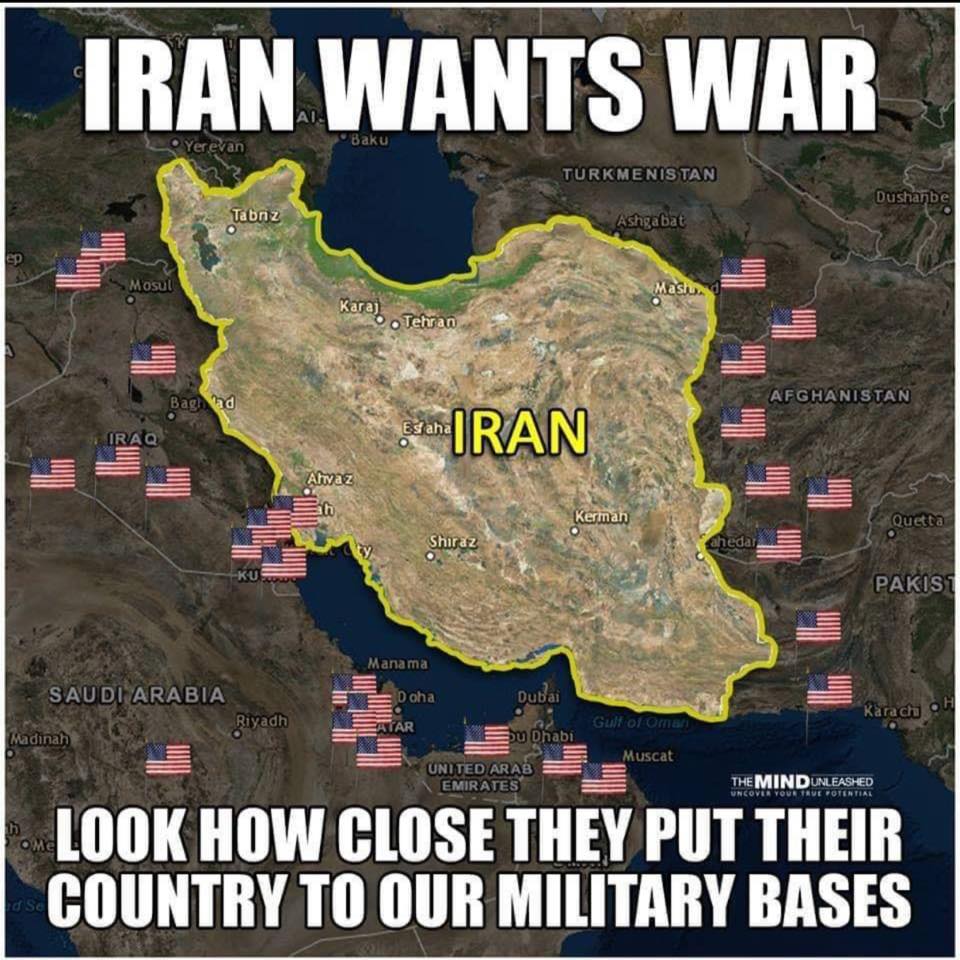
Iran’s fear here is that those “looming sanctions against Iranian oil exports” will be accompanied by a U.S. military blockade in order to enforce the economic sanctions militarily, and not merely by sanctioning both Iran and any company that trades with Iran. That would then be a physical blockade in addition to the economic blockade. In a sense, it would be like what the U.S. and Saudi Arabia and UAE are doing to the residents in the Houthi area of Yemen: starving the people to death.
The Trump regime is clearly hoping for an excuse to invade Iran; and, if Iran blocks the Strait of Hormuz, then Trump and his friend Netanyahu will have their wish, their excuse to invade that country.
Iran is being abandoned now, not only by America’s allies such as in Europe, but even in countries that had formerly been friendly toward Iran, such as China. Trump and Netanyahu are having their way. Iran is apparently trapped, by the two fascist regimes in U.S. and Israel (and not only by the Sauds, who also crave to destroy Iran).
The U.S. regime is additionally trying this strategy against Venezuela, of economically strangling the country with sanctions as a way to soften it up for a subsequent invasion. The excuse for an invasion there will probably be ‘humanitarian’, in order to stop the shortages of food, medicine and other necessities, which shortages are being caused actually by America’s economic sanctions against Venezuela and against any company that trades with Venezuela.
On May 13th, the New York Times bannered “White House Reviews Military Plans Against Iran, in Echoes of Iraq War” and reported that Trump’s team had presented to the President “an updated military plan that envisions sending as many as 120,000 troops to the Middle East should Iran attack American forces or accelerate work on nuclear weapons.” The plan was not for a land-invasion but for an air-invasion: bombers and missiles.
If Russia abandons any of its allies, such as Iran and/or Venezuela, then the U.S. regime will have discredited Russia in the eyes of any remaining allied or even just friendly country, and this too could be part of Trump’s strategy — his expectation that Russia will abandon its allies if the U.S. regime invades one of Russia’s allies.
However, otherwise (in the event that Russia stands with and defends its allies), World War III seems likely.
Under Obama and escalating under Trump, there already are many U.S. sanctions against Russia; so, the start of America’s war against Russia preceded Trump, who merely continues and escalates Obama’s policies regarding Russia — policies that had (and have) overwhelming support from both Parties in both houses of Congress. All of this — against Iran, against Venezuela, and against Russia — is strongly bipartisan. It started with the Magnitsky Act in 2012, which was based on a hoax that became accepted as true and which created the first of now a string of congressionally legislated U.S. sanctions against Russia. It can’t be blamed only on a political Party but on the group of people who basically control both of America’s political Parties, which is America’s 585 billionaires — the people who decide whom their Party will nominate for the U.S. Presidency and for seats in Congress. These policies — fraud-based though all of them actually are — have no opposition from any of America’s billionaires. And here is the latest such fraud.
Those examples show how economic sanctions against a country are the first stage of war by the U.S. regime, an unofficial declaration of war against that ‘enemy’ country and the preparatory stage for a coup, or, if the coup fails to work, then for an invasion. A successful coup happening in any of those countries would be extremely unlikely. Consequently, if Trump is going to be demanding at least one victory, then at least one of those countries will probably be invaded, and Americans will be prepared for it, with intense ‘patriotism’ (though the U.S. Constitution did everything it could to prevent any of this from happening). Maybe the term for that should instead be “nationalism,” and maybe “patriotism” should apply only to people who loathe aggressors and violators of the U.S. Constitution. But, then, there would be very few American patriots around, anymore (if there ever were). Anyway, in our time, America is clearly a dictatorship; so, what the public want is irrelevant to what the rulers do. Politics is just propaganda and theater now, here.
—————

Wednesday, April 24, 2019

Haddad-Adel: Iran seeks strategic ties with China

TEHRAN - Gholam-Ali Haddad-Adel, a member of the Expediency Council and a cultural and political figure, said on Tuesday that Iran seeks strategic and long-standing ties with China.
During a speech at Beijing International Studies University, Hadad Adel said Iran attaches great importance to expansion of cultural relations in order to lay grounds for expansion of ties.
He also praised China’s policy of non-interference in other countries’ internal affairs, describing it as “proper” and “wise” policy.
“We believe that in a world in which nations are suffering from adventurism of some powers, China can help create a balance in the international atmosphere through preventing the world from become unipolar,” he stated.
The former parliament speaker added that Iran and China can establish stable economic relations, suggesting Iran can meet China’s energy needs and China can make investments in Iran.
Hadad Adel noted that Iran prioritizes ties with China in its foreign policy.
The White House announced on Monday that U.S. President Donald Trump has decided not to renew waivers that allow eight countries, including China, to buy Iranian oil without facing Washington’s sanctions.
China’s Foreign Ministry said on Tuesday it has formally complained to the United States over its decision to end waivers on sanctions on Iranian oil imports, Reuters reported.
Geng Shuang, a ministry spokesman, said that China is resolutely opposed to the U.S. enforcing unilateral sanctions.
Trump unilaterally pulled Washington out of the 2015 nuclear deal in May 2018 and ordered reimposition of sanctions against Iran. The first round of sanctions went into force on August 6 and the second round, which targets Iran’s oil exports and banks, were snapped back on November 4.

Monday, March 18, 2019

Energy-Rich Iran on the Threshold of Economic Bonanza Despite Sanctions

By: Kayhan Int’l 

The inauguration yesterday of four new phases of South Pars, the world’s largest gas field in the strategic hydrocarbon processing region of Asaluyeh in Bushehr Province by President Hassan Rouhani, will increase Iran’s gas production capacity by up to 110 million cubic meters per day. 
Iran, which shares South Pars with the Persian Gulf emirate of Qatar, would be operating 27 phases by next March, and expects to exceed gas production at this field by 750 million cubic meters per day by late 2019.
According to Oil Minister Bijan Namdar Zanganeh Iran is all set to produce 950 million cubic meters of gas per day in the next year. 
The steady progress of the Islamic Republic, thanks to indigenous expertise, is indeed a blessing in disguise for the nation, which is the target of the illegal economic sanctions of the roguish US president, Donald Trump.
Actually, the development of Iranian industries, including petrochemicals, is a slap on the face of Washington and indication of the fact that the enemy will not succeed in its nefarious plans.
Although France’s Total and the China National Petroleum Corp (CNPC) suspended investment in phase 11 of South Pars last year after the US threatened to impose sanctions on companies that do business in Iran, there is neither shortage of expertise nor funds to carry on the projects in Aaluyeh, over twelve kilometers of whose coastline on the Persian Gulf is dotted with various petrochemical plants, whose exports have increased by more than 40 percent this year. 
Iran’s proven natural gas reserves are about 1,201 trillion cubic feet or 17.8% of the entire world’s total reserves, making it the world’s second largest country after Russia in terms of gas deposits. In other words, Iran’s gas reserves represent the equivalent of about 205 billion barrels of oil.
To protect its rich resources as well as to ensure the welfare of its citizens, who throughout the length and breadth of the country have been provided access to piped gas, Iran maintains highly alert security forces, both on land and in the waters of the Persian Gulf, in addition to a sophisticated air defence umbrella.
This has frustrated the devilish designs of the US and its agents, who had plotted to deprive the Islamic Republic of its ability to increase natural gas exports, and part of the plots were the crises created in Syria and Iraq, which Iran decisively helped defeat.
Iran, which operates the flourishing 2,577 km long Tabriz-Ankara pipeline for gas supply to Turkey, has embarked on ambitious projects, such as the proposed Iran-Iraq-Syria pipeline (the Friendship Pipeline) running from the South Pars Gas field towards Europe via Lebanon’s Mediterranean coast. 
The planned 5,600 km pipeline, when complete, will also benefit Turkey, and though the Swiss energy company "Elektrizitätsgesellschaft Laufenburg” breached its contract with Iran in October 2010 in the face of US pressures, the Islamic Republic is working on the project, following the agreement it signed with Iraq in June 2013 to fuel power plants in Baghdad and Diyala. 
With the power and prestige of the legal governments of Iraq and Syria growing by the day and the terrorists on the run, this project may soon become feasible, much to the chagrin of Uncle Sam and the illegal Zionist regime.
The Islamic Republic of Iran believes in the collective development of the region, and is willing to share its rich natural resources with the neighbouring countries, including energy-starved Pakistan and India to its east.
True, there is delay for the moment, but the future is exceptionally bright, since economic terrorism of a fast declining power like rank outsider US, will not last long. 

Friday, November 09, 2018

Pakistan in the Middle of Saudi, Iran and Rival Pipeline Plans

Pakistan in the Middle of Saudi, Iran and Rival Pipeline Plans
Pepe ESCOBAR
A tweet roared like announcing a blockbuster premiere and sanctions did engulf Iran on time – despite opposition from Russia, China and the EU-3 (France, Germany and the United Kingdom), who still support the United-Nations endorsed Iran nuclear treaty.
Iranian President Hassan Rouhani has called this an economic war waged by a “bullying power”.
The US has imposed sanctions on Iranian shipping, finance and energy exports, blacklisting 700 people. They target the EU special mechanism to facilitate purchases of Iranian oil, a sort of alternative international payment system, and threats persist about cutting Iran completely off the Swift system (although several Iranian banks are already suspended).
There are also “temporary waivers” related to oil exports granted mostly to China, India, Japan, South Korea, Taiwan and Turkey, plus two Italy and Greece. This means that in the real world, beyond all the bluster, there’s no way to downgrade Iranian oil imports to “zero” without causing a global energy crisis.
The key exemption might as well be Chabahar port in Iran, the cornerstone of India’s own mini-New Silk Road strategy for South Asia and Central Asia, which depends on exports to and across Afghanistan.
In the words of John Bolton, the US National Security Adviser, they seek to achieve a “massive change in the regime’s behavior”.
But is that ever likely to happen? I got a different take on this when I visited a Pakistani courtyard…
Meanwhile, in Islamabad…
It’s a balmy night in an Islamabad courtyard and, punctuated by salutary laughs, a geopolitical carousel develops among some of the sharpest minds in West Asia, Southwest Asia and South Asia. They are  Junaid Ahmad from the School of Advanced Studies at the UMT in Lahore, Professor Mohammad Marandi of the University of Tehran, and Tugrul Keskin, a professor of Sociology at Shanghai University.
A Pakistani, an Iranian, a Turk and this global nomad. Inevitably our conversation swirls around the tasty possibilities of an Ankara-Tehran-Islamabad rapprochement.
We have had the privilege of being part of one of the most extraordinary conferences in recent times, “The Geopolitics of Knowledge and Emerging World Order,” which could not possibly take place in a paranoid West, but only in Asia, at the relatively young National Defense University (NDU) in frontline state Pakistan.
Not to mention the extra bonus of watching Pakistani generals talk about international relations across the Global South from what is a center-left, genuinely progressive perspective.    
The merit for the conference goes to gentleman-scholar Dr Ejaz Akram, professor of Religion and World Politics at the NDU, and a gifted, dedicated team.
Where else to discuss, in the same breath, the unity of Eastern civilizations in a New World Order, as exposed by Prof. Li Xiguang of Tsinghua University and a member of the Chinese Foreign Ministry Advisory Committee or be rocked by Isa Blumi, professor of Turkish Studies at Stockholm University, totally ripping apart Western silence on the genocidal war inflicted on Yemen by the “Saudi-led coalition?”
But for some of us, the real star of the show was a putative, developing alliance that could turn into a crucial game-changer in Eurasia integration. Hopeful signs are on the cards.
Presidents Erdogan and Rouhani have a very good relationship and are both deciders in the Astana process trying to solve the Syrian tragedy. Whatever the pressure, Turkey won’t cease to buy Iranian oil. Iranian Foreign Minister Javad Zarif was in Islamabad last week talking to Prime Minister Imran Khan. Turkey-Pakistan relations are extremely tight.
On a Shanghai Cooperation Organization (SCO) level, Pakistan is a full member, Iran will soon become a full member and Ankara is very much interested – and so are powerhouses Russia and China to have them all together inside the club.
Pakistan and China will start trading in yuan, as announced by Pakistani Information Minister Fawad Chaudhry, who has just extolled an expansion of the China-Pakistan Economic Corridor (CPEC) to agriculture and the construction of industrial zones.
At the China International Import Expo in Shanghai, Imran Khan defined CPEC as a vital link to the Middle East and Central Asia. CPEC is the flagship project of the New Silk Roads or the Belt and Road Initiative (BRI). Iran is a crucial BRI node as well. Turkey, though, is far from being integrated with Erdogan still studying the chessboard.
Still, an irresistible geopolitical pull – heavily influenced by Washington’s sanctions obsession – would drive Turkey-Iran-Pakistan closer to BRI and trading in their own currencies or in yuan.
Spoiler in the room
Of course, daunting pitfalls abound. Pakistan’s foreign policy is largely shaped by the army, where a significant faction just can’t get enough of “gifts” from the US industrial-military complex.
Imran Khan’s position, on the record, is that Pakistan will defend Saudi Arabia against all enemies – the Pakistanis head the Saudi Islamic Military Alliance and their two militaries are very close. But what if Imran, after visiting China and Saudi Arabia, pulls out a stunner and heads to his neighbor Iran?
Iran and Pakistan need a clear understanding about Wahhabi-indoctrinated fanatics using Pakistani Balochistan to wreak havoc in Iranian Sistan-Balochistan, as Imran and Zarif discussed last week in Islamabad.
On the energy front, a major soap opera that I have been tracking for years, the Iran-Pakistan pipeline, could finally be sorted out, much to the benefit of energy-starved Pakistan. The Iranian stretch was finished long ago while the Pakistani sector has been derailed by relentless pressure from Washington.
And that’s exactly where the ultimate spoiler, the House of Saud, comes in.
Pakistani Finance Minister Asad Umar insists Riyadh “did not ask for anything” in return for a crucial $6 billion aid package that includes selling $3 billion in crude oil on deferred payment. Islamabad badly needed it, as its foreign exchange reserves had dropped to a paltry $7.8 billion last week.
Riyadh not asking for anything in return does not cut it. On the energy front, Riyadh is very much aware that last month Tehran and Moscow signed a preliminary agreement with Islamabad to build a 2,775 km-long offshore natural gas pipeline from Iran to India via Pakistan.
The Saudi counterpunch was not less than spectacular; renewed investment to finally build the Turkmenistan stretch of another such link: the Turkmenistan-Afghanistan-Pakistan-India (TAPI) pipeline. The Iran-Pakistan pipeline and TAPI have been in virtual competition since the days of the Dick Cheney regime.
Turkmenistan, the ultimate idiosyncratic regime, has had enormous trouble – with both Iran and Russia, for different reasons – exporting its natural gas wealth. Ashgabat’s only secure market is China. Riyadh believes that by helping Turkmenistan on TAPI, Pakistan will not become too heavily dependent on the Iranian pipeline or the proposed offshore pipeline.
Yet there’s no guarantee that TAPI will ever be completed. TAPI starts at the Galkynysh gas field in Turkmenistan and goes right through Kandahar province in Afghanistan, which remains largely immune to Kabul’s influence. There’s no way a pipeline can be built there without Taliban acquiescence – and that would mean a negotiating process led by the SCO, which neither Russia nor Iran, for energy market reasons, are fond of.
So the key in all these interlocking intrigues is how Imran Khan will decide to position himself – between Iran and Saudi Arabia – for maximum leverage. Riyadh, for all its faults, still carries enormous weight on all matters Pakistani.
Meanwhile, deep in the Persian Gulf, a fleet of large Iranian oil tankers, actually “floating storage containers” as traders call them, have their geolocation devices turned off and stand ready to deliver oil on demand to any sanctioned, un-sanctioned or soon-to-be-sanctioned nation. And that’s a reality no roaring barrage of tweets is able to change.

Saturday, October 27, 2018

How U.S. Policy on Iran Got Stuck Between Saudi Arabia and Kuwait

To make Iran oil sanctions work better, the fields in the 

neutral zone must produce oil. They aren’t.

Jean Paul Getty became the richest man in America, and its first billionaire, thanks to a barren strip of desert where he discovered oil in the 1950s. The land was a “neutral zone” straddling Saudi Arabia and Kuwait—a relic of the time when European powers carved implausible ruler-straight borders across the Middle East. The fields continue to be a tremendous resource: They can pump the equivalent of $15 billion of crude a year at current prices. The famously stingy Getty squeezed oil out of the fields as hard as he could. In contrast, the Saudis and the Kuwaitis aren’t pumping a single barrel nowadays because of a century-old sovereignty dispute, pride, and money.
In other circumstances, the fight over the neutral zone would be an obscure local dispute of interest to a handful of government officials, foreign diplomats, and petroleum executives. But these aren’t normal times in the oil market—or in the Middle East, which is caught up in the policies of President Trump, who has an eye on containing Iran, and Saudi Arabia’s Crown Prince Mohammed bin Salman, who also has an eye on Iran but is surrounded by controversy over the murder of journalist Jamal Khashoggi.
U.S. sanctions on Iran are set to go back into effect in early November. With that already sending oil prices to a four-year high, Washington is encouraging its allies to open the taps fully so supplies can lower prices. The 500,000 barrels a day that the oil fields of the neutral zone could produce—about the same as OPEC member Ecuador—would go a long way to reassure the market that there’s enough additional crude to meet not only the loss of sanctioned Iranian production but also that of any future outage. “There is little spare capacity,” says Jason Bordoff, director of the Center on Global Energy Policy at Columbia University in New York and a former Obama administration oil official. “And that makes the market nervous.”
To get the neutral zone out of neutral, Washington has spent the past several months trying to push Saudi Arabia and Kuwait into a deal to restart the fields, which haven’t produced anything since they were shut down after a series of tit-for-tats in 2014 and 2015. So far, American diplomats have come home empty-handed. In the last attempt at a breakthrough, Prince Mohammed traveled to Kuwait at the end of September to meet the country’s ruler, Sheikh Sabah Al-Ahmed Al-Sabah. What was supposed to be a landmark two-day visit was cut short, with the prince leaving unexpectedly within a few hours of landing in the neighboring nation—without a deal. Privately, oil officials and diplomats familiar with the talks say the meeting went badly, with each side trading barbs.
On Oct. 3, the day after Khashoggi vanished, the 33-year-old prince said in an interview with Bloomberg News that “sovereignty issues” prevented a deal. “We think a 50-year-old issue is almost impossible to fix in a few weeks,” he said. “So we’re trying to have an agreement with the Kuwaitis to continue to produce for the next 5 to 10 years and, at the same time, we work on the sovereignty issues.” To restart the pumps, however, Kuwait wants a deal first.
The neutral zone, spreading over 5,700 square kilometers—an area a bit smaller than Delaware—was created by a 1922 treaty between Kuwait and the fledgling Kingdom of Saudi Arabia. In the 1970s the two nations agreed to divide the area and incorporate each half into their territory, although still sharing—and managing in common—the petroleum riches. The region contains two main oil fields: the onshore Al-Wafra and the offshore Khafji. The latter is now operated by a joint venture between the two countries’ state-owned oil companies. It was Al-Wafra where the disagreement began.
Chevron Corp., the second-largest energy company in the U.S., operates the fields there on behalf of Saudi Arabia. It’s done so since 2000, when it acquired Texaco Inc., which bought the Getty empire in 1984. In 2009, Saudi Arabia extended the original 60-year-old Getty concession, giving Chevron rights over Al-Wafra until 2039. Kuwait was furious over the announcement and claims Riyadh never consulted with it about the extension. The emirate wants the U.S. company to be subject to its laws, according to people familiar with the talks.
The relations between Saudi Arabia and Kuwait over the neutral zone further soured in 2014 when Riyadh unexpectedly shut down the offshore Khafji field, which lay in Saudi Arabia’s sphere of control. The official reason was environmental problems, but the timing was convenient for Saudi Arabia, which was concerned about a glut in the oil market. Kuwait responded a few months later in 2015, forcing the closure of the onshore Al-Wafra field, which is part of the territory that went over to the emirate after the partition in the 1970s. Since then the fields that created Getty’s oil fortune have remained shut. “The impasse between Saudi Arabia and Kuwait seems to have deepened,” says Amrita Sen, of Energy Aspects Ltd., a consulting firm in London.
The implications for Chevron remain unclear. For the moment, not a drop of oil is coming out of the neutral zone. In a statement, the company said it’s “focused on supporting operational activities to maintain readiness for production restart when that time comes.”
Despite pressure from the U.S., a restart is unlikely anytime soon. Expelling Chevron from the neutral zone, as Kuwait may ultimately demand, would cost Riyadh dearly—both in money and pride. Kuwait won’t compensate for it, either. Getty once said that “oil is like a wild animal,” adding that “whoever captures it has it.” In the neutral zone, the Saudis and the Kuwaitis are circling their prey.