Showing posts with label Erdogan. Show all posts

Sunday, November 10, 2019

President Assad: European States Hate Erdogan but Want Him!


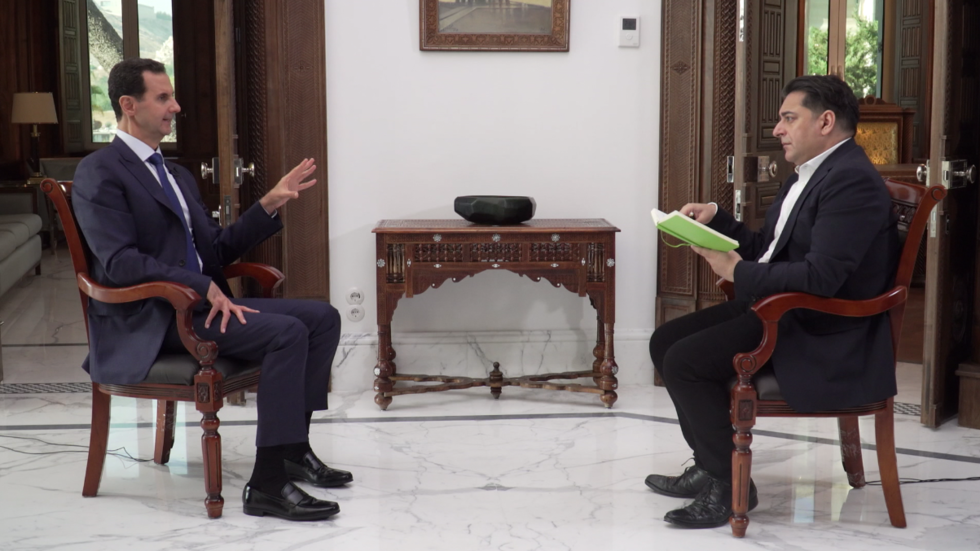
Assad RT interview

Syrian President Bashar Al-Assad in an interview with RT

 Syrian Presdient Bashar Al-Assad slammed as Hypocrisy the way European nations deal with Turkish President Recep Tayyip Erdogan.


In an interview with RT, Assad said it’s hypocrisy for European nations to fear that Ankara will send refugees to Europe, but continue to sponsor terrorism in Syria.
The Syrian leader argued that the primary concern for Europe should not be the Syrian refugees which Erdogan now threatens to release to Europe, but the “hundreds of thousands” of extremists Europe allied itself with.
“How can you fear those few millions, the majority of them are moderates and they have few terrorists, while you support those terrorists directly in tens of thousands at least and maybe hundreds of thousands in Syria and you don’t fear that they’re going to go back to your country?” Assad told Afshin Rattansi in an interview that will be fully broadcast this Monday.
While there might be some extremists among those who fled the war-torn country, the majority of the refugees do not pose any acute threat, as opposed to hardened jihadists who may turn on their patrons, the Syrian leader said.
“Let’s say that sending those Syrians and other refugees is dangerous, the most dangerous [for] Europe is to support the terrorists in Syria, this is the most dangerous part.”
The relationship between Europe and Turkey is love-hate, Assad said. He noted that although the EU “hates” the Turkish leader, European nations cannot but listen to what he has to say.
“Actually, the relation between Erdogan and the EU is two ways: they hate him but they want him.”
Source: RT

Friday, October 11, 2019

The Puzzling Logic Behind Trump’s Syria Withdrawal

Turkish President Recep Tayyip Erdogan (L) shakes hands with US President Donald Trump in Osaka, Japan, on June 29, 2019. Trump has now given Erdogan the green light to go into Syria.
Trump has tossed the ball right back into Erdogan’s court, and given Putin a headache
M.K. BHADRAKUMAR

Wednesday, September 18, 2019

How Russian And Iran Beat Their Opponents' Strategies

By Moon Of Alabama

September 17, 2019 "Information Clearing House" -   Over the last decades Russia and Iran both needed to develop means to protect themselves against an ever growing threat from the United States and its allies. Both found unique ways to build deterrence that fit their situation.
Neither the U.S. nor its allies reacted to those developments by adopting their strategies or military means. It is only recently that U.S. woke up to the real situation. The loss of half its oil export capacity may finally wake up Saudi Arabia. Most other U.S. allies are still asleep.
When NATO extended into east Europe and the U.S. left the Anti-Ballistic-Missile Treaty Russia announced that it would develop countermeasures to keep the U.S. deterred from attacking it. Ten years later Russia delivered on its promise.
It had developed a number of new weapons that can defeat the ballistic missile defense the U.S. installed. It also put emphasis on its own air and missile defense as well as on radar and on electronic countermeasures that are so good that a U.S. general described as "eye-watering".
All this allowed Putin to troll Trump by offering him Russian hypersonic missiles. As we analyzed:
Trump is wrong in claiming that the U.S. makes its own hypersonic weapons. While the U.S. has some in development none will be ready before 2022 and likely only much later. Hypersonic weapons are a Soviet/Russian invention. The ones Russia now puts into service are already the third generation. U.S. development of such missiles is at least two generations behind Russia's.That Russian radar can 'see' stealth aircraft has been known since 1999 when a Yugoslav army unit shot down a U.S. F-117 Nighthawk stealth aircraft. Russian air and missile defense proved in Syria that it can defeat mass attacks by drones as well as by cruise missiles. U.S.-made air and missile defense in Saudi Arabia fails to take down even the primitive missiles Houthi forces fire against it.
Yesterday, during a press conference in Ankara with his Turkish and Iranian colleagues, Putin trolled Saudi Arabia (video @38:20) with a similar offer as he had made to Trump:
Q: Does Russia intend to provide Saudi Arabia with any help or support in restoring its infrastructure?Putin: As for assisting Saudi Arabia, it is also written in the Quran that violence of any kind is illegitimate except when protecting one’s people. In order to protect them and the country, we are ready to provide the necessary assistance to Saudi Arabia. All the political leaders of Saudi Arabia have to do is take a wise decision, as Iran did by buying the S-300 missile system, and as President Erdogan did when he bought Russia’s latest S-400 Triumph anti-aircraft system. They would offer reliable protection for any Saudi infrastructure facilities.
President of Iran Hassan Rouhani: So do they need to buy the S-300 or the S-400?
Vladimir Putin: It is up to them to decide.
Erdogan, Rouhani and Putin all laughed over this exchange.
U.S. allies, who have to buy U.S. weapons, have followed a similar defense investment strategy as the U.S. itself. They bought weapon systems that are most useful for wars of aggression but did not invest in defensive weapon systems that are needed when their enemies prove capable of hitting back.

Are You Tired Of The Lies And Non-Stop Propaganda?
Get Your FREE Daily Newsletter
No Advertising - No Government Grants - This Is Independent Media
That is the reason why Saudi Arabia has more than 350 modern fighter planes but only relatively few medium and long range air defense systems that root back to the 1970s.
The Saudi air defense is only able to protect certain economic and social centers. Most of its borders and its military bases are not covered.
[T]he point-defense layout of the network leaves large portions of the nation undefended by strategic SAM assets. While aircraft can be called upon to defend these areas if required, the presence of large gaps in the nationwide air defense picture leaves numerous vulnerabilities open to exploitation by a foreign aggressor.
Saudi air defense as documented by Amir at Iran GeoMil.
Moreover the protection it has in place is unidirectional. The red circles designate the theoretical reach of the U.S. made PAC-2 air defense systems installed at their center. But the real reach of these systems only cover less than a half-circle. The PAC-2 and PAC-3 systems are sector defenses as their radars do not rotate. They can only see an arc of 120°. In the case of the Saudis those radars only look towards the east to Iran whcih is the most likely axis of attack. That left the crude oil processing plant in Abqaiq completely unprotected against attacks from any other direction. Neither Saudi Arabia nor the U.S. know from where the attack really came.
The Russian experience against the U.S. directed drone swarm attacks against its airbase Hmeymim in Syria showed that short range air defenses and electronic countermeasures are the best defense against mass drone and cruise missile attacks.
Saudi Arabia does not have short range air defenses against drones and cruise missiles because the U.S. does not have such systems. It also does not have sophisticated electronic countermeasures because the U.S. can not provide any decent ones.
What the Saudis need are the Russian Pantsyr-S1 short range air defense, dozens of them, and the Krasukha-4 electronic warfare system. The Russian may well offer at least the first item. But would the U.S. allow the Saudis to buy them?
Saudi Arabia, like the U.S., never took its opponents serious. It bombed Yemen to smithereens and never expected to be hit back. It long rallied the U.S. to wage war on Iran but took little measures to protect itself from an Iranian counter reaction.
After the long range attack from Yemen in August it was warned that the Houthi's missile reach had increased. Saudi Arabia ignored the warning and it took zero notable measures to protect Abqaiq processing center which is a choke point for half its income.
Iran, in contrast, developed its weapons along an asymmetric strategy just as Russia did.
Iran does not have a modern airforce. It does not need one because it is not aggressive. It has long developed other means to deter the U.S., Saudi Arabia and other opponents in the Middle East. It has a large number of self developed medium range ballistic missiles and a whole zoo of short to medium range drones and cruise missiles. It can hit any economic or military target within their 2,000 kilometer reach.
It also makes its own air defenses which recently enabled it to take down an expensive U.S. drone. Here is General Amir Ali Hajizadeh, the commander of IRGC's Aerospace Force, explaining how that was done (video, engl. subs).
Iran developed relations to friendly population groups in other countries and trained and equipped them with the necessary defensive means. These are Hizbullah in Lebanon, various groups in the Syria, the PMG/Hashd in Iraq, the Houthi in Yemen and Islamic Jihad in Gaza.
None of these groups is a full proxy for Iran. They all have their own local politics and will at times disagree with their big partner. But they are also willing to act on Iran's behalf should the need arise.
Iran developed a number of weapons exclusively for its allies that differ from the ones it itself uses. It enables its partners to build those weapons themselves. The cruise missile and drones that the Houti in Yemen use are different from the one Iran uses for its own forces.
New drones and missiles displayed in July 2019 by Yemen’s Houthi-allied armed forces
Iran has thereby plausible deniability when attacks like the recent one on Abquiq happen. That Iran supplied drones with 1,500 kilometer reach to its allies in Yemen means that its allies in Lebanon, Syria and Iraq and elsewhere have access to similar means.
The Saudis long failed to take Iran's counter strategy into considerations just like the U.S. failed to consider the Russian one. Both will have to change their aggressive strategies. Both will now have (re-)develop real defensive means.

Sunday, April 07, 2019

Kurds in Fateful Triangle as US Moves to Redeploy IS Terror Groups

Kurds in Fateful Triangle as US Moves to Redeploy IS Terror Groups
FINIAN CUNNINGHAM
Kurdish fighters have been used by the US to ostensibly defeat the remaining Islamic State holdouts in eastern Syria. But what is emerging is not a final defeat of the terrorists, more a redeployment to further destabilize the Arab country.
Potentially, the Kurds could wind up not with the regional autonomy they desire, but as part of a rebranded American dirty war army whose ranks include the very terrorist the Kurdish militias have been successfully battling against.
President Donald Trump has been lately crowing about how US-backed Kurdish forces have wiped out the IS self-proclaimed caliphate around Baghouz in eastern Syria. “They’re losers… they’re gone tonight,” he boasted about supposedly vanquishing the jihadists.
However, things are not that clear-cut. Syria’s envoy to the United Nations Bashar al Jaafari dismissed Trump’s victory celebrations as a “bluff”. He said that IS was not defeated in areas under US control, but rather were being shunted off to various camps for retraining.
There are credible reports that thousands of jihadists who surrendered or were captured in the fighting around Baghouz have since been relocated by US forces to its military base at al Tanf near the border with Iraq and Jordan, as well as to nearby refugee camps such as Rukban, where some 40,000 detainees are held. Suspiciously, the Americans are refusing international access to these camps, even for UN humanitarian relief agencies. As Russia’s Foreign Minister Sergei Lavrov pointed out recently, the detention centers are being used by the Americans as a pretext for illegally occupying Syrian territory.
We can also add the purpose of clandestine military recruitment for US proxies.
Despite Trump’s announcement four months ago that US military was pulling out of Syria, there seems no sign that his plan is being implemented. That’s why Moscow reacted angrily to Washington’s demand for Russian troops to leave Venezuela. The Kremlin responded testily that the US should first deliver on its promise to withdraw from Syria, where its forces are illegally present unlike Russian personnel in Venezuela under bilateral agreement.
In Syria’s supposedly post-war scenario what seems to be happening is the US seeking to find a way to reconfigure its destabilizing intervention in the Arab country. The past eight years of US-sponsored covert war has failed in its objective for regime change against President Bashar al Assad, who is allied with Russia and Iran. What the US is aiming to do now is keep military footprints in the country, effectively annexing swathes of territory, especially in the oil and gas-rich eastern region around the Euphrates River.
That accounts for why supposedly defeated enemy terrorists are being retrained by US special forces at al Tanf. They are reportedly being tasked with capturing the oil and gas fields in Deir ez-Zor province as well as production infrastructure in Homs province.
This puts the Kurdish forces in an invidious position. There is little doubting the courage and fighting ability of the Kurdish men and women who make up the Syrian Democratic Forces (SDF) and its spearhead YPG militias. The Kurds have managed to liberate up to 30 per cent of Syria’s territory in the northeast and east from the IS jihadists. They have dealt a decisive blow to the residual caliphate at Baghouz. American air power augmented the Kurds in their offensive.
But what the US is maneuvering to do is to combine the defeated jihadists with the Kurds in order to push its agenda for breaking up Syria and controlling its eastern mineral-rich resources.
The Special Monitoring Mission to Syria reports that IS militants captured by the SDF are being redeployed by the Americans for seizing oil and gas production facilities.
Still another crucial objective for Washington is to control the Deir ez-Zor east-west corridor from Iraq to Damascus so as to contain Iranian presence in Syria.
This is the context for Trump’s brazen declaration recognizing Israel’s annexation of Syria’s southern Golan Heights. Washington’s game plan is to keep Syria destabilized and fragmented, partly to appease Israel and partly for the US’s own imperial designs for dominance in the region.
In this insidious US maneuvering, the Kurds face a potentially treacherous situation. They have been well armed and supported by Washington, but are finding they are being used like a disposable asset. The Kurds may have calculated that accepting Washington’s patronage in recent years was a way to earn political capital for building a future separate independent Kurdish state. What seems to be emerging, however, is that the Americans only intend to exploit the Kurds as a fighting force to do its dirty work of breaking up Syria – in the same way that the Americans have covertly used jihadist terror groups in other parts of Syria.
The Kurds have been very effective in routing IS in the latter’s remaining strongholds in eastern Syria. But the result is the Kurds are being used as a recruitment agency for the Americans to redeploy the “defeated” terrorists in its ongoing covert war against the Syrian state.
There are signs, though, that the Kurds are well aware of the treacherous danger in dealing with Washington. When Trump made is troop withdrawal announcement, there were palpable concerns among the Kurds about being betrayed to the mercy of Turkey. Turkish President Recep Tayyip Erdogan has repeatedly threatened to send his military forces into Syria to crush the SDF and YPG militia whom Ankara views as “terrorist” affiliates of its own separatist Kurdish movement, the PKK.
It’s not clear if the US will implement a withdrawal of its estimated 2,000 troops in Syria. There are indications it won’t happen, despite Trump’s claims. Nevertheless, the surprise announcement was enough to undermine Kurdish confidence its patron. With the result that Kurdish leaders have begun reaching out to the Assad government in Damascus in the hope of dialogue producing a future federal arrangement.
The Kurds have reportedly requested Russia to mediate with the Syrian government.
Kurdish forces have not heretofore been at war with the Syrian Arab Army. They share the same common enemy of IS and assorted jihadist terror groups.
In the past, President Assad has rebuffed Kurdish aspirations for regional autonomy. But apparently, Damascus has shifted to be more open on forming a new federal constitution for Syria in which the Kurds would gain important regional independence – in a way analogous to the Kurdish Regional Government in northern Iraq.
In this fateful political triangle that the Syrian Kurds find themselves, they would be advised to throw their lot in with the Damascus government. If a mutual pact could be established that would bring the two major chunks of Syria’s territory back into territorial integrity.
If, on other hand, the Kurds accede to Washington’s nefarious agenda, they run the risk of losing independence and being eviscerated from exploitation in endless dirty-war machinations by the Americans. An ominous sign is that after bravely fighting to rout IS, the Kurdish militia are being set up to form a devil’s bargain with the same terrorists – to satisfy Washington’s geopolitical interests.
The Kurds would do well to remember a cynical maxim in Washington, whereby the US “does not have allies, only interests”.

Friday, March 22, 2019

Muslims urge fight on Islamaphobia, slam West after carnage

Muslims urge fight on Islamaphobia, slam West after carnage

Iran’s Foreign Minister Mohammad Javad Zarif says certain countries in the West must be held accountable for an attack on two mosques in New Zealand, which left at least 50 worshipers dead.
"The terrorist attack in New Zealand represents a very dangerous tide in the West that is Islamaphobia," he said in Istanbul where the Organization of Islamic Cooperation (OIC) held an emergency meeting Friday. 
Certain Western officials and institutions, he said, are aiding and abetting crimes against Muslims with their silence.
Zarif criticized "those who prevent citizens of Muslim countries from entering their countries," referring to US President Donald Trump and "those who prevent the use of Islamic symbols in their countries," meaning Europeans.
"Unfortunately those who claim to be promoting freedom of speech are both suppressing the freedom of expression of Muslims and allowing all forms of insult against Muslims in the name of the freedom of expression," he said. 
"And we are seeing the consequences of this in various parts of the West," Zarif added.
The minister said the OIC emergency meeting in Istanbul came on Iran's request during his phone conversation with Turkish Foreign Minister Mevlut Cavusoglu last week after the New Zealand massacre. 
"Our Turkish friends, given the sensitivity they have toward the issue, announced holding this ministerial meeting within a couple of hours after our conversation. This was a very good step taken by the Turkish government," Zarif said. 
"At this meeting, we plan to try to establish a consensus not only to condemn this (terrorist attack in New Zealand), but also to take necessary measures for the Islamic countries to prevent the repetition of such events," he said.
"With OIC ministers in Turkey; all condemn barbaric Christchurch terror against Muslims & seek to unite against dangerous tide of racism & Islamophobia in the West," Zarif tweeted later.
In his speech to the OIC meeting, Turkish President Tayyip Erdogan called for a global fight against rising Islamophobia, saying Muslim nations cannot allow "this brutal terror attack to be forgotten."
"Just as humanity fought against anti-Semitism after the Holocaust disaster, it should fight against rising Islamophobia in the same determined fashion," Erdogan said. 
"Right now we are facing Islamophobia and Muslim hatred," he said, adding far-right neo-Nazi groups should be treated as terrorists in the same way as Daesh extremists.
The Turkish president also said the reaction and empathy shown by New Zealand Prime Minister Jacinda Ardern following the attack should be an example to world leaders.
New Zealand’s foreign minister arrived in Turkey early Friday for “substantial” talks after comments made by Erdogan over the killing sparked a diplomatic spat between the nations.
Representatives from the UN, the European Union, and the Organization for Security and Cooperation in Europe (OSCE) also participated in the event.

Thursday, January 17, 2019

Trump, Bolton and the Syrian Confusion

It’s a messy, though typical picture.  US President Donald Trump wants to pull out forces in Syria.  When announced in December, jaws drooped and sharp intakes of breath were registered through the Washington establishment.  Members of the military industrial complex were none too pleased.  The President had seemingly made his case clear: US blood and treasure will not be further drawn upon to right the conflicts of the Middle East.
His national security advisor, John Bolton, prefers a different message: the US will not leave north-eastern Syria till the militants of Islamic State are defeated and the Kurds protected.  If this was a message of intended confusion, it has worked.  The media vultures are confused as to what carrion to feed upon. The US imperial lobby is finding the whole affair disruptive and disturbing.  Washington’s allies attempt to read the differences between policy-by-tweet and policy by representation.
Trump’s pre-New Year announcement suggested speediness, a rapid removal of US forces supposedly indispensable in Making America Great Again.  Once made, US troops were to leave in a matter of weeks – or so went a certain wisdom.  “They’re all coming back, and they’re coming back now,” ventured the president.  But Bolton suggested otherwise.  US personnel, he suggested, would remain in al-Tanf to counter Iranian influence.  Timetables could be left to the talking heads.
A change of heart also came from the White House, with Trump asserting that, “We won’t be finally pulled out until ISIS is gone.”  To reporters, he adopted a familiar stance in ever shifting sands: promising to do something meant doing something different. “We are pulling back in Syria.  We’re going to be removing our troops.  I never said we’re doing it that quickly.”
On Sunday, Trump delivered another streaky note on Twitter, thereby adding another lace of confusion. “Starting the long overdue pullout from Syria while hitting the little remaining ISIS territorial caliphate hard, and from many directions.”  Last Thursday, information on the withdrawal of some US military ground equipment from Syria was noted.  On Friday, Col. Sean Ryan, spokesman for the US-led coalition in Syria, issued a statement claiming that the coalition had “begun the process of our deliberate withdrawal from Syria” leaving little by way of details.  In Trumpland, the scanty detail often prevails over the substantive.
US strategy in the Middle East has tended to revolve around setting up figures for the fall while inflicting the fall of others.  The Kurds have tended to find themselves in that role, encouraged and prompted to take up arms against their various oppressors, only to find themselves left to the slaughter in the subsequent geopolitical dramas of the region.  The promise by Great Britain and France at the conclusion of World War I that a Kurdish state be chalked out of the remains of the Ottoman Empire never materialised.  In the crude machinations of international relations, they have remained, as Joost Hiltermann describes them, the “expendable” ones.
Bolton is keen not to make that same mistake, which is exactly why he risks doing so.  The great enemy of the Kurds on this occasion remains a prickly US ally, Turkey.  “We don’t think the Turks ought to undertake military action that’s not fully coordinated with the agreed to by the United States”.
Trump, similarly, suggested in a direct call with the Turkish president that the Turkish economy would be devastated “economically if they hit Kurds.”  In a statement from White House press secretary, Sarah Sanders, “The President expressed the desire to work together to address Turkey’s security concerns in northeast Syria while stressing the importance to the United States that Turkey does not mistreat the Kurds and other Syrian Democratic Forces with whom we have fought to defeat ISIS.”
Bolton’s credibility in pursuing that agenda seemed to crumble in Ankara before a notable snubbingby Turkish President Recep Tayyip ErdoÄŸan on January 8.  The national security advisor had to make do with a meeting with ErdoÄŸan’s senior advisor, Ibrahim Kalin. Bolton was not one the Turkish leader particularly wanted to see in light of his comments that Turkey not harm members of the Kurdish Syrian militias in the aftermath of the US withdrawal.  Such views also fly in the face of Turkey’s self-appointed role as an agent of influence in the region.  An absent Washington is simply too good a chance to press home the advantage, and Ankara is bound to capitalise.
Secretary of State Mike Pompeo did not fare much better in his regional whistle-stops in Egypt Jordan, Iraq and the Gulf states.  In Cairo, Pompeo denied that there was any “contradiction whatsoever” about Trump’s position on withdrawal.  “I think everyone understands what the United States is doing.”  If not everyone, then at the very least, “the senior leaders in their governments”.  Very good of them.
The views of American functionaries have not necessarily meant much in the righteous intent of other powers, but Bolton is nonetheless happy to pen his name to this mast.  He wishes for the Kurds to hold firm, avoid the temptation of seeking another sponsor who just might do a better job.  “I think they know,” suggested Bolton, “who their friends are.”  (Bolt is more than nudging here, making sure the Russians or the Assad regime are avoided in any future security arrangements that might supply a shield for the Kurds.)
Daft, can be Bolton, who sees himself as a true appraiser of the international relations system when he is disabled by presumption.  The Turks may, in time, hand Washington another bloody lesson of retribution showing that basic, keen hatreds in historical dramas are far more significant than sophisticated notions of self-interest.  The presence of US troops in Syria will no doubt be reclassified, withdrawal by which any other name would be as confusing.  The Kurds will have to chew over their options with the sort of caution nursed by a history of promise followed by abandonment.  Be wary of the expendable ones.
Dr. Binoy Kampmark was a Commonwealth Scholar at Selwyn College, Cambridge.  He lectures at RMIT University, Melbourne.

Sunday, December 23, 2018

Iran-Turkey Ties Model for Regional Peace & Development


By: Kayhan Int’l 

Iran and Turkey may agree differ on certain issues, but the issued on which they agree far exceed the points of trivial difference, and this augurs good for bilateral ties bilateral ties between the two mature Muslim neighbours sharing a myriad of commonalities as well as for the region and the whole Islamic Ummah.
Last Thursday’s summit between President Hassan Rouhani and his host Rajab Tayyeb Erdoghan as part of the 5th Session of the High Council of Iran-Turkey Strategic Relationship, underscored these points and should be considered a slap on the face of the US, which has a black, bleak and bloodied record of meddling in West Asia.
We are not concerned here with the sanctions the Don Quixote in the White House has illegally imposed on Iran, neither with the US decision to end the illegal presence of its troops in Syria, nor with the American Senate’s vote to end support for Saudi state terrorism in Yemen.
For us what matters most is the importance of Iran’s principled policies to safeguard national and Islamic interests as well as the peace and stability of the whole region.
Tehran’s wisdom, whether in Syria and Lebanon, or whether Palestine and Yemen, is indeed paying rich dividends.
Whatever the Islamic Republic has done was and is doing, is to the benefit of the people of the said countries, and this reality has finally been understood by Turkey, whose president agreed with his Iranian counterpart and stressed that neither the American meddling in the region is welcome (including Washington’s roguish action in moving its embassy from Tel Aviv to the occupied Islamic city of Bayt al-Moqaddas – Jerusalem), nor the legitimacy of Trump’s economic sanctions against Iran.
The two countries thus intend to increase the volume of their trade ties to as much as 30 billion dollars per year, without regard for US threats and pressures.
This was evident in Dr. Rouhani’s talks in Ankara where he said: "Iran is capable of supplying energy to Turkey in the long run,” adding that solidifying ties between the two countries is of vital importance to the whole region in view of the fact that Iran and Turkey serve as a bridge connecting Asia with European
The stage is now set for proper coordination and cooperation, as was shown last week during the foreign ministerial meet of Iran, Turkey and Russia, for resolving the crisis in Syria.
The Tehran-Ankara model of cooperation should serve as a pattern for promotion of ties among the other countries of the region, which has into turmoil because of the mischief of the unholy trinity – Saudi Arabia, the US, and the illegal Zionist regime.
To be brief, the region needs major steps by mature regional leaders in order to salvage from the harm done by reactionary regimes led by murderous maniacs that do not represent the people they rule and despite their kowtowing to the West, are merely looked upon as mere milk-giving cows worth nothing once their milk runs dry.

Thursday, November 29, 2018

White House Desperate to Rein in Saudi ‘Loose Cannon’: US Analyst

TEHRAN (Tasnim) – An American political analyst said the White House now views Saudi Crown Prince Mohammad bin Salman as a “loose cannon” who has turned into an “international liability”, adding that Washington is trying to keep a tight rein on him.


“Well, I think there is a number of issues going on. First of all, we have to 
understand the relationship between Saudi Arabia and the United States. 
Saudi Arabia is probably one of the United States' closest allies in the 
Middle East along with Israel. And Saudi Arabia is also a major export 
market for American armaments. Recently, there was a multibillion-dollar 
arms deal between the United States and Saudi Arabia and this is a major 
boom to American arms manufacturers. This is essentially a foreign export 
market for armaments that is underwritten by the American government. So, 
there are a lot of vested interest who want to preserve this relationship,” 
Keith Preston, the chief editor of AttacktheSystem, told Tasnim.

The United States and Saudi Arabia are connected at every level, he added.
Referring to the situation in Yemen, Preston described it as serious.
“That is now the worst humanitarian crisis anywhere in the world. And 
it's become something bringing a lot of international criticism to the Saudis. 
It's gotten to the point even that the American media cannot ignore what is 
happening in Yemen. Until very recently, America's media almost never 
reported on anything to do with the war in Yemen not even the anti-Trump 
media. I mean much of the media in the United States is affiliated with the 
Democratic Party, which is the opposition party to the president’s 
administration, but even those networks did not report what was happening 
in Yemen. But that changed recently. Recently MSNBC, actually did run a 
story about what's happening in Yemen. So, the Yemen situation has gotten 
so bad that it can't be ignored by American policy makers or by the American 
media.
“As far as the Khashoggi incident (is concerned), he, Mohammad bin Salman, 
made a mistake of having someone killed who was actually a prominent 
American journalist. Even though he was in Saudi Arabia, he had been living 
in United States for years and actually written for some major newspapers. 
So, this is not someone that they can just hush up or sweep under the rug. 
Particularly, because of the role of the Turks in this, because the Turks 
actually may have recordings of this and that, and they have been, the 
Turks, the Turkish government has actually been providing this to the 
international media and the Turkish government I think by the way 
is being very shrewd. What they are trying to do is trying to work and 
drive a wedge between the Americans and the Saudis and they are 
playing this strategically very well. But this has gotten to be a situation 
that United States simply can't ignore and now a bill has been introduced
 in the American Senate, legislation has been introduced that would halt arm 
sales to Saudi Arabia. ... If it passes, the president, Donald Trump, would have
 to sign again the legislation. So, this is still something that is in the works.”
Noting that the prince has overstepped certain boundaries, Preston said, 
“I think the best probable solution that the Americans ultimately prefer and 
I suspect that behind the scenes the Americans are working with the 
Saudi Royal family to work to have this individual removed from power”.
Watch the full interview here: http://tn.ai/1886993

Friday, September 07, 2018

Tehran summit to neutralize US regional coalition: Expert


Tehran, Sept 7, IRNA - An international affairs expert says the Tehran summit of the presidents of Iran, Russia and Turkey can neutralize the coalition formed in the region against Iran's regional policies and carry a message that Iran is not alone in Syria.

Morteza Makki, an expert on international affairs said the tripartite summit of the heads of state of Iran, Russia and Turkey, is the third of its kind to be held within the framework of the Astana process to coordinate efforts aimed at restoring security and stability to Syria.

Unlike previous round of talks held in various cities of the world over the past few years which failed to end the Syria crisis, the negotiations held in Astana with participation of three guarantor states - Iran, Russia and Turkey- have so far helped the process of establishing peace in Syria.

The summit assumes extra importance given the fact that the Syrian province of Idleb, as the last region controlled by the terrorist organizations, has come under siege and countdown has started for its liberation.

Considering that efforts are underway to minimize civilian casualties during operations to liberate the province, it is important for the three guarantor states to make last coordination to ensure that peace process would enter its final stage and this issue tops the agenda of the Tehran summit meet.

Makki maintained 'Syria issue is not the sole axis of Tehran talks. The three countries of Iran, Russia and Turkey have numerous points in common the most important of which is that all three states have been sanctioned by the United States. The trio will try to minimize the impacts of sanctions through trilateral cooperation.'

He said the trend of cooperation among the three countries is of importance because by devising a financial mechanism they can somehow decrease the impacts of the sanctions. 

On Iran's role in eliminating terrorism in the region, Makki said the three countries through their coalition have taken strides in the fight against terrorism and in restoring stability to the region to the dismay of the Arab-US coalition. They have also prevented Baghdad and Damascus from falling into the hands of Daesh terrorists. This was a victory for Tehran and a big disappointment for them.

President Hassan Rouhani of Iran, President Vladimir Putin of Russia and President Recep Tayyip Erdogan of Turkey are to gather together in Tehran Friday for exchange of views on the process of fighting terrorism and establishing security in Syria.