
By Ramin Hossein Abadian
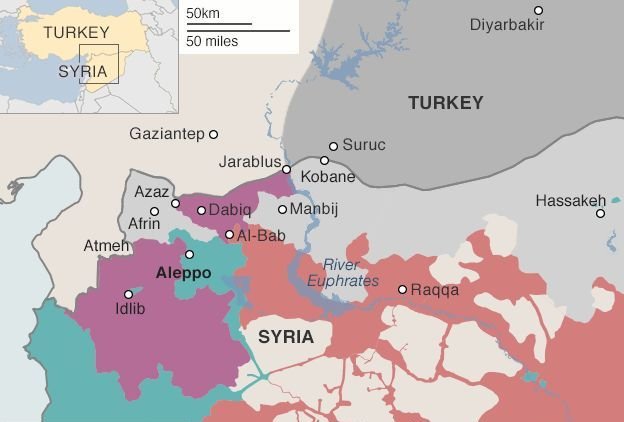
TEHRAN - The eastern Euphrates, which is under the control of the U.S. allies, has taken the attention of most regional actors in Syria.
The region has the largest and most important oil fields, particularly al-Omar filed, which before 2011 produced around 300 barrels of oil per day.
Al-Raqqah, alone, has 70 percent of Syria’s water resources, not to mention its fertile land for agricultural products. The area accounts for one-third of Syria’s fertile land and plays a big role in Syrian food and economy.
Al-Raqqah, also called Raqqa, is a city in Syria located on the northeast bank of the Euphrates River, about 160 kilometres east of Aleppo. It is located 40 kilometres east of the Tabqa Dam, Syria's largest dam.
The area also contains 90 percent of Syria’s gas and oil revenue and over half of the country’s wheat and cotton. Deir ez-Zor province, in eastern Euphrates, is the second most prominent Syrian province in terms of area (about 33,000 square kilometers). Most of the Syrian oil production comes from these areas, and it also is the richest source of Syria's gas.
After the Syrian army defeated terrorists in various parts of the country, especially on the outskirts of Damascus and in the south, and made advances in the depths of As-Suwayda, two regions are still not in the control of the Syrian government. One is the province of Idlib that based on Putin and Erdogan agreement it is kept a weapons-free area, despite the attacks carried out on the Syrian army's positions there by the terrorists. Some Syrian military experts, including the Brigadier General Hamdan believe that the Syrian army will soon embrace Idlib too.
General Hamdan said, “Terrorist activities that resulted in the deaths of 18 Syrian soldiers and the failure of other players to subside terrorism have put a halt to the ceasefire in Idlib. Thus, the final operation by the Syrian army is approaching fast.
Syrian army, as we have repeatedly said, continues on the path of self-restraint, but it seems the purpose of the moves is to bring all parties to war in Idlib, be it with a political reason, for exploiting the military movements of the Syrian army politically or with the aim of targeting more Syrian army personnel, militarily.
The goal of the Russian moves in the next few weeks before the coming New Year is to gain more international support for the region in bringing an end to the daily activities of terrorists. And that is only possible when everyone takes responsibility for their own action. In a clearer sense, provokers must be put in a bottleneck and pushed aside.
The U.S., the greatest supporter of terrorism, is the only actor that gets benefit from terrorist acts in Idlib, and therefore is seeking to defeat the military victories of the Syrian army and the political achievements of Damascus.”
Syrian actors’ view of eastern Euphrates
The other area, out of the Syrian army’s control, is the eastern Euphrates that all actors of the Syrian affairs are keeping an eye on. This region has its own story. The other day, Recep Tayyip Erdogan, Turkish President warned the U.S. and said “no one can turn Turkey into their own backyard.”
Turkey's Defense Minister Hulusi Akar, who was attending Halifax International Security Forum in Canada, expressed indignation at photos showing U.S. troops dining with Kurdish militants near the Turkish border in Syria and said, “We expect U.S. to stop cooperation with the YPG terror group as promised.”
“These photos have found wide coverage in our media and disturbed our people. They tarnished the image of the U.S. and its army... for the Turkish public. It is unacceptable for the U.S. to provide arms and ammunition by plane and trucks to the YPG terrorist group even when Daesh has been neutralized to a large extent. We will not allow the formation of a terrorist corridor on our southern border,” Akar said.
It seems that north-east of Syria, where the U.S.-backed Kurds are present, will face new developments, as Ankara has threatened to intervene in the area, and Damascus has announced to send the Syrian forces to east of Euphrates after the liberation of Idlib.
The Syrian newspaper Al-Watan has quotes the Syrian opposition as saying, “Turkey intends to attack the Syrian Democratic Forces, SDF, in Tel Avia, located on the southern border of Turkey, where these Kurds are supported by the U.S.”
Turkey has told armed groups in Idlib, and in the western and northern Aleppo that they are ready to move to the east of Euphrates to confront the Kurdish forces who are in control of the area. Erdogan is seeking an invasion of Kobai as a starting point for moving to other parts of eastern Euphrates to dominate the border areas in the second phase.
In October, the Turkish army struck Kurdish positions in eastern Euphrates, coinciding with the statement made by Turkish President Erdogan on the determination of his country to overcome Kurdish forces in eastern Euphrates.
This is while the U.S.-backed Kurdish forces, SDF, in northern Syria also stepped in and patrol the area which invited Erdogan criticism, saying that that joint U.S.-Kurdish patrols just over the Turkish border with Syria were unacceptable and that he expected U.S. President Donald Trump to stop them.
This is while the U.S.-backed Kurdish forces, SDF, in northern Syria also stepped in and patrol the area which invited Erdogan criticism, saying that that joint U.S.-Kurdish patrols just over the Turkish border with Syria were unacceptable and that he expected U.S. President Donald Trump to stop them.
Iran-Syria-Russia axis
Meanwhile, Damascus considers the military presence of the U.S. and Turkey illegitimate in the country. The Syrian army has announced that the next step will be eastern Euphrates after the liberation of Idlib. If the area east of the Euphrates were not given to the Syrian government, this will led to the confrontation between the Syrian army and U.S.-backed.
Syrian President Bashar al-Assad warned U.S.-backed Kurdish forces. “We're going to deal with it by two options: the first one we started now opening doors for negotiations, because the majority of them [SDF] are Syrians. If not, we're going to resort ... to liberating those areas by force”, Assad said.
Moscow, on the other hand, considers the U.S. actions in eastern Euphrates to be an attempt to create a region separate from Syria, and considers it unacceptable. Russia’s Foreign Minister Sergey Lavrov said on Oct. 12, 2018: “In eastern Euphrates, the situation is such that there are inevitable actions. And the United States seeks to exploit this land through its Syrian allies, in particular the Kurds, to create a region similar to that of the country.”
But Iran has consistently stated that the presence of the United States is in the eastern Euphrates as an occupation. Iran's President Hassan Rouhani during the Tehran summit saw the post-Idlib phase against the Syrian army as the U.S. forces in the east of Euphrates.

