Showing posts with label Finian Cunningham. Show all posts

Tuesday, October 15, 2019

Russia to Salvage US Mess

By Finian Cunningham


 "Information Clearing House" -  It’s going to be a precarious balancing act, but only one nation can possibly help bring stability to the chaos unleashed in Syria by US President Donald Trump. That’s Russia.

Reports of a deal brokered over the weekend by Russia between Syrian government forces and Kurdish militia are a prelude to a wider effort by Moscow to achieve full peace in the war-torn country. That constructive role played by Russia is no doubt due to the mutual respect it holds among warring sides.The deal brokered by Russia will allow the Syrian Arab Army to take over control of northern border areas with Turkey which were formerly under the control of the Kurds. Since Trump threw the Kurds under the bus last week and effectively green-lighted the incursion into Syria by Turkish forces, the Kurds have had to subsequently align with the Syrian government. Russia was crucial to facilitating the new alliance.
With the Kurdish areas returning to the control of the central government in Damascus – after five years of US-backed Kurdish occupation – that arrangement of a fully integrated Syrian territory is not just legally proper. It also could placate Turkey’s long-held demands for security regarding Kurdish militants, whom Ankara accuses of being “terrorists” trying to destabilise Turkey.
incursion into Syria by Turkish forces, . With the Russian-backed Syrian army on the border facing Turk forces, it is a fair bet that Turkey’s President Recep Tayyip Erdogan will think twice about escalating the incursion. Having had the Kurdish autonomous area dismantled and under control of Damascus again, the Turkish leader should feel assured to back off from further military action. Again, we may reasonably surmise that Russian President Vladimir Putin has quietly, but firmly, told Erdogan to calm down. Perhaps Putin is the only person whom the bullish Erdogan will heed at this point.
One thing is apparent though. The US and its European allies are a more than ever exposed as a hopeless bunch of losers whose criminal meddling and mischief in Syria, and more widely across the Middle East, leave them without a shred of credibility to resolve conflict.
“This is a monumental failure on behalf of the United States”, commented Aaron Stein of the US-based Foreign Policy Research Institute think-tank, as quoted by Reuters.
Stein added that “it would be the Syrian government or Russia, not American sanctions, that could stop the Turkish operation… The only thing that will stop them is if the [Syrian] regime or the Russians move in significant numbers to where they stop”.

Washington and its European allies have created the entire bloody mess in Syria with their criminal, covert war for regime change against Syrian President Bashar al-Assad since the war on that country erupted in March 2011 – with as many as 600,000 dead. The Americans and other NATO powers have secretly weaponised jihadist terror gangs for their regime-change plot – an intrigue which failed because of Russia’s military intervention from the end of 2015 in order to defend the Syrian nation.

The US and its NATO cronies also used Kurdish militants as proxies to break up Syria’s territorial unity. Officially, Western governments and media claim that the Kurds fought a war against jihadist terrorism. That may be partly true in the murky world of running anti-government insurgents. But, primarily, the Kurds were used by Washington to annex Syrian territory, especially the oil-rich and water-abundant northeastern regions. In doing that, however, the Americans antagonised Turkey by mobilising the Kurds and affording them a de facto state within the Syrian state.
Trump’s sell-out of the Kurds last week by withdrawing American special forces in the region aligned with them has unleashed the mayhem and violence seen over several days. Trying to claw back some credibility, the Trump administration is now moving to heap tough economic sanctions on Ankara to “wreck the Turkish economy”.
European states have also clamoured with condemnation of Turkey for its military operations against the Kurds, which have resulted in many civilian deaths and tens of thousands of terror-stricken refugees fleeing from the violence.
Germany, France, Netherlands, Norway and others have announced suspension of arms exports to Turkey.
This is an incredible debacle. NATO members are bickering with and sanctioning fellow NATO member Turkey. There are even reports of Turkish artillery shelling positions near American special forces to cut them off from their former Kurdish ally.
Meanwhile, Turkey’s Erdogan has basically told Washington and the Europeans to shove their sermonising and hypocrisy. Erdogan knows that the Americans and Europeans have blood on their hands from sponsoring Syria’s covert war, just as he does too.
Washington has no moral authority whatsoever to unravel the mess it has engendered in Syria.
Russia can salvage the disastrous situation because it has earned respect from all sides due to its principled and powerful military deployment in Syria. Moscow will want to avoid delving in too deeply whereby it ends up in a war with Turkey on Syria’s border. Somehow, however, Russia has the right balance between respect, diplomatic intelligence and power to salvage the morass made by America and its NATO cronies.
If peace can be settled between Syria and Turkey and Syria’s territorial integrity restored, then Russia stands to emerge with newfound status in the Middle East as an honest broker and neighbour – unlike the scoundrels barking in Washington and European capitals.

Finian Cunningham has written extensively on international affairs, with articles published in several languages. He is a Master’s graduate in Agricultural Chemistry and worked as a scientific editor for the Royal Society of Chemistry, Cambridge, England, before pursuing a career in newspaper journalism. He is also a musician and songwriter. For nearly 20 years, he worked as an editor and writer in major news media organisations, including The Mirror, Irish Times and Independent.

Saturday, September 21, 2019

Uncle Sam Scapegoats Iran


By Finian Cunningham

September 18, 2019 "Information Clearing House" -  Following the devastating airstrikes on Saudi Arabia’s oil industry, US Vice President Mike Pence flexed his tough-talking muscles, vowing that his country is “ready to defend our interests and allies… make no mistake about it.”

Don’t you think the assurance is a bit late? Saudi Arabia – a historic and key ally of Washington – had its entire oil production knocked out by 50 per cent last weekend when it came under aerial attack. Global markets were rattled over possible critical fuel shortages as the world’s biggest exporter of crude oil might not recover full production for weeks.

So, Pence’s stern words of being “ready to defend” certainly ring a bit hollow, if not rather farcical. If Washington was indeed on sentry duty for the Middle East, as it has appointed itself to do decades ago, why weren’t the airstrikes on Saudi Arabia’s vital oil industry intercepted to prevent the havoc wreaked?

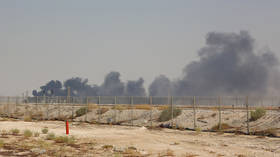
We are not talking here about some remote oil field or installation. The infrastructure targeted for massive damage was at the very heart of Saudi’s oil industry. The Abqaiq refinery and processing plant is where up to 70 per cent of all Saudi crude is prepared for export. It is said to be the biggest crude oil processing plant in the world. And it is near to other vital refining and shipping facilities in Saudi Arabia’s Eastern Province adjacent to the Persian Gulf.
The Yemeni Houthi rebels claimed responsibility for the air raids last weekend, which also targeted a major oil field at Khurais, located in Eastern Province, not far from the Abqaiq processing plant. The Houthis said the blitz was conducted with 10 unmanned aerial vehicles (UAVs). The distance covered from Yemen is nearly 1,000 kms. It is thought that the Yemeni rebels have developed drones capable of reaching up to 1,500 kms. What’s more, they have threatened that all key Saudi oil infrastructure is vulnerable to future attacks.

Potentially, a new wave of airstrikes from Yemen using more sophisticated drone models could bring the Saudi rulers to their knees from their oil economy being decimated.

What must be deeply troubling for the Saudis is that their lifeline oil economy seems to be defenceless – despite having spent hundreds of billions of dollars on US anti-missile systems. Months after Donald Trump took office in early 2017, recall how he boasted about the Saudis buying over $100 billion in Pentagon weaponry.
That’s why VP Mike Pence’s stirring words of “defending allies” sound ridiculous.
It also suggests that’s why US intelligence and military officials are hurriedly trying to blame Iran for carrying out the latest attacks. If the rag-tag Houthi rebels from war-torn Yemen can penetrate US-backed air defences to demolish Saudi oil infrastructure, then American anti-missile technology is more over-rated and much worse in practice than many had already suspected.

President Trump has been a little more circumspect about blaming Iran for the air assaults, but senior administration officials like Pence and Secretary of State Mike Pompeo and Defense Secretary Mark Esper have come out forcefully claiming that Iran is responsible. Iran denies any involvement and says that the US is “in denial” about the fact that the Yemenis are capable and entitled to defend themselves in a more-than-four-year military operation launched on their country by the US-backed Saudi military coalition in March 2015.

US intelligence and military sources are briefing American media outlets that the airstrikes were carried out with drones and cruise missiles fired from southwest Iran. No evidence has been presented, as usual from these anonymous and faceless US spooks; the only “evidence” so far are satellite images of the damaged oil installations. Those images are far from conclusive. The attacks could have come from the southerly direction of Yemen.

But here’s the thing. If drones and cruises missiles were launched from  Iran, as the US is claiming, then their flight path would have come within close range of the American Navy’s Fifth Fleet headquarters base in Bahrain which is near to Saudi’s Eastern Province and its oil infrastructure.

The US Fifth Fleet is responsible for “securing” the entire Middle East and in particular the strategically important Persian Gulf waterway where a third of all globally shipped oil is daily transported. It is the world’s premier chokepoint for oil trade.
Is it really plausible that a swarm of drones and cruise missiles allegedly transiting from Iran across the Gulf within a few hundred kilometres of the US Fifth Fleet – with all its warships, radar, satellite and detection technology bristling – were not detected in flight heading for Saudi Arabia?

If Iranian drones and missiles were detected then we can be sure US officials would be blaring the information, categorically pinpointing the incriminating evidence. As it is, American officials and their intelligence sources are so far peddling vague accusations against Iran based on dubious satellite images.
That suggests that Iran’s denials are credible and that the Houthis’ version of events is closer to the truth. They hit Saudi Arabia’s “crown jewels” and the Saudis’ supposed protector, the US, could do nothing about it.

Finian Cunningham has written extensively on international affairs, with articles published in several languages. He is a Master’s graduate in Agricultural Chemistry and worked as a scientific editor for the Royal Society of Chemistry, Cambridge, England, before pursuing a career in newspaper journalism. He is also a musician and songwriter. For nearly 20 years, he worked as an editor and writer in major news media organisations, including The Mirror, Irish Times and Independent.

Friday, September 20, 2019

Yemeni Killer Blow to House of Saud


Finian CUNNINGHAM
The Yemeni rebels’ drone blitz on the “nerve center” of Saudi Arabia’s oil industry was a devastating counter-offensive which potentially could end the four-year war in short order. What is even more catastrophic for the Saudi monarchy – especially the ambitious Crown Prince – is that the Houthi rebels have wielded the ultimate power to crash the kingdom’s oil economy.
Crown Prince Mohammed bin Salman (MbS) was the main architect of the disastrous Saudi war on Yemen. His military hard-man display was meant to consolidate his rise to power as heir to the Saudi throne. It was a calculation based on the blood of the Yemeni people. But now the war has gone from a callous game to a far-more dangerous threat to the House of Saud’s seat of power. If the Saudi oil economy is put at severe risk, then the lifeline for the monarchy is liable to be cut.
After last weekend’s spectacular air strike on the main oil processing plant in Saudi Arabia – northeast of the capital Riyadh, some 1,000 kms from Yemen – the Houthi military leadership is warning that more deeply-penetrating aerial attacks are on the way. The Yemeni rebels have demonstrated that nowhere in Saudi Arabia is safe.
Saudi air defenses and their multi-billion-dollar US Patriot anti-missile systems have been rendered useless against an-ever increasing arsenal of more sophisticated unmanned aerial vehicles (UAVs) operated out of Yemen. UN experts reckon that the Houthis’ UAV-X drone has a range of up to 1,500 kms, which means that all of the Saudi oil infrastructure located in the Eastern Province near the Persian Gulf is a viable target.
Last weekend’s air strikes carried out with 10 drones, according to the Houthis, caused Saudi oil output to shut down by nearly half. The main target – the Abqaiq refinery – processes some 70 per cent of all Saudi crude destined for export. It is not clear when the processing plant can be restored to normal function. It may take weeks or even months. But if the Yemeni rebels can inflict that extent of damage in one air raid, it is not hard to foresee how the Saudi oil-dependent economy could conceivably be brought to a crippling standstill.
“The only option for the Saudi government is to stop attacking us,” said a Houthi military spokesman following the drone strikes. The rebels also warned foreign workers in Saudi Arabia associated with the country’s oil industry to vacate.
The Yemenis have a gun to the House of Saud’s head. It must give the rebels great satisfaction to finally have the Saudi monarchy in their cross-hairs after four years of Yemen suffering relentless aerial bombardment and siege by the US-backed Saudi military. The Saudi-led war on its southern neighbor – the poorest country in the Arab region – was always an outrageous aggression under the guise of supporting the return of a corrupt crony who had been ousted by the Yemenis in early 2015. Up to 100,000 people have been killed – most of them from the indiscriminate bombing campaign by Saudi (and Emirati) warplanes supplied and armed by the US, Britain and France. Millions face starvation in what the UN calls the worst humanitarian crisis for many years.
The Saudi rulers, Western governments and media have tried to obscure the genocidal war on Yemen as a “proxy war” involving Iran, as if Tehran is the instigator of subverting Saudi Arabia from the south. Iran backs the Houthis politically, and perhaps also militarily more recently, but any involvement by Tehran is a reaction to the initial Western-backed Saudi aggression against Yemen.
Claims by US and Saudi officials that Iran is responsible for the latest air strikes on Saudi Arabia’s vital oil industry are more of the same obfuscation. Such muddying of the waters is an attempt to distract from the central point that the Houthis are retaliating with the legitimate right of self-defense after years of merciless slaughter inflicted on their people by the Western-backed Saudi coalition.
There’s another urgent reason for why the Saudi rulers and the US are trying to blame Iran for the latest drone attacks on the Saudi oil industry. If admitted that the air raids were carried out primarily by the Houthis – perhaps even with Iranian drone technology – then that admission points to the complete vulnerability of the Saudi oil economy and the very power structure of the monarchial rulers.
A hint of the trepidation being felt in Riyadh are reports that the latest air strikes have rattled stock markets for Saudi petrochemical companies. Worse, it is also reported that the attacks may delay the planned stock market listing of Saudi Aramco, the state-owned oil company. Worse still, the valuation of the company may be slashed due to the perceived risk from further Yemeni air strikes.
The planned Initial Public Offering (IPO) of Aramco – whereby the Saudi state is selling a portion of the company to private investors – has been one of the most talked about events in recent years among international business. The IPO which is due to be launched next year has been called the “biggest-ever” stock market sell-off.
In an extensive interview with Bloomberg in October last year, the Saudi Crown Prince, MbS, boasted that it was the “biggest IPO in human history”. He claimed then that Aramco’s total valuation was worth $2 trillion. If the Saudis sell off a 5 per cent share in the company, they are expecting to raise $100 billion in cash. The Aramco IPO is central to MbS’ ambitious diversification master plan for the entire Saudi economy, known as Vision 2030. The capital raised from the Aramco sell-off is intended to catalyze private sector employment and technological innovation in the oil-dependent kingdom whose budget is unsustainably propping up government-sector jobs and welfare largesse to prevent the young population of Saudis rebelling against the sclerotic House of Saud.
After the Houthis’ devastating air attacks on the Saudi oil heartland – the crown jewels of the kingdom – potential investors are now reportedly looking warily at the future risk of Aramco. Valuation of the company in the aftermath of the Yemeni drone strikes has been slashed by some estimates to $300 billion – that’s down by 85 per cent from the previous aspired-for $2,000 billion. If that downgrade holds or worsens with future Houthi attacks on Saudi oil infrastructure, then the capital raised from an IPO could shrink from the $100 billion projected by the Crown Prince to $15 billion. In short, his Vision 2030 plan is down the pan.
It must be alarming to the young Saudi potentate that US President Donald Trump has begun to play down any retaliation against Iran, saying that he doesn’t want to be drawn into a war.
That means the Saudi monarchs are on their own and at the mercy of the Houthis and what they do next. The downfall of the scheming Crown Prince evokes a Shakespearian drama of treachery.

Wednesday, September 18, 2019

US defense failure… Why Washington has to blame Iran over Saudi attacks

Finian Cunningham

US defense failure… Why Washington has to blame Iran over Saudi attacks

The devastating blitz on Saudi Arabia’s oil industry has led to a flurry of accusations from US officials blaming Iran. The reason for the finger-pointing is simple: Washington’s spectacular failure to protect its Saudi ally.
The Trump administration needs to scapegoat Iran for the latest military assault on Saudi Arabia because to acknowledge that the Houthi rebels mounted such an audacious assault on the oil kingdom’s heartland would be an admission of American inadequacy.
Saudi Arabia has spent billions of dollars in recent years purchasing US Patriot missile defense systems and supposedly cutting-edge radar technology from the Pentagon. If the Yemeni rebels can fly combat drones up to 1,000 kilometers into Saudi territory and knock out the linchpin production sites in the kingdom’s oil industry, then that should be a matter of huge embarrassment for US “protectors.”
American defense of Saudi Arabia is germane to their historical relationship. Saudi oil exports nominated in dollars for trade – the biggest on the planet – are vital for maintaining the petrodollar global market, which is in turn crucial for American economic power. In return, the US is obligated to be a protector of the Saudi monarchy, which comes with the lucrative added benefit of selling the kingdom weapons worth billions of dollars every year.
According to the Stockholm International Peace Research Institute, Saudi Arabia has the world’s third biggest military budget, behind the US and China. With an annual spend of around $68 billion, it is the world’s number one in terms of percentage of gross domestic product (8.8 per cent). Most of the Saudi arms are sourced from the US, with Patriot missile systems in particular being a recent big-ticket item.
Yet for all that financial largesse and the finest American military technology, the oil kingdom just witnessed a potentially crippling wave of air assaults on its vital oil industry. Saudi oil production at its mammoth refinery complex at Abqaiq, 205 miles (330 kms) east of the capital Riyadh, was down 50 per cent after it was engulfed by flames following air strikes. One of the Saudi’s biggest oilfields, at Khurais, also in the Eastern Province, was also partially closed.
There are credible reports that the damage is much more serious than the Saudi officials are conceding. These key industrial sites may take weeks to repair.
US Secretary of State Mike Pompeo got it half right when he claimed, “Iran launched an unprecedented attack on the world’s energy supply”.
Yes, it is unprecedented. But Pompeo and other US officials have most likely got it wrong about blaming Iran.
Some Trump administration officials told US media that “cruise missiles” were responsible for the giant fireballs seen over the Saudi oil facilities. One was quoted anonymously as saying: “There’s no doubt that Iran is responsible for this… there’s no escaping it. There is no other candidate.”
In a hurried effort to substantiate accusations against Iran, satellite images were released which show what appears to be the aftermath of the air strike on the Abqaiq refinery complex. US officials claim the location of the explosions indicate the weapons originated not from Yemen to the south, but from either Iran or Iraq. 
Even the normally dutiful New York Times expressed doubt about that claim, commenting in its report: “The satellite photographs released on Sunday did not appear as clear cut as officials suggested, with some appearing to show damage on the western side of facilities, not from the direction of Iran or Iraq.”
The accusations made by Pompeo and others are assertions in place of substantiated claims.
It is noteworthy that President Donald Trump refrained from openly blaming Iran by name, merely hinting at the possibility. If Pompeo is so adamant in fingering Iran, why didn’t Trump? Also, the president made a telling remark when he said he was “waiting for verification” from Saudi Arabia “as to who they believe was the cause of the attack.” Again, if US officials are explicitly accusing Iran then why is Trump saying he wants “verification” from the Saudis?
For its part, Iran has flatly dismissed the allegations that it had any involvement, saying that statements by Pompeo were “blind” and tantamount to setting up a conflict.
Iraq’s Prime Minister Adel Abdul Mahdi also rejected claims that his country’s territory might have been used by pro-Iranian Shia militants to launch the air strikes.
The Houthi rebels in Yemen have issued unambiguous statements claiming responsibility for the air raids on the Saudi oil installations. They were specific that the weapons were drones, not missiles, adding with details that 10 unmanned aerial vehicles (UAVs) were deployed.
Notably too, most US media reported initially that the attacks were by drones flown from Yemen. Associated Press reported a level of sophistication in the attacks whereby drones were used first to disable the US Patriot radar systems before other UAVs proceeded to execute the air strikes. 
It therefore seems that US officials are attempting to switch the story by blaming Iran. It is reckless scapegoating because the logical consequence could elicit a military attack against Iran, in which event Tehran has warned it is ready for war.
The rationale for blaming Iran is that the Yemeni rebels (which Iran supports politically) are just not capable of using drones with such dramatic success against the Saudi oil industry. The culprit must be Iran, so the rationale goes. This is a follow-on from alleged sabotage by Iran against oil tankers in the Persian Gulf earlier this summer.
However, a timeline shows that the Houthis are more than capable of launching ever-more powerful ballistic missiles and deeper penetrating drones into Saudi territory. The rebels have been using drones from the beginning of the war which the US-backed Saudi-UAE coalition launched on the southern Arabian country in March 2015.
Over the past four years, the Houthi aerial firepower has gradually improved. Earlier, the Saudis, with American defense systems, were able to intercept drones and missiles from Yemen. But over the last year, the rebels have increased their success rate for hitting targets in the Saudi interior, including the capital Riyadh.
In May this year, Houthi drones hit Saudi Arabia’s crucial east-west pipeline. Then in August, drones and ballistic missiles were reported to have struck the Shaybah oil field near the border with the United Arab Emirates (UAE), as well as the Dammam exporting complex in Saudi Arabia’s Eastern Province. 
The Yemenis claim they are taking the war to Saudi Arabia and the UAE after years of relentless air strikes on their homeland which have resulted in nearly 90,000 dead. A recent UN report censured the US, Britain and France for possible complicity in war crimes through their military support for the Saudi coalition.
There must be trepidation among the monarchs in Saudi Arabia and the UAE that the rebels from war-torn and starving Yemen are now coming after them with drones that could demolish their oil economies. What’s more, the much-vaunted American protector is not able to deliver on its strategic bargain, despite billions of dollars of Pentagon weaponry. That’s why Washington has to find an excuse by casting Iran as the villain.
Finian Cunningham
Finian Cunningham is an award-winning journalist who has written extensively on international affairs.

Sunday, August 04, 2019

Pompeo ‘Happy’ to Pontificate in Tehran, Revealing US Tyranny of Arrogance


Finian CUNNINGHAM
Imagine the spectacle. US Secretary of State Mike Pompeo sitting in Tehran and telling the Iranian people via a state media interview how “evil” their government is. No wonder tensions with Iran are reaching a flashpoint when Washington is so arrogant and delusional.
Last week, Pompeo told US media he was willing to go to Iran despite the Americans having no diplomatic relations with Tehran. Pompeo was not intending to suddenly meet with Iranian officials. Instead he wants a putative visit to Tehran to be an occasion to get on state media and address the Iranian people “directly”.
In response to a question about whether he was prepared to go to Tehran, the American top diplomat said: “Sure. If that’s the call, I’d happily go there… I would welcome the chance to speak directly to the Iranian people.”
“I’d like a chance to go [to Tehran], not do propaganda but speak the truth to the Iranian people about what it is their leadership has done and how it has harmed Iran,” he added.
That’s not diplomatic outreach. It is simply about seeking the chance to pontificate in Tehran. Despite claiming he would “not do propaganda”, the talking points that Pompeo would regurgitate on Iranian media would be the usual baseless slander that has become Washington’s standard depiction of Iran. A depiction that Pompeo as well as President Donald Trump have personally propagated.
Iran, according to Washington dogma, is an evil terrorist-sponsoring regime that ruthlessly represses its 80 million people, fueling conflict all over the Middle East, and secretly building nuclear weapons. Typically, the Americans never provide any evidence to substantiate their caricature of Iran. It’s merely a “truth” solidified by relentless repetition of hollow allegations. In short, propaganda.
And Pompeo wants to insult the intelligence of Iranians by being given a pulpit on Iranian state media.
By saying he wants to “speak directly” to the Iranian people, Pompeo is adverting to the real US agenda of fomenting regime change.
America’s official arrogance and hypocrisy are boundless. Every malign activity that Washington accuses Iran of can be thrown straight back at the US with manifold more accuracy of facts. The US has destroyed the Middle East with numerous criminal wars and covert regime-change operations, has sponsored terrorists as its proxies, and has fueled the danger of nuclear war by illegally arming Israel with hundreds of weapons of mass destruction.
President Trump has sinisterly alluded to potentially using WMD against Iran in recent weeks, threatening to deploy overwhelming force “to end the regime”.
Admittedly, the American president has at times said he is open to talks with the Iranian government. His “offer” is unconvincing of an intention for genuine dialogue. Trump expects Iran to come to the negotiating table in an act of surrender and self-debasement to accept his terms of “disarmament”. All the while using the threat of annihilation as a bargaining tool.
Moreover, Pompeo expressed his entitlement to lecture the Iranians and urge them to liberate themselves from a “theocratic tyranny” because, he said, the Iranian foreign minister Mohammad Javid Zarif is allowed “the freedoms of the United States to come here and spread malign propaganda”.
Pompeo was referring to an official visit to the US earlier this month by Zarif who was attending the United Nations in New York City for a diplomatic conference. All foreign diplomats have a sovereign right to attend the UN. Pompeo’s remarks indicate a presumption that the US government has dominion over the UN and international law.
The alleged “malign propaganda” that Pompeo accused Zarif of spreading was an interview he conducted with the NBC news channel at the Iranian ambassador’s residence. During that interview, Zarif did not unload on the litany of factually verifiable war crimes that the US is culpable of.
What Zarif said was a model of restraint and diplomacy. He said that if the US lifted crippling sanctions off Iran, then the “door is wide open” for future negotiations.
Calling for the avoidance of war, the Iranian diplomat pointed out that it was the United States, not Iran, that had undermined diplomacy by walking away from the 2015 nuclear agreement between Tehran and world powers, reported NBC.
“It is the United States that left the bargaining table. And they’re always welcome to return,” Zarif added.
What Pompeo calls “malign propaganda” many other people would view as an accurate, if restrained, telling by the Iranian diplomat of how it really is.
Given the unlawful aggression that the Trump administration is wielding against Iran in terms of economic warfare on the country’s vital oil trade and in terms of military force buildup in the Persian Gulf, including nuclear-capable B-52 bombers, what Iran is demonstrating is an immense discipline to maintain regional and world peace.
Iran’s conditions for possible negotiations are eminently reasonable. They include being respected as a sovereign nation and entering into dialogue as a mutual party where discussions can be held on the basis of facts and international law.
Pompeo’s supreme arrogance about America’s presumed exceptional entitlements and superiority are, unfortunately, a sign that Washington is incapable of being a normal state. The real “theocratic tyranny” is in Washington where it has the perverse belief that it has divine right to destroy other nations if they don’t grovel sufficiently at its feet. But those feet are made of the proverbial clay signifying a doomed power, as Iran’s dignity and defiance is revealing.

Sunday, July 21, 2019

UAE Pullout From Yemen Less About Peace, More About War With Iran

Finian CUNNINGHAM
The surprise pullout of troops and warplanes from Yemen by the United Arab Emirates has been interpreted as a “peace move”, or at least a tacit admission of defeat. But, more plausibly, the timing of the withdrawal seems more to do with the UAE redeploying forces at the behest of the United States in order to ramp up military pressure on Iran.

The UAE has been a major actor in the US-backed Arab military coalition, along with Saudi Arabia, which has been waging a war in Yemen for the past four years to oust the Houthi rebel government in Sanaa. The Emiratis and Saudi Arabia want to reinstall an exiled clique which the Houthis kicked out of Yemen at the end of 2014. The US, Britain and France have backed the anti-Houthi coalition with massive arms supplies and logistics for a relentless air war campaign.
Despite the relative lack of Western media coverage of the conflict, Yemen has become widely seen as a horrendous humanitarian disaster. Nearly half its population of 24 million are suffering from critical food and water shortages. The Western-backed coalition has also been blamed for war crimes from indiscriminate air strikes on civilian centers. The war has been described as an “un-winnable quagmire” for the Saudis and Emiratis, not unlike Vietnam was for the Americans.
So, when an Emirati official was quoted last week as saying the withdrawal from Yemen was motivated by bolstering a United Nations-sponsored peace plan, a more skeptical reading would be that the UAE simply wants to get out of a futile and costly war. Thus the move is less about peace and more about saving face for the Emiratis. But there also seems to be a bigger geopolitical picture concerning US designs to confront Iran.
It is reported that the Saudis are not happy about the Emiratis turning their back on active involvement in the war. Understandably too, because the Saudis will have to deploy more financial resources and forces to fill the gap left behind. The Yemen quagmire can only get deeper and more miserable for the Saudis. That suggests Riyadh is being left in the lurch.
Although the UAE is aligned with Saudi Arabia as part of the pro-US Gulf Arab monarchies, including Kuwait, Bahrain, Qatar and Oman, there are nevertheless petty rivalries for power and regional influence. Saudi Arabia is often resented for its overbearing dominance by the other smaller oil-rich emirates. The Saudi-UAE blockade on Qatar over the past two years is a case in point where the former pair are trying to put the latter in its place over perceived competitive interests.
The UAE rulers would appear to be closest to the hardline Wahhabi Saudis in terms of sharing a vehement hostility towards Shia Iran.
However, given that the impetuous Saudi Crown Prince Mohammed bin Salman is reckoned to have launched the war in Yemen based on an ill-thought-out campaign that was supposed to last for a few weeks, not years, it can be surmised that the Emiratis would only be too glad to let the young royal rue the day for his rash egotism.
In addition, the Emiratis seem to be positioning themselves for a greater regional role by extricating their forces from Yemen. This is less about bolstering peace in Yemen and more about giving itself a freer hand to gain dominance at Saudi expense.
On the news of the pullout last week, the US-based think tank ran an articlewith this telling headline: ‘Yemen: The UAE Trades Its Involvement in the Yemen Conflict for a Stronger Regional Posture’.
The timing is also significant. Not coincidently, it seems, the UAE announced withdrawal comes just as the US is pushing for a new naval coalition force to deploy in the Persian Gulf and Red Sea, purportedly to “counter Iranian aggression” and to “safeguard” international commercial shipping.
Mike Milley, the nominated top US General who is due to take over from Major General Joseph Dunford as Chairman of the Joint Chiefs of Staff, told a Senate confirmation hearing panel last week that the proposed coalition is scheduled to shape up in the “next couple of weeks”.
The Pentagon will have overall command of the naval forces, which will comprise only Washington’s regional allies. The move seems to be a reckless escalation of US-led military forces in the Persian Gulf amid already-combustible tensions with Iran.
A string of sabotage incidents on oil tankers in the Gulf carried out by unknown assailants, as well as a shoot-down of a US spy drone by Iran, strongly suggests that the Trump administration is secretly planning for a military confrontation with Tehran. The Trump White House has said it doesn’t want war nor is seeking regime change in Iran, but all the indicators point to the opposite conclusion.
If the US is indeed lining up for a military strike on Iran, then it would require its regional allies to be mobilized as part of a coalition. The naval coalition being proposed by the Pentagon thus takes on a sinister implication, in spite of the apparently benign “freedom of navigation” claims invoked as its purpose.
The abrupt pullout of UAE forces from Yemen may therefore be less about giving peace a chance, or even about cutting and running from a futile, un-winnable war. Instead, the Emiratis seem to be reconfiguring their forces do Washington’s bidding for a war on Iran.
After all, the Gulf Arab propaganda claims that the Houthi rebels in Yemen are “Iranian proxies”. For them, Yemen has always been about challenging Iran. Pulling forces to redeploy with the US in the Gulf may seem a more appealing, if high-risk, direct way to confront Iran. Furthermore, the UAE gets to play top dog over their petty Saudi rival in pleasing Uncle Sam.
Unfortunately, peace is not about to break out in Yemen because of the UAE military pullout. More ominously, the wider reconfiguration of forces in the region could mean a much bigger and disastrous war breaking out with Iran.

Monday, July 15, 2019

Idiots Driving World to War

By Finian Cunningham
July 14, 2019 "Information Clearing House" -  Like a person going up in an escalator while asserting they are going down, the British foreign secretary Jeremy Hunt has a bizarre way of trying to assure Iran that war is not on the cards.

Hunt, who is vying to become Britain’s new prime minister, stated on camera that “he wants to de-escalate” the danger of a military confrontation with Iran over mounting tensions in the Persian Gulf.
That was only days after he vowed to dramatically increase Britain’s military spending and in particular, boost the country’s naval firepower  – citing Iran as the main threat to British commercial shipping interests.

It also follows news that London has ordered a second warship to patrol the Persian Gulf. Earlier this week a British Royal Navy frigate reportedly challenged Iranian military vessels (three small boats) after they allegedly tried to impede a British oil tanker entering the narrow Strait of Hormuz. Iran vehemently denied any such interference by its boats and claimed that Britain and the US were engaging in a provocation.

Given that the Pentagon has announced plans to send an international coalition of warships to the Gulf “over the next two weeks”, under the guise of protecting commercial shipping from alleged Iranian threats, it must certainly look to Iran like the “war escalator” is speeding upwards.

There seems little doubt that Hunt is playing the “hard military man” card in his grubby contest with Boris Johnson to become the next prime minister. Conservative Party members are due to vote later this month on who is to replace the hapless Theresa May.Hunt has previously asserted that British forces would join in any American military attack on Iran. The resonance of past Anglo-American skullduggery against Iran is no doubt palpable to most Iranians.


Bumbling Boris is the favourite to win the party race. But Hunt is making a last-gasp bid to rally the rank-and-file with seeming credentials of being a “tough leader”.

This week he wrote in a newspaper oped: “As the son of a naval officer, I know a little of the sacrifices of these individuals and of their families back home.”

He then promised that, if elected prime minister, he would ramp up military spending by 25 per cent, or by £15 billion, over the next five years. He claimed the tensions in the Gulf with Iran are “proof” that Britain needs to overhaul its maritime forces.

That exorbitant indulgence of military spending will likely wreak havoc on public services and prolong years of economic austerity on ordinary Britons. But such is the ambition of Hunt to get into 10 Downing Street, it’s a devastating price he seems willing to make British citizens pay.
However, more damning is Hunt’s reckless gamble from inflaming tensions with Iran. Sending more naval forces to the Gulf at a time of knife-edge fears about a war breaking out is ludicrous, if not criminally irresponsible.

Over the past two months, there have already been numerous incidents of alleged sabotage on shipping in the strategically important Gulf which the US has blamed on Iran. An American spy drone was shot down on June 20 by the Iranians after it allegedly violated Iran’s airspace. That incident nearly resulted in, reportedly, Trump ordering airstrikes.

The seizure last week by British commandoes of an Iranian oil tanker off Gibraltar has added to fraught nerves in the region. More so because Tehran contends that seizure to be an illegal “act of piracy” orchestrated by Washington and London. The refusal by Britain to release the cargo of two million barrels of oil – based on dubious claims of enforcing EU sanctions against Syria – would also seem to be a calculated insult to provoke Iran.

From Iran’s point of view, the British are permitted to hijack oil ships, but whenever its patrol boats even as much as approach a British tanker near its territorial waters, then London and Washington are crying “foul”. The flagrant hypocrisy is in itself another provocative goading.

Let’s be clear: the Buffoonish Boris Johnson would be equally as deplorable as the Silly Hunt. Both of them are unscrupulous sycophants to America’s President Trump and his crazed warmongering towards Iran.

Russia has warned that the escalating tensions in the Gulf could spark a catastrophic war. Potentially a war in the tinderbox region could lead to World War III.

Lamentably, Britain’s shambolic politics and its venal politicians are playing with fire in their pathetic plans for personal self-aggrandizement of power.

Hunt’s double-think posturing of “escalating to de-escalate” is a sure sign that this Tory toff should not be heading to Downing Street, but rather to a padded cell. Johnson could also qualify for a cell next door.

The backdrop to resolving the current madness for endangering global peace seems blindingly obvious. Washington needs to abide by the 2015 international nuclear treaty with Iran, lift the sanctions crushing the Iranian economy, and remove all warships from the Persian Gulf.
As Iranian President Hassan Rouhani said this week, there would be no need for the US or Britain to “protect shipping” in the Gulf if these two states simply respected international law and norms of diplomacy.
It is insane and gut-wrenchingly tragic that world peace is being jeopardized by idiots like Hunt, Johnson and their puppet master in Washington. The only long-term solution is for the whole rotten political class in Britain, and the US, to be thrown out by popular revolt.

Finian Cunningham has written extensively on international affairs, with articles published in several languages. He is a Master’s graduate in Agricultural Chemistry and worked as a scientific editor for the Royal Society of Chemistry, Cambridge, England, before pursuing a career in newspaper journalism. He is also a musician and songwriter. For nearly 20 years, he worked as an editor and writer in major news media organisations, including The Mirror, Irish Times and Independent.