Showing posts with label YPG. Show all posts

Tuesday, October 15, 2019

Syrian Government Regains Control Over Country's Northeastern Parts


By Moon Of Alabama
"Information Clearing House" -Eight days ago U.S. President Donald Trump gave a green light for another Turkish invasion of Syria. We explained why that move made it inevitable for the Kurds to submit to Damascus and to let the Syrian Arab Army back into northeast Syria:
While the YPG might want to fight off a Turkish invasion they have little chance to succeed. The land is flat and the YPG forces only have light arms.There is only one solution for them. They will have to call up the Syrian government and ask it to come back into the north east. That would remove the Turkish concerns and would likely prevent further Turkish moves.
After Trump had spoken with the Turkish president Erdogan, the U.S. military removed a few of its forces from some areas near the Turkish border. The Pentagon was still under the false impression that Turkey would limit its invasion to some 5 kilometer in depth. It was obvious, as we wrote, that Turkey wanted far more:
A major goal is to interrupt the M4 highway that runs parallel to the border and allows for troop movements between the east and the west of the Kurdish majority areas. The highway is about 20-30 kilometers from the border.
The M4 road is also one of the major logistical routes for the U.S. troops stationed in the western part.
The Kurds could do little to resist the Turkish onslaught. On Saturday Turkish supported "Syrian rebels" reached the M4 highway and captured and killed several Kurdish troops and civilians who were passing by. The Pentagon finally took notice of the imminent danger:
“This is total chaos,” a senior administration official said at midday, speaking on the condition of anonymity about the confusing situation in Syria.Although “the Turks gave guarantees to us” that U.S. forces would not be harmed, the official said, Syrian militias allied with them “are running up and down roads, ambushing and attacking vehicles,” putting American ­forces — as well as civilians — in danger even as they withdraw. The militias, known as the Free Syrian Army, “are crazy and not reliable.”
Ahhhh. The "Free Syrian Army", which the U.S. built and supplied with an immense amount of weapons to fight the Syrian government, is "crazy and not reliable". How come that all the think tankers and 'journalists' who for years lauded that 'army' never noticed that?
The Pentagon finally recognized that it was not possible to hold onto the area without starting a war with its NATO partner Turkey. On Saturday evening Trump gave the order that all U.S. troops shall leave northeast Syria within 30 days. The Secretary of Defense did not resign as his predecessor did over a similar decision but defended the move.
The decision was the kick in the ass the Kurds needed to agree to the return of Syrian government troops to the area they had held on to while under U.S. command. Currently Syrian troops and their heavy weapons are streaming in. Their primary task is to prevent any further encroachment by Turkish forces. They will also move to retake the oil fields east of Deir Ezzor and they will take control of the prison camps where ISIS fighters are held.
As of this writing Syrian troops (red) have entered Manbij, Ain al Issa, Tabqa airbase near Raqqa and Tel Tamr. Turkish supported groups (green) hold Tell Abyad and Ras al-Ayn and the villages between those two cities. That area has an Arab majority population.
The Kurds wish to keep their 'autonomous administration' of northeast Syria. While talks are still ongoing I do not expect that the mostly Arab inhabitants of the whole area, nor the Syrian government will agree to that. There can not be a special status for any of Syria's many ethnic or religious groups.
The Kurdish led Syrian Democratic Forces will be disbanded. Its soldiers will be integrated into the Syrian army. The Syrian government will also disband the 'autonomous' Kurdish administration. It will confiscate the weapons the U.S. has given to the Kurds. All this will take some time but it will, in the end, remove the Turkish concerns that the organized Syrian Kurdish groups could enter Turkey to fight on the side of  their PKK separatist brethren.
The U.S. had more than 1,000 troops in northeast Syria. There were also several hundred French and British special forces and some 2,000 U.S. contractors. They, and a huge amount of equipment, are now moving out. They have nothing to fear from the Syrian forces. Syria is happy to see them leave. (Reports that the U.S.yesterday bombed Syrian troops are false.)
The strategic plan behind last weeks development must have come from Moscow. Russia has tried for some time to get Turkey into its camp. Russia, Iran and Syria allowed Turkey a limited invasion of Syria to scare the U.S. out. Russia largely supported the Turkish move but it will also set its limits.
Since last year Trump looked for a chance to move the U.S. troops out of Syria. The borg made that politically unfeasible. The Turkish (Russian) move gave him the excuse he needed.

It is possible that the whole arrangement was made for exactly that purpose.

Nasrallah: Anyone bets on America is destined to fail

Leader of Lebanon’s Hezbollah Sayyed Hassan Nasrallah has said that the US is untrustworthy.
“The Americans abandoned the Kurds overnight and left them. This is the fate of all who bet on the US,” Nasrallah said during his speech at the weekly Ashura council at Sayyed Al-Shuhada compound, according to Alahed News.
Hezbollah’ Secretary-General pointed out that all experiences confirm that the Americans do not preserve their allies and do not respect the agreements.
Nasrallah called on anyone looking the US for alternative options, pointing out that what is happening in the east of the Euphrates is a message to them.
He pointed to the words of the Iranian leader Ali Khamenei when he rejected any negotiations with the US, stressing that Iran’s experience confirms that the US cannot be trusted.
He added that what they have done today with the Kurds is a message to all the peoples of the region and all those who rely on the US; they have to search for another alternative as betting on the US brings nothing but failure.
On Monday, the United States began withdrawing its troops from northeast Syria near the border with Turkey amid preparations for a military operation by Turkey to clear the territory of the Kurdish People’s Protection Units (YPG), which is the primary component of the US-backed Syrian Democratic Forces coalition in the war against Daesh. Ankara sees YPG an arm of the PKK and considers both to be terrorist organisations.

Monday, October 14, 2019

Iran’s View On Turkey’s Operation Peace Spring

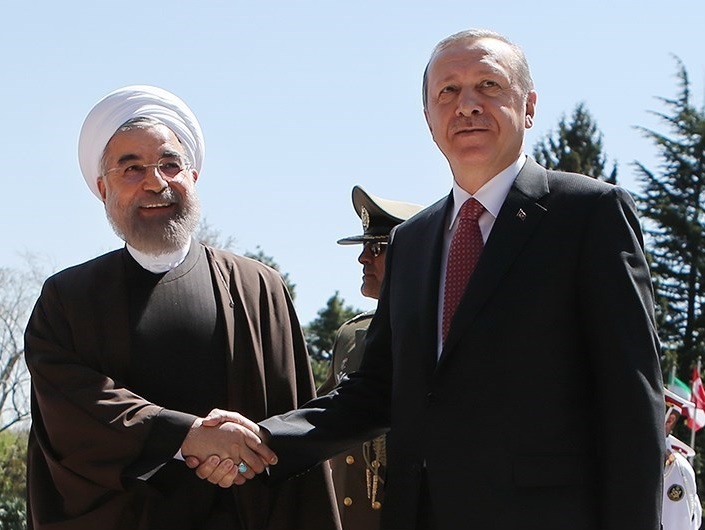
Iranian President Hassan Rouhani and Turkish President Recep Tayyip Erdogan (Wikimedia Commons)
by Giorgio Cafiero
A common view in Washington is that President Donald Trump’s decision to essentially green light Turkey’s Operation Peace Spring against the Peoples’ Protection Units (YPG) in northern Syria benefits key U.S. adversaries, including the Islamic Republic of Iran. Prominent members of the U.S. foreign policy establishment and writers in mainstream American media outlets keep making this argument.
Brett McGurk, the former special presidential envoy for the Global Coalition to Defeat ISIS, called Trump’s decision a “gift to Russia, Iran, and ISIS.” House Minority Leader Kevin McCarthy condemned Turkey’s Syria operation, maintaining that it could “give the likes of al-Qaeda and Iran new footholds in the region…” Wajahat Ali, a contributing op-ed writer at the New York Times, tweeted: “It’s a win for ISIS, Russia, Iran and Turkey.”
Yet such claims are too simplistic and misleading. Tehran’s interests in the Kurdish parts of northern Syria are complicated and the Iranian government officially and strongly opposes the Turkish incursion into northern Syria.
Shortly before Turkey launched Operation Peace Spring, Iranian Foreign Minister Mohammad Javad Zarif called on Ankara to have “respect for Syria’s territorial integrity and national sovereignty.” Two days later, the Iranian military began holding drills close to the Iranian-Turkish border, while Tehran was warning Ankara not to move ahead with its plans in northern Syria. According to the Iranian Students News Agency (ISNA), the drills entailed army helicopters, rapid reaction units, and mobile and offense brigades. Iranian army chief Major General Abdul Rahim Mousavi, who oversaw the drills, hailed their results as positive, stating that they were meant to “measure the readiness, mobility and speed” of Iranian forces near Turkey. Mousavi added: “The message to the enemies is that if they make the wrong calculations, they should know that the children of this land are ready to resist with their full power at any time and place.”
Iran’s parliamentary speaker, Ali Larijani, had a trip planned to the Turkish capital which he cancelled after Turkey launched its Syria operation. Iran’s Foreign Ministry called for an “immediate end to the attacks and for the withdrawal of Turkish forces from Syrian soil” after the Turkish assault began. The ministry also emphasized that while Tehran understands Ankara’s “security concerns,” Iran’s position is that Turkey’s “military action would not only not diminish that country’s security concerns, but also cause financial and humanitarian damages.”
Ultimately, Ankara’s military campaign leaves Tehran in a difficult situation. On one hand, Iran wants to see the Astana peace process (involving Iran, Russia, and Turkey) succeed in terms of resolving the Syrian crisis, particularly in Idlib, thus Tehran desires a continuation of good relations with Ankara. Similarly, Moscow doesn’t want its conflicts of interests with Turkey to upset the Astana process. On the other hand, as a supporter of the Syrian government, the Islamic Republic is deeply unsettled by the fact that Turkey’s Operation Peace Spring relies so heavily on anti-Assad rebel forces from northern and/or eastern Syria. Indeed, Iranian and Iranian-aligned forces have fought those rebels throughout the Syrian civil war.
Turkish-backed groups, including the Sultan Murad Division, Faylaq al-Sham, Ahrar al-Sharqiya, etc., which have fought the Assad regime under the umbrella of the Free Syrian Army (FSA)—now rebranded the Syrian National Army (SNA)—are central to Turkey’s Syria operation. Some of the 14,000 rebels in these groups entered Syria from Turkey with the Turkish military while others were already in Syria, near the towns where the Turks have targeted the YPG this month. These forces are on the frontlines doing much of the heavy lifting in the fight against Ankara’s Syrian Kurdish enemies and Turkey will count on them to guard towns taken from the YPG. Naturally, Iran does not want to see these Sunni groups—some of which previously received U.S. support—to gain new life in the Syrian war, which now appears to be happening because of the Turkish incursion.
On October 11, protests took place in Iranian Kurdistan one day before hundreds of Iranians gathered at Turkey’s embassy in Tehran to express their staunch opposition to Ankara’s military campaign. Such public displays of anger directed against Turkey underscore how domestic as well as regional/international politics are also impacting Tehran’s response to Operation Peace Spring.
Within the context of the Trump administration’s “maximum pressure” campaign against Iran, officials in Tehran have sought to improve the Islamic Republic’s relationship with Iranian Kurdish communities. Fearful of the U.S. military presence in the Gulf as well as Salafist-jihadist groups operating in Sistan and Baluchestan Province, allegedly with U.S. and Saudi support, the leadership in Tehran wants to prevent outside forces from exploiting opportunities to use militant Iranian Kurdish groups as proxies in any campaign to weaken Iran’s government. Doing so requires engaging Iranian Kurdish factions in a dialogue, which has been taking place in Norway since May, while also addressing socio-economic and political problems in northwestern Iran, which for many years have fueled Kurdish resentment toward the Iranian government.
Doubtless, with millions of Iranian citizens sympathizing with Syrian Kurds who are struggling to survive amid Turkey’s campaign, Iran has to contain such anger and not appear to be siding with Ankara in Operation Peace Spring. At the same time, Iran is Turkey’s neighbor and the two states have always maintained a relationship rooted in pragmatism even when Tehran and Ankara have not seen eye to eye on regional issues. As sanctions continue taking a severe toll on Iran’s economy, the Islamic Republic understands the importance of maintaining its friendship with Turkey. 
Furthermore, Iran does not want to walk away from the progress that it has made in working with Turkey and Russia via the Astana process—however hampered that arrangement might be due to Operation Peace Spring. Tehran also shares Ankara’s interest in preventing the YPG from establishing a statelet in northern Syria that could provide Israel with a foothold near the Syrian-Iraqi border from where it could conduct more strikes against Iranian-backed actors in the region.
At this juncture, despite some silver linings that Tehran might see in Ankara’s assault on northern Syria, Iran is seeking to pressure Turkey into halting its military incursion while also pushing the YPG, Ankara, and Damascus toward a new understanding that can lead to stability and security along the Turkish-Syrian border. On October 12, Zarif offered to engage all three while referring to the Adana accord of 1998, which prevented a Turkish-Syrian war by requiring the Assad government to end its sponsorship of the Kurdistan Workers’ Party (PKK), as the basis for striking a deal that could lead to Turkey’s military and the Syrian Arab Army (SAA) guarding the Turkish-Syrian border through a coordinated effort. Nonetheless, with Erdogan vowing not to negotiate with “terrorists,” it is difficult to imagine Ankara and the YPG reaching any sort of peace in the foreseeable future.
Looking ahead, Tehran will not be shy about voicing its opposition to Turkey’s anti-YPG operation. The regional and domestic ramifications for Iran appear dangerous from Tehran’s perspective. Yet Iran is carefully considering Turkey’s legitimate security interests in the process while seeking to avoid any actions that could create major problems for bilateral affairs. The Islamic Republic’s ability to maintain friendly relations with Turkey while standing by its ally in Damascus will be severely tested as the world grows increasingly concerned about a potential new Middle Eastern war erupting between Syria and Turkey. Now that the YPG and the Syrian government have reached a deal to allow SAA forces to re-enter land territory in northeastern Syria that has been controlled by the YPG since 2012, it remains to be seen what will happen to Operation Spring Peace. Yet with Turkey voicing its determination to push its offensive deeper into Syria, officials in Tehran are nervous about the future of the Astana peace process.
Undoubtedly, such an outcome would be anything but a “gift” to Iran.

Sunday, October 13, 2019

Implications of Turkey's invasion of Syria

Crescent International
Regardless of the justifications Turkey offers for its invasion of northeast Syria, it is a clear violation of Syria’s sovereignty and carries grave implications.
Threatened for a long time, Turkey’s military invasion comes at a time when Syrian government forces were making steady progress against foreign backed terrorists.
The terrorists had been holed up in a small rump in Idlib province and would surely have been completed routed had it not been for such foreign support.
After three days of military operations, Turkey’s defense ministry said on October 12 its forces had taken control of the Syrian border town of Ras al-Ain although the Kurdish-led Syrian Democratic Forces (SDF) has disputed this.
The border town has been under the control of US-backed Kurdish militants, YPG.
“As a result of successful operations within the scope of ‘Operation Peace Spring’, the town of Ras al-Ain to the east of the Euphrates has been brought under control,” the Turkish defence ministry wrote on its Twitter.
Turkey’s target is the Kurdish armed group YPG that it says is closely aligned with the terrorist group the PKK operating in Turkey.
Ankara wants to prevent the Kurds from dominating both sides of the border and linking up because it views them as a threat to its security.
Turkey’s aim is to capture a swath of Syria territory measuring 30 km by 110 km inhabited largely by Kurds.
Two towns—Ras al-Ain and Tal Abyad—are the primary focus of Turkey’s invasion. They have come under heavy bombardment, forcing tens of thousands of civilians to flee.
Launching artillery and air strikes, there have been civilian casualties with some estimates putting the number at 50 on both sides.
While Turkey wants to prevent Kurdish militants residing in another country (Syria) from linking up with Kurds on its soil, it has little trouble supporting and maintaining militants inside Syria.
On October 12, the Turkish-backed militants claimed to have cut the 712 Road that links Tel Abyad and Ras al-Ain. A militant spokesman claimed 18 villages have been captured in the advance.
Syria’s official news agency SANA reported from Hasakah that Turkey had also cut off an international highway linking the province in the far northeastern corner of Syria to Aleppo.
The Turkish invasion was launched following a telephone conversation between Turkish President Recep Tayip Erdogan and his American counterpart Donald Trump on August 6.
After he spoke to Erdogan, Trump said he was withdrawing US troops, illegally occupying Syrian territory, from the border with Turkey. The US maintains an airbase at al-Tanf in Syria, again in clear violation of the latter’s sovereignty and international law.
The Western corporate media went into a breast-beating frenzy about the US “betrayal” of Kurds.
The media also talked about the thousands of Daesh terrorists held by the Kurds that could now escape from captivity.
They could keep their powder dry. SANA reported that US forces had whisked out 80 foreign Daesh prisoners held at al-Shadadi prison south of Hasakah to Iraq.
The West, especially the US is not and has not fought ISIS terrorists; they are the West’s creation to be used against countries they wish to destabilize.
Unfortunately, the Kurds’ political and military leaders have always made poor choices and allowed themselves to be used by unsavory foreign powers.
These include such countries as the US, Israel, Britain and a host of others.
When it became clear that Trump had given greenlight to Nato member Turkey to invade northeastern Syria, the Kurds turned to Damascus for help.
Syria’s Deputy Foreign Minister Faisal Mikdad in an interview in Beirut on October 10 ruled out any talks with the Kurds.
“The armed factions betrayed their country and committed crimes against it. We will not accept dialogue with those who became hostages of foreign forces. There will not be any foothold for agents of Washington on Syrian soil,” Mikdad said.
The government in Damascus, however, has been placed in a difficult position. Its forces do not have the capacity to take on Nato-member Turkey.
Syrian armed forces with help from allies like Hizbullah, Iran and Russia have barely managed to contain and gradually defeat foreign terrorists flooding the country.
In addition to controlling the Kurds, Turkey wants to transfer some of the estimated 3.6 million Syrian refugees on its soil to this area.
Having used them for eight years, Turkey no longer wishes to look after the Syrian refugees. Resentment of Syrian refugees has grown especially in Turkish border towns like Sanliurfa.
If successful in this transfer, the refugee resettlement project would give Turkey a permanent base inside Syria because Ankara would be involved in administering their affairs under the pretext of protecting them.
It may even lead to Turkey occupying this area that used to be part of the Ottoman State before the colonial division of the region a century ago.
The incursion into Syria is fraught with danger and will only add to further destabilization of the region to the benefit of imperialists and Zionists.

Sunday, April 07, 2019

Kurds in Fateful Triangle as US Moves to Redeploy IS Terror Groups

Kurds in Fateful Triangle as US Moves to Redeploy IS Terror Groups
FINIAN CUNNINGHAM
Kurdish fighters have been used by the US to ostensibly defeat the remaining Islamic State holdouts in eastern Syria. But what is emerging is not a final defeat of the terrorists, more a redeployment to further destabilize the Arab country.
Potentially, the Kurds could wind up not with the regional autonomy they desire, but as part of a rebranded American dirty war army whose ranks include the very terrorist the Kurdish militias have been successfully battling against.
President Donald Trump has been lately crowing about how US-backed Kurdish forces have wiped out the IS self-proclaimed caliphate around Baghouz in eastern Syria. “They’re losers… they’re gone tonight,” he boasted about supposedly vanquishing the jihadists.
However, things are not that clear-cut. Syria’s envoy to the United Nations Bashar al Jaafari dismissed Trump’s victory celebrations as a “bluff”. He said that IS was not defeated in areas under US control, but rather were being shunted off to various camps for retraining.
There are credible reports that thousands of jihadists who surrendered or were captured in the fighting around Baghouz have since been relocated by US forces to its military base at al Tanf near the border with Iraq and Jordan, as well as to nearby refugee camps such as Rukban, where some 40,000 detainees are held. Suspiciously, the Americans are refusing international access to these camps, even for UN humanitarian relief agencies. As Russia’s Foreign Minister Sergei Lavrov pointed out recently, the detention centers are being used by the Americans as a pretext for illegally occupying Syrian territory.
We can also add the purpose of clandestine military recruitment for US proxies.
Despite Trump’s announcement four months ago that US military was pulling out of Syria, there seems no sign that his plan is being implemented. That’s why Moscow reacted angrily to Washington’s demand for Russian troops to leave Venezuela. The Kremlin responded testily that the US should first deliver on its promise to withdraw from Syria, where its forces are illegally present unlike Russian personnel in Venezuela under bilateral agreement.
In Syria’s supposedly post-war scenario what seems to be happening is the US seeking to find a way to reconfigure its destabilizing intervention in the Arab country. The past eight years of US-sponsored covert war has failed in its objective for regime change against President Bashar al Assad, who is allied with Russia and Iran. What the US is aiming to do now is keep military footprints in the country, effectively annexing swathes of territory, especially in the oil and gas-rich eastern region around the Euphrates River.
That accounts for why supposedly defeated enemy terrorists are being retrained by US special forces at al Tanf. They are reportedly being tasked with capturing the oil and gas fields in Deir ez-Zor province as well as production infrastructure in Homs province.
This puts the Kurdish forces in an invidious position. There is little doubting the courage and fighting ability of the Kurdish men and women who make up the Syrian Democratic Forces (SDF) and its spearhead YPG militias. The Kurds have managed to liberate up to 30 per cent of Syria’s territory in the northeast and east from the IS jihadists. They have dealt a decisive blow to the residual caliphate at Baghouz. American air power augmented the Kurds in their offensive.
But what the US is maneuvering to do is to combine the defeated jihadists with the Kurds in order to push its agenda for breaking up Syria and controlling its eastern mineral-rich resources.
The Special Monitoring Mission to Syria reports that IS militants captured by the SDF are being redeployed by the Americans for seizing oil and gas production facilities.
Still another crucial objective for Washington is to control the Deir ez-Zor east-west corridor from Iraq to Damascus so as to contain Iranian presence in Syria.
This is the context for Trump’s brazen declaration recognizing Israel’s annexation of Syria’s southern Golan Heights. Washington’s game plan is to keep Syria destabilized and fragmented, partly to appease Israel and partly for the US’s own imperial designs for dominance in the region.
In this insidious US maneuvering, the Kurds face a potentially treacherous situation. They have been well armed and supported by Washington, but are finding they are being used like a disposable asset. The Kurds may have calculated that accepting Washington’s patronage in recent years was a way to earn political capital for building a future separate independent Kurdish state. What seems to be emerging, however, is that the Americans only intend to exploit the Kurds as a fighting force to do its dirty work of breaking up Syria – in the same way that the Americans have covertly used jihadist terror groups in other parts of Syria.
The Kurds have been very effective in routing IS in the latter’s remaining strongholds in eastern Syria. But the result is the Kurds are being used as a recruitment agency for the Americans to redeploy the “defeated” terrorists in its ongoing covert war against the Syrian state.
There are signs, though, that the Kurds are well aware of the treacherous danger in dealing with Washington. When Trump made is troop withdrawal announcement, there were palpable concerns among the Kurds about being betrayed to the mercy of Turkey. Turkish President Recep Tayyip Erdogan has repeatedly threatened to send his military forces into Syria to crush the SDF and YPG militia whom Ankara views as “terrorist” affiliates of its own separatist Kurdish movement, the PKK.
It’s not clear if the US will implement a withdrawal of its estimated 2,000 troops in Syria. There are indications it won’t happen, despite Trump’s claims. Nevertheless, the surprise announcement was enough to undermine Kurdish confidence its patron. With the result that Kurdish leaders have begun reaching out to the Assad government in Damascus in the hope of dialogue producing a future federal arrangement.
The Kurds have reportedly requested Russia to mediate with the Syrian government.
Kurdish forces have not heretofore been at war with the Syrian Arab Army. They share the same common enemy of IS and assorted jihadist terror groups.
In the past, President Assad has rebuffed Kurdish aspirations for regional autonomy. But apparently, Damascus has shifted to be more open on forming a new federal constitution for Syria in which the Kurds would gain important regional independence – in a way analogous to the Kurdish Regional Government in northern Iraq.
In this fateful political triangle that the Syrian Kurds find themselves, they would be advised to throw their lot in with the Damascus government. If a mutual pact could be established that would bring the two major chunks of Syria’s territory back into territorial integrity.
If, on other hand, the Kurds accede to Washington’s nefarious agenda, they run the risk of losing independence and being eviscerated from exploitation in endless dirty-war machinations by the Americans. An ominous sign is that after bravely fighting to rout IS, the Kurdish militia are being set up to form a devil’s bargain with the same terrorists – to satisfy Washington’s geopolitical interests.
The Kurds would do well to remember a cynical maxim in Washington, whereby the US “does not have allies, only interests”.

Tuesday, December 25, 2018

Imperial Interventions, Withdrawal from Syria and Self-Determination

by 


Trump’s sudden announcement to withdraw US troops from Syria is a good development that should be welcomed by everyone who proclaims to care about what the US does in their name around the world. American interference in that country starting in 2011 was never authorized by the UN according to international law and therefore has been illegitimate from the start. But that doesn’t mean there shouldn’t be serious debate about how that withdrawal should be carried out.

The Kurdish Question
One of the most pressing questions that arise is about the quasi-autonomous, Kurdish-majority region of Rojava in Northern Syria. After the civil war started, infrastructure quickly collapsed and Assad lost control of large chunks of the country. That was seen by the Kurds of Syria as the perfect opportunity to try and build a Kurdistan along the lines of what Kurdish activist and political prisoner Adbullah Öcalan calls Democratic Confederalism and Democratic Autonomy. These models involve communal ownership of the means of production, equal rights for women and a progressive view on ecology and sustainability, and the people of Northern Syria (mostly Kurds, but also Arabs, Armenians, Syriacs and other minority groups) have been trying to implement them in Rojava against all odds. They have struggled with the lack of resources stemming from economic embargos from Iraqi Kurdistan and Turkey at the same time that they have had to fight an ISIS that was being given free passage into Turkish territory, from where they could launch attacks with impunity [1][2].
Turkey’s president, Recep Tayyip Erdogan, is openly hostile to the Kurds, who he considers terrorists, and has recently stated that an offensive on Rojava is imminent [3]. In fact, he has already attacked the canton of Afrin, one of the three units that compose Rojava, on January of this year, causing hundreds of casualties [4] and forcing around 167,000 people to flee for their lives [5]. The reason why casualties weren’t worse back then presumably being because the YPG, which is the army branch of the PKK (Kurdistan’s Workers party), had already at that time secured an alliance with Washington, thus forcing Ankara to exercise some restraint lest it anger its main NATO ally.
Now with the US about to withdraw, what will happen to the people of that region should be of serious concern to anyone with a conscience. If history is any indication, the US empire has no qualms in abandoning their Kurdish allies to their fates [6]. As a matter of fact, it seems possible that Erdogan himself played a part in Trump’s decision to remove his troops [7], meaning that a new betrayal has possibly already happened. Washington seems to be delivering the YPG to Ankara, and with them, thousands of innocent civilians.
If you listen to what a certain segment of the left has to say, Assad is the only legitimate leader of an undivided Syria and therefore the Kurds should be seen as terrorist separatists who should either surrender or be crushed. The fact that they are an oppressed people with a right to self-determination and who are trying to implement leftist ideals on the ground instead of only talking about them on the internet seems to matter little to them. Their logic seems to be: the US invaded Assad’s Syria; Assad has a right to defend himself and his country; the YPG allied itself with the US; the YPG is the enemy. This is a kind of knee jerk anti-imperialism that casts aside any sense of human decency, and presumably also of irony, in that they want to defend the oppressed by opposing the Empire that right now is the only thing standing between the oppressed and carnage. They seem to participating in a who’s more anti-imperialist game where anyone who doesn’t immediately oppose US presence anywhere automatically loses their leftist credentials.
That is not say the US should stay there forever. Of course it shouldn’t. As I said above, the US never had any right to intervene in Syria in the first place. But since Washington got itself in a position where it can prevent massacres, they should provide protection until the situation can be solved diplomatically.
There is no contradiction between supporting withdrawal and at the same time advocating that some amount of US troops stay temporarily in Northern Syria. There is no reason why it would be impossible to arrange a negotiation between Turkey, the Rojava administration and Syria. US troops could then be replaced with UN forces with a very specific mandate to keep the peace. None of this is outside the realm of possibility and therefore the left ought to fight for such an outcome.
If the Trump doesn’t take the initiative, however, then Rojava’s only hope lies in some sort of agreement with Assad, which, while possible, is unlikely to result in continuation of its socialist experiment. Rojava would join the Paris Commune and the Spanish anarchists in the hall of movements that had enormous potential but an antagonist federal government in a position to crush them.
The Russian Question
I have also seen some debate over whether to oppose Russian presence now the US is on its way out. My own opinion on the matter is pretty simple: Russia was invited into Syria by president Bashar Al-Assad to help fight the civil war which erupted during the so-called Arab Spring. So unlike the US, it has legitimate reasons for being there, but only for as long as they are welcome there.
Now, it needs to be said that Russia was invited not by popular will, but because Assad had very little choice but to ask for help before his country convulsed into one or several failed states. But the now the situation is different. ISIS has been almost completely crushed, the Arab Spring ended in disaster everywhere but in Tunisia, and large sections of the country are starting to pick up the pieces as Syrians try to resume their daily lives. Not that the war is over yet –wars in the Middle East have a tendency to reignite when you least expect it-, but the fact is that Syrians are in a position to speak for themselves, if not right now then very soon. So it should not be up to Assad, who in true Mediterranean tradition was “elected” with more than 90% of the vote, to decide when Russia goes; that choice should be made by Syrians (in the same way, they should be allowed to organize free and fair elections in order to choose their post-war government, regardless of whether that results in them legitimizing Assad or getting rid of the man once and for all).
Just like in Rojava, the moral position should be to support the notion that it is the people who should be deciding who stays or who goes, who rules and who is ruled.
L.H. Sartori is a Brazilian citizen concerned about the current state of the planet.
Notes
[1] Michael Knapp, Anja Flach, Ayboga Ercan, Revolution in Rojava(Pluto Press, 2016).
[2] Patrick Cockburn War against Isis: US air strategy in tatters as militants march on, The Independent, October 13, 2014, https://www.independent.co.uk/voices/comment/war-against-isis-us-strategy-in-tatters-as-militants-march-on-9789230.html/. Specifically the following passage: “Of the countries supposedly uniting against Isis, by the far most important is Turkey because it shares a 510-mile border with Syria across which rebels of all sorts, including Isis and Jabhat al-Nusra, have previously passed with ease.”See also: https://www.businessinsider.com/links-between-turkey-and-isis-are-now-undeniable-2015-7and https://www.counterpunch.org/2018/02/12/is-turkey-recruiting-ex-isis-fighters/
[3] The Guardian, Turkey primed to start offensive against US-backed Kurds in Syria, December 12, 2018, https://www.theguardian.com/world/2018/dec/12/turkey-primed-to-start-offensive-against-us-backed-kurds-in-syria.
[4] The Syrian Observatory for Human Rights, November 23, 2018, http://www.syriahr.com/en/?p=107310
[5] United Nations, Daily Press Briefing by the Office of the Spokesperson for the Secretary-General, March 22, 2018, https://www.un.org/press/en/2018/db180322.doc.htm.
[6] See the excellent article by Phil Gasper, published by the International Socialist Review, called The Betrayal of the Kurds, 2003, at https://isreview.org/issues/28/kurds.shtml.
[7] Reuters, Haaretz and Noa Landau, U.S. Starts Withdrawing Troops From Syria but Campaign Not Over, White House Says, December 19, 2018, https://www.haaretz.com/us-news/u-s-military-preparing-for-full-withdrawal-from-northeastern-syria-report-1.6762877. “The decision came after a phone call between U.S. President Donald Trump and his Turkish counterpart Tayyip Erdogan on Friday. “Everything that has followed is implementing the agreement that was made in that call,” the official said.”

Sunday, July 22, 2018

Sarah Abed: US Aims for Long Term Presence in Syria to Check Iran and Ensure Israeli Domination


TEHRAN (FNA)- Syrian journalist Sarah Abed says that United States seeks to have a long term presence in Syria and the region to keep an eye on Iran and guard their number one ally in the region which is the Zionist regime in Tel Aviv.
Sarah Abed, in an exclusive interview with FNA, said that establishing an independent Kurdish state in Syria is just part of the decades-long Israeli-American plan to weaken and divide all the nations neighboring Israel.

The journalist also added that the presence of the Turkish forces in Syria is seen as illegal and just like other uninvited foreign fighters in violation of the UN Charters and international law.
Sarah Abed is an independent journalist and political commentator, covering a broad range of issues relating to the Syrian war, Kurdish issues in Iraq and Syria, as well as US policy in the Middle East. She has been interviewed by international media outlets such as Press TV, FOX News 1450 and Radio Sputnik.

FNA has conducted an interview with Sarah Abed about the ongoing crisis in Syria and the recent developments surrounding the issue namely the missile strikes on the Arab country by the US and its allies and also the American plan for an independent Kurdish state on Syrian soil.
Below you will find the full text of the interview.

Q: Multiple places in Syria came under attack by the United States and its allies, namely Britain and France, based on a video footage of an alleged gas attack in Syria’s Douma released by the White Helmets. Who are the White Helmets? How can their unverified video be presented as justification for a large scale attack on Syria?

A: The White Helmets also known as Syria Civil Defense claim to be a “humanitarian organization". The White Helmets won an Oscar for best documentary and were nominated for a Nobel Peace Prize. According to their Twitter account they claim that they are “3,922 volunteer search and rescue workers from local communities who risk their lives to save others and bring hope”. They also state that they have “saved +104,933 lives”.

The reality on the ground however is an entirely different story. They hijacked the name “Syria Civil Defense". The White Helmets were created with the assistance of Western intelligence by former British Army officer and mercenary James Le Mesurier. Their main goal initially was the ousting of President Assad, through the use of propaganda against the Syrian government and army. They have acted out fake rescue operations and even staged chemical weapon attacks in order to gain financial and emotional support from governments and well-meaning but unfortunately uninformed western spectators.
These fabrications have been used as pretexts for foreign military and political aggression against the Syrian state. Most recently The White Helmets have been described by locals as actors, who produce and film fabrications in order to get funding from a number of NATO members mainly the US and UK.
Although they claim to be an impartial non-governmental “NGO” made up of volunteers, each member is paid $1,500 a month, an amount that is drastically higher than the average monthly Syrian salary. They have received millions of dollars of funding from the US and UK. All while committing a myriad of atrocities including killing not only Syrian soldiers and captives, but innocent women and children as well. They have been thoroughly exposed by independent journalists as well as the Russian and Syrian government for their crimes. Most recently the Douma incident has shed light on the extent to which this group will go to fabricate an incident in order to evoke a military response from the United States.
An earlier example is the liberation of Aleppo which took place late 2016 by the Syrian Arab Army and their allies. Civilians revealed that they had only heard of the white helmets on TV or in publications. Others stated that The White Helmets were only concerned with “rescuing” terrorist sympathizers. It comes as no surprise that they shared buildings with terrorist factions. They also were hoarding food, medical supplies, and aid that were meant for the locals. Recently Washington has suspended their funding and put the group under “active review”. This affects ⅓ of their funding. It’s interesting to note that these supposed “volunteers” only operate in areas where terrorists reside and they leave with the terrorists when they relocate to other areas in the country when the Syrian Arab Army and their allies liberate the areas.

It’s ridiculous that the US/UK/France used a fabricated video presented to them by The White Helmets to strike targets in Syria last month. A completely unjustified and illegal action, that destroyed research centers that did not house chemical weapons as these countries alleged. Citizens have reported that no such chemical weapons attack took place in Douma.

Eyewitnesses were flown to The Hague and gave their testimonies which matched that of other civilians that were interviewed by reporters in Douma. They stated that not only did The White Helmets create a chaotic event and filmed it, but that none of the patients showed signs of chemical weapon poisoning. The fact that the US acted as judge, jury and executioner, as I had stated on an interview with Radio Sputnik, is disturbing. The day before the OPCW investigators were scheduled to arrive in Syria, the US along with the UK and France took matters into their own hands. This irrational action has now been proven to be illegitimate and hasty.

Q: We have seen the Israeli regime and the so-called US-led coalition targeting the Syrian Arab Army (SAA) and its allied forces many times. What do you think is the reason for such moves?

A: Whenever the SAA and its allies make significant on-the-ground progress, Israel and the US-led coalition take actions to hinder their progress. They have on multiple occasions directly hit SAA military bases which in turn benefits terrorist organizations including Daesh. These airstrikes are illegal and illegitimate provocations meant to stir a reaction from Syria, Russia, Iran, or Hezbollah in hopes that they would respond with military action. Israel can then use any defensive response and claim that it was an offensive strike and then retaliate based on the notion of self defense, even though they are the agitators in this scenario. It’s important to note that although they might temporarily delay advancements made by the SAA and their allies, they do not have long lasting results and will not impact the ultimate goal of liberating every inch of the country which would then set the stage for peace to return to Syrian state which has been aggressively attacked by foreign nations and foreign backed terrorists for over seven years in this western imposed insurrection and attempt at ‘regime change”.

Q: Since the beginning of the crisis in Syria, Saudi Arabia has been actively supporting terrorists in the country. These terrorists are now losing ground every day. What do you think would be the implications of such failure for the Saudi foreign policy?

A: Indeed they have supported terrorist factions, and these groups have gone through a number of costume changes and rebranding. KSA has gotten a generally abysmal return on their investment, but will this change their policies as a matter of course? The members of the House of Saud are closely aligned with the United States and Israel against their own Arab brothers and sisters in the Middle East. They have been raining bombs and killing civilians in Yemen for the past 3 years while supporting terrorist factions in Syria. To think that they might lose interest or back away from either of these battlefields is to underestimate their ambitions and greed. Although their arrogance will most likely prevent them from retreating anytime soon it will be interesting to see where they funnel their support once their terrorist factions have been defeated.

Q: The so-called Syrian Democratic Forces (SDF) have received tremendous amount of arms and support from the United States, initially with the stated aim to fight Daesh (ISIL or ISIS). But apparently, the US is now preparing the ground to establish an independent Kurdish state in Syria. What do you think the US is seeking to achieve by disintegrating Syria?

A: Since the US invasion of Iraq and the ongoing conflict in Syria, Kurdish militias have been romanticized by the media and US politicians alike to justify a Western interventionist narrative in those countries. The People’s Protection Unit (YPG) is a Kurdish-majority militia which is the military wing of the Democratic Union Party (PYD), a Kurdish democratic confederalist political party in northeastern Syria. The YPG is the Syrian offshoot of the Kurdistan Workers Party (PKK), which is an organization based in Turkey and Iraq that has been engaged in armed conflicts with the Turkish state since 1984.
The plan to weaken and divide not only Syria but other nations surrounding Israel has been in the works for decades by the United States. By establishing a Kurdish state in Syria the United States hopes to have a long term presence in the area. This benefits the US by allowing them to keep a watchful eye on Iran while also protecting their number one ally in the region Israel. In Oded Yinon’s “Plan for a Greater Israel” in 1982 it states the imperative use of Kurds to help divide neighboring countries in order to aid in their plans for greater domination. The United States has established over 10 military bases in the north eastern portion of the country, which also happens to be the most oil and agriculturally rich region. The United States and its allies underestimated not only the determination of the Syrian Arab Army and their allies but the resilience of the Syrian people as a whole. Syrians will stop at nothing to keep their nation united and any attempts to divide and weaken their sovereign state will be countered with a powerful response.

Q: The US announcement on its plans to recognize a Kurdish state in Syria has seemingly provoked Turkish invasion of the Kurdish areas. What are Turkey’s objectives in its military intervention and how do you think this recent development would affect the process of reaching peace in Syria?

A: Turkey has seen the accumulation of Kurdish armed factions on its border as a threat to its national security. It has looked at the relationship between the United States and Kurdish militias very unfavorably and Erdogan has personally stated his discontent with this alliance. Turkey’s plans were to return Syrian refugees on the Turkish border back to Afrin and they had stated that they do not plan on staying in Syria long term. Syrian officials see Turkish forces as an illegal presence and just like other uninvited foreign fighters they are violating UN Charters and international law and must withdraw their forces from Syrian territory. They are yet another hurdle in liberating the entire country of all illegal, illegitimate, and uninvited armed invaders. In due time, just like their American and NATO counterparts, they will be dealt with by the Syrian Arab Army and government.