Showing posts with label Ali Larijani. Show all posts

Tuesday, December 17, 2019

Iran, Oman voice pleasure as hopes rise over cession of war in Yemen

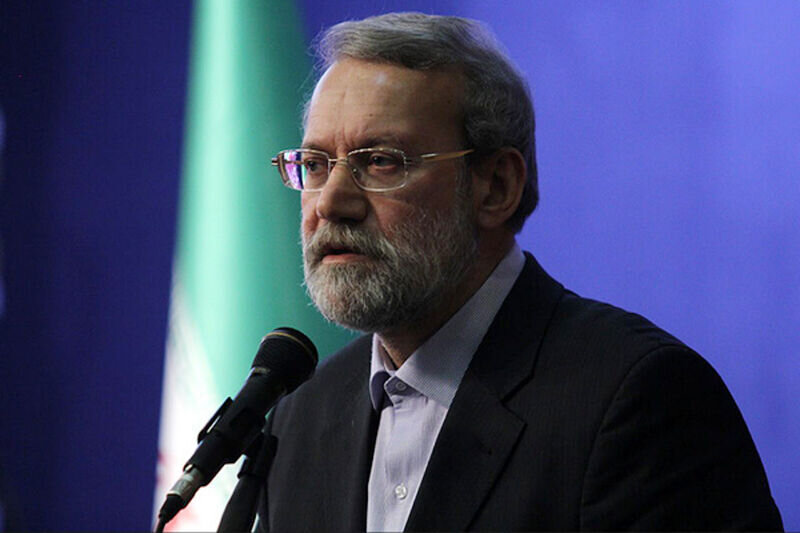
TEHRAN - Iranian Parliament Speaker Ali Larijani and Omani Deputy Parliament Speaker Abdullah Al Amri on Saturday expressed pleasure over relative ceasefire in Yemen, underlining their respective countries' support for a peaceful settlement of the war in the country. 
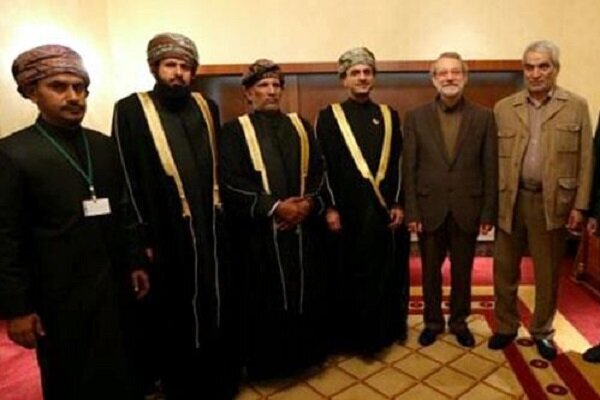
The top Iranian and Omani parliamentarians met on the sidelines of the 12th plenary session of the Asian Parliamentary Assembly (APA) in Antalya, Turkey.
Larijani praised Oman for mediating between the warring sides in Yemen, saying, "Your role was wise and rational. We hope that talks on Yemen would lead to a practical measure and an actual ceasefire.”
He stressed that accepting a partial ceasefire in Yemen is a “logical path.”
Al Amri, for his part, voiced his country's readiness to increase efforts to find a solution to the war in impoverished Yemen.
“The situation in Yemen is improving. Efforts to settle the conflict have been formed in the most appropriate way possible,” he assured.
In April 2015, Iranian Foreign Minister Mohammad Javad Zarif submitted a letter to Ban Ki-moon, then UN secretary-general, outlining its four-point peace plan for Yemen.
The plan called for an immediate ceasefire and end of all foreign military attacks, humanitarian assistance, a resumption of broad national dialogue and establishment of an inclusive national unity government.
On November 22, United Nations Yemen envoy Martin Griffiths told the UN Security Council that the number of airstrikes by the Saudi-led coalition battling Houthis in Yemen has dropped nearly 80% in the last two weeks.
The coalition, which intervened in the war in 2015 to try to restore the ousted Sanaa government, has carried out thousands of airstrikes that have killed thousands of civilians at hospitals, schools, and markets, drawing international criticism.
De-escalation of hostilities is a major aspect of informal talks that have been going on between Saudi Arabia and Houthi officials on a ceasefire in Yemen since September.
“In what is perhaps an even more important sign that something is changing in Yemen..., in the last two weeks the rate has dramatically reduced: there were almost 80% fewer airstrikes nationwide than in the two weeks prior,” Reuters quoted Griffiths as telling the Security Council by videoconference from his Amman office.
He added that there had been “entire 48-hour periods without airstrikes” for the first time since the conflict began in 2014 when the Houthi movement ousted the government of President Abd-Rabbu Mansour Hadi from power in Sanaa.
The talks began after the Houthis offered to halt cross-border missile and drone attacks on Saudi cities if the Saudi-led coalition ended airstrikes on Yemen.
“We call this de-escalation, a reduction in the tempo of the war, and perhaps a move towards an overall ceasefire in Yemen that...many members of this Council have been calling for a very long time,” Griffiths said by a video conference from Amman, where his office is based.
The UN diplomat added that skirmishes between the warring parties in the port city of Hodeidah, where the two sides agreed on a ceasefire last year, have been reduced by 80 percent after the deployment of UN monitors in recent weeks.
The war has killed more than 100,000 people and pushed millions to the brink of famine, according to the Armed Conflict Location & Event Data Project, a non-governmental organization.
Griffiths has said he hopes for a resolution to the conflict in the first few months of 2020.

Saturday, August 24, 2019

Trump administration ruined opportunity for future talks: Iran's Larijani

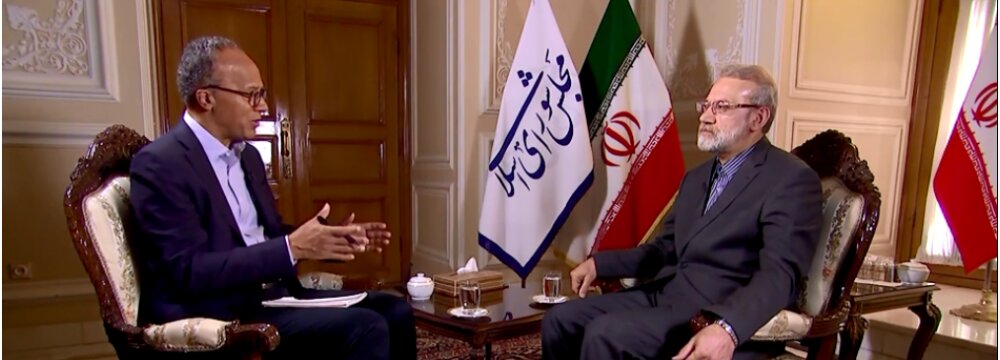
TEHRAN – In an interview with the NBC’s Lester Holt in Tehran aired on Tuesday, Iranian Parliament Speaker Ali Larijani said that the administration of Donald Trump ruined opportunity for future talks between Tehran and Washington.
“During the previous administration of Barack Obama [former U.S. president], he offered talks to Iran and Iran accepted it. Because our initial impression was the fact that Mr. Obama was following some principles in his policies. He was our enemy, but he was the wise enemy. It is easier to interact with a wise enemy,” he said.
He said that Trump’s withdrawal from the international agreements is tarnishing the impression of the people across the world. 
“That creates the impression that the United States is not trustworthy and this does not serve them good,” he noted.
‘It was not mistake to sign nuclear deal’
Larijani also said that it was not a mistake to sign the 2015 nuclear deal, known as the JCPOA.
“From my viewpoint it was not a mistake to sign the nuclear deal. We discussed the issue with the major powers in the world and reached a conclusion. It could have served as the basis to discuss more important issues in the future including sustainable security in the region, but the fact is that they ruined this. I have to note that there were very serious critics in Iran, but overall Iran accepted the deal but what they did changed the calculations very much,” stated the philosopher-turned politician.
Commenting on effects of sanctions against Iran, he said, “There is no doubt that the sanctions have had impacts. There are problems in our economic system that need to be tackled.”
He added, “We should not have been relying that much on oil. With the sanctions we are accelerating the process (of reducing reliance on oil). Now, with the problems increasing we are increasingly focusing on internal economic capacities to create more grounds for production. When our imports are cut down, we have no other choice but to increase production.”
‘We don’t care what will happen in 2020’
Larijani also said that Iran does not care what will happen in the U.S. presidential elections in 2020.
“We have the same path and we don’t care what will happen in 2020. We have long term strategies and policies that we follow,” the top legislator remarked.
‘U.S. conduct has strengthened solidarity among Iranians’
Larijani says Iranian people consider video messages of U.S. Secretary of State Mike Pompeo as “jokes” 
Larijani also said that the Iranian people considers video messages of U.S. Secretary of State Mike Pompeo as “jokes” 
He went on to say that the U.S. conduct has strengthened solidarity among Iranians.
‘Iran has never sought military conflict’
Larijani also said he does not think the U.S. commit the mistake of military confrontation with Iran, adding Iran has never been seeking military conflict.
“I think a brief glimpse of the U.S. recent history will lead us to the conclusion that they will not commit such a mistake of military confrontation. Even at the time when Saddam was provoked by the U.S. to attack Iran, Iran did not seek any conflict. During the past 400 years, we have had no single case of aggression against any other country. Military conflict is not strategy of Iran. However, in case of any aggression, we are serious and adamant in defending ourselves,” he stated.
‘It is the Palestinians who should decide for their future’
Larijani also said it is the Palestinians who should decide for their future.
“Our wish is for the Palestinian people to return to their original land. The proposal was for all the Palestinian people including Muslims, Christians and Jews to participate in a free referendum and to decide for their own future. Our stance is that the decision by the people of Palestine should be followed by everyone,” he said.

Thursday, July 18, 2019

American rulers have created problems for entire world: Larijani

Majlis speaker says Trump is a rare, outlandish creature with ‘pathological behavior’

TEHRAN – Parliament Speaker Ali Larijani says the American rulers have created problems, not just for Iran, but for the entire world.
Addressing a meeting with Iranian entrepreneurs in Ablborz Province on Wednesday, Larijani said the U.S. has created problems for Europeans, Chinese and Latin American countries.
He also lashed out at U.S. President Donald Trump, saying among the world leaders, rarely can one find an “outlandish creature” like Trump.
The Majlis speaker said Trump’s racist tweet targeting four minority congresswomen were the embodiment of his “pathological behavior”.
“He has created troubles for Iran with such behavior, and of course, some regional countries have also provoked him and gave him money,” he added.
Larijani also spoke at a joint parliament-administration meeting in Tehran on Wednesday, during which he highlighted efforts made to reduce economic pressures against the Islamic Republic.
“Necessary arrangements have been made to counter the economic war waged against the Islamic Republic,” he said, pointing to U.S. sanctions.
“The country’s current situation is completely different from previous years and Leader of the Islamic Revolution (Ayatollah Ali Khamenei), considering the situation, has ordered the formation of the economic council of the heads of three branches of the government,” Tasnim quoted Larijani as saying.
“In the current situation, the fundamental issue is to provide working capital for factories and industries in order to strengthen the industrial sector,” he stated.
“Today, the country is in a state of economic war, however, necessary measures have been taken in this regard at the macro-management level,” Larijani added.
The parliament speaker also emphasized that efforts should be made to counter the economic war at lower levels.
The remarks come against the backdrop of increased tensions between Iran and the U.S., a year after the latter walked away from the international nuclear deal and imposed harsh sanctions against Tehran.
Recently, the U.S. has taken a quasi-warlike posture against Iran and stepped up its provocative military moves in the Middle East, among them the June 20 incursion of an American spy drone into the Iranian borders.
The U.S. says it is deploying an aircraft carrier strike group and a bomber task force to the Middle East in a “clear and unmistakable” message to Iran.
In May, Washington dispatched an aircraft carrier strike group, a bomber task force, and an amphibious assault ship to the Persian Gulf, citing an alleged Iranian threat.
The military deployment sparked global concerns that the U.S. may be planning to wage war on Iran.

Monday, June 24, 2019

Rouhani: Most intl. problems rooted in U.S. unilateralism

TEHRAN – Iranian President Hassan Rouhani said on Sunday that most of the problems the world is facing today are rooted in U.S. unilateralism and violation of international law by Washington.
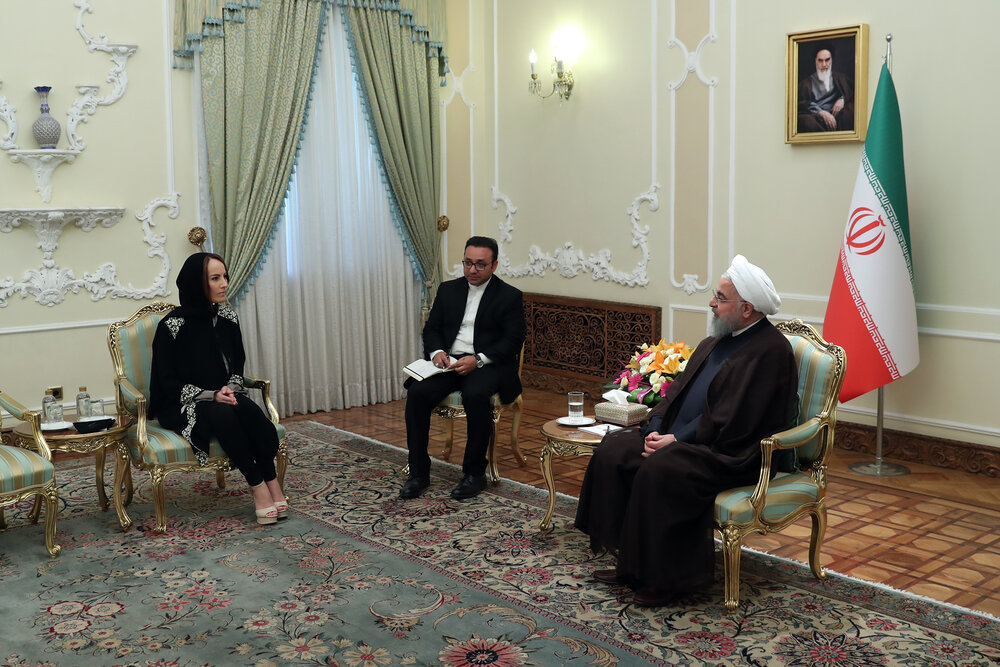
“Most of the regional and international problems have been caused by dictatorship and bullying of certain countries especially the United States whose roots are in violating international law and moving on the path of unilateralism,” Rouhani said during a meeting with President of the Inter-Parliamentary Union (IPU) Gabriela Cuevas Barron.
Rouhani said that the U.S. quit the 2015 nuclear deal, officially known as the Joint Comprehensive Plan of Action (JCPOA), in May 2018 and has threatened other countries to violate the resolution 2231 of the UN Security Council which endorsed the JCPOA.
The U.S. sanctions against the Iranian people are “economic terrorism”, Rouhani noted.
In remarks last week, Rouhani said since the sanctions target ordinary people they are “crimes against humanity”.
‘Reducing tensions is a fixed principle’
 
In his talks with the IPU chief, Rouhani also said, “Iran’s fixed approach is reducing tension, avoiding military conflicts and promoting international peace.”
The remarks by Rouhani were an open reference to rising tensions between Iran and the United States in the region.  
Elsewhere, Rouhani said that the IPU has always had a positive role in bringing parliaments and public opinions closer together in line with coordination on important political and social issues.
“Terrorism, unilateralism and environmental issues are the problems that today’s world is facing and we need more cooperation among parliaments to address them,” he said.
For her part, Cuevas said that Iran plays an important and powerful role in promoting multilateralism and settling conflicts.
She described Iran as a powerful country in the region.
“Today, the world should learn a lesson from Iran’s successful experience of interaction and respect dialogue and international agreements,” she explained.
Cuevas said that the JCPOA proved that multilateralism and interaction are essential to maintain international peace.
“This agreement has a very powerful content and today the entire world knows that dialogue and interaction are important for achieving peace and stability,” she explained.
U.S. helps terrorist groups: Larijani
Iranian Majlis Speaker Ali Larijani also met separately with Cuevas. During the meeting, Larijani said that U.S. and certain countries in the region help terrorist groups.
Larijani said that the IPU is a democratic institution and should support democratic solutions.
Cuevas said that fight against terrorism should not be politicized, adding Iran has valuable experiences in this respect.

Sunday, April 28, 2019

Larijani deplores US sponsoring terrorism in Islamic states

Tehran, April 28, IRNA – Speaker of Majlis (Iranian parliament) Ali Larijani on Sunday deplored sponsoring terrorism by the US and some regional countries, putting at risk the world peace and security.

Larijani made the remarks at the international conference of Future of Islamic World in the Horizon of 2035 held in Tehran.

He said that terrorism has turned into a big problem in the region; it has damaged security of many countries. Instead of going ahead with economic development, the countries in the Middle East have got engaged in their security issues suffering from a lot of economic damage.

Larijani said that the US and its allies in the Middle East created the Islamic State of Iraq and Syria (ISIS), but, after a while, they lost control of terrorist group; they had the same problem in Afghanistan as well. They decided to suppress it, which shows that they cannot understand the Muslim World.

'When they are plaguing Islamic countries with terrorism and insecurity, the Muslim World cannot reach economic development,' said Larijani in University of Tehran.

He said that the world intellectuals and scholars should undertake to propagate international peace and understanding to isolate radical groups being sponsored by the US and certain states in the Middle East to carry terrorist operations.

Larijani said that academic relations are useful for helping settlement of disputes and that the academic ties should be a good diplomatic road to international understanding.

He suggested that the relations between universities expand regardless of political and security issues, serving the interest of all the regional countries. 

Larijani said that the academics and researchers from different countries are interconnected and that they enjoy common political understanding, which helps resolve the disputes in the long run. 

He said that when Saddam intended to attack Iran all the dissident groups came together in Baghdad; they were informed that Iraq would attack Iran in a few days, all but one group, happily agreed to help. A group told the others that they were making a mistake and that they didn’t know Iran and Imam Khomeini well; Iran would resist to Saddam's invasion and gain victory.

He added that some countries, with the green light from the US, engaged both Iran and themselves in an eight-year war. King Abdullah was wiser than the present officials of Saudi Arabia and was aware of the regional issues; Iran set up relations with him.

Larijani said that in a meeting with Saudi security officials about Iraq and Lebanon, one of them said that Saudi Arabia has done two mistakes about Iran and, now, regrets them: making Taliban and helping $40b to Iraq to invade Iran. That amount just came from one country. 

'But, Iran never wanted to retaliate.'

He added that there are security problems in Muslim World; the terrorists entered Iraq and changed it to an area to grow terrorism, and then attacked Syria.

Monday, April 08, 2019

Doha’s hosting IPU proves defeat of anti-Qatari coalition

- Larijani

Doha’s hosting IPU proves defeat of anti-Qatari coalition

TEHRAN, Apr. 08 (MNA) – The participation of 180 parliamentary delegations in Inter-Parliamentary Union (IPU) shows that the anti-Qatari Arab coalition has suffered defeat, said Iranian Parliament Speaker Ali Larijani.
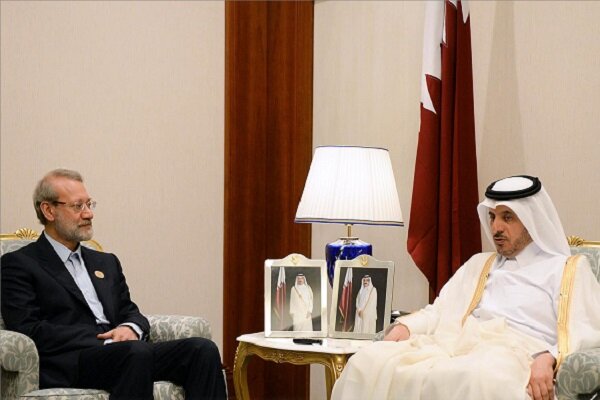
He made the remarks Sunday in a meeting with Qatari Prime Minister Abdullah bin Nasser bin Khalifa Al Thani on the sidelines of 140th Ordinary General Assembly of the IPU in Doha.
Iran and Qatar have strategic relations with each other and bilateral ties should be cemented in all fields, Larijani added.
Iran considers Qatar’s security and development as its own security and development, he stressed, adding that Tehran supports Doha on all levels.
The Qatari PM, for his part, appreciated Iran’s support in recent years while highlighting the need to boost cooperation in all fields.
Larijani had a busy schedule on Sunday as he also held separate meetings with a host of his counterparts from different countries. 
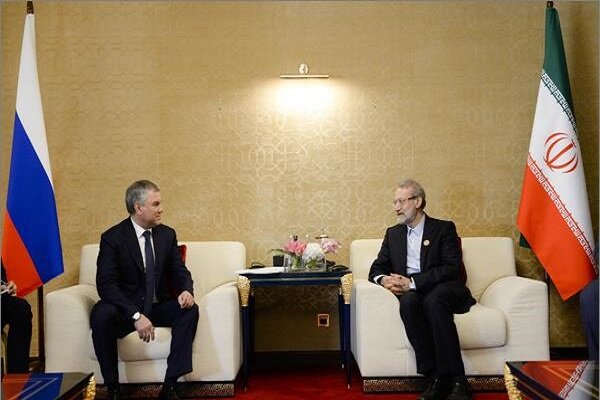
Meeting with Russian State Duma Speaker Vyacheslav Volodin
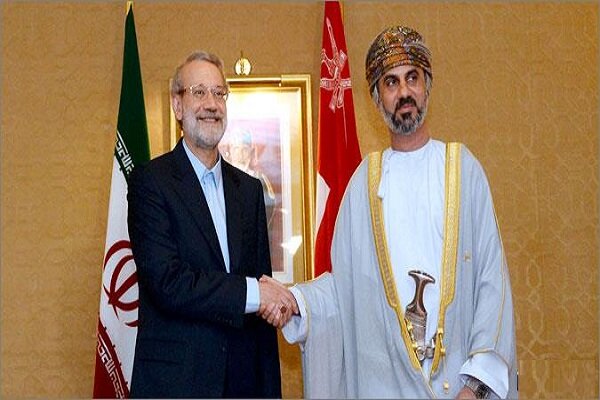
Meeting with Chairman of Oman’s Majlis Al Shura Khalid bin Hilal Al Mawali
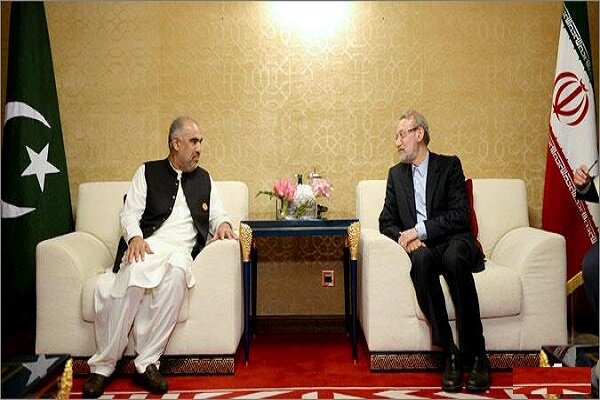
Meeting with Speaker of Pakistan’s National Assembly Asad Qaiser
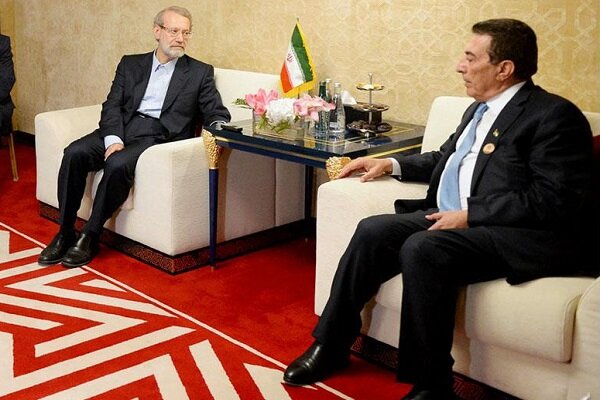
Meeting with Speaker of Jordan’s House of Representatives Atef Tarawneh

Wednesday, November 28, 2018

Iran says won’t let ‘deal of the century’ pass


Iranian Parliament Speaker Ali Larijani says the United States plans to make Israel a dominant force in the Middle East through its ‘deal of the century’ plot, but Iran is determined to foil it.
“The so-called ‘deal of the century’ is an Israeli-American plot,” Larijani said in a Monday address to the closing ceremony of the Islamic Unity Conference in Tehran.
“We will stand against the Israeli regime and won’t let the deal take place in this region,” he went on to say.
“They have called it the ‘deal of the century’ to achieve a number of major goals. Their first goal is to increase the power of Israel in the region. … The other goal is to end the story of Palestine by telling Palestinian refugees to stay in other countries and not to return to their homeland,” Larijani said.
He further noted that the United States has a serious plan to plunder the region’s oil resources and accuses Iran of misbehavior in order to only justify their presence in the Middle East and encourage regional countries to buy their weapons.
“They target Iran because it is the only country that has stood against Israel and America and has maintained its position for 40 years,” he said.
Larijani warned certain countries in the region against supporting the so-called ‘deal of the century’ and hosting Israeli officials, saying that such moves won’t have any benefit for them.
He said Saudi Arabia, the UAE, and some other countries admit they made a mistake when they supported former Iraqi dictator Saddam Hussein in his eight-war war against Iran. “We overlooked that mistake and did not retaliate, but their second mistake – supporting Israel – wouldn’t remain without retaliation.”
Iran won’t let countries that are siding with the US and serving the Israeli regime by supporting the ‘deal of the century’ achieve anything, he warned.
“You are the leaders of Muslim countries, but know it that we’ll stand against Israel, and won’t let the ‘deal of the century’ happen in the region,” Larijani noted. “People never forget the issue of Palestine. Their governments may say something for their own interests or to appease the US; they may remain silent or establish ties with Israel. But their people hate it. The people of the region in any country consider Israel as a cancerous tumor, and hate it."
The so-called deal, a backchannel plan to allegedly reach a peace settlement between Israel and the Palestinians, was proposed by the US administration late last year. Although the plan has not been released, leaks signal it will consist of the same tried and failed ideas.
While little is known about the controversial deal, leaks have suggested that it regards Jerusalem al-Quds entirely as Israeli territory, whereas Palestinians view the eastern sector of the occupied city as the capital of their future state.
Palestinians also believe that the US-drafted plan calls for keeping borders and security under Israeli control, while it keeps Israeli settlements’ final borders to be discussed in later negotiations.
Earlier this month, Palestinian President Mahmoud Abbas rejected the plan and decried what he called efforts to separate the West Bank from the Gaza Strip.
"The ‘deal of the century’ will not pass and the fate of the land of Palestine will be decided by the Palestinian people," Abbas said in a recorded speech aired on Palestine TV on Nov. 10.
Abbas has described US President Donald Trump’s plan as “the slap of the century" and boycotted the US administration since December 2017 when Trump recognized Jerusalem al-Quds as Israel’s capital.
In Gaza, Hamas official Sami Abu Zuhri said the resistance movement would never allow the "deal" to be implemented. 
He said weekly protests held near an Israeli fence separating the occupied territories from Gaza would be held with the aim of thwarting the "deal of the century."

Iran Not to Forget Saudi, UAE Mistake of Backing Israel, US: Larijani

TEHRAN (Tasnim) – Iranian Parliament Speaker Ali Larijani deplored the wrong policies of Saudi Arabia and the United Arab Emirates (UAE) toward Iran and some other regional countries and said the Islamic Republic will not overlook the two Arab states’ support for Israel and the US.


Iran Not to Forget Saudi, UAE Mistake of Backing Israel, US: Larijani
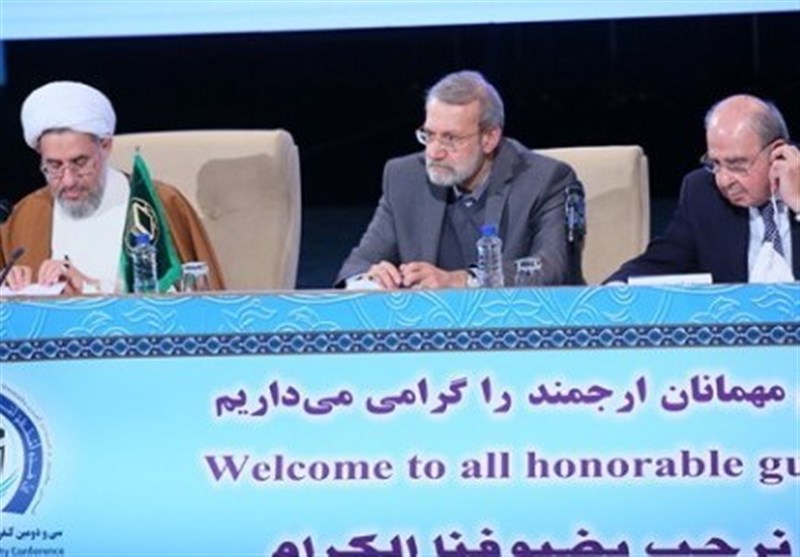
Addressing the closing ceremony of the 32nd Islamic Unity Conference in Tehran on Monday night, Larijani pointed to the Syrian issue and said from the very beginning of the crisis, Iran, unlike some countries, had emphasized that the issue would be resolved through political agreements.
He further addressed the Saudis and Emiratis, saying that they made a mistake in the early years after the victory of the 1979 Islamic Revolution by standing against Iran and provoking Saddam Hussein to wage a war on the country.
“But then you (Saudis and Emiratis) said that you had made a mistake and we overlooked your fault but today, we are not going to forget your mistake of supporting the US and the Zionists,” Larijani said, adding, “We will respond to your behaviors.”
He further pointed to the US’ so-called “deal of the century” plot, saying that Washington seeks to help Israel dominate the Middle East by such a plot but Iran is determined to foil it.
The Islamic Unity Conference opened in Tehran on Saturday under the motto of “Quds, the Axis of Unity” with a speech delivered by Iranian President Hassan Rouhani.
About 350 foreign guests, including 10 ministers and 40 Muftis, participated in the three-day international event.

The conference is held annually on the occasion of the birth anniversary of Prophet Muhammad (PBUH) in an effort to lay the ground for stronger unity and solidarity among Muslims and provide appropriate solutions for their problems.