Showing posts with label 2019 Algerian protests. Show all posts

Monday, September 23, 2019

Would Algerian PM Bedoui resign, paving way for vote?

By Hana Saada

ALGERIA - Algerian Prime Minister Noureddine Bedoui will soon step down paving the way for the holding of the presidential elections, postponed by the Government on July 4, citing the lack of candidates amid ongoing protests against the current government.
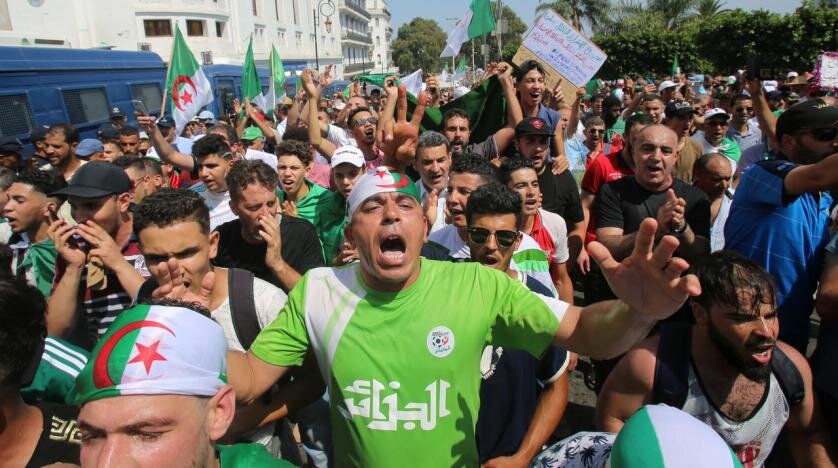
The resignation is a development that would mark a major win for protestors who are piling into the streets every week, calling for the departure of the remnants of the old guard, including the Prime Minister Bedoui, and the prosecution of the corrupted officials and oligarchs.
Earlier, and after weeks of demonstrations, protesters were able to force, in April,  the long-time president Abdelaziz Bouteflika to step down after two decades in power, a major win that was unthinkable two months earlier.
Protests demanding an overhaul of the ruling regime are showing no sign of waning despite the April resignation of veteran leader Bouteflika and the launch of anti corruption onslaught targeting former and current senior officials. These claims have been endorsed by Army Chief of Staff Ahmed Gaid Salah who urged magistrates and judges to act bravely while launching anti-corruption probes against politicians and businessmen who embezzled public funds.
Following Bouteflika resignation, the Upper House Speaker Abdelkader Bensalah assumed the post of Head of State in application of the provisions of the Algerian Constitution. One of his first actions was to call the country's postponed presidential election for July 4, However, this announcement failed to quell protesters, with thousands taking to the streets of the capital, Algiers, to call for a complete political overhaul and boycott of the election. Effectively, this election was latter scrapped, citing the lack of candidates.
Demonstrators have repeatedly demanded the departure of a coterie of individuals closely-linked to Bouteflika's administration, including the Prime Minister Bedoui, who was appointed by Bouteflika days before he stepped down, before the holding of any election. This claim is advocated by the Mediation and Dialogue Panel set by the interim president Bensalah to oversee a national dialogue, consult, communicate and hold talks with civil society actors, political parties, national figures, young people and activists from all over the country in order to develop a clear vision of ways to end the country’s months of political crisis and enable it to hold Presidential Elections as soon as possible. The Panel, in its final report submitted to the Head of State, following consultation with 5670 associations of different categories within two months, during which they met with various spectrums and components of society, called for the formation of a high electoral commission and amendments to the election law in an attempt to distance the authorities from the organization of the elections. It called, also, for the departure of Prime Minister Bedoui as the only solution to convince protesters to return to the poll ballot.
The handover of the Panel's proposals comes days after Army Chief of Staff Lt. Gen. Ahmad Qaid Saleh called for presidential elections before the end of 2019. A call adhered by the Head of State who inked, this week, a decree convening the electorate on September 15 so that elections could be held within 90 days (on December 12), in addition to two Organic Laws; the first one  on the Independent National Authority in Charge of Elections and the second one amending and supplementing Organic Law 16-10 dated August 25, 2016 on the electoral system.
"Today, based on our mission, mandate and respect for the constitution and the laws of the Republic, we find it best to summon the Electoral Commission on 15 September," Salah said, as reported by the official news agency APS.
"I have decided... that the date of the presidential election will be Thursday, December 12," said Bensalah, following army chief of staff Lieutenant General Ahmed Gaid Salah announcement.
Opposition parties, for their part, are still calling for deep political reforms to avoid electing a new president with the same mechanisms that allowed Bouteflika to remain in power for 20 years, stressing on the need to dismiss the current government of Prime Minister Noureddine Bedoui, appointed by Bouteflika before his departure, seen as a continuity with the old system.
In this sense, Talaïe El Houriet party considered that the institutional and legal conditions for the organization of an inclusive and transparent presidential election were brought together; however, the Government must resign and be replaced by a Government of national competences. This dismissal, according to them, would create the appropriate environment to guarantee a strong participation during the next presidential election to give the next president sufficient legitimacy to launch political, economic and social reforms.
The resignation of Noureddine Bedoui would ease the political deadlock, speed up the election process and calm down protesters determined to achieve their claims at any costs.

Monday, September 16, 2019

Algeria’s political impasse: What is next?

By Hanaa Saada

ALGERIA - Seven months after a wave of protests began in Algeria; people are still pilling onto the streets of the Algerian capital “Algiers” and other cities nationwide every Friday, reiterating their main demands: the departure of the regime and its symbols and the application of Articles 7 and 8 of the Constitution stating that the constituent power belongs to the people.
The demonstrations have gained a familiar rhythm and worldwide admiration since tens of thousands of Algerians first took, peacefully, to the streets on 22 February. Thousands of students turn out on Tuesdays and there are larger protests each Friday revolting against former opaque group of power-brokers that have run the country for decades.
After weeks of mass demonstrations, President of the Republic Abdelaziz Bouteflika stepped down, ceding power after 20 years of rule and abandoning his re-election bid. The protesters pressured the authorities, again, to cancel presidential elections originally scheduled for April.
Despite the postponement of the election, the public anger continued to mount. Thus, Army chief Gaid Salah emerged as the key powerbroker positioning himself in favor of El Hirak “Popular movement”. He publicly disavowed the former leader and called for his impeachment, winning legitimacy in the streets.
Purging Corruption
Gaid Salah responded favorably to protesters’ demands, launching a sweeping anti-graft campaign targeting high-ranked officials that have served the Bouteflika government as well as influential tycoons and businessman.
Two Prime Ministers, namely; Ahmed Ouyahia and Abdelmalek Sellal, the deposed President's brother Said Bouteflika, tens of ministers, leading industrialists, tycoons, key businessmen, Governors,  and two former Intelligence chiefs, have been remanded in custody for accusations ranging from money laundering, embezzlement, misuse of public money to using officials posts to influence industrial and commercial contracts and granting undue privileges, affiliation to suspicious parties that plot to destabilize the country, plotting against the army, and instigating the opposition to call for a transitional phase before holding any election.
Bouteflika's resignation puts Abdelkader Bensalah, Speaker of the upper house of parliament, in charge as caretaker Head of State for 90 days until elections are held. However, elections (scheduled for July 4th) have been postponed for a second time and protesters are demanding his departure.
For his part, Bensalah, and in a bid to calm them, set a Panel of Dialogue and Mediation, composed of political actors, the civil society, the representatives of the trade union organizations and many citizens, with the aim to mediate between public authorities and people  and hold a "serious and responsible" dialogue to reach a national consensus which would help resolve the political crisis in Algeria, through the organization of a fair and transparent presidential election, as soon as possible."
However, the Panel itself is facing rejection by protesters who are taking into the streets denouncing its formation, saying it does not represent them along other claims, such as the departure of Bensalah, a former head of the upper house of parliament, and Prime Minister Noureddine Bedoui, who are regarded by them as part of the old guard.
Despite all these arrangements, Algeria is still at an impasse, with two camps facing each other in seemingly irreconcilable positions.
To resolve this stalemate, Lieutenant General Ahmed Gaïd Salah, Deputy Minister of  National Defence, Chief of Staff of the People’s National Army (ANP), launched, last week, a call, saying that it would be "appropriate" to convene the electorate on the 15th of September, and that the elections could be held within the deadlines set by law.
In my previous speech, "I have spoken about the priority to seriously launch the preparation of the presidential elections within the coming weeks, and today, based on our missions, prerogatives and our compliance with the Constitution and the laws of the Republic as well, I confirm that we regard as appropriate to summon the Electorate on September 15th and the elections can be held within the deadlines provided for by the law. Reasonable and acceptable deadlines which respond to the insistent demand of the people," said Lieutenant General.
Theoretically, if the head of state, Abdelkader Bensalah, summons the electorate on September 15, 2019, as desired by the head of the army, the presidential election should take place before the end of the current year (mid-December).  The Organic Law No. 12-01 2012 (Electoral Code) provides in article 25 that "Subject to the other provisions of this organic law, the electorate shall be convened by presidential decree within three (3) months preceding the date of the elections ".
As a response, Algerian street has expressed its rejection of elections in the current political conditions. According to demonstrators, no election should take place as long as Bouteflika-era officials remain in positions of power.
For their parts, the opposition parties and civil society groups have also demanded the resignation of the government which constitutes “a popular demand”, voicing rejection of the holding of the elections.
The people are determined to pursue the hirak until the establishment of a state of institutions, widening gap between them and the power constrained, for lack of serious candidates, to cancel the vote twice.
According to observers, these presidential elections are unachievable for the moment because the approach advocated by Ahmed Gaid Salah " requires the revision of some texts of the electoral law to adapt to the requirements of the current situation, and not a total and profound revision that would affect all texts, as claimed by the demonstrators. The partial amendment means the holding of elections basing on the same mode of organization. This is likely to trigger the street again as the popular movement with its magnitude unparalleled in the contemporary history of the country will, likely, sabotage the preparations for this election. The political climate also does not allow the organization of such an election with the absence of total trust between voters and the political class.
However, it is imperative to go quickly to a presidential election provided that it is transparent, where the mediation initiatives of the Panel or other organizations, can lead to a consensual platform far from the occult practices of the past which saw the majority of the population sulking the ballot boxes, reflecting the state-citizen divorce, noting that an independent election monitoring commission and the departure of the Bedoui government are two prerequisites for a transparent presidential election.
This necessarily implies the cleaning up of the electoral file, the creation of an independent election supervision body where neither the executive (the government - especially the Ministry of the Interior and the Walis) nor the deputies/senators and representatives of the current APCs denounced by Al Hirak, will be stakeholders. 
Only a democratically elected legitimate president, elected on the basis of a transparent agenda, pledging to include the legitimate demands of Al Hirak including a new balance of power and the moralization of management (fight against corruption and embezzlement), can amend the constitution and carry out the profound political and economic reforms to bring Algeria to the new world and make it an emerging country: a pivotal country regionally and internationally.
Economically, it is imperative to quickly resolve the political crisis before the end of 2019 or at most the first quarter of 2020, to avoid towards a cessation of payments at the end of 2021 and beginning of 2022, and prevent Algeria the depletion of its foreign exchange reserves which would culminated in the economic, social, political insecurity.