Showing posts with label oil market. Show all posts

Tuesday, September 17, 2019

Attack on Saudi oil facilities: consequences and solutions

BY: Ebrahim Fallahi

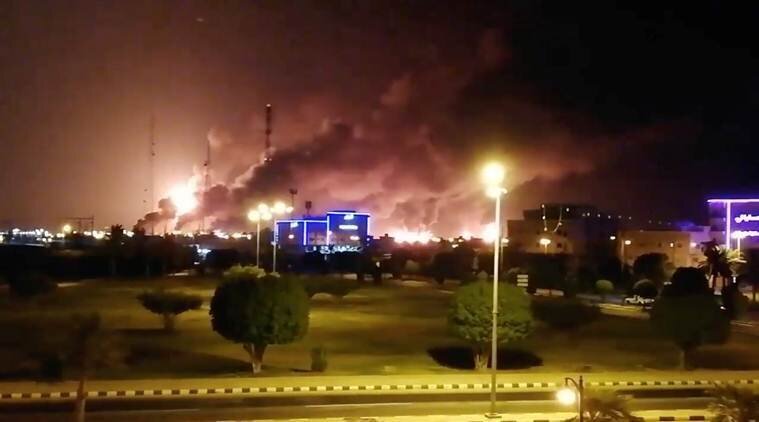
TEHRAN – As expected, oil markets started Monday trading with an unprecedented jump in prices following the attacks on Saudi Arabia’s oil facilities which wiped nearly five percent of the global oil supply from the market.
Drone attacks claimed by Yemen’s Houthi rebels on Saturday struck two of Saudi Aramco’s major oil facilities in Khurais and Abqaiq - the world's largest oil processing facility and crude oil stabilization plant.
Now, few days after the attacks, global oil markets are waiting to see how the disrupted oil is going to be compensated for.
 Will Saudis be able to get their production back to its full capacity in a short period of time? If not, what are the options for replacing the lost barrels to keep the market in balance?
The market’s reaction
A few hours after the strikes, Aramco released a statement confirming that production of 5.7 million barrels of crude (more than half of the kingdom’s output) was affected by the attacks.
Aramco’s statement sparked a wave of panic in the oil markets across the globe, causing for bets on oil prices to go as high as $100. 
As it was expected, in the first minutes of the Monday morning trades, Brent crude jumped $12 to reach $71 per barrel, posting its biggest ever surge in a day.
The market’s significant reaction to the incident could also be translated as an indication of the skepticism about the promises of recovery by the Saudis or vows of taping into emergency oil reserves by the United States. 
It is also a manifestation of yet another aspect of the world’s energy cycle, that is the realization a
bout the vulnerability of the global oil market and the magnitude of the impact of geopolitical factors on this market.
As Ed Morse from Citigroup Inc. wrote in a research note, “No matter whether it takes Saudi Arabia five days or a lot longer to get oil back into production, there is but one rational takeaway from this weekend’s drone attacks on the Kingdom’s infrastructure -- that infrastructure is highly vulnerable to attack, and the market has been persistently mispricing oil.” 
So, despite all the reassurance, oil markets around the world are once again overshadowed by the geopolitical risks and at least for some time the geopolitical risk premium will be seen in the oil prices.
Replacements for the lost oil
Many analysts and experts believe that Saudi Aramco won’t be able to get all the lost capacity back over a short period of time and it would at least take a couple of weeks to get back to the full capacity.
Considering the worst case scenario, some analysts believe that the oil market should be looking for new sources of crude supply in case the damage to the Aramco facilities turn out to be more than what is seems and the Saudi’s oil production takes more time than expected to get back to its full capacity.
One option, as previously mentioned, is the U.S. emergency reserves which Trump has promised to release to balance the market. However, analysts believe that such an action will likely not be taken in the short term.
"I don't think a release is imminent," Bob McNally, president of Rapidan Energy Group, told S&P Global Platts. "Everything depends on how much damage has been done and how long will it last."
There is also the matter of distance and time, as Sandy Fielden, analyst at Morningstar puts it, “It takes 19-20 days to ship Ras Tanura (Saudi) to Singapore, but 54 days from Houston to Singapore. So U.S. ‘relief’ will take time.”
It should also be mentioned that, although the U.S. strategic reserves are estimated at about 625 million barrels, but its offshore borders have restrictions on oil transportation. As the U.S. Department of Energy said in a report in 2016, the United States could release up to 2.1 million barrels a day from its strategic reserves.
Another option which is more likely in the short term is Saudi Arabia’s own reserves in countries like China and Japan, but with the kingdom’s limited reserves, the loss could only be replaced for approximately 30-45 days, according to McNally.
“Saudi Arabia has about 188 million barrels of oil stockpiled, which can offset the 5-million-barrels of lost oil only for about 37 days,” McNally said.
Even if Aramco manages to recover 2 million barrels of the disrupted capacity in short term (as they have claimed), the other 3.7 million barrels should be supplied from the reserves.
So if the oil which has been disrupted is not replaced before the company’s stored supplies end, the market would go into an even more complicated situation.
Finally, some other believe that the easiest solution is to waiver the Iranian oil.
 “The obvious short-term fix would be waivers on Iran sanctions, but politically that’s a hard pill for the Trump administration to swallow. By all accounts the Iranians have tankers full of storage ready to go,” Sandy Fielden said.
Jason Bordoff, founding director of the Center on Global Energy Policy at Columbia University also believes that Iran could be a reliable source of additional supply in case the disruptions prolong.

Wednesday, April 24, 2019

Would Saudis play the U.S. puppet in Iran sanctions scenario?

The U.S. announced on Monday that the country is not going to extend the sanctions waivers which were granted to some of Iran’s oil customers in November 2018.
Many analysts believe that Trump’s decision on ending the exemptions is a double-edged sword and the U.S. president might well be shooting himself in the leg by doing so, since on one hand, he doesn’t want the prices to follow their current upward trend and on the other hand he is willing to raise the pressure on Iran to its utmost level.
Finding the solution to make both these scenarios happen hasn’t been easy for the U.S. government and clearly by announcing the end of waivers on Iranian sanctions, Washington is betting big on its allies in the region for preventing the situation to get out of hand.
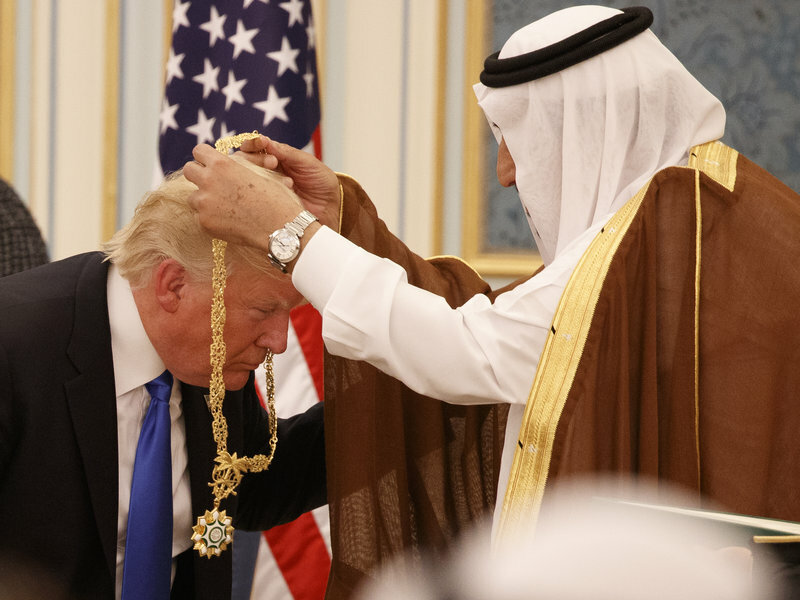
In this regard, Saudi Arabia’s announcement on Monday about the possibility of a boost in production is a clear indication of the fact that like many other times, this time too, the U.S. expect Saudi Arabia to play the oil-rich puppet which is ready to offset the losses from Iranian oil.
Now the question is, would Saudis really fill the gap? To answer this question one should have a clear understanding of the market statistics these days. In theory it might be possible for the Arab country to raise its output to a certain level but for how long and at what cost? (Both figuratively and literary) 
Saudi Arabia and the repeating scenario
As OPEC’s biggest exporter, Saudi Arabia is currently producing around 9.8 million barrels of oil and the country has been trying hard to maintain a production cut deal which has held OPEC producers alongside nations outside the cartel in a battle to keep the prices from falling.
This is not the first time that the Saudis are being ordered to play obedient executor in the region. Trump has been constantly criticizing OPEC for its actions regarding its activities to maintain the prices and the Saudis have been pressured to increase production again and again.
In July 2018, when Trump was planning on leaving Iran’s nuclear deal, he had asked the Saudis to rise their production to compensate the Iranian oil which was supposed to be wiped out of the market.
The kingdom promised to increase production to 12 million barrels per day, a dream that never came true.
At the time many experts and analysts pointed out the unrealistic nature of Saudi Arabia’s claims.
Gary Ross, head of global oil analytics at S&P Global said “The Saudis do not have 2 million bpd of spare capacity as it would imply production of 12 million bpd. They can likely produce a maximum of 11 million and even that will be running their system at stress levels,” 
“I do not believe that Saudi can increase production to 12 million bpd but they can increase exports by digging into their reserves.” Ole Hansen, head of commodities research at Saxo Bank said.
However, this time the situation is a little different. Considering the kingdom’s current production which is under 10 million bpd, the possibility of an increase to 11 million bpd is not that far from the reality.
But would the Saudi’s be able to go through with this promise?
Saudis and OPEC: The pact
Despite clear opposition from Trump, in December 2018, Saudi Arabia and its other fellow OPEC members along with the non-OPEC oil producers reached an agreement based on which all the signees would commit to a certain level of production cuts to take 1.2 million barrels per day off the market for the first six months of 2019. The 15-members of OPEC agreed to reduce their output by 800,000 bpd, while non-OPEC allies including agreed to contribute a 400,000 bpd reduction.
Since the beginning, all the OPEC+ members showed significant commitment to the deal and their efforts led to an almost balanced market in which the prices started to rise from their low levels.
In the meantime, Saudi Arabia has been pressured multiple times by the U.S. to end the accord and to increase production, however since the kingdom desperately needs the prices above $50 to maintain its precious Aramco’s value, the Saudis have resisted the U.S. requests for cooperation.
If the Saudis go through with Trump’s request this time, the kingdom would not only be ending a deal which has kept the prices from falling for so long, but it will also negate its position of strength within OPEC.
Despite all the pressures from the U.S., Saudi Arabia wants to make sure that in the next OPEC+ meeting in June, the pack would stay committed to the cuts deal. And if Saudi Arabia goes through with the commitment to rise its production under the U.S. pressure, it would definitely come to the OPEC+ gathering empty handed and it cannot expect other signees to stay in a deal which needed all the members to cut to certain levels.
Considering the fact that other members of OPEC+ deal are not at a position which could be able to increase production, the U.S. is expecting Saudi Arabia and the UAE to shoulder the burden.
If they do so, this would be a clear indication for the OPEC+ deal to end and that would not be good news for the Saudis that do not want to go back to the bad old days of under-$50 oil.
That’s why Saudis haven’t been clear about their position in all these, they have said that the kingdom is going to assess the impact of the U.S. decision on the oil market before any raise in output.
Let’s not forget Iran’s ability to maintain some level of its oil exports under any circumstances. Iran has proven multiple times that it has its own strategies and approaches for seeing its oil in the global markets and many oil experts and analysts alongside Iranian officials including Iranian Oil Minister Bijan Namdar Zanganeh have clearly asserted that the U.S. cannot realize its dream of “zero Iranian oil”.
So with some portion of Iranian oil added to the mixture, and despite the short-term spike in the prices for now, the markets could be awaiting a downfall for oil prices if Saudis go through with the U.S. plans.
there is also the possibility of a conflict in the region, since Iran could potentially close the strategic Strait of Hormuz.