Showing posts with label Recep Tayip Erdogan. Show all posts

Monday, November 11, 2019

Trump to Arab Protesters: I Stand With Your Rulers, Not You

by COLUM LYNCH, Foreign PolicySaudi Trump


As demonstrations erupt from Iraq to Lebanon to Egypt, the United States is sending strong signals that it no longer has any stomach for democracy promotion.
This year, the largest popular protests since the Arab Spring have gripped the Middle East and North Africa, toppling a military dictator and accused war criminals in Sudan, prompting the resignation of Lebanese Prime Minister Saad Hariri, and challenging the rule of leaders in Algeria, Egypt, Jordan, and Iraq.
During that time, the Trump administration has responded with a fairly consistent message: America no longer much cares—unless you are protesting against Iran.
While the State Department has offered measured expressions of support for protesters, critics and former U.S. officials say the White House has remained largely indifferent, raising doubts about the administration’s commitment to the demonstrators’ aspirations. For some observers, President Donald Trump’s silence represents a betrayal of America’s traditional role as an inspiration for democracy abroad. But others feel that it would be best for the protesters if the White House stays out of their business—especially since Washington has so egregiously botched democracy promotion in the Arab world before, particularly in Iraq.
“It is better if they don’t say anything,” Marwan Muasher, a former Jordanian foreign minister, told Foreign Policy.
Yet Trump has gone even further in the opposite direction than mere silence, unambiguously siding with the region’s autocratic rulers and leaving lower-level bureaucrats in his administration to deliver mild encouragement to the protesters. Asked this fall to comment on Egypt’s most violent crackdown on protesters since the Arab Spring, Trump offered unconditional support for the country’s leader, Egyptian President Abdel Fattah al-Sisi, whom he once described as “my favorite dictator.”
“I’m not concerned with it. Egypt has a great leader. He’s highly respected,” Trump said following a meeting with Sisi in September on the sidelines of the United Nations General Assembly. “Everybody has demonstrations.”
Trump’s apparent disregard for democratic yearnings in the Middle East may come as no surprise for a president that has questioned the legitimacy of key democratic institutions that have challenged him at home, including the courts, the press, and Congress.
“We have never had a president beaming out to the world a set of anti-democratic instincts and actions that conform so closely with the strongman playbook,” said Thomas Carothers, an expert on international democracy promotion with the Carnegie Endowment for International Peace.
Still, his public embrace of autocrats represents a sharp departure from his predecessors, who may have learned to turn up their noses and work with foreign despots but preached the virtues of democratic government in public.
“After [Abraham] Lincoln, this is the first time we’ve had a president who is not just autocratic but has dictatorial tendencies,” said Hussein Ibish, a senior resident scholar at the Arab Gulf States Institute in Washington, citing Trump’s effort to bend constitutional institutions to his will. “He has more in common with Sisi and [Turkish President Recep Tayyip] Erdogan than any of his predecessors.”
Trump’s views on promoting democracy elsewhere in the world contrast sharply with those of his predecessors, including President Barack Obama.

Monday, October 14, 2019

Iran’s View On Turkey’s Operation Peace Spring

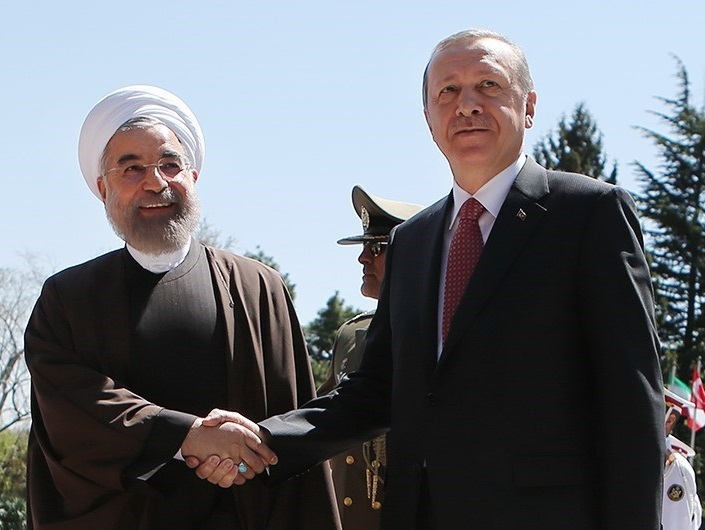
Iranian President Hassan Rouhani and Turkish President Recep Tayyip Erdogan (Wikimedia Commons)
by Giorgio Cafiero
A common view in Washington is that President Donald Trump’s decision to essentially green light Turkey’s Operation Peace Spring against the Peoples’ Protection Units (YPG) in northern Syria benefits key U.S. adversaries, including the Islamic Republic of Iran. Prominent members of the U.S. foreign policy establishment and writers in mainstream American media outlets keep making this argument.
Brett McGurk, the former special presidential envoy for the Global Coalition to Defeat ISIS, called Trump’s decision a “gift to Russia, Iran, and ISIS.” House Minority Leader Kevin McCarthy condemned Turkey’s Syria operation, maintaining that it could “give the likes of al-Qaeda and Iran new footholds in the region…” Wajahat Ali, a contributing op-ed writer at the New York Timestweeted: “It’s a win for ISIS, Russia, Iran and Turkey.”
Yet such claims are too simplistic and misleading. Tehran’s interests in the Kurdish parts of northern Syria are complicated and the Iranian government officially and strongly opposes the Turkish incursion into northern Syria.
Shortly before Turkey launched Operation Peace Spring, Iranian Foreign Minister Mohammad Javad Zarif called on Ankara to have “respect for Syria’s territorial integrity and national sovereignty.” Two days later, the Iranian military began holding drills close to the Iranian-Turkish border, while Tehran was warning Ankara not to move ahead with its plans in northern Syria. According to the Iranian Students News Agency (ISNA), the drills entailed army helicopters, rapid reaction units, and mobile and offense brigades. Iranian army chief Major General Abdul Rahim Mousavi, who oversaw the drills, hailed their results as positive, stating that they were meant to “measure the readiness, mobility and speed” of Iranian forces near Turkey. Mousavi added: “The message to the enemies is that if they make the wrong calculations, they should know that the children of this land are ready to resist with their full power at any time and place.”
Iran’s parliamentary speaker, Ali Larijani, had a trip planned to the Turkish capital which he cancelled after Turkey launched its Syria operation. Iran’s Foreign Ministry called for an “immediate end to the attacks and for the withdrawal of Turkish forces from Syrian soil” after the Turkish assault began. The ministry also emphasized that while Tehran understands Ankara’s “security concerns,” Iran’s position is that Turkey’s “military action would not only not diminish that country’s security concerns, but also cause financial and humanitarian damages.”
Ultimately, Ankara’s military campaign leaves Tehran in a difficult situation. On one hand, Iran wants to see the Astana peace process (involving Iran, Russia, and Turkey) succeed in terms of resolving the Syrian crisis, particularly in Idlib, thus Tehran desires a continuation of good relations with Ankara. Similarly, Moscow doesn’t want its conflicts of interests with Turkey to upset the Astana process. On the other hand, as a supporter of the Syrian government, the Islamic Republic is deeply unsettled by the fact that Turkey’s Operation Peace Spring relies so heavily on anti-Assad rebel forces from northern and/or eastern Syria. Indeed, Iranian and Iranian-aligned forces have fought those rebels throughout the Syrian civil war.
Turkish-backed groups, including the Sultan Murad Division, Faylaq al-Sham, Ahrar al-Sharqiya, etc., which have fought the Assad regime under the umbrella of the Free Syrian Army (FSA)—now rebranded the Syrian National Army (SNA)—are central to Turkey’s Syria operation. Some of the 14,000 rebels in these groups entered Syria from Turkey with the Turkish military while others were already in Syria, near the towns where the Turks have targeted the YPG this month. These forces are on the frontlines doing much of the heavy lifting in the fight against Ankara’s Syrian Kurdish enemies and Turkey will count on them to guard towns taken from the YPG. Naturally, Iran does not want to see these Sunni groups—some of which previously received U.S. support—to gain new life in the Syrian war, which now appears to be happening because of the Turkish incursion.
On October 11, protests took place in Iranian Kurdistan one day before hundreds of Iranians gathered at Turkey’s embassy in Tehran to express their staunch opposition to Ankara’s military campaign. Such public displays of anger directed against Turkey underscore how domestic as well as regional/international politics are also impacting Tehran’s response to Operation Peace Spring.
Within the context of the Trump administration’s “maximum pressure” campaign against Iran, officials in Tehran have sought to improve the Islamic Republic’s relationship with Iranian Kurdish communities. Fearful of the U.S. military presence in the Gulf as well as Salafist-jihadist groups operating in Sistan and Baluchestan Province, allegedly with U.S. and Saudi support, the leadership in Tehran wants to prevent outside forces from exploiting opportunities to use militant Iranian Kurdish groups as proxies in any campaign to weaken Iran’s government. Doing so requires engaging Iranian Kurdish factions in a dialogue, which has been taking place in Norway since May, while also addressing socio-economic and political problems in northwestern Iran, which for many years have fueled Kurdish resentment toward the Iranian government.
Doubtless, with millions of Iranian citizens sympathizing with Syrian Kurds who are struggling to survive amid Turkey’s campaign, Iran has to contain such anger and not appear to be siding with Ankara in Operation Peace Spring. At the same time, Iran is Turkey’s neighbor and the two states have always maintained a relationship rooted in pragmatism even when Tehran and Ankara have not seen eye to eye on regional issues. As sanctions continue taking a severe toll on Iran’s economy, the Islamic Republic understands the importance of maintaining its friendship with Turkey. 
Furthermore, Iran does not want to walk away from the progress that it has made in working with Turkey and Russia via the Astana process—however hampered that arrangement might be due to Operation Peace Spring. Tehran also shares Ankara’s interest in preventing the YPG from establishing a statelet in northern Syria that could provide Israel with a foothold near the Syrian-Iraqi border from where it could conduct more strikes against Iranian-backed actors in the region.
At this juncture, despite some silver linings that Tehran might see in Ankara’s assault on northern Syria, Iran is seeking to pressure Turkey into halting its military incursion while also pushing the YPG, Ankara, and Damascus toward a new understanding that can lead to stability and security along the Turkish-Syrian border. On October 12, Zarif offered to engage all three while referring to the Adana accord of 1998, which prevented a Turkish-Syrian war by requiring the Assad government to end its sponsorship of the Kurdistan Workers’ Party (PKK), as the basis for striking a deal that could lead to Turkey’s military and the Syrian Arab Army (SAA) guarding the Turkish-Syrian border through a coordinated effort. Nonetheless, with Erdogan vowing not to negotiate with “terrorists,” it is difficult to imagine Ankara and the YPG reaching any sort of peace in the foreseeable future.
Looking ahead, Tehran will not be shy about voicing its opposition to Turkey’s anti-YPG operation. The regional and domestic ramifications for Iran appear dangerous from Tehran’s perspective. Yet Iran is carefully considering Turkey’s legitimate security interests in the process while seeking to avoid any actions that could create major problems for bilateral affairs. The Islamic Republic’s ability to maintain friendly relations with Turkey while standing by its ally in Damascus will be severely tested as the world grows increasingly concerned about a potential new Middle Eastern war erupting between Syria and Turkey. Now that the YPG and the Syrian government have reached a deal to allow SAA forces to re-enter land territory in northeastern Syria that has been controlled by the YPG since 2012, it remains to be seen what will happen to Operation Spring Peace. Yet with Turkey voicing its determination to push its offensive deeper into Syria, officials in Tehran are nervous about the future of the Astana peace process.
Undoubtedly, such an outcome would be anything but a “gift” to Iran.

Sunday, October 13, 2019

Implications of Turkey's invasion of Syria

Crescent International
Regardless of the justifications Turkey offers for its invasion of northeast Syria, it is a clear violation of Syria’s sovereignty and carries grave implications.
Threatened for a long time, Turkey’s military invasion comes at a time when Syrian government forces were making steady progress against foreign backed terrorists.
The terrorists had been holed up in a small rump in Idlib province and would surely have been completed routed had it not been for such foreign support.
After three days of military operations, Turkey’s defense ministry said on October 12 its forces had taken control of the Syrian border town of Ras al-Ain although the Kurdish-led Syrian Democratic Forces (SDF) has disputed this.
The border town has been under the control of US-backed Kurdish militants, YPG.
“As a result of successful operations within the scope of ‘Operation Peace Spring’, the town of Ras al-Ain to the east of the Euphrates has been brought under control,” the Turkish defence ministry wrote on its Twitter.
Turkey’s target is the Kurdish armed group YPG that it says is closely aligned with the terrorist group the PKK operating in Turkey.
Ankara wants to prevent the Kurds from dominating both sides of the border and linking up because it views them as a threat to its security.
Turkey’s aim is to capture a swath of Syria territory measuring 30 km by 110 km inhabited largely by Kurds.
Two towns—Ras al-Ain and Tal Abyad—are the primary focus of Turkey’s invasion. They have come under heavy bombardment, forcing tens of thousands of civilians to flee.
Launching artillery and air strikes, there have been civilian casualties with some estimates putting the number at 50 on both sides.
While Turkey wants to prevent Kurdish militants residing in another country (Syria) from linking up with Kurds on its soil, it has little trouble supporting and maintaining militants inside Syria.
On October 12, the Turkish-backed militants claimed to have cut the 712 Road that links Tel Abyad and Ras al-Ain. A militant spokesman claimed 18 villages have been captured in the advance.
Syria’s official news agency SANA reported from Hasakah that Turkey had also cut off an international highway linking the province in the far northeastern corner of Syria to Aleppo.
The Turkish invasion was launched following a telephone conversation between Turkish President Recep Tayip Erdogan and his American counterpart Donald Trump on August 6.
After he spoke to Erdogan, Trump said he was withdrawing US troops, illegally occupying Syrian territory, from the border with Turkey. The US maintains an airbase at al-Tanf in Syria, again in clear violation of the latter’s sovereignty and international law.
The Western corporate media went into a breast-beating frenzy about the US “betrayal” of Kurds.
The media also talked about the thousands of Daesh terrorists held by the Kurds that could now escape from captivity.
They could keep their powder dry. SANA reported that US forces had whisked out 80 foreign Daesh prisoners held at al-Shadadi prison south of Hasakah to Iraq.
The West, especially the US is not and has not fought ISIS terrorists; they are the West’s creation to be used against countries they wish to destabilize.
Unfortunately, the Kurds’ political and military leaders have always made poor choices and allowed themselves to be used by unsavory foreign powers.
These include such countries as the US, Israel, Britain and a host of others.
When it became clear that Trump had given greenlight to Nato member Turkey to invade northeastern Syria, the Kurds turned to Damascus for help.
Syria’s Deputy Foreign Minister Faisal Mikdad in an interview in Beirut on October 10 ruled out any talks with the Kurds.
“The armed factions betrayed their country and committed crimes against it. We will not accept dialogue with those who became hostages of foreign forces. There will not be any foothold for agents of Washington on Syrian soil,” Mikdad said.
The government in Damascus, however, has been placed in a difficult position. Its forces do not have the capacity to take on Nato-member Turkey.
Syrian armed forces with help from allies like Hizbullah, Iran and Russia have barely managed to contain and gradually defeat foreign terrorists flooding the country.
In addition to controlling the Kurds, Turkey wants to transfer some of the estimated 3.6 million Syrian refugees on its soil to this area.
Having used them for eight years, Turkey no longer wishes to look after the Syrian refugees. Resentment of Syrian refugees has grown especially in Turkish border towns like Sanliurfa.
If successful in this transfer, the refugee resettlement project would give Turkey a permanent base inside Syria because Ankara would be involved in administering their affairs under the pretext of protecting them.
It may even lead to Turkey occupying this area that used to be part of the Ottoman State before the colonial division of the region a century ago.
The incursion into Syria is fraught with danger and will only add to further destabilization of the region to the benefit of imperialists and Zionists.