Showing posts with label Kurds. Show all posts

Thursday, December 12, 2019

The Israel Lobby’s Hidden Hand in the Theft of Iraqi and Syrian Oil

Agha HUSSAIN, Whitney WEBB
“We want to bring our soldiers home. But we did leave soldiers because we’re keeping the oil,” President Trump stated on November 3, before adding, “I like oil. We’re keeping the oil.”
Though he had promised a withdrawal of U.S. troops from their illegal occupation of Syria, Trump shocked many with his blunt admission that troops were being left behind to prevent Syrian oil resources from being developed by the Syrian government and, instead, kept in the hands of whomever the U.S. deemed fit to control them, in this case, the U.S.-backed Kurdish-majority militia known as the Syrian Democratic Forces (SDF).
Though Trump himself received all of the credit — and the scorn — for this controversial new policy, what has been left out of the media coverage is the fact that key players in the U.S.’ pro-Israel lobby played a major role in its creation with the purpose of selling Syrian oil to the state of Israel. While recent developments in the Syrian conflict may have hindered such a plan from becoming reality, it nonetheless offers a telling example of the covert role often played by the U.S.’ pro-Israel lobby in shaping key elements of U.S. foreign policy and closed-door deals with major regional implications.
Indeed, the Israel lobby-led effort to have the U.S. facilitate the sale of Syrian oil to Israel is not an isolated incident given that, just a few years ago, other individuals connected to the same pro-Israel lobby groups and Zionist neoconservatives manipulated both U.S. policy and Iraq’s Kurdish Regional Government (KRG) in order to allow Iraqi oil to be sold to Israel without the approval of the Iraqi government. These designs, not unlike those that continue to unfold in Syria, were in service to longstanding neoconservative and Zionist efforts to balkanize Iraq by strengthening the KRG and weakening Baghdad.
After the occupation of Iraq’s Nineveh Governorate by ISIS (June 2014-October 2015), the Kurdistan Regional Government (KRG) took advantage of the Iraqi military’s retreat and, amidst the chaos, illegally seized Kirkuk on June 12. Their claim to the city was supported by both the U.S. and Israel and, later, the U.S.-led coalition targeting ISIS. This gave the KRG control, not only of Iraq’s export pipeline to Turkey’s Ceyhan port, but also to Iraq’s largest oil fields.
Israel imported massive amounts of oil from the Kurds during this period, all without the consent of Baghdad. Israel was also the largest customer of oil sold by ISIS, who used Kurdish-controlled Kirkuk to sell oil in areas of Iraq and Syria under its control. To do this in ISIS-controlled territories of Iraq, the oil was sent first to the Kurdish city of Zakho near the Turkey border and then into Turkey, deceptively labeled as oil that originated from Iraqi Kurdistan. ISIS did nothing to impede the KRG’s own oil exports even though they easily could have given that the Kirkuk-Ceyhan export pipeline passed through areas that ISIS had occupied for years.
In retrospect, and following revelations from Wikileaks and new information regarding the background of relevant actors, it has been revealed that much of the covert maneuvering behind the scenes that enabled this scenario intimately involved the United States’ powerful pro-Israel lobby. Now, with a similar scenario unfolding in Syria, efforts by the U.S.’ Israel lobby to manipulate U.S. foreign policy in order to shift the flow of hydrocarbons for Israel’s benefit can instead be seen as a pattern of behavior, not an isolated incident.
“Keep the oil” for Israel
After recent shifts in the Trump administration in its Syria policy, U.S. troops have controversially been kept in Syria to “keep the oil,” with U.S. military officials subsequently claiming that doing so was “a subset of the counter-ISIS mission.” However, Secretary of Defense Mark Esper later claimed that another factor behind U.S. insistence on guarding Syrian oil fields was to prevent the extraction and subsequent sale of Syrian oil by either the Syrian government or Russia.
One key, yet often overlooked, player behind the push to prevent a full U.S. troop withdrawal in Syria in order to “keep the oil” was current U.S. ambassador to Turkey, David Satterfield. Satterfield was previously the assistant secretary of state for Near Eastern Affairs, where he yielded great influence over U.S. policy in both Iraq and Syria and worked closely with Brett McGurk, the former Deputy Assistant Secretary of State for Iraq and Iran and later special presidential envoy for the U.S.-led “anti-ISIS” coalition.
Over the course of his long diplomatic career, Satterfield has been known to the U.S. government as an Israeli intelligence asset embedded in the U.S. State Department. Indeed, Satterfield was named as a major player in what is now known as the AIPAC espionage scandal, also known as the Lawrence Franklin espionage scandal, although he was oddly never charged for his role after the intervention of his superiors at the State Department in the George W. Bush administration.
In 2005, federal prosecutors cited a U.S. government official as having illegally passed classified information to Steve Rosen, then working for AIPAC, who then passed that information to the Israeli government. That classified information included intelligence on Iran and the nature of U.S.-Israeli intelligence sharing. Subsequent media reports from the New York Times and other outlets revealed that this government official was none other than David Satterfield, who was then serving as Principal Deputy Assistant Secretary for Near East Affairs.
Charges against Rosen, as well as his co-conspirator and fellow AIPAC employee Keith Weissman, were dropped in 2009 and no charges were levied against Satterfield after State Department officials shockingly claimed that Satterfield had “acted within his authority” in leaking classified information to an individual working to advance the interests of a foreign government. Richard Armitage, a neoconservative ally with a long history of ties to CIA covert operations in the Middle East and elsewhere, has since claimed that he was one of Satterfield’s main defenders in conversations with the FBI during this time when he was serving as Deputy Secretary of State.
The other government official named in the indictment, former Pentagon official Lawrence Franklin, was not so lucky and was charged under the Espionage Act in 2006. Satterfield, instead of being censured for his role in leaking sensitive information to a foreign government, was subsequently promoted in 2006 to serve as the Coordinator for Iraq and Senior Adviser to then-Secretary of State Condoleezza Rice.
In addition to his history of leaking classified information to AIPAC, Satterfield also has a longstanding relationship with the Washington Institute for Near East Policy, a controversial spin-off of AIPAC also known by its acronym WINEP. WINEP’s website has long listed Satterfield as one of its experts and Satterfield has spoken at several WINEP events and policy forums, including several after his involvement with the AIPAC espionage scandal became public knowledge. However, despite his longstanding and controversial ties to the U.S. pro-Israel lobby, Satterfield’s current relationship with some elements of that lobby, such as the Zionist Organization of America (ZOA), is complicated at best.
While Satterfield’s role in yet another reversal of a promised withdrawal of U.S. troops from Syria has largely escaped media scrutiny, another individual with deep ties to the Israel lobby and Syrian “rebel” groups has also been ignored by the media, despite his outsized role in taking advantage of this new U.S. policy for Israel’s benefit.
US Israel Lobby secures deal with Kurds
Earlier this year, well before Trump’s new Syria policy of “keeping the oil” had officially taken shape, another individual with deep ties to the U.S. Israel lobby secured a lucrative agreement with U.S.-backed Kurdish groups in Syria. An official document issued earlier this year by the Syrian Democratic Council (SDC), the political arm of the Kurdish majority and U.S.-backed Syrian Democratic Forces (SDF), a New Jersey-based company, founded and run by U.S.-Israeli dual citizen Mordechai “Motti” Kahana, was given control of the oil in territory held by the SDC.
Per the document, the SDC formally accepted the offer from Kahana’s company — Global Development Corporation (GDC) — to represent SDC in all matters pertaining to the sale of oil extracted in territory it controls and also grants GDC “the right to explore and develop oil that is located in areas we govern.”
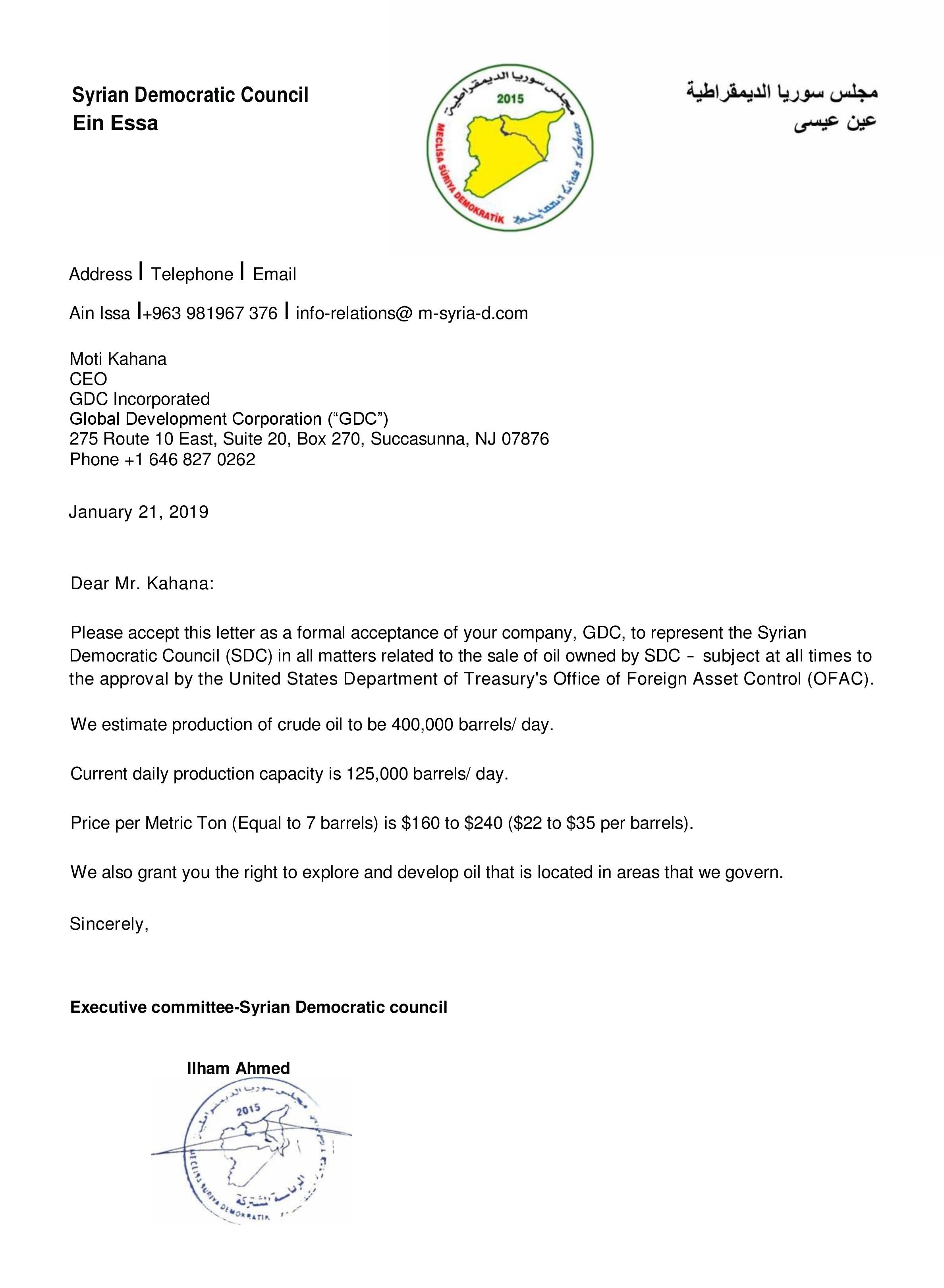
Global Development Corporation Kurdish Oil
The SDC’s formal acceptance of Global Development Corporation’s offer to develop Syrian oil fields. Source | Al-Akhbar
The document also states that the amount of oil then being produced in SDC-controlled areas was 125,000 barrels per day and that they anticipated that this would increase to 400,000 barrels per day and that this oil is considered a foreign asset under the control of the United States by the U.S. Department of the Treasury.
After the document was made public by the Lebanese outlet Al-Akhbar, the SDC claimed that it was a forgery, even though Kahana had separately confirmed its contents and shared the letter itself to the Los Angeles Times as recently as a few weeks ago. Kahana previously attempted to distance himself from the effort and told the Israeli newspaper Israel Hayom in July that he had made the offer to the SDC as means to prevent the “Assad regime” of Syria from obtaining revenue from the sale of Syrian oil.
The Kurds currently hold 11 oil wells in an area controlled by the [Syrian] Democratic Forces. The overwhelming majority of Syrian oil is in that area. I don’t want this oil reaching Iran, or the Assad regime.”
At the time, Kahana also stated that “the moment the Trump administration gives its approval, we can begin to export this oil at fair prices.”
Given that Kahana has openly confirmed that he is representing the SDC’s oil business shortly after Trump’s adoption of the controversial “keep the oil policy,” it seems plausible that Kahana has now received the approval needed for his company to export the oil on behalf of the SDC. Several media reports have speculated that, if Kahana’s efforts go forward unimpeded, the Syrian oil will be sold to Israel.
However, considering Turkey’s aversion to engaging in any activities that may benefit the PKK-SDF – there are considerable obstacles to Kahana’s plans. While the SDF — along with assistance from U.S. troops — still controls several oil fields in Syria, experts assert that they can only realistically sell the oil to the Syrian government. Not even the Iraqi Kurds are a candidate, considering Baghdad’s firm control over the Iraq-Syria border and the KRG’s weakened state after its failed independence bid in late 2017.
Regardless, Kahana’s involvement in this affair is significant for a few reasons. First, Kahana has been a key player in the promotion and funding of radical groups in Syria and has even been caught hiring so-called “rebels” to kidnap Syrian Jews and take them to Israel against their will. It was Kahana, for instance, who financed and orchestrated the now infamous trip of the late Senator John McCain to Syria, where he met with Syrian “rebels” including Khalid al-Hamad – a “moderate” rebel who gained notoriety after a video of him eating the heart of a Syrian Army soldier went viral online. McCain had also admitted meeting with ISIS members, though it is unclear if he did so on this trip or another trip to Syria.
In addition, Kahana was also the mastermind behind the “Caesar” controversy, whereby a Syrian using the pseudonym “Caesar” was brought to the U.S. by Kahana and went on to make claims regarding torture and other crimes allegedly committed by the Assad-led government Syria, claims which were later discredited by independent analysts. He was also very involvedin Israel’s failed efforts to establish a “safe zone” in Southern Syria as a means of covertly expanding Israel’s territory from the occupied Golan Heights and into Quneitra.
Notably, Kahana has deep ties — not just to efforts to overthrow the Syrian government — but also to U.S. Israel lobby, including the Washington Institute for Near East Policy (WINEP) where Satterfield is as an expert. For instance, Kahana was a key player in a 2013 symposiumorganized by WINEP along with Syrian opposition groups intimately involved in the arming of so-called “rebels.” One of the other participants in the symposium alongside Kahana was Mouaz Moustafa, director of the “Syrian Emergency Task Force” who assisted Kahana in bringing McCain to Syria in 2013. Moustafa was listed as a WINEP expert on the organization’s website but was later mysteriously deleted.
Kahana is also intimately involved with the Israeli American Council (IAC), a pro-Israel lobby organization, as a team member of its national conference. IAC was co-founded and is chaired by Adam Milstein, a multimillionaire and convicted felon who is also on the boards of AIPAC, StandWithUs, Birthright and other prominent pro-Israel lobby organizations. One of IAC’s top donors is Sheldon Adelson, who is also the top donor to President Trump as well as the entire Republican Party.
Though the machinations of both Kahana and Satterfield to guide U.S. policy in order to manipulate the flow of Syria’s hydrocarbons for Israel’s benefit may seem shocking to some, this same tactic of pro-Israel lobbyists using the Kurds to illegally sell a country’s oil to Israel was developed a few years prior, not in Syria, but Iraq. Notably, the individuals responsible for that policy in Iraq shared connections to several of the same pro-Israel lobby organizations as both Satterfield and Kahana, suggesting that their recent efforts in Syria are not an isolated event, but a pattern.
War against ISIS is a war for oil
In an email dated June 15, 2014, James Franklin Jeffrey (former Ambassador to Iraq and Turkey and current U.S. Special Representative for Syria) revealed to Stephen Hadley, a former George Bush administration advisor then working at the government-funded United States Institute of Peace, his intent to advise the KRG in order to sustain Kirkuk’s oil production. The plan, as Jeffery described it, was to supply both the Kurdistan province with oil and allow the export of oil via Kirkuk-Ceyhan to Israel, robbing Iraq of its oil and strengthening the country’s Kurdish region along with its regional government’s bid for autonomy.
Jeffrey, whose hawkish views on Iran and Syria are well-known, mentioned that Brett McGurk, the U.S.’ main negotiator between Baghdad and the KRG, was acting as his liaison with the KRG. McGurk, who had served in various capacities in Iraq under both Bush and Obama, was then also serving Deputy Assistant Secretary of State for Iraq and Iran. A year later, he would be made the special presidential envoy for the U.S.-led “anti-ISIS” coalition and, as previously mentioned, worked closely with David Satterfield.
Jeffrey was then a private citizen not currently employed by the government and was used as a non-governmental channel in the pursuit of the plans described in the leaked emails published by WikiLeaks. Jeffrey’s behind-the-scenes activities with regards to the KRG’s oil exports were done clandestinely, largely because he was then employed by a prominent arm of the U.S.’ pro-Israel lobby.
At the time of the email, Jeffrey was serving as a distinguished fellow (2013-2018) at WINEP. As previously mentioned, WINEP is a pro-Israel foreign policy think-tank that espouses neoconservative views and was created in 1985 by researchers that had hastily left AIPAC to escape investigations against the organization that were related to some of its members conducting espionage on behalf of Israel. AIPAC, the American Israeli Public Affairs Committee, is the largest registered Israel lobbyist organization in the US (albeit registration under the Foreign Agents Registration Act would be more suitable), and, in addition to the 1985 incident that led to WINEP’s creation, has had members indicted for espionage against the U.S. on Israel’s behalf.
WINEP’s launch was funded by former President of the Jewish Federation of Los Angeles,  Barbara Weinberg, who is its founding president and constant Chairman Emerita. Nicknamed ‘Barbi’, she is the wife of the late Lawrence Weinberg who was President of AIPAC from 1976-81 and who JJ Goldberg, author of the 1997 book Jewish Power, referred to as one of a select few individuals who essentially dominated AIPAC regardless of its elected leadership. Co-founder alongside Weinberg was Martin Indyk. Indyk, U.S. Ambassador to Israel (1995-97) and Assistant Secretary of State for Near Eastern Affairs (1997-99), led the AIPAC research time that formed WINEP to escape the aforementioned investigations.
WINEP has historically received funding from donors who donate to causes of special interest for Zionism and Israel. Among its trustees are extremely prominent names in political Zionism and funders of other Israel Lobby organizations, such as Charles and Edgar Bronfman and the ChernicksIts membership remains dominated by individuals who have spent their careers promoting Israeli interests in the U.S.
WINEP has become more well-known, and arguably more controversial, in recent years after its research director famously called for false-flag attacks to trigger a U.S. war with Iran in 2012, statements well-aligned with longstanding attempts by the Israel Lobby to bring about such a war.
A worthy partner in crime
Stephen Hadley, another private citizen who Jeffrey evidently considered as a partner in his covert dealings discussed in the emails, also has his own past of involvement with Israel-specific intrigues and meddling.
During the G.W. Bush administration, Hadley tagged along with neoconservatives in their numerous creations of fake intelligence and efforts to incriminate Iraq for possessing chemical and nuclear weapons. Hadley was one of the promoters from within the U.S. government of the false claim that 9/11 hijacker Mohammed Atta met with Iraqi officials in Prague.
Hadley also worked with then-Chief of Staff to the Vice President, Lewis Libby — a neoconservative and former lawyer for the Mossad-agent and billionaire Marc Rich — to discredit a CIA investigation into claims of Iraq purchasing yellowcake uranium from Niger. That claim famously appeared in Bush’s State of the Union address in 2002.
What this particular claim had in common with the ‘Iraq meets Atta in Prague’ disinformation, and other famous lies against Iraq fabricated and circulated by the dense neocon network, was its source: Israel and pro-Israel partisans.
The distribution network of these now long-debunked claims was none other than the neoconservatives who act a veritable Israeli fifth column that has long sought to promote Israeli foreign policy objectives as being in the interest of the United States. In this, Hadley played his part by helping to ensure that the United States was railroaded into a war that had long been promoted by both Israeli and American neoconservatives, particularly Richard Perle — an advisor to WINEP — who had been promoting regime change in Iraq for Israel’s explicit benefit for decades.
In short, for covert intrigues to serve Israel that would likely be met with protest if pitched to the government for implementation as policy, Hadley’s resume was impressive.
Israeli interests pursued through covert channels
Given his employment at WINEP during this time, Jeffrey’s intent to advise the KRG to sustain Kirkuk’s oil production despite the seizure of the Baiji oil refinery by ISIS is somewhat suspect, especially since it required that 100,000 barrels per day pass through ISIS-controlled territory unimpeded.
Jeffrey’s email from June 14, therefore, demonstrated that he had foreknowledge that ISIS would not disturb the KRG as long as the Kurds redirected oil that was intended originally for Baiji to the Kirkuk-Ceyhan export pipeline, facilitating its export and later sale to Israel.
Notably, up until its liberation in mid-2015 by the Iraqi government and aligned Shia paramilitaries, ISIS kept the refinery running and, only upon their retreat, destroyed the facility.
In July 2014, the KRG began confidently supplying Kurdish areas with Kirkuk’s oil per the plan laid out by Jeffrey in the aforementioned email. Baghdad soon became aware of the arrangement and lashed out at Israel and Turkey, whose banks were used by the KRG to receive the oil revenue from Israel.
One would normally expect ISIS to be opposed to such collusion given that the KRG, while a beneficiary of the ISIS-Baghdad conflict, was not an ally of ISIS. Thus, a foreign power with strategic ties to ISIS used its close ties to the KRG and assurances that it was on-board for the oil trade, to deliver a credible guarantee that ISIS would ‘cooperate’ and that a boom in production and exports was in the cards.
This foreign power — acting as a guarantor for the ISIS-KRG understanding vis-a-vis the illegal oil economy, represented by Jeffrey and clearly not on good terms with Iraq’s government — was quite clearly Israel.
Israel established considerable financial support as well as the provision of armaments to other extremist terrorist groups active near the border between the Israeli-occupied Golan Heights and Southern Syria when war first broke out in Syria in 2011. At least four of these extremist groups were led by individuals with direct ties to Israeli intelligence. These same groups, sometimes promoted as ‘moderates’ by some media, were actively fighting Syria’s government – an enemy of Israel and ally of Iran – before ISIS existed and eagerly partnered with ISIS when it expanded its campaign into Syria.
Furthermore, Israeli officials have publicly admitted maintaining regular communication with ISIS cells in Southern Syria and have publicly expressed their desire that ISIS not be defeated in the country. In Libya, Israeli Mossad operatives have been found embedded within ISIS, suggesting that Israel has covert but definite ties with the group outside of Syria as well.
Israel has also long promoted the independence of Iraqi Kurdistan, with Israel having provided Iraq’s Kurds with weapons, training and teams of Mossad advisers as far back as the 1960s. More recently, Israel was the only state to support the KRG independence referendum in September 2017 despite its futility, hinting at the regard Israel holds for the KRG. Iraq’s government subsequently militarily defeated the KRG’s push for statehood and reclaimed Kirkuk’s oil fields with assistance from the Shia paramilitaries which were responsible for defeating ISIS in the area.
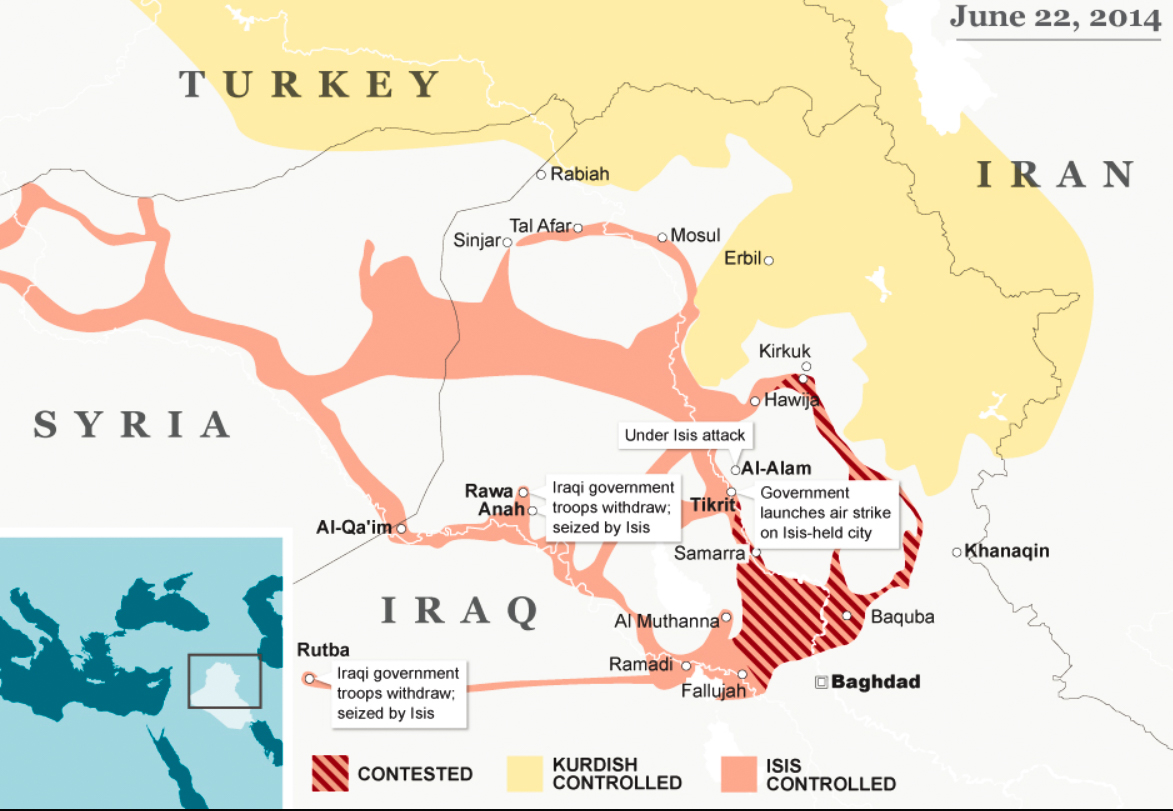
Iraq ISIS control map
A 2014 map shows the areas under ISIS and Kurdish control at the time. Source | Telegraph
This arrangement orchestrated by Jeffrey, served the long-time neoconservative-Israeli agenda of empowering the Kurds, selling Iraqi oil to Israel and weakening Iraq’s Baghdad-based government.
WINEP’s close association with AIPAC, which has spied on the U.S. on behalf of Israel several times in the past with no consequence, combined with Jeffrey’s long-time acquaintance with key U.S. figures in Iraq, such as McGurk, provided an ideal opening for Israel in Iraq. Following the implementation of Jeffrey’s plan, Israeli imports of KRG oil constituted 77 percent of Israel’s total oil imports during the KRG’s occupation of Kirkuk.
The WINEP connection to the KRG-Israel oil deal demonstrates the key role played by the U.S. pro-Israel Lobby, not only in terms of sustaining U.S. financial aid to Israel and ratcheting up tensions with Israel’s adversaries but also in facilitating the more covert aspects of U.S.-Israeli cooperation and the implementation of policies that favor Israel.
Yet the role played by the U.S. Israel lobby in this capacity, particularly in terms of orchestrating oil sale agreements for Israel’s benefit, is hardly exclusive to Iraq and can accurately be described as a repeated pattern of behavior.

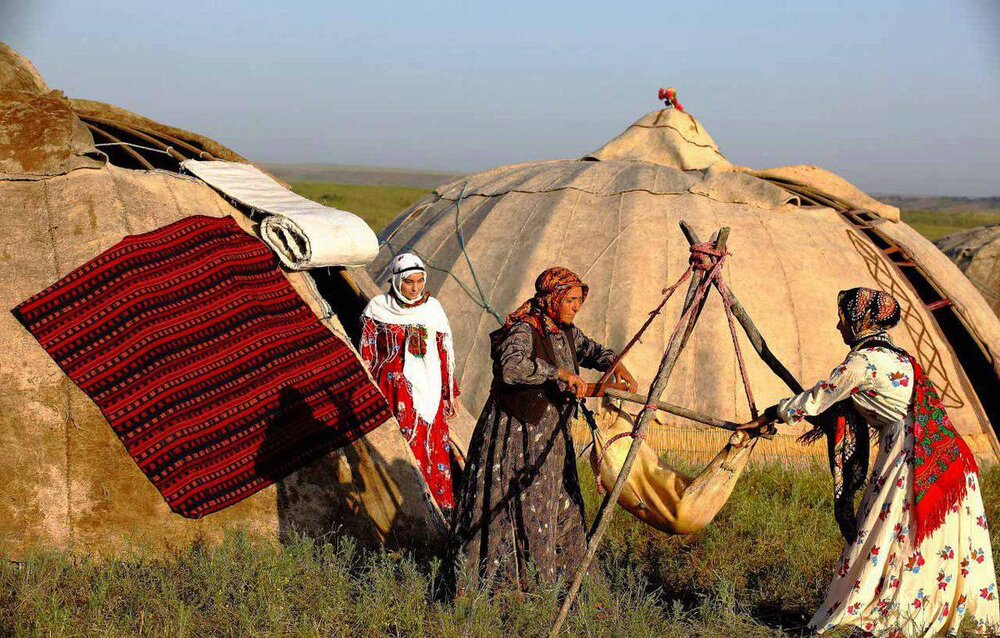
Tribal tourism gives chance to discover another face of Iran

By Afshin Majlesi
For both domestic and foreign travelers, tribal tourism is all about opening eyes to new places, traditions, cuisines, beliefs, and ways of life.
Also called ethno-tourism, ethnic tourism or tribe tourism, it lays the ground for you to feel indigenous people by living with a nomad or rural family or enjoying an independent stay. However, as the name implies, it’s a trip for recreational purposes rather than being an expedition for anthropological research!
There are many tourists from all over the world who tend to observe the lifestyle of these hardworking people and spend a few days watching activities such as milking, yogurt making, buttering, oiling, woolen, carpeting and much more. Many Iranian and foreign tourists are interested in sleeping in nomadic black tents.
For some, it’s a great opportunity to learning more about the world and yourself. Some others may say, in our globalized age, seeing indigenous cultures with the naked eye yields a more memorable and authentic experience. And for others, tribal tourism may simply be a kind of nosy exercise to discover people whose appearance and way of life look very different from their own.
And finally, for indigenous communities, it brings financial benefits and cultural exchange. From another point of view, tribal tourism has its own challenges; it can cause immense damage to the environment for intense. 
Varied natural setting of the country never disappoints visitors when it comes to tribal tourism as the culturally-diverse country is home to many regional people including ones with Turk and Arab elements in addition to the Kurds, Baloch, Bakhtyari, Lurs, and other smaller minorities such as Armenians, Assyrians, Jews, and others.
Language, music, indigenous cuisine, clothing, songs, anecdotes, crafts, live performances, and local rituals such as celebrations and wedding ceremonies have always spurred many to experience life among the tribes.
Over the past couple of years, the trend has gained a lot of support and attention in the country by both the government and the private sectors, as well as sightseers and local communities. Each month, several tribal festivals are held across the country. Moreover, tens of collective tours bring visitors to experience life among the tribespeople.
For instance, a number of foreign ambassadors, diplomats, as well as cultural and economic attaches were invited to attend a regional nomadic festival, which was held in northern Golestan province back in November. The festival, however, showcased wide range of regional arts, handicrafts, workshops, souvenirs, culinary traditions, and tourist-attraction exhibits and live performances to attendees from China, Greece, Iraq, Kazakhstan, Azerbaijan, Tajikistan, Uzbekistan, Afghanistan, Pakistan, Belarus, the Philippines, Senegal, Bolivia, and Mauritania, amongst others.
Experts say that tribal tourism has an untapped capacity to attract more and more foreign tourists. Mohammad Javad Azimi, a tourism expert in Kermanshah province, believes that the nomadic livelihoods certify a kind of functional authenticity that well reflects human interaction with nature.
Many tour operators believe that tribal regions could be deemed as the legacy of human authenticity in its novel cultural and human aspects. In the Iranian culture, literature and public opinion, nomads have always been a proud part of the nation.
Iran’s tourism ministry believes that the construction of eco-lodges in rural areas could cater to the trend as it last year set a target to help build 2,000 eco-lodges by 2021.
“Each eco-lodge unit averagely generates jobs for seven to eight people so that the scheme could create 160,000 jobs,” tourism minister Ali-Asghar Mounesan says.
Steeped in history, culture, and nature, the country is a well-known destination for fans of Persian arts, culture, and architecture. For mainstream travelers it might be difficult to figure out which places may be their priority, but here’s a list 20 favorite attractions that you can’t miss on your trip to Iran: Persepolis; the Valley of the Stars; Chogha Zanbil (Tchogha Zanbil); Babak Castle; Nasir ol-Molk Mosque; Anzali Lagoon; Chalus Road; Naqsh-e Jahan Square; Shushtar Historical Hydraulic System; Bridges of Isfahan; Kashan’s historic homes; Sheikh Safi al-din Khanegah and Shrine; Pigeon Towers; Zoroastrian temple of Chak Chak; Rudkhan Castle; Katale-khor Cave; Hafez Tomb; Hurmuz Island; the Lut Desert and historical sites of Bisotun and Taq-e Bostan.

Friday, November 01, 2019

Turks Invade, Trump Flees: Is a Solution Looming?

Or, is this a prelude to more destabilization?


Kevin Barrett
Turkey’s decision to invade Syria — and Donald Trump’s decision to get out of the way — has opened up a whole new world of possibilities for the region, both positive and negative. On the positive side, the Syrian Kurds, who hurled rotten potatoes and obscene insults at US troops fleeing the scene, are now realigning with Damascus. If the Kurds give up their pathetic Zionist-inspired pipe dream of an independent Kurdistan, and accept the legitimate authority of the sovereign Syrian government, the long-term outcome could favor peace in the region: Syria reestablishes control over all of its territory, including the regions richest in such natural resources as oil and gas, agricultural land, and water; while Turkey declares victory, backs off, and lets Damascus rein in the Kurds and other destabilization agents.
This best-case scenario rests on many assumptions, some of them dubious. It assumes that Turkey, facing military difficulties, will recognize Syrian sovereignty and abandon its hope of permanently occupying Syrian territory. It assumes the Kurds will submit to Damascus and abandon their anti-Turkey insurgency. It assumes Ankara and Damascus will re-establish relations and find a way to help the 3.6 million Syrian refugees in Turkey, along with millions elsewhere, return to their homes and restart their lives. And it assumes that Damascus, Baghdad, and their allies, presumably with help from Turkey, will successfully continue on their path to victory over Da‘ish and other foreign-supported mercenaries of destabilization.
Erdogan’s decision to invade Syria — like his earlier decision to support the US-Zionist-instigated War of Syrian destabilization — represents a departure from Turkey’s “no problems with neighbors” policy that worked so well prior to 2011. Such acts of aggression against sovereign states violate international law. They contribute to an environment of lawlessness that fosters ever-increasing war and chaos. The only real winners in destabilization scenarios are the Zionists and their imperialist allies — and even they only win temporarily, at tremendous cost in blood and treasure and human suffering. Let us hope and pray that Turkey has learned its lesson and is planning to admit its mistake, work with Syria to solve the Kurdish separatist problem, and ultimately bow to Syrian territorial sovereignty.
The primary strategic lesson from the Syrian debacle is simple: those of us who would like to see the Islamic world reunited as a single Ummah — meaning all politically aware Muslims — should strive for reunification peacefully. The Zionists and imperialists who sponsored the war on Syria took advantage of naïve Muslims’ legitimate wish to erase national borders established by the 1916 Sykes-Picot imperialist carve-up of the Muslim East. Turkish participation in the ill-fated war on Syria was driven in part by the pan-Islamist designs of Erdogan’s former chief advisor Ahmet Davutoglu, whose ideas inspired Erdogan to seek a Turkish-run “safe zone” on the Syrian side of the border — a step toward more expansive neo-Ottoman boundaries. And demented Da‘ish and its atrocious allies are even more upfront (and even more unrealistically extremist, not to mention counterproductive) in their rejection of Sykes-Picot.
Unfortunately, the Muslims’ legitimate desire to reunite the Ummah has been hijacked in service to the exact opposite goal: further balkanization of the Muslim heartland along ethnic and sectarian lines, as laid out by Zionist strategist Oded Yinon. Turkey was lured into the war on Syria by the Zionist neocons whose 9/11 false flag was designed to implement Oded Yinon and “take out seven countries in five years” as reported by General Wesley Clark. Syria, one of the “seven countries,” had to be “taken out” so the neocon Zionists could “finish off” the list by overthrowing Islamic Iran. As former US National Security Council member Gwenyth Todd explained on my radio show, the US invasions of Iraq and Afghanistan, and subsequent attack on Syria, were all designed to surround Iran with US forces and bases in preparation for the mother of all regime-change wars. But as Allah (swt) tells us in the Qur’an, “…they plot and plan and Allah plots, and Allah is the best of planners” (8:30). The neocon-Zionists’ plan backfired, strengthening Tehran’s position in the region and surrounding Iran with US forces and bases incapable of waging a successful war of aggression. Instead, the Americans’ outposts in the region have become big, juicy targets for the latest generation of Iranian missiles. The once-great US Navy has become a fleet of sitting ducks. Like US bases in South Korea and Japan that were originally designed to cow North Korea and China, US bases in the Muslim East are now little more than expensive encampments of voluntary hostages. The prospect of thousands of Americans dying quickly in the event of all-out war dissuades Uncle Sam from going along with the Netanyahu-neocon plan to attack Islamic Iran.
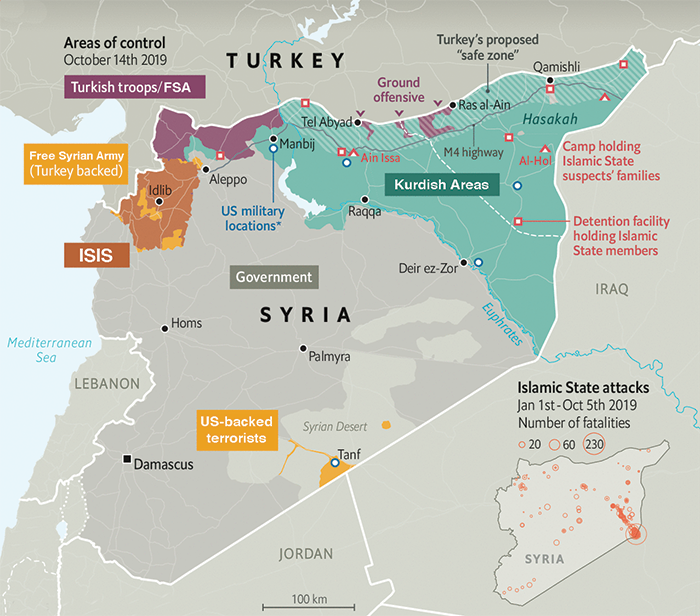
A map of the conflict zone demonstrating the complexity of the situation the local players have to deal with, not the least of which are the terrorists backed by the US-Israel-Saudi Arabia axis on the one hand, who are looking at the invasion as an opportunity to make a comeback and cause further problems for the Asad government; and on the other hand, the US-Israel backed Kurdish outfits (YPG) who once again threw their lot in with the Zio-Western imperial project to balkanize the bulk of the Muslim-majority world into ethno-states perpetually at war with each other. The wise thing to do at this point is for the Turkish, Syrian, and Iranian governments to sit down with each other, excluding any participation by the Gulf royals and their American handlers, and hash out a lasting agreement.
Trump’s withdrawal from Syria is an admission of defeat. The Americans have lost in Afghanistan, Iraq, and now Syria. The 9/11 wars have failed. Whether their aim was a “new American century,” or the real purpose was to pave the road for long-term Zionist domination of the region, the illegal wars of aggression launched on the controlled demolition of the World Trade Center have boomeranged against the warmongers. Today the bankrupted US empire is collapsing on all fronts, while the colonial-apartheid Zionist entity busily rearranges the deck chairs on the Titanic, deep in denial about the fact that its position in the emerging multipolar world is unsustainable.
And yet the Islamic pole of the multipolar world is weak and divided. From Colonized Palestine to Kashmir, from Syria to Burma, from Sudan to East Turkestan, Muslim lands are being invaded, occupied, plundered, and subjected to genocidal ethnic cleansings. Roughly one-quarter of the world’s people are Muslim — a proportion that is expected to rise to almost one-third by 2050 — yet Muslims do not enjoy diplomatic and military power in proportion to their numbers. The result is that the Muslim-majority lands are easy pickings for such predators as Modi and his Hindu fascists, the genocidal Buddhists of Myanmar, the equally genocidal Zionists, and of course the Western-dominated riba banking elite behind the West’s grand larceny of Muslim energy reserves. Even China, which sends Han settlers into East Turkestan and seeks domination of the Muslim Silk Road, cannot resist taking advantage of Muslim weakness.
The only remedy for weakness through disunity is strength through unity. Those who imagine they are fighting for a “caliphate,” or a neo-Ottoman pan-Islamic dispensation, should consider the lessons of their war on Syria and realize that they have been following the wrong path — a fake path toward ostensible Islamic unity that dead-ends in further disunity. If enough of the important players learn the lessons of the Syrian misadventure, give up on military mayhem, and resolve to work patiently for voluntary Islamic union on the basis of non-sectarianism (including political and social equality for non-Muslims, as set forth in the Constitution of Madinah and the Covenants of the Prophet) they and their successors may insha’allah one day succeed in re-establishing a united Muslim Ummah as the world’s political and spiritual center of gravity.
 

Kevin Barrett

Monday, October 28, 2019

The Real Reason Why the West Is Upset Over the Syria-Turkey Debacle

Cynthia CHUNG

In tense world situations like this it is easy to get caught up in wave after wave of headlines as we are hourly updated on what is supposedly happening in a region that we really can’t rely on for ‘accurate’ timely reporting. In addition, there is the very problematic issue of a constant and very conscious intent to misinform the public as to what is going on and even resort to fallacious, fabricated, information in order to escalate tension rather than de-escalate.
Notorious examples of this include the accused chemical attacks claimed to have been done by President Assad on the Syrian people, accusations that were caught in a web of lies committed by the Western press and the Obama administration. There have also been continual lies on the source of funding and training of the terrorist groups in these areas which is also largely dependant on the West for its function and existence, not to mention the cases of Libya and Iraq and all the lying that is ongoing on those subjects.
The first question I would ask myself then is why is the Western press so concerned over the lives of the Kurdish people, when they have never cared about all the murder and terror going on against the Syrian people, the Yemeni people, the Libyan people and the Iraqi people that has led to a horrific level of death and an enormous refugee crisis which has largely been ignored by the West. In fact, the only time Western governments and media show some level of human concern is when there is an intention to intervene militarily in these areas.
The topic of the Kurdish peoples’ welfare is the number one topic in the news and even the US Democrat presidential candidate debates. The same Democrats who, with the exception of Tulsi Gabbard, would rather go to war with Russia than work with Russia to attain peace in the Middle East.
The reason for this extreme level of passion and concern for the Kurdish people is said to be because they helped the US fight the terrorists in Syria…the same terrorists that the US was largely implicated in training and transferring into Syria, the so-called ‘moderate rebels’. This was a rather unsustainable circular pattern, which if carried out for long enough would have resulted in the erasure of the Kurdish fighters in that region due to the US’ direct support for the very terrorists they were fighting, something the Democrats don’t want to bring attention to.
But now there is massive uproar that the Kurdish people are being slaughtered in North-East Syria by the Turkish military. ABC News was at the forefront in the exposure of this terrible genocide showing footage that was claimed to be of the Kurdish massacre. It turned out to be a video from April 2017 of a Kentucky gun-range show. ABC News has apologised for their ‘mistake’ and ho hum let’s go on as if there isn’t something deeply concerning going on. The desperation to rile up Western outcry over this issue should raise suspicion.
When in Doubt Look Toward Putin
President Putin is without a doubt the most competent person in the world to know how best to handle this ‘situation’, which is much more complicated than a simple condemnation of Erdogan or Trump’s seemingly blasé abandonment of the Kurdish people.
In the October 17th weekly briefing by the Russian Federation, Maria Zakharova was asked in the Q&A section what Russia’s thoughts were on the EU meeting that occurred on Oct 14th discussing the North-East Syrian situation. Zakharova’s response to this question of the EU’s role in the conflict resolution in Syria was basically…that it was non-existent and thus a non-issue from the standpoint of a constructive agenda. She went on to say that she could have provided a more diplomatic response to this question but if it were not for the millions of people who are indeed suffering who do not even have the opportunity to hear the statement given by the EU High Representative about her involvement in their destinies and in their fate. Zakharova ended by stating that “the years of which this conflict has evolved and the consequences of this conflict as well as the evident results of certain countries involvement in the conflict, allow us [Russia] today to forget about superficial tolerance and call things what they are.
The strong message sent was therefore that the West has no place in the resolution of the Syrian – Turkey conflict, but rather, that this will be resolved by an agreement between Erdogan and Assad with Russia as the mediator.
Interestingly, Putin’s meeting with Erdogan that occurred on Tuesday Oct 22 resulted in an agreement that the Kurdish fighters would have to move 30 km away from the border area in northeast Syria within 150 hours, and that this 150 hour time period would begin at noon on Wednesday. It was also agreed that both Russian and Syrian troops would control the rest of the border with joint patrols with the Turkish military occurring on the northeast Syrian border area.
There is an obvious long-term plan here, and the US military is not physically sticking its nose in it. So why is everyone so upset again over the US military leaving this region?
The Real Reason for the West’s Emotional Fervour
It should not be news for anyone at this point that Syria is part of the Western geopolitical regime-change warfare that is leading to an eventual direct confrontation with Russia, if successful. This has always been the plan, and started with the toppling of the Iraqi government, followed by the Libyan government and the attempt to overthrow the government of Syria, which has been saved purely due to the intervention of Russia. The plan was to cause an increasing level of chaos that would reach a peak level of mayhem along the Russian border, and like a swarm of wasps one would not be able to identify who stung who and amongst the confusion could easily lead to full scale war. However, the orchestrators of this plan have seriously under-estimated the Russians, in not only their intelligence gathering capabilities, their military strength but also in their very wise diplomatic resolutions and patience for long-term peace plans.
This Western confrontation against Russia would also be backed by NATO’s setting up of ‘defense systems’ in their members’ territories. Turkey is among the absolutely vital strategic regions for the placement of these weapons systems. Therefore, it is no surprise that NATO and the American military industrial complex are very concerned over Erdogan’s succumbing to the strategic advising of Putin. With the recent purchase by Turkey of the S-400 Russian missile system this past summer, which went ahead despite threats by NATO that they would no longer consider Turkey an ally, the balance in the Middle East is increasingly abandoning the West in favour of the Russia-China alliance.
At this point, I think it highly unlikely that Erdogan is under any illusion of how his Western counterparts truly regard the role of Turkey in this fiasco, which is the same poisoned honey they having been dripping into the ears of anyone in the Middle East who has held the grand delusion of becoming a super power as the favourite pet of Britain and the US, and that the reality is that these wannabe demi-gods of the Middle East are completely dispensable and in fact the plan by their Western ‘allies’ is to dispense of them at some point, the uncertainty is just exactly when.
When Erdogan announced an apology to Russia for shooting down the Russian fighter jet in Syrian air in June 2016, there was an attempted coup d’état against Erdogan by a faction of the Turkish Armed Forces orchestrated by US asset Fethullah Gülen only days later. This was no coincidence in timing and Erdogan to the surprise of everyone…survived (it is said only due to receiving intelligence from the Russians merely hours before the actual coup). The West has been a little insecure about where Turkey stands ever since, after all, what can be said when you find yourself in the awkward situation of having to continue relations with someone you tried to dispose of, “Hey I am really sorry about that time I lost my temper and tried to have you brutally killed…But we’re good now right?”. Erdogan is fully aware that Russia is Turkey’s only solution to getting out of its hostage situation under NATO.
So why is there so much uproar against Trump’s decision to remove the US military from Syria?
Because, the presence of the US military was the last controlled hold-out to furthering instability in that area. I think we can all agree that it is not in the interest of Turkey, Syria, the Kurdish fighters nor Russia to have these terrorist cells in the northeast region of Syria activated, it would only be in the interest of the US military, which has been its function there from the get go. The Russian military is fully capable of managing what remains of this clean-up job, nobody needs the US’ continued presence there. And the US military should further remove its presence in any country that does not welcome it.
As some journalists on Strategic Culture have already acknowledged, there is a situation going on within the US that is pretty much equivalent to that of a second civil war. This has been further confirmed by Project Veritas’ expose thanks to a CNN whisteblower, where CNN was caught enforcing the agenda to push the impeachment of Trump on the American people, above all other news. In addition, there is a clear intention from one side to go to war with Russia, and there is another side that does not. Trump despite his distasteful choosing of words and concerning personal beliefs on certain subjects, clearly does not want to go to war with Russia and that is the number one issue in the world because no one will be unaffected by such a catastrophic outcome if there is war. Any drama that is cooked up by the Western press has at this point a near 100% certainty that they are trying to rile up a sentiment to go to war, most notably with the ongoing Russia Gate hoax, the British orchestrated alternate dimension of the Skripal case and the present Ukraine-Gate absurdity.
President Putin is leading one of the most challenging diplomatic situations in history. We should be confident when the Russians say that they don’t need anyone else’s nose in this and we should rather be weary that the largest threat to stability in this region is if the West, notably the US, succeeds in revving up a fervour for another foreign military occupation.

Saturday, October 26, 2019

The United States, Turkey and the SDF: The Internal War Between Syria’s Enemies

Federico PIERACCINI

The truth is that in addition to Turkey, the US, the UK, France, Saudi Arabia and Qatar have armed, financed and trained about 250 thousand jihadis from all around the world since 2010 for the purposes of attacking Syria, precipitating a disaster in the region, with repercussions felt in Europe, and committing crimes against humanity.
The Syrian Arab Army, with the assistance of its Russian, Iranian and Hezbollah allies, has managed to overcome the depredations of al-Qaeda and ISIS, confining them to the Idlib region, creating in the process some problems for the countries that armed and supported these monsters.
One of these problems lies with two of NATO’s most important countries, and the respective factions that they support in Syria.
Ankara considers the PKK-affiliated YPG to be a terrorist organization, using the jihadis of al-Nusra Front, Daesh, al-Qaeda and the FSA to attack areas under the control of Damascus in order to exterminate the Kurds.
Before the alt-media started to talk about the use of terrorists against Syria, the complaints emanating from Damascus about what was going on were dismissed as propaganda. Now the mainstream media is all of a sudden beside itself with concern for the wellbeing of the Kurds. When Syrian civilians were under similar assault, the likes of CNN and other international media created a smokescreen to prevent people from understanding what was happening in Syria. Such deliberate obfuscation has caused thousands of deaths that are no less heinous than those committed by Daesh.
Behind the obfuscating fog is the fact that the United States helped create Daesh in Iraq and used them in 2012 as a weapon against Damascus, in full coordination with Erdogan. Dozens of jihadist groups were armed and equipped to support US plans to destroy Syria.
Washington is a master at creating “problems” (al-Qaeda, ISIS, etc.) for its own geo-political purposes that require the ready-made solution. However, when things do not go to plan, there is a Plan B to fall back on in order to justify an illegal presence under the pretense of fighting terrorism.
Syria was subjected to just this gameplan. But with Damascus getting the better of Daesh, the Pentagon had to fall back on Plan B, which involved the occupation of northern Syria, under the pretext of protecting the Kurds from Daesh as well as advancing the noble quest of fighting terrorism. It is only thanks to the complacency of the mainstream media that such heights of contradiction have been achieved.
The SDF and the YPG illegally occupy Syria under the enabling umbrella of the illegal presence of the US, which hoped to use these proxies to partition Syria through the cause of Kurdish separatism.
Interestingly, the mainstream media never reveals that a good deal of Syria’s Kurds, who have been living for months in areas under the control of Damascus, actually support the Assad government.
Unsurprisingly, the SDF and YPG are supported politically by many Western countries seeking to partition Syria in favor of a Kurdish enclave. Israel, even as it destroys the lives of millions of Palestinians, shamelessly demands self-determination for the Kurds in Syria.
The SDF masters in Washington understand well that without a force on the land controlled by them, they could not prevent Assad from reuniting the country and taking over the a commercial, economic and energy connection project between Lebanon, Syria, Iraq and Iran, with the Beijing Economic blessing that intends to invest / grant lines of credit of more than 600 billion dollars between Iran, Syria and Iraq.
The only legitimate authority in Syria that is able to guarantee the safety of civilians from the depredations of Daesh, the FSA, al-Nusra, al-Qaeda and all the other 256 iterations of jihadists (none of whom is “moderate”) is the Syrian Arab Army and its central government in Damascus.
Turkey, the SDF and the United States are three irregular, illegal and illegitimate occupants of Syrian soil who are fighting in the midst of thousands of civilians and are causing death and destruction that could easily be avoided.
The international political and media reaction to events happening in Syria confirms in my mind that there is an internal wrangle between the United States, Turkey and the SDF stemming from their defeat at the hands of the Syrian Arab Army and allies; a win for civilization.