Showing posts with label Giorgio Cafiero. Show all posts

Monday, October 14, 2019

Iran’s View On Turkey’s Operation Peace Spring

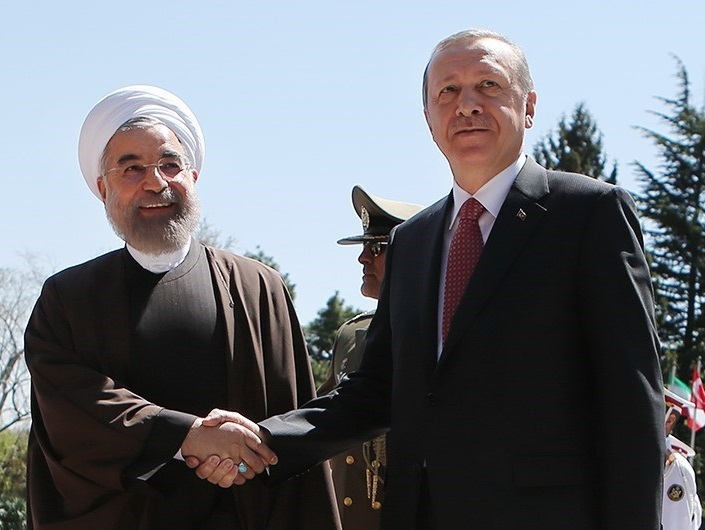
Iranian President Hassan Rouhani and Turkish President Recep Tayyip Erdogan (Wikimedia Commons)
by Giorgio Cafiero
A common view in Washington is that President Donald Trump’s decision to essentially green light Turkey’s Operation Peace Spring against the Peoples’ Protection Units (YPG) in northern Syria benefits key U.S. adversaries, including the Islamic Republic of Iran. Prominent members of the U.S. foreign policy establishment and writers in mainstream American media outlets keep making this argument.
Brett McGurk, the former special presidential envoy for the Global Coalition to Defeat ISIS, called Trump’s decision a “gift to Russia, Iran, and ISIS.” House Minority Leader Kevin McCarthy condemned Turkey’s Syria operation, maintaining that it could “give the likes of al-Qaeda and Iran new footholds in the region…” Wajahat Ali, a contributing op-ed writer at the New York Timestweeted: “It’s a win for ISIS, Russia, Iran and Turkey.”
Yet such claims are too simplistic and misleading. Tehran’s interests in the Kurdish parts of northern Syria are complicated and the Iranian government officially and strongly opposes the Turkish incursion into northern Syria.
Shortly before Turkey launched Operation Peace Spring, Iranian Foreign Minister Mohammad Javad Zarif called on Ankara to have “respect for Syria’s territorial integrity and national sovereignty.” Two days later, the Iranian military began holding drills close to the Iranian-Turkish border, while Tehran was warning Ankara not to move ahead with its plans in northern Syria. According to the Iranian Students News Agency (ISNA), the drills entailed army helicopters, rapid reaction units, and mobile and offense brigades. Iranian army chief Major General Abdul Rahim Mousavi, who oversaw the drills, hailed their results as positive, stating that they were meant to “measure the readiness, mobility and speed” of Iranian forces near Turkey. Mousavi added: “The message to the enemies is that if they make the wrong calculations, they should know that the children of this land are ready to resist with their full power at any time and place.”
Iran’s parliamentary speaker, Ali Larijani, had a trip planned to the Turkish capital which he cancelled after Turkey launched its Syria operation. Iran’s Foreign Ministry called for an “immediate end to the attacks and for the withdrawal of Turkish forces from Syrian soil” after the Turkish assault began. The ministry also emphasized that while Tehran understands Ankara’s “security concerns,” Iran’s position is that Turkey’s “military action would not only not diminish that country’s security concerns, but also cause financial and humanitarian damages.”
Ultimately, Ankara’s military campaign leaves Tehran in a difficult situation. On one hand, Iran wants to see the Astana peace process (involving Iran, Russia, and Turkey) succeed in terms of resolving the Syrian crisis, particularly in Idlib, thus Tehran desires a continuation of good relations with Ankara. Similarly, Moscow doesn’t want its conflicts of interests with Turkey to upset the Astana process. On the other hand, as a supporter of the Syrian government, the Islamic Republic is deeply unsettled by the fact that Turkey’s Operation Peace Spring relies so heavily on anti-Assad rebel forces from northern and/or eastern Syria. Indeed, Iranian and Iranian-aligned forces have fought those rebels throughout the Syrian civil war.
Turkish-backed groups, including the Sultan Murad Division, Faylaq al-Sham, Ahrar al-Sharqiya, etc., which have fought the Assad regime under the umbrella of the Free Syrian Army (FSA)—now rebranded the Syrian National Army (SNA)—are central to Turkey’s Syria operation. Some of the 14,000 rebels in these groups entered Syria from Turkey with the Turkish military while others were already in Syria, near the towns where the Turks have targeted the YPG this month. These forces are on the frontlines doing much of the heavy lifting in the fight against Ankara’s Syrian Kurdish enemies and Turkey will count on them to guard towns taken from the YPG. Naturally, Iran does not want to see these Sunni groups—some of which previously received U.S. support—to gain new life in the Syrian war, which now appears to be happening because of the Turkish incursion.
On October 11, protests took place in Iranian Kurdistan one day before hundreds of Iranians gathered at Turkey’s embassy in Tehran to express their staunch opposition to Ankara’s military campaign. Such public displays of anger directed against Turkey underscore how domestic as well as regional/international politics are also impacting Tehran’s response to Operation Peace Spring.
Within the context of the Trump administration’s “maximum pressure” campaign against Iran, officials in Tehran have sought to improve the Islamic Republic’s relationship with Iranian Kurdish communities. Fearful of the U.S. military presence in the Gulf as well as Salafist-jihadist groups operating in Sistan and Baluchestan Province, allegedly with U.S. and Saudi support, the leadership in Tehran wants to prevent outside forces from exploiting opportunities to use militant Iranian Kurdish groups as proxies in any campaign to weaken Iran’s government. Doing so requires engaging Iranian Kurdish factions in a dialogue, which has been taking place in Norway since May, while also addressing socio-economic and political problems in northwestern Iran, which for many years have fueled Kurdish resentment toward the Iranian government.
Doubtless, with millions of Iranian citizens sympathizing with Syrian Kurds who are struggling to survive amid Turkey’s campaign, Iran has to contain such anger and not appear to be siding with Ankara in Operation Peace Spring. At the same time, Iran is Turkey’s neighbor and the two states have always maintained a relationship rooted in pragmatism even when Tehran and Ankara have not seen eye to eye on regional issues. As sanctions continue taking a severe toll on Iran’s economy, the Islamic Republic understands the importance of maintaining its friendship with Turkey. 
Furthermore, Iran does not want to walk away from the progress that it has made in working with Turkey and Russia via the Astana process—however hampered that arrangement might be due to Operation Peace Spring. Tehran also shares Ankara’s interest in preventing the YPG from establishing a statelet in northern Syria that could provide Israel with a foothold near the Syrian-Iraqi border from where it could conduct more strikes against Iranian-backed actors in the region.
At this juncture, despite some silver linings that Tehran might see in Ankara’s assault on northern Syria, Iran is seeking to pressure Turkey into halting its military incursion while also pushing the YPG, Ankara, and Damascus toward a new understanding that can lead to stability and security along the Turkish-Syrian border. On October 12, Zarif offered to engage all three while referring to the Adana accord of 1998, which prevented a Turkish-Syrian war by requiring the Assad government to end its sponsorship of the Kurdistan Workers’ Party (PKK), as the basis for striking a deal that could lead to Turkey’s military and the Syrian Arab Army (SAA) guarding the Turkish-Syrian border through a coordinated effort. Nonetheless, with Erdogan vowing not to negotiate with “terrorists,” it is difficult to imagine Ankara and the YPG reaching any sort of peace in the foreseeable future.
Looking ahead, Tehran will not be shy about voicing its opposition to Turkey’s anti-YPG operation. The regional and domestic ramifications for Iran appear dangerous from Tehran’s perspective. Yet Iran is carefully considering Turkey’s legitimate security interests in the process while seeking to avoid any actions that could create major problems for bilateral affairs. The Islamic Republic’s ability to maintain friendly relations with Turkey while standing by its ally in Damascus will be severely tested as the world grows increasingly concerned about a potential new Middle Eastern war erupting between Syria and Turkey. Now that the YPG and the Syrian government have reached a deal to allow SAA forces to re-enter land territory in northeastern Syria that has been controlled by the YPG since 2012, it remains to be seen what will happen to Operation Spring Peace. Yet with Turkey voicing its determination to push its offensive deeper into Syria, officials in Tehran are nervous about the future of the Astana peace process.
Undoubtedly, such an outcome would be anything but a “gift” to Iran.

Monday, July 29, 2019

Israel’s involvement in Libya’s civil war


Tel Aviv, along with Cairo, Paris, Riyadh and Abu Dhabi support retired Libyan General Khalifa Haftar, whose opponents suspect him of wanting to become a “new Gaddafi” who seeks to establish an Egyptian-style military dictatorship in Libya.
Zionist regime’s backing of the Benghazi-based commander illustrates the regional geopolitical dynamics which have led Arab states—specifically Egypt, Saudi Arabia, and the UAE—to find themselves in the same boat with Israel, sharing the same perceptions of security threats.
Now we have an article in this regard, titled Israel’s involvement in Libya’s civil war” that appeared on the frontpage of Consortiumnews website.
The writer is Giorgio Cafiero, the CEO of Gulf State Analytics, a Washington-based geopolitical risk consultancy.
Since mid-2014, Libya has been mired in civil war, pitting the UN-recognized Government of National Accord (GNA) in Tripoli against a rival administration in Tobruk, the House of Representatives (HoR), which is allied with General Khalifa Haftar’s Libyan National Army (LNA). Despite lacking UN legitimacy, Haftar and his forces have received backing from a host of states whose leaders view the Benghazi-based commander as Libya’s only alternative to the Muslim Brotherhood and other actors in the war-torn North African country. Among these nations is illegal Israeli regime.
Tel Aviv, along with Cairo, Paris, Riyadh and Abu Dhabi support retired Libyan General Khalifa Haftar, whose opponents suspect him of wanting to become a “new Gaddafi” who seeks to establish an Egyptian-style military dictatorship in Libya.
Zionist regime’s backing of the Benghazi-based commander illustrates the regional geopolitical dynamics which have led Arab states—specifically Egypt, Saudi Arabia, and the UAE—to find themselves in the same boat with Israel, sharing the same perceptions of security threats.
Coordination between Haftar and the Israelis, which has been conducted through the UAE, began in 2015, if not sooner. Initially, Zionist regime’s interests in post-Qaddafi Libya were from the perspective of its interests in the Sinai Peninsula. Links between various jihadi forces in Libya and the Sinai have been well-documented.
In 2015 and 2016, Haftar met Mossad agents in Jordan in “strict secrecy”. One military source told The New Arab that Zionist regime began providing the LNA with sniper rifles and night vision equipment at that time. This source suggested that the Israeli military began carrying out air raids in Libya in coordination with the LNA after Haftar launched Operation Dignity in 2014. By mid-2017, Algerian media outlets reported that officials in Algiers warned Haftar against receiving Israeli military support.
Last year, al-Araby al-Jadeed explained that Haftar held another meeting in Amman “to deepen security coordination between him and Israel” and that Haftar sought a stronger Israeli presence in southern Libya to thwart Italy from asserting significant influence throughout the Fezzan, the southwest region of Libya. Middle East Monitor quoted an unnamed source claiming that Haftar promised Tel Aviv regime “safe centers” in Libya’s desert, and that the commander’s connection with Israel is Oren Hazan, a member of Israel’s Likud Party who has Libyan roots.
Middle East Monitor ‘s source also said that while the Egyptian government backs Haftar’s tacit and covert partnership with Israel, authorities in Cairo have not wanted Haftar’s communication with Tel Aviv to be become direct.
In May, Al Jazeera Arabic published an investigation which uncovered Israeli support for Haftar’s offensive on Tripoli, which the LNA launched on April 4. According to Al Jazeera, A joint Emirati-Kazakh firm, Reem Travel, had an aircraft registered to its name which was flying between Egypt, Occupied Palestine, and Jordan prior to arriving in LNA-controlled territory in Libya shortly before Haftar’s westward assault began.
Israel’s intervention in the Libyan civil war on the side of Haftar is understandable from its point of view, given a host of factors. First, when it comes to coordinating with actors in West Asia and North Africa, Zionist regime’s clear preference is for strongmen regardless of ideology. Like Hosni Mubarak and Abdel Fattah el-Sisi in Egypt, or King Abdullah II in Jordan, Haftar is perhaps the type of Arab leader whom the Israelis can engage with on intelligence sharing.
Second, Israeli support for Haftar brings illegal Zionist regime into greater de facto alignment with the Arab states that have been backing the eastern commander for years, namely Egypt and the UAE, and more recently Saudi Arabia too. Thus, by supporting Haftar, Tel Aviv can further cement its role in this emerging bloc of regional Arab states, which share Israel’s perception of a so-called threat from both Iran and Iranian-backed fighters, as well as certain Islamist groups, including the Muslim Brotherhood. As one Israeli Defense Forces source told Middle East Eye, “A friend of our friend – and an enemy of our enemy – is our friend, and Haftar is a friend of Egypt, Jordan, and UAE. He also fights Daesh.”
Third, the opportunities to secure money through lucrative weapons sales also help explain Israel’s interest in backing Haftar. As a leading arms dealer, Zionist regime has made billions by selling arms and leasing Israeli military advisers to different conflict-plagued countries in Africa, such as South Sudan. Israel is expanding its clout in Africa, where it is seeking to deepen its role and strengthen its relations with a host of countries. Israel’s Africa foreign policy reached a watershed in January when Prime Minister Benjamin Netanyahu travelled to Chad to meet President Idriss Deby and renew bilateral relations. Tel Aviv’s closer relationship with Haftar can further advance Israel’s grander geopolitical interests in the region.
Fourth, Libya’s natural resources are a factor too. Constantly looking for oil-rich allies to sell it oil, Israel may expect to secure access to Libya’s petroleum after backing Haftar in the country’s ongoing civil war. As the eastern commander’s forces have demonstrated, their capacity to take control of virtually all onshore oil fields in Libya means Israel likely sees a tacit alliance with Haftar as a prudent move in regard to its energy needs.
France’s support for Haftar, which has been based on Paris’ view of the LNA as a so-called bulwark against extremism, has created a major division within Europe with respect to Libya. This division has had a remarkably negative impact on French-Italian relations. Unquestionably, Paris and Rome’s different ideas about Libya have been another factor contributing to the North African country’s crisis, while France and Italy compete for influence in this part of the Maghreb. The U.S. officially supports the UN-recognized Government of National Accord (GNA), yet Trump has praised Haftar, so the U.S. position is unclear on Libya.
Turkey and its own interests are in play too. Tension is heating up between the LNA and its external supporters on the one side, and the GNA-allied militias with Turkey on the other. To counter the LNA’s advance on Tripoli, the Turks have provided GNA-aligned factions with armored vehicles and drones, including one shot down by Haftar’s forces late last month. By siding with Haftar, Israel has firmly positioned itself with Abu Dhabi, Cairo, and other capitals, which view Haftar as the strongest leader in Libya capable of taking on “terrorists,” while returning stability to the country.
With the further regionalization of the Persian Gulf Cooperation Council (PGCC) crisis, which has been a driver of greater instability in Libya and other countries in Africa, Israel’s position is unambiguous in the Abu Dhabi-Doha clash. By supporting the Emirati and Egyptian positions on Libya—firmly placing Zionist regime at odds with both Ankara and Doha—Tel Aviv is making clear it prefers Arab figures representing the model of Western-backed authoritarian stability and secular dictatorships, rather than those who advance the Muslim Brotherhood’s vision for the region.
For the Libyan people, a dismal future is most likely. The proxy war has been fueled by many external actors, which have come into the country seeking to fill the power vacuum that emerged after Moammar Qaddafi’s fall in 2011. With GNA-allied fighters recently pushing back against the LNA offensive, it is unclear how the civil war will evolve as Haftar’s forces continue to shell Tripoli.
The growing danger for Libya, torn apart by various militias fighting with the support of Israel and the other external actors, is long-term fragmentation.