Showing posts with label Yemen War. Show all posts

Wednesday, December 04, 2019

Will Riyadh end its invasion into Yemen?

By Farzad Farhadi

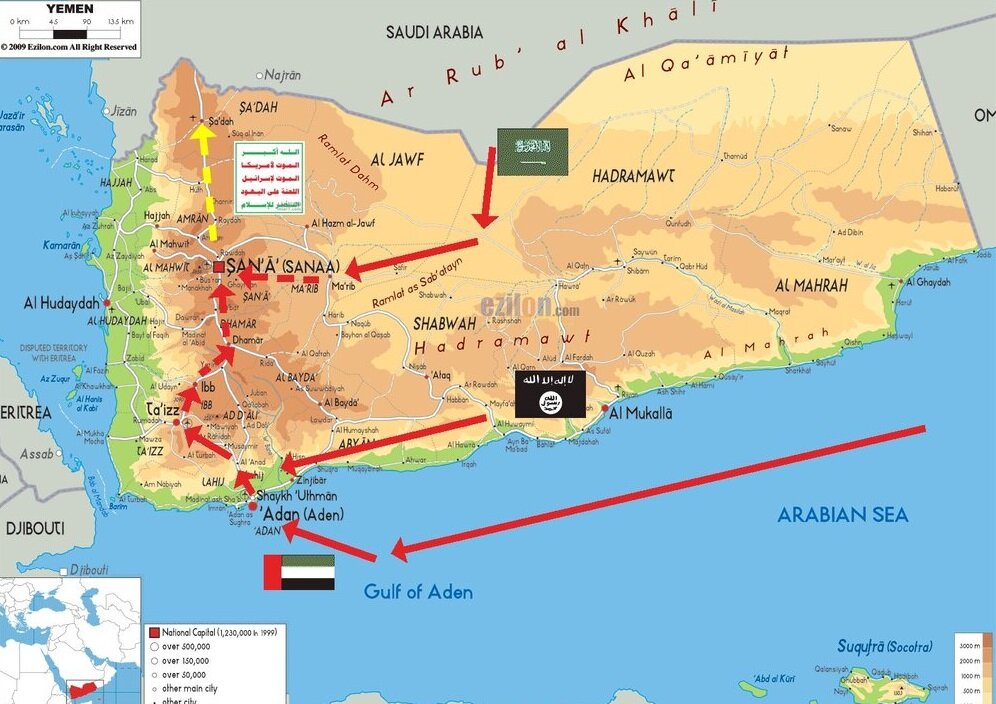
TEHRAN – A military coalition, led by Saudi Arabia, the UAE and the U.S., has launched a war against Yemen since March 26, 2015. The war has so far failed to meet its desired goals.
Along with the news about the Yemen war, borrowing a loan from banks around the world by Saudi Arabia has attracted the attention of observers.
In January 2018, Reuters quoted the Saudi debt management office as saying that Riyadh has asked banks for proposals to refinance its $10 billion international syndicated loan and to help the sovereign raise funds through other means.
The office said the refinancing of the loan, which was raised in 2016, will include a repricing of the facility and the extension of its maturity to 2023 from 2021.
The Saudi war against Yemen has caused a lot of military, political and economic pressure on Riyadh. According to media reports, due to the war, Saudi Arabia has lost all of its cash and non-cash reserves.
A way to take Riyadh out of Yemen quagmire
Saudi Arabia has been caught in the military, political and economic quagmire of the Yemen war. The war, which Mohammad bin Salman did not expect to last more than three years, has been raging for nearly five years and putting unbearable pressure on the Saudi economy. That is why Riyadh is looking for a way to take itself out of the trouble. Mahdi al-Mashat, chief of the Houthi political office, put forward the solution that the Saudis needed.
 
On September 20, al-Mashat announced a conditional ceasefire, calling on the coalition to halt the war and seize the opportunity of ceasefire. 
According to military experts, the Yemeni conditional peace plan was presented at a time when Yemen was at the height of its power, the most important proof of which was the strikes on the Aramco oil facilities. 
The strikes were so severe that prompted various reactions internationally.
 
The important point of the plan is that it was presented by the Supreme Political Council, which is currently the most powerful organization in Yemen.
The Saudis slowly seized the opportunity to get out of the Yemen deadlock. In the meanwhile, Muscat became a place for two sides involved in the war to reach an agreement.
Muscat, a host with a positive and effective role
Officials from both Yemen and Saudi Arabia told the Associated Press on November 13 that both sides are holding indirect, behind-the-scenes talks to end the devastating five-year war in Yemen.
The news agency said the negotiations are taking place with Oman, a Persian Gulf Arab country that borders both Yemen and Saudi Arabia, as mediator. 
It said Oman has positioned itself as a quiet mediator in the past and in a possible sign the back-channel talks could be stepping up, Saudi Deputy Defense Minister Prince Khalid bin Salman arrived in Muscat on November 11.
It said the current talks focus on interim goals, such as re-opening Yemen’s main international airport in Sanaa, shut down by the Saudi-led coalition in 2016. According to AP, also under discussion is a buffer zone along the Yemen-Saudi border in areas under Houthi control.
However, the best solution for Saudi Arabia and the UAE is to take a serious step to stop the war. The release of 200 Yemeni captives by Saudi Arabia and the arrival of 128 of them is a promising move by Riyadh, which, if continued, can prepare the ground for ending war and easing Yemenis’ pain.

Wednesday, September 25, 2019

The continuance of Riyadh’s false claims against Iran instead of stopping the Yemen war

By Farzad Farhadi

TEHRAN - What has troubled Riyadh officials is inefficiency in American Patriot system, and The U.S. positions, as the Saudi Arabia expected to receive more support. U.S. Secretary of State Mike Pompeo affirmed the failure of air defense system. 
Reuters had earlier reported that Saudi Arabia is spending billions of dollars to buy military equipment from Western countries. It is said that the equipment is designed to counter advanced attacks, but it could not resist cheap drones and Cruise missiles.
Inefficiency of air defense systems against Yemeni scathing attacks
Analysts believe the Yemeni attacks reveal the vulnerability of Saudi Arabia’s air defense system in protecting these important oil facilities. It also shows that the U.S. “dodges” defending its allies, despite of being paid billions of dollars for this defense. 
Secretary General of Hizbullah Seyyed Hassan Nasrallah, pointed to Yemeni army and popular committees’ attacks on Aramco oil facilities in eastern Saudi Arabia, and extensive international reaction in support of Riyadh. He also said, “Targeting Aramco by the Yemenis was indeed a significant event that shocked the region, and faced many reactions in the world. International positions in attacks on Aramco have shown that oil has more value than blood. I advise Saudi Arabia to stop the war instead of buying large-scale air defense systems and paying millions of dollars to no avail. The only solution is to stop the brutal war against Yemen.” 
However, what has to be mentioned is that Yemeni attacks moved from alarm level to effectiveness level.  The great operation of Yemeni army and popular committees, in any aspect, was more destructive and effective than their previous reactions. This is a message to Saudi Arabia that Yemen reached the fatal blow level, and the future operations will be more deadly and crushing. This will continue until the attack on Yemen is stopped and the siege of oppressed Yemenis is over.
As Seyyed Hassan Nasrallah claimed, the solution is to stop the war because buying defense systems and paying bribe to the U.S. and Trump will not solve the problem.
But Saudi Arabia that seems to become accustomed to relying on the U.S., insist on continuing the war and accusing Iran. Saudi Foreign Minister Adviser Adel al-Jubeir said in a recent adversarial statement, “the attack on Aramco has been carried out by Iranian weapon, therefore we consider Iran to be in charge of this operation.”

Monday, June 17, 2019

London’s costly mistake in following U.S. foreign policy

By Hanif Ghaffari

United Kingdom Foreign Secretary Jeremy Hunt once again accused Iran of being behind the explosions off the port of Fujairah in the Gulf of Oman. 
He has claimed that Iran is “almost certainly” responsible for the attacks on oil tankers in the Gulf of Oman, and the operation was carried out by a branch of Iran military force and no other governmental or non-governmental state can be responsible for this incident.
Undoubtedly, U.K. government is trying to falsely accuse Iran of the attacks, to help Trump administration in spreading anti-Iran propaganda. It seems that London is blindly following Trump’s high-risk strategies in the Middle East, but 10 Downing Street (headquarters of U.K. government) has already paid a big price for following U.S. games. Taking part in Yemen War and starting Brexit, majorly supported by Trump, are only a small part of these costs. 
U.K. will pay a high price for blindly supporting White House war-mongering and anti-Iran policies. U.K. support for U.S. regional strategies is surely based on Britain’s traditional policy to stay in the corners and take a share of the final profits, but this time, given the upcoming crisis, it seems that London will not receive the benefits it seeks. 
Since 2000, U.K. citizens have been severely burdened by high prices that they had to pay for government projects such as supporting George W. Bush in Afghanistan and Iraq war, constant interference in Persian Gulf and constructing military bases in this region, supporting Saudi Arabia regime in attacking Yemen, supporting the Zionist regime in many attacks against Palestinian resistance groups and giving large amounts of money and arms to terrorist and Takfiri groups such as ISIS and Al-Nusra Front. 
UK, with following Trump’s regional polices will be incurring just more high costs on the country and will surely become the “complete loser” of this game. It is no surprise that many U.K. citizens are constantly protesting against the government and ask them to stop following Washington in their international policies. Undoubtedly, regarding U.K. notorious history in their political, economic and diplomatic relations with Iran, this kind of accusations will be a “risky regional policy” for Britain to take. 
U.K. doesn’t have the right or capacity to get itself into these kind of challenges, and with continuing this behavior, it will only make itself more vulnerable to political and economic risks and promote the already negative worldview about the country’s long-standing interference in Middle East.

Saturday, February 17, 2018

Yemen War: Trial Time for Saudi Arabia?


Saudi Arabia is fast approaching trial time on its illegal war on Yemen, as the international humanitarian community will soon have to respond against them. This includes the United Nations and the International Criminal Court in The Hague.

While the United Nations and the international civil society insist they want a peaceful resolution to the worst humanitarian crisis in the 21st century, Riyadh dismisses the idea of diplomacy in the assessment, saying they wouldn’t be willing to bargain away their stated goal, which is regime change in Sana’a.

However, since many people are dying and the country is facing famine, there is no time in which the Saudis and their allies can threaten Yemen any further. Simply put, Yemen is dying and time is almost here. There is an increasing rate of civilian casualties. According to the UN aid agencies, the upsurge in fighting is of particular concern. Civilians are under fire, as Saudi-led forces carry out airstrikes and indiscriminate bombing, without taking care to spare the civilian population, much less respecting the principles of distinction, proportionality and precaution.

This is while any intentional, direct attack against civilians or civilian objects is considered a serious violation of International Humanitarian Law and the UN Charter. The warmongers refuse to take any feasible precautions to avoid, or in any event, minimise, the impact of violence on civilians. And that’s when it’s safe to conclude that the UN and the International Criminal Court in the Hague will have to step in to stop the protracted conflict and hold to account those who want this crisis to continue apace – one way or another:

– It is true that in the wake of unlawful US-backed, Saudi-led bombing, some Western governments have decided to suspend the sale of weapons worth tens of billions of dollars to Saudi Arabia. It is a recognition, a long time in coming, that the Saudi-led coalition’s military campaign in Yemen have devastated the country, killed thousands of civilians and brought it to the brink of famine. However, unlawful airstrikes still continue, which means the decision by some Western governments to suspend arms sales has sent no message to the Saudis. US President Donald Trump, in his first trip to Riyadh for instance, sent an alternative, deeply troublesome message. He sold American weapons to the Saudis worth $110 billion – nearly as much as President Obama authorized during his eight years in office.

– The deals include Raytheon bombs, Lockheed Martin missile defense systems and BAE combat vehicles, and some of the weapons whose sales had been suspended. Thanks to these weapons, the scars of unlawful airstrikes can be found across Yemen, where the Saudi-led coalition has carried out scores of attacks that hit homes, schools, markets, and hospitals since March 2015, when it began its military campaign against the Ansarullah resistance movement and forces loyal to the former President Ali Abdullah Saleh.

– Human Rights Watch has documented numerous unlawful coalition attacks over the last three years, many war crimes. In many of these cases, including the attacks on funeral halls and markets, the organization’s investigators were able to identify the US weapons that were used. These are the very same weapons that continue to drive Yemen, already the poorest nation in the Middle East, toward humanitarian catastrophe.

– Both the Saudi-led coalition and their American allies have blocked or restricted critical relief supplies from reaching civilians. Seven million people face starvation and cholera ravages parts of the country. The UN should be urging the Saudis to shift course by abiding by the laws of war and holding those responsible for past abuses to account.

– Without Washington’s much-needed support and consent this war can never continue. By going to Riyadh to sell the Saudis weapons worth over $110 billion, President Donald Trump effectively told them to continue as before and not to worry about any international backlash at the UN – the flow of US weapons would not stop. This makes the US government complicit in Saudi war crimes. Continued US arms sales to a country that has repeatedly violated the laws of war expose US officials to legal liability for aiding and abetting Saudi war crimes.

It is against this backdrop and others that the UN and The Hague should step in, introducing a resolution intended to end the US-backed, Saudi-led war on Yemen. The resolution should end US arms transfers to Saudi Arabia, as requiring the White House to certify that the Saudi-led coalition is taking all feasible precautions to minimize civilian casualties is not going to mean anything at all – let alone end the human suffering there.

The UN and the International Criminal Court in The Hague are in the know that the people of Yemen can take no more and that they need to react fast. Innocent people are suffering from unlawful airstrikes because the US supports the Saudi-led coalition and because US weapons have been used against civilian populations. This is an international legal problem the UN and the ICC should be paying more attention to. If they won’t try to curtail the ongoing Us-backed war crimes by Saudi Arabia and the rest of the coalition, no other world body would ever step in to make clear – by using its own power to end the war – that the lives of Yemeni civilian can no longer be disregarded.