Few often learn anything until it is too late, and even then they may not learn much that matters except in a context of a disaster that probably could have been avoided. The reference here is to the relatively comfortable and well off, say the mid to upper levels of a shrinking middle class in a society such as the U.S. has.
Walk around the campus of the university here in central North Carolina and there is a wealth of entertainments like sports teams and presentations and parties of all kinds aside from classes and study. Idyllic it can appear. Everyone seems to act, at least, just like their forebears on campus seemed to act say 50 years ago, at the height of the U.S. war on Vietnam. Except for one thing:
On campuses back then there existed student protests and occasional rage over the Vietnam War – not so much on campuses in the relatively conservative southern states, but for sure on campuses like Harvard and Columbia in the northeast of the U.S. where students are notably brighter and more often concerned about U.S. directions. Today? It is depressing. There has been very little protestive demand about anything but something fairly inane such as the removal of a 100-year-old life-sized bronze statue of a Confederate soldier during the Civil War of the mid 19th century.
Why were students demanding the removal of the statue? Because it implied a time when slavery was supported in the Southern states of the U.S. and some students lately did not want anything on campus that signified the past existence of “racism” and slavery 200 years ago. It apparently is “cool” to have SOME conscience about something appalling, at least about something that was long ago and is not really going to upset or diminish the criminality of current Washington warmongers. Students today are relatively boring compared to students half a century ago and part of the reason is that there is no forced “draft” into the military as there was for decades up until the early 1970s when it was suspended. Young Americans back then, if drafted and most young men were, could be sent to die in Vietnam or elsewhere. Over 55,000 Americans did die in the rice paddies of Southeast Asia – a sacrifice for absolutely nothing of any merit.
Then the warmongers and profiteers in Washington after the Vietnam debacle figured they could get away with advancing the imperialist and militarist agenda even more if soldiers, fodder really, were just volunteers. Recruits nowadays are often relatively poor, not especially smart, not often reliable college material, starved for money and reliable advancement potential and even sometimes healthcare. It’s a huge scam. The suicide rate among U.S. soldiers has never been higher: they don’t have a clue what they are fighting for overseas except for platitudes drilled into them in boot camp, even as they are in fact fighting for wealthy oligarchs and powerful U.S. corporations and banks and their owners and corrupted politicians and profits, profits they will rarely if ever themselves enjoy.
America’s probably fatal disease, long centered in and emanating from Washington, seems to be primarily greed and a broad lack of understanding, appreciation, and magnanimity towards other cultures, like the Islamic world’s, and other people in other nations. This altogether is surely reflected in rampant U.S. imperialism and the apparent desire to dominate and exploit others. And there are many thoughtful Americans who fervently want change but who lack the power to summon it except, possibly, through the vote and the election of better representation in Washington. But real democracy has been cancelled by an entrenched class of powerful people, Republicans or Democrats, whose hands are on the levers of power for their own benefit and maintenance. In sum, whether the U.S. government can change before it sets itself and the world on fire may be impossible. The real question is what can countries under sanction or attack by imperialism do not only to influence radical change in the West, but also to avoid further U.S. attacks whether by war or by sanctions. One obvious mandate is to try to erect effective defensive arrangements – alliances or military preparedness – that might obviate the progression of U.S. imperialism as it has existed particularly in this century.
One idea that may be useful in this regard for countries like Iran is to lower “defensiveness” (if not actual, latent and necessary defenses) and try to set examples of better ways to contend with and defuse foreign challenges and enmity. Ayatollah Khamenei recently hinted at this when he suggested or invoked the notion of “Islamic mercy” -- a powerful idea in its own right and expressed by Khamenei in the context of how to deal with the protesters and dissidents within Iran who expressed themselves during the recent disturbances over the gas price hikes. One must wonder to what extent it may be possible for Iran’s leaders to extend the concept or practice of Islamic mercy and magnanimity towards the Islamic Republic’s enemies, even if this should involve relatively straightforward measures such as unilaterally pardoning and releasing foreign prisoners, as has been done recently and from time to time, or by reducing the vocalization at least of (defensive) threats to countries like the U.S. or its allies, particularly the Zionists and the Saudis who are not respected most everywhere.
It may be worth further study to discern exactly what might be the most effective balance between the expression of Iran’s defensive actualities and implied military counter measures against Iran’s enemies, and an Iranian/Islamic posture of mercy and forgiveness that includes an expressed desire for building accord with hostiles like the Trump Administration. Iran under attack by sanctions, for example, has already proven, since the U.S. withdrew from the JCPOA and erected the sanctions, to be patient and counter-responses have been measured and thoughtful.
Some responses by Iran to date have involved steps to ramp up very marginally the country’s efforts to develop further its extant nuclear expertise. But what, for example, if Iran’s leaders halted the expansions, which are implied if not real threats to Iran’s enemies, and declared unequivocally and unilaterally that it was going to maintain its nuclear activities solely within the broader confines of the JCPOA even if the other JCPOA signatories still remain dilatory about honoring their own promises to Iran under the original terms of the deal. Would this not help at least to obviate actual military aggressions against Iran, because any military attack on Iran – which the Trumpists have tried to justify at the behest of the Zionists mostly, would be a disaster for Iran and in fact the entire world. Most all of humanity is entirely against more war in the Middle East and especially war on Iran.
The question here is whether, with most of the world already cognizant of the unfairness and aggressive nature of America’s and its allies’ actions, whether even more mercy and magnanimity (which Khamenei has hinted at internally) might act as a way literally to further SHAME the U.S. in the world’s opinion with the chance that this shaming may produce dividends by somehow forcing the U.S. eventually to reduce its bellicose posturing and begin to seek real accord and reduced tensions with Iran. In any event, Iran has correctly sought the elimination of sanctions and a U.S. recommitment to the JCPOA. What, exactly, can Iran do best to defuse and reduce U.S. imperialism pushed by literally craven “leaders” in Washington, which has to be the most tiresome and unproductive thing the alleged superpower pushes? Perhaps the search for answers is in vain, but maybe not.
The U.S. has spent (and wasted) an estimated seven trillion dollars in the so-called War(s) on Terror, a misnomer if ever there was one. It has been nothing but an expression of a destructive imperialism that has not benefitted humanity at all, and that includes no benefits whatsoever for most Americans, too, including college kids in North Carolina, at a time when humanity MUST begin to tackle together threats, environmental and otherwise, to the species as a whole.
It is one of those complex stories that are so difficult to tell, and yet they should, they have to be shared.
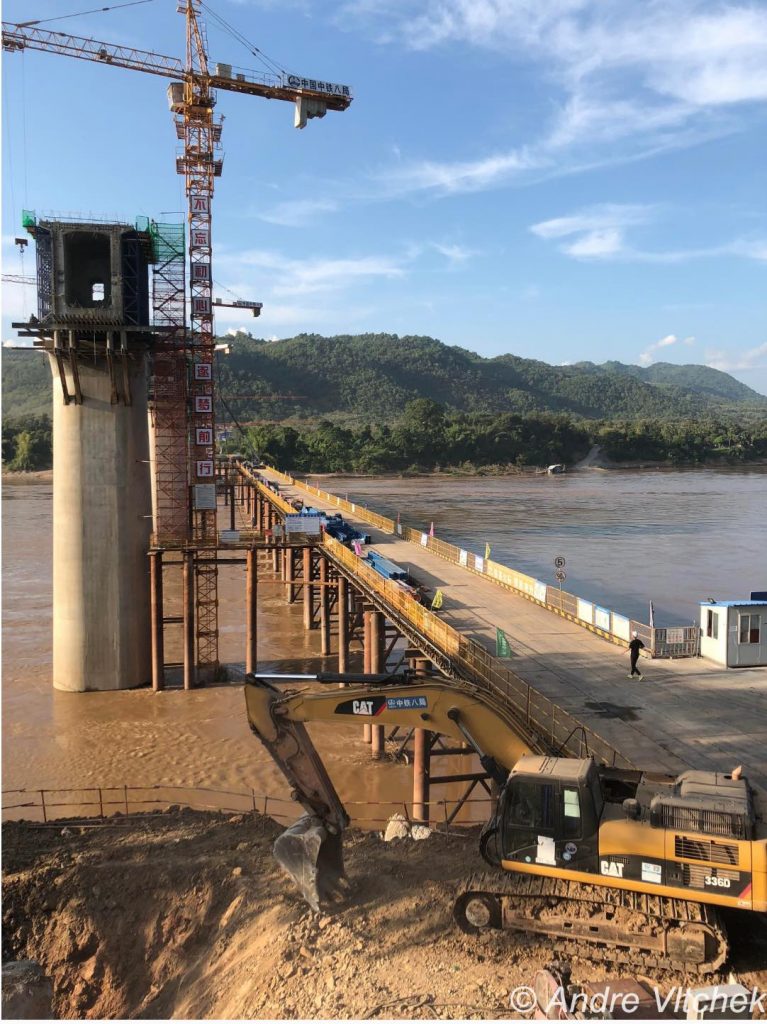
Imagine the splendid Mekong River, as it flows not far from an ancient capital of Laos,Luang Prabang. The river is powerful, with muddy banks, surrounded by lush mountains. Imagine poor villages and old ferry crossings, as well as broken plastic sandals on the feet of local people.
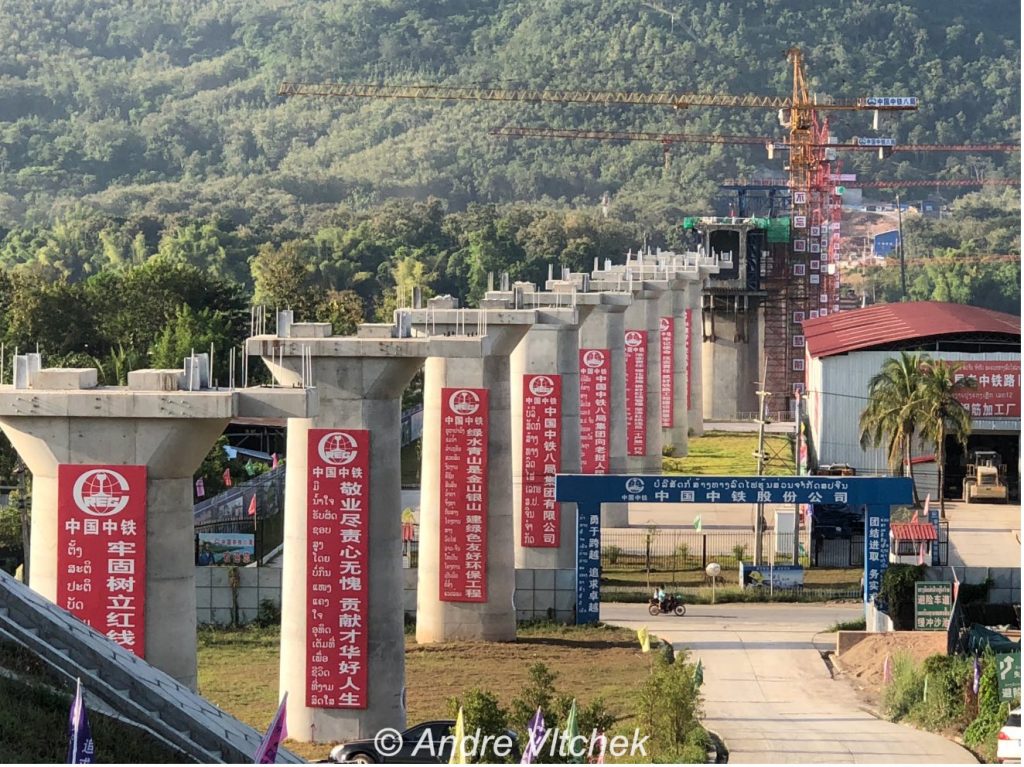
Then suddenly, near the village of Phonesai, you can spot several tremendous concrete pillars. They are growing out from the water, and from both river banks, literally connecting two mountains.
Soon it will be a bridge for high-speed trains. It is being built by China, a nation with the most advanced high-speed rail technology on earth. And a bit below, there will be another bridge, for cars and pedestrians.
Both mountains are being drilled, carefully and sparingly. This is where two tunnels will be passing through.
It is of course much cheaper to blow the mountains down with explosives. But earlier this year, China engraved the “Ecological Civilization” into its Constitution, and what it preaches at home, it also implements abroad.
Railway project
This is the biggest project in the history of Laos, and it is often described as a mammoth engineering task: with 154 bridges and 76 tunnels, as well as 31 train stations. The Laotian terrain is very complex, its nature still pristine at large, and it is supposed to remain as such. The railroad will be 414 kilometers long, connecting Boten on the Laos-China border and the Laotian capital Vientiane. It is estimated that 20,000 Chinese workers will take part in the construction, as well as further tens of thousands of local laborers.
The railroad is expected to be operational in 2021, linking Laos with both China in the north, and Thailand to the south.
China Daily reported:
“The Lao government hopes that the completion of China-Laos railway will bring powerful momentum to social and economic development, while the construction of the railway has already brought great changes in many areas along the route.
At Sinohydro Bureau 3 Co Ltd’s railway construction site between towns of Luang Prabang and Vangvieng, local staffs outnumber Chinese workers. Nearby hilly villages have over 300 people while some 20 of them have been employed to work for Sinohydro 3. Lao staffs are learning the advanced technology and management from their Chinese colleagues.
Chinese construction companies also donated money to local villages for building bridges and roads.”
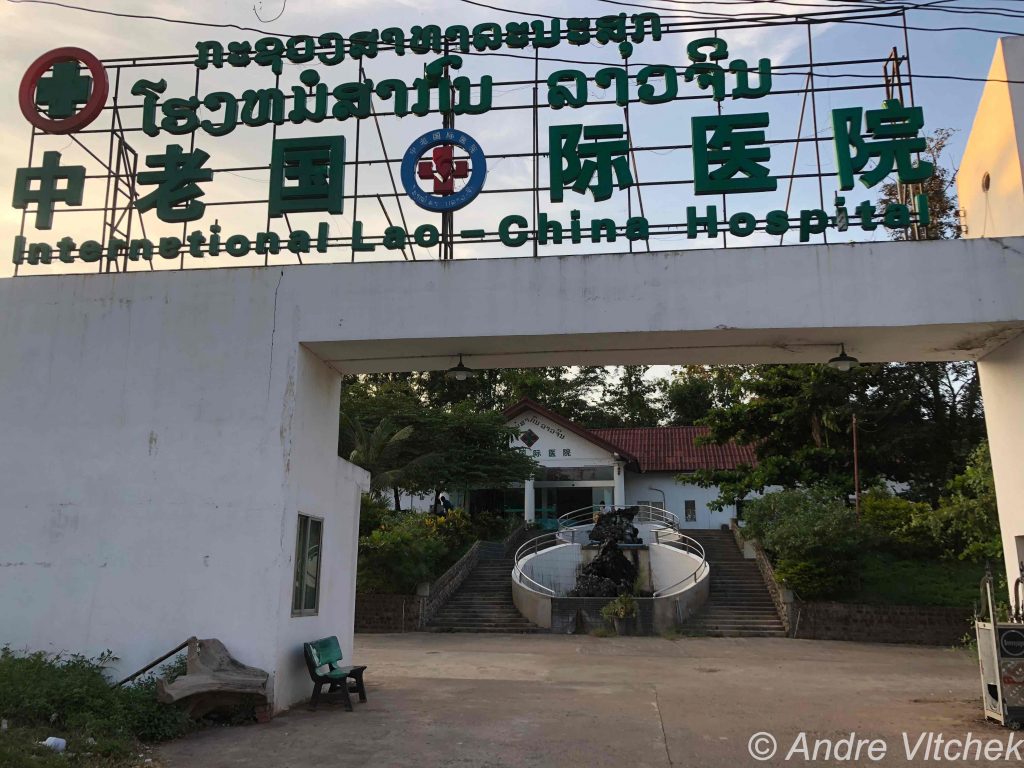
International Lao-China hospital
And not only roads, I saw and photographed new workshops, hotels, small factories and hospitals, along the road from Luang Prabang to Phonesai Village.
This is all part of Belt and Road Initiative, an optimistic, internationalist plan of China and its leadership, designed to connect lift out from poverty, a great number of nations, among them various previously colonized and plundered (by the West) countries in all corners of the globe.
*
While the Chinese workers are sweating, constructing the future of Laos, several French-speaking tourists on the main street of Luang Prabang are having beer.
In 1995, UNESCO inscribed this ancient capital of Laos onto the world heritage site list. Mass tourism, mainly from the West, followed.
Beautiful but sentimental touristy Luang Prabang
Restored strictly the ‘French-way’ into a sentimental, colonialist nostalgia ‘living museum’, Luang Prabang caters mainly to European tastes. The local people are here predominantly to serve, to ‘just be there’ for decorative purposes; poor and ‘native’, humble, selling craft, sitting on the asphalt and making sure to look appropriately destitute but ‘friendly’.
There are a few posh boutiques and high-end hotels in town. No Laotian person could ever be able to afford a glass of Belgian beer on offer, or a meal in one of identical ‘traditional’ restaurants.
Signs are in English, sometimes in French or Laotian, but very rarely in Chinese.
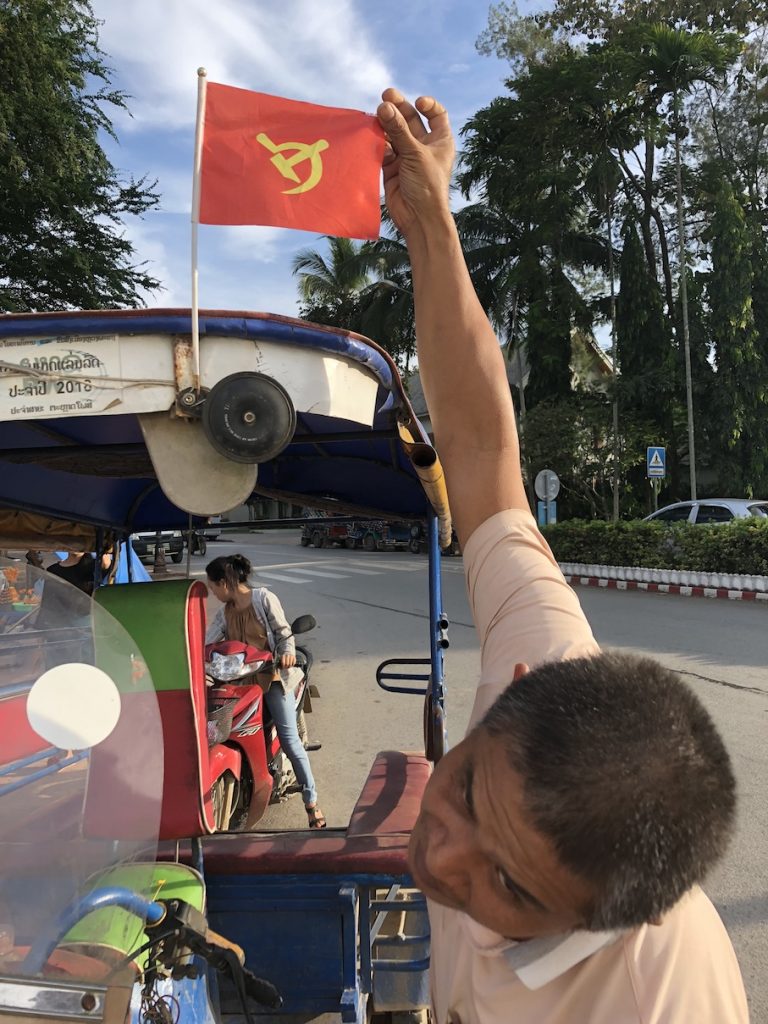
Official Communist flags of Laos have almost entirely disappeared from the main streets of Luang Prabang.
In a local library, I am told by Mr. Seng Dao, who is the main librarian:
“Foreigners, mainly Europeans, used to come to local people and ask, sarcastically, even aggressively: “Why do you show Communist flags here? Or: ‘Why do you have Communist history in your books?”
Within few years, in the center of the city, the proud Communist legacy and identity of Laos has almost been entirely replaced with mass-produced low-quality silk, banal toys and other kitsch catering to the Western cultural fundamentalists, mainly from Europe.
But Laos is a Communist country, and flags are still waving in the wind as a rebellion, from various tuk-tuks and from the houses.
*
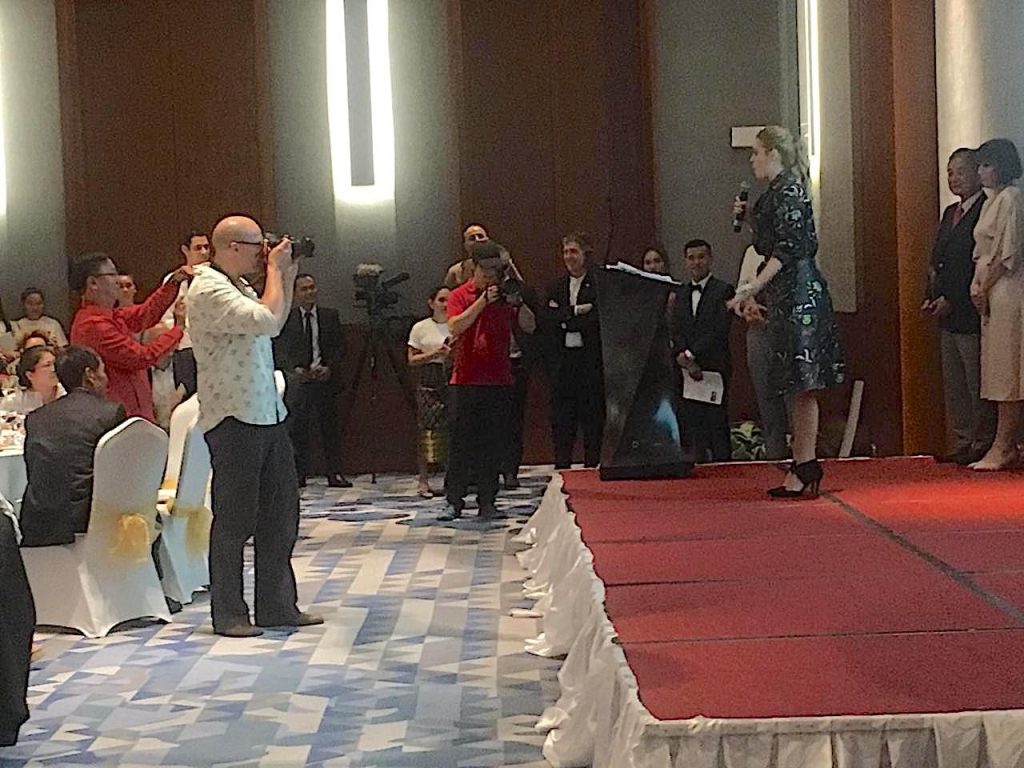
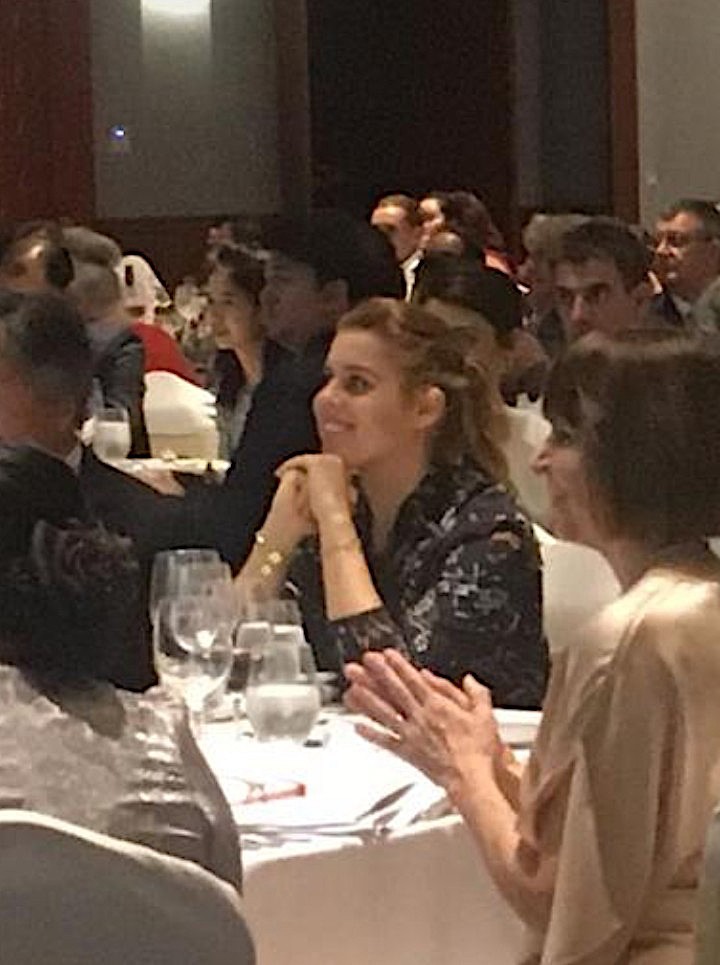
Princess Beatrice in Luang Prabang – photo taken by pilou
At UXO (Unexploded Ordinance) Center in Luang Prabang, I was unceremoniously kicked out, as they were expecting the visit of ‘her royal highness’, Princess Beatrice. A member of the vile British royal family responsible for the horrendous colonialist legacy all over the world (including Southeast Asia), Ms. Beatrice came to Luang Prabang mainly to attend a charity gala at the newly built Pullman hotel (where I happened to be staying), where she addressed 230 guests, most of them Western ‘expats’ – mostly men who have settled in and around Luang Prabang.
Rumors spoke of the possibility of collecting enough money to build a bigger structure for UXO in the city.
I used to work in Laos, on several occasions, but especially in 2006, when I reported on the activities of the British de-mining agency MAG, in the devastated Plain of Jars.
For many years I have been passionate about this part of the world, trying to understand what really happened during the horrendous ‘side-kick’ wars initiated by the Empire: those in Cambodia and Laos.
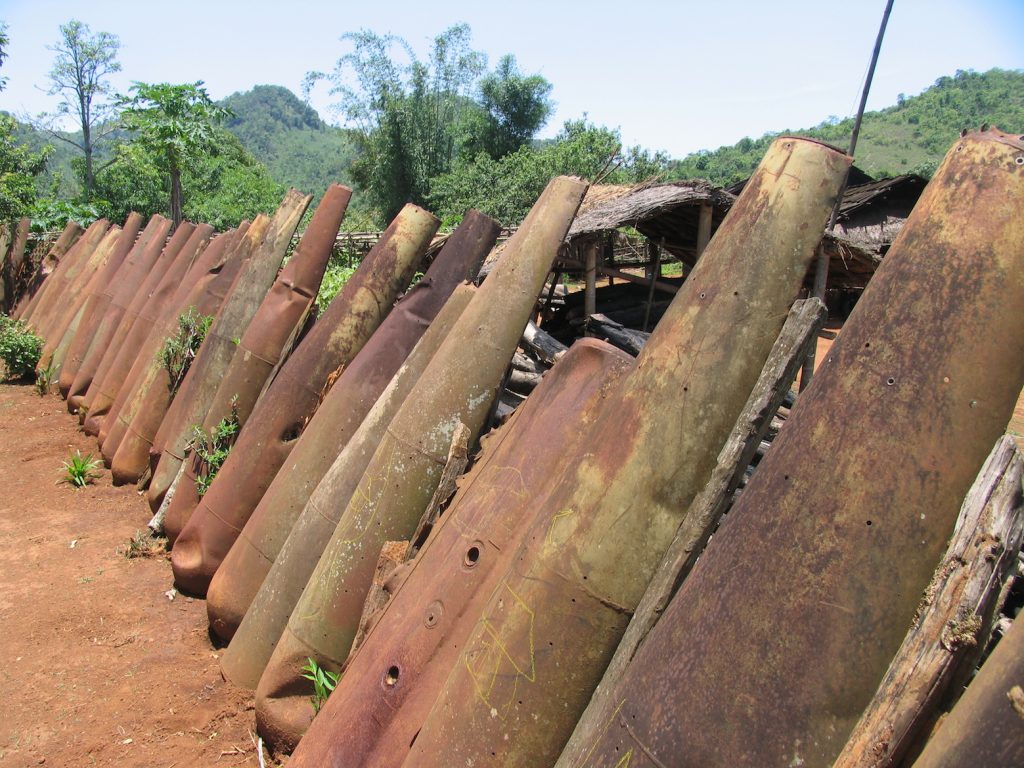
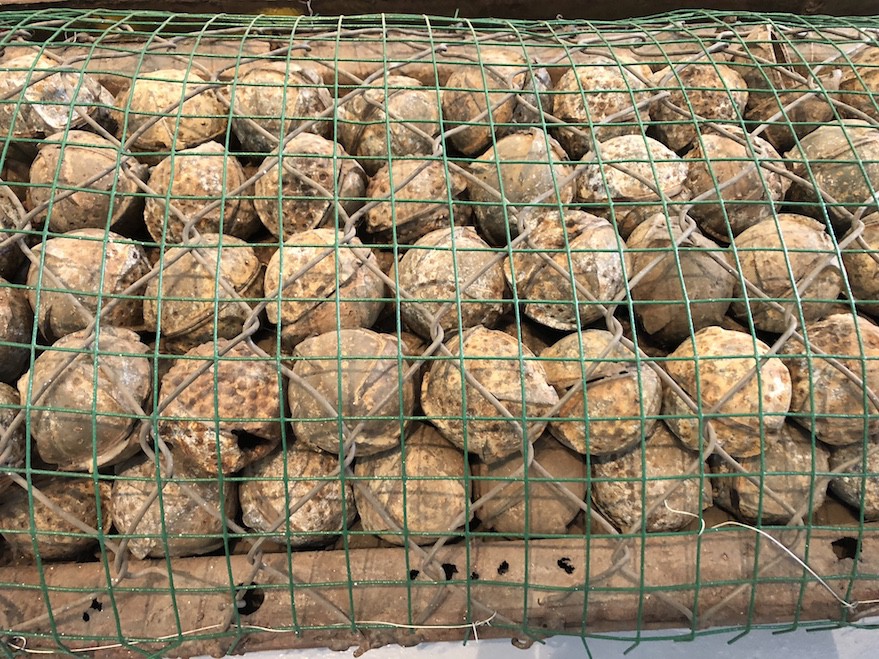
Laos Plain of Jars village fence made of American bombs
In a beastly show of cruelty and indifference, the West took millions of innocent human lives in Vietnam, Laos and Cambodia. We will never know the precise numbers, but combined, the death toll of the civilians most likely reached between 5 to 8 million. The West murdered and maimed people, and it poisoned entire huge areas of what was once known as ‘Indochina’. And it got away with it, as it has donein virtually every corner of the world, where it brought genocide, thorough destruction and indescribable misery.
I spoke to dozens of local people in the Plain of Jars, using the services of my patient and deeply compassionate local interpreter, Mr. Luong.
There, in a small village of Ban Khai, Mr. Phommar who was then already 81 years old, revealed to me all the horrors of the so called “Secret War”, unleashed by the West but particularly by the United States, against the scarcely populated Laos:
“We used to hide by the side of the road, in the ditch. Bombs kept falling and once our entire family was buried and we had to dig ourselves out. People were dying all around us. They used to bomb us with enormous airplanes which flew so high that we couldn’t see or hear them approaching. And they used to send small planes which were looking for people on the ground; those flew so low that we were able to see faces in the cockpits.”
“But the carpet bombing was the scariest. There was no warning. Bombs began to explode all around this area and we had no idea where they were coming from. On average, they bombed us five times a day. They bombed us almost every day, for more than ten years. Laos had only two million people then. And we were later told that the U.S. and its allies dropped three million tons of bombs on us.”
“Eventually, nobody could survive here, anymore. Our houses were destroyed and our fields were full of unexploded substances. People were dying and so were the animals. We had to leave and so we decided to go to Vietnam, to search for refuge. But the journey was tremendously arduous. We were moving at night, carrying few possessions. During the day we were hiding from the enemy planes.”
“During the war I was very angry at Americans. I couldn’t understand how can somebody be so brutal. How can somebody kill fellow human beings in such cold blood? But now my government tells me that everything is ok, that it is past and we should forget. But how can we forget? I don’t feel angry anymore, but I would like the world to know what happened to us.”
US bombs in Laos
John Bacher, a historian and a Metro Toronto archivist once wrote about The Secret War in Laos:
“More bombs were dropped on Laos between 1965 and 1973 than the U.S. dropped on Japan and Germany during WWII. More than 350,000 people were killed. The war in Laos was a secret only from the American people and Congress.”
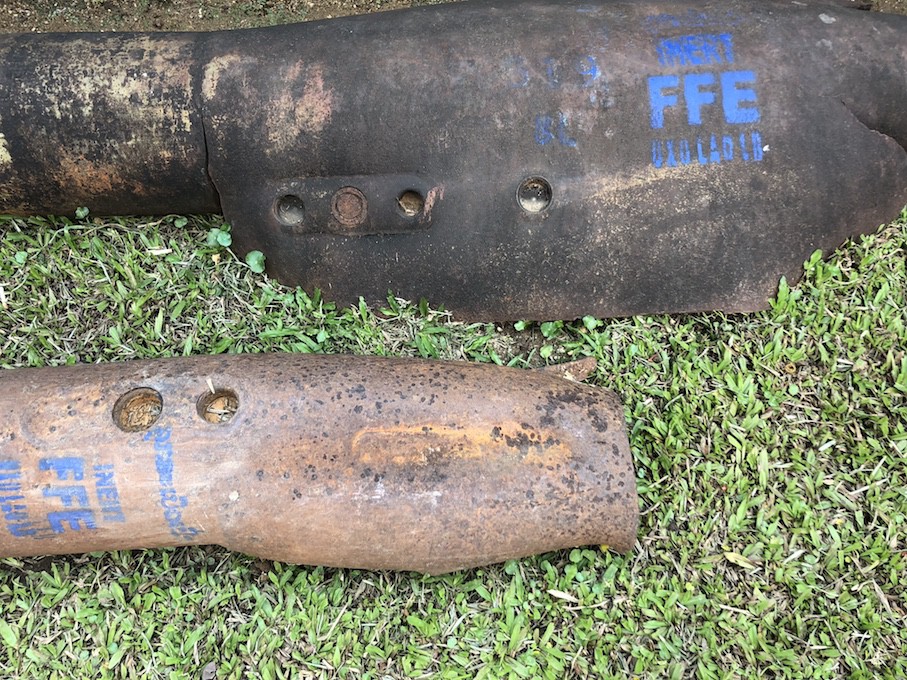
US cluster bombs in Laos
Jeremy Kuzmarov described in detail and in full psychological horror, what the West did to Laotian men, women and children:
“Military planners and “defense intellectuals” saw Laos as a testing ground for new forms of counterinsurgency and automated warfare the Pentagon had been developing, unencumbered by media or congressional scrutiny. A State Department official said: “This is [the] end of nowhere. We can do anything we want here because Washington doesn’t seem to know that it exists. While USAID provided rice drops in the effort to win “hearts and minds,” the military pioneered computer-directed bombing along with drone surveillance and dropped over 270 million cluster bombs, 80 million of which did not detonate… These strategies helped to delay the victory of the Pathet Lao revolutionary forces by over a decade, while providing a template for the automated warfare of the 21st century.”
Conclusions of Jeremy Kuzmarov are chilling but precise:
“If the Nazi activities represented a kind of apex to an age of inhumanity, American atrocities in Laos are clearly of a different order,” Branfman wrote. “Not so much inhuman as a-human. The people of Na Nga and Nong Sa were not the object of anyone’s passion. They simply weren’t considered. What is most striking about American bombing in Laos is the lack of animosity felt by the killers to their victims. Most of the Americans involved have little if any knowledge of Laos or its people. “
To put numbers into perspective, as reported by Santi Suthinithet, at Hyphen:
“From 1964 to 1973, as part of the Secret War operation conducted during the Vietnam War, the US military dropped 260 million cluster bombs – about 2.5 million tons of munitions – on Laos over the course of 580,000 bombing missions. This is equivalent to a planeload of bombs being unloaded every eight minutes, 24 hours a day, for nine years – nearly seven bombs for every man, woman and child living in Laos.”
My credentials as a writer, film-maker and investigative journalist who was risking his life for Laos (and Cambodia), browsing through the minefields, interviewing victims of the beastly Western campaigns in this part of the world, got me, this time, absolutely nowhere. Or more precisely, they got me just 5 minutes of a visit to the UXO center. After that I got escorted to my car, so the safety of a member of mass-murderous British monarchy could be guaranteed.
Did Laos really need Princess Beatrice? It does not need charity, does it? The UK, together with the US, Australia and few other nations were fully responsible for the death of at least 300,000 Laotian people. The West killed here; it lied, and it has been covering it all up until today.
For experimenting on defenseless and innocent human beings, for ruining their land, poisoning rivers, slaughtering animals from the comfortable distance and height of the B-52 strategic bombers flight-paths, in an ideal, or even just ‘normal world,the West should be standing on its knees throwing ashes on its head, begging for forgiveness. Naturally, it should be paying war reparations amounting to trillions of dollars; to Laos, Vietnam and Cambodia. All this and much more it should be doing, to offset at least some of the monstrosities it committed, instead of throwing gala charity parties for the royal mafia, in the middle of 5-star establishments surrounded by local rice fields.
*
But we are not living in an ideal or even ‘normal’ world. The West is unapologetic. Despite everything, it feels morally superior to the rest of the world. It preaches its fundamentalist gospel. And here, in Laos, it is trashing China for pulling this wonderful gentle nation out of decades of horrors, misery and dependency.
Western propaganda against the Chinese projects in Laos, is now in top gear.
Like in Africa, Western-financed NGO’s are in full force in Vientiane and other cities of Laos. Instead of building or improving Laos, they are there just in order to push the Western agenda; to agitate against the Communist government and its projects and cooperation with China.
Bizarre and totally false stories are circulating in many major Western publications, accusing China of virtually everything, from not paying adequate wages, to ruining the Laotian environment.
The reason for all this propaganda is clear: Laos is an extremely strategically-located country, bordering China, Burma, Vietnam, Cambodia, Thailand and Vietnam.
It is a Communist country. It is still very poor, but with tremendous potential. And now it is clearly aware of the fact that it can soon stand on its own feet.
China is capable and willing to transform this country, literally overnight, from a recipient of meager aid, to a powerful nation of 7 million inhabitants.
China is involved in building roads, railroads, hospitals, factories, workshops, as well as dams and hydroelectric powerplants on the Mekong River. The latter is solving the notorious electricity shortages of Laos, while turning it into a net exporter of electricity, particularly to neighboring Thailand. It is also pulling hundreds of thousands of Laotian people out of poverty.
An article published on February 1, 2016 by NEO Magazine(“Laos: The new Cold War Battleground You Don’t Know About”) addresses the issue:
“Protesters paradoxically claim that the dams will disrupt both the environment and traditional fishing communities along rivers downstream from dams. Traditional fishing communities, however, are generally synonymous with both unsustainable environmental destruction and poverty. Conversely, environmental impacts by dam construction can be mitigated through careful planning, while working to lift surrounding communities and the nation as a whole from poverty through improved infrastructure and cheaper and more accessible energy.
Protesters are not campaigning for careful planning, or better oversight of projects, they are campaigning instead for arrested development for Laos and its people – the sort of campaign only Wall Street and Washington could benefit from.”
The West has built nothing substantial in Laos. And it is horrified by the possibility that under the Chinese leadership, Laos will provide an example to the world, proving that even a poor and once destroyed country could stand independent and tall, if it is helped by its mighty, ideologically close neighbor.
My driver and comrade
While the West is helping to build a few services in the old city, mainly for its own tourists and profits, China has already built the efficient Luang Prabang International airport, replacing the old tiny yellowish building that used to serve as a terminal.
Railroad and highway projects that will be passing through Laos will connect China with several countries of Southeast Asia, and securefor Laos substantial transit fees. It is a win-win situation, but not when observed from the point of view of those who just want the continuation of Western supremacy in the region and the rest of the world.
And what about the people of Laos? Is the West really treating them better than they are treated by the Chinese? This is what I learned from Mr. Seng, a Laotian supervisor working at a luxury international hotel 3 Nagas in Luang Prabang:
“I am really glad that the Chinese are here. They are now involved in many projects here in Laos, including powerplants and this high-speed train project which will interlink Laos with China, Thailand and hopefully, Cambodia. Chinese are treating us very well. My brother works for them; he is a driver. He earns 900 dollars monthly. This is enormous amount of money here. In fact, Chinese are paying him 1.500 dollars, but the government here takes 600 as an income tax, or something… I work for a French hotel chain ACCOR, which is the biggest hotel company in the world, and I earn 200 dollars, as a supervisor. Local staff earns on average 120 dollars.”
I checked with a French ACCOR employeewho is based in Luang Prabang, and he confirmed the numbers.
The conclusions are clear: China pays local people the same wages as they pay to the Chinese workers. The French are paying local staff approximately 25-30 times less than what they pay their own people.
But search the net: at least in the English language, and all you will find is an avalanche of fake news about the Chinese involvement in Laos. This is all that the world is allowed to know about this country, and its epic battle for true independence.
As always in the Western media: black is white, boys are girls, war is peace, and flamingos are pigs.
*
In the meantime, as I wrote earlier, the Communist flags have almost entirely disappeared from the center of Luang Prabang. It is because, I was told, the European tourists don’t like to see them.
Yes, UNESCO supervised the preservation work of the old capital, but what is the result? Sentimental, feel-good ‘colonial charm’; temples, silk shops and cafes with the Western beer and free WIFI. Old Chinese-Lao architecture looks, suspiciously, French. Not a word about the horrors that the country had to go through in recent history; not a word that hundreds of people of Laos are still losing their lives due to the UXO, all over the country. Not a word about the French colonialism, the Western genocide during the so-called “Secret War”, which was unleashed against the defenseless Laos.
And yes, not a word about the heroic Pathet Lao, and its superhuman struggle for a Communist fatherland, against the Western imperialist monsters.
On the outskirts of the city, predominantly European tourists visit the fake ‘bear rescue center’ (it is really nothing more than a depressing zoo for foreigners), overcrowded waterfalls and caves with religious motives. Hardly anyone goes to the real, tough and beautiful caves, where the Laotian patriots hid while they fought against the West.
Now the “National Museum” in the center of the city is basically an implanted (from abroad) glorification of the departed Laotian monarchy. While its shabby theatre shows, exclusively for foreign tourists and at an ‘international price’, several fragments of Ramayana.
And the public library in the city center has, since several years ago, something called “The American Corner”. You can find Allure there, Entrepreneur, Reader’s Digest…
Mr. Seng Dao, my friend, a librarian, explains:
“There is not much we can do. We can’t just say ‘no’ to their corner, to their books. We cannot yet openly say ‘no’ to them, when it comes to so many things. But Lao people did not lose their memory. We know, we remember very well what was done to us. And our government reminds us; through our radio stations, through our press, our history books…”
In the old city, there are hardly any Chinese language signs. Yes, it is paradoxical, as the city is built in a Chinese style, although it now feels ‘colonial’, or call it Europeanized; catering to standardized, mainly ignorant German and French tastes.
Lao people are supposed to look native, cute and poor. They do, here in the city. But only for now.
A few kilometers away from this pseudo-reality, from this over-sugary and to some extent treasonously demeaning tourist bordello, Chinese signs are proudly displayed, next or underneath Laotian writing. Chinese people, who are engaged in building Laos, prefer to live on the outskirts of Luang Prabang, together with local people, eating their food, sleeping in their guest houses.
The presence of the Chinese engineers and workers is transforming, improving reality. Workshops are growing, eateries flourishing, and the real local economy is growing.
Further away from the city, powerful machines are roaring, drilling tunnels, building bridges. Laos is undergoing electrification; it is getting connected to the rest of the world through high-speed railroads and new highways. Schools and hospitals are being built, roads paved. Two Communist countries;two Asian sisters, side-by-side, are hard at work.
Nobody chases me away when I photograph Chinese construction sites. Proud smiles welcome me. Workers wave at me, or bow, and then, immediately, they go back to work. There is nothing to hide. There is no time to waste. This is reality; good, progressive reality!
Nothing is perfect, here or anywhere else in the world, but this is as good as it gets. I believe it is. I watch a giant construction site and people who are building the nation, raising it literally from the ashes, left by imperialism. The lenses of my glasses get foggy. Mekong is flowing below, and intact, pristine green mountains are resting in a tender embrace of white clouds.
I think: “The West dares to talk about ‘environmental damage’ here? Yet they have already ruined, thoroughly poisoned and literally liquidated some of the most pristine parts of the world that I know: Borneo, Papua, the Democratic Republic of Congo! How dare they?” But they do; they dare, and still getting away with it.
The nihilism, smear, filth that pours from the muzzles of the West and its regional servants, but it cannot deter this revolutionary optimism, which is so clearly detectable. It is simply beautiful to watch both Chinese and Laotian people working side by side, for a better world.
What did the countries that are attacking this tremendous effort, ever do for Laos? What has the West done for the people here? It colonized and enslaved Laos. And then, in one prolonged and truly incomprehensible horror show, carpet bombed, for years, the entire nation, murdering hundreds of thousands, without even declaring war against it!
How can the countries that committed genocide against Laos (and the entire world) be allowed to criticize Laos and China, belittling their efforts to improve lives of their people? And how come that Laotian people are still tolerating, even ‘welcoming’ Westerners in places like Luang Prabang, while they show clear disrespect for true essence of the Laotian state, for which so many local people sacrificed their lives? What are Westerners going to teach Laos, what can they teach, really: how to serve, how to be good obedient neo-colonial subjects?
Nobody needs that here, except the few members of the treasonous elites.
Princess Beatrice in Laos/Photo – Pilou
How can people like Princess Beatrice, or any of those ‘royal’ freaks be even allowed on the premises of such places as the UXO? The British royal family is the symbol of global colonialist holocaust. In their name, hundreds of millions of ‘un-people’ vanished, all over the world.
In the past, these were only rhetorical questions. Now such questions are being asked, in order to be answered.
What goes on in Laos is what I call the war between revolutionary optimism and Western nihilism (my latest book has the same title:Revolutionary Optimism, Western Nihilism ).
It is the last attempt of the monstrous Western imperialist culture to retain its control over the Planet.
Laos, in the past one of the most devastated countries on earth, is not going to allow being lectured to by its tormentor – the West – anymore. In the past, it fought, and against all odds it won. Now it is winning again. But the ‘weapons’ are different than in the days of the so-called “Secret War”: they consist of high-speed railroad tracks, bridges and tunnels, mighty power-plants, hospitals and schools.
*
[Text first published by NEO – New Eastern Outlook]
Andre Vltchek is a philosopher, novelist, filmmaker and investigative journalist. He has covered wars and conflicts in dozens of countries. Three of his latest books are Revolutionary Optimism, Western Nihilism, a revolutionary novel “Aurora” and a bestselling work of political non-fiction: “Exposing Lies Of The Empire”. View his other books here. Watch Rwanda Gambit, his groundbreaking documentary about Rwanda and DRCongo and his film/dialogue with Noam Chomsky “On Western Terrorism”. Vltchek presently resides in East Asia and the Middle East, and continues to work around the world.
I have an acquaintance and occasional correspondent who was a famed U.S. Marine Corps pilot during the Vietnam War. At age 20 he began two years in Nam and logged over 800 combat missions in F-4B Phantoms and other aircraft. He won Distinguished Flying Crosses.
A few years later he got back, after a lapse working elsewhere, into aviation and began ferrying aircraft of all kinds across oceans to countries all over the world. He holds a number of aviation records and a little over three decades ago he was the second (and last) pilot to fly an aircraft under and through the legs of the Eiffel Tower in Paris.
He wrote me not long ago: “I delivered the last F-227 aircraft in November 1979 to Tehran. I was there for a week and while the natives were restless, they were really nice people. The aircraft was going to the Shah’s sister. She paid for each plane in her fleet every month. But Iranians were wonderful. They just did not like what the CIA did to them in 1953.
By not responding now, the Iranians are winning. The world is not blind. The U.S. Empire is going to crumble far faster than anyone realizes. If Iran keeps standing, they will win. Iran is doing the right thing and Europe is waking up to the realization that they have a choice. They can honor their agreements like the JCPOA for mutual benefit, or they can let the neighborhood bully push them around. One day they will realize who their friend is and who is not.”
This man has called wars the U.S. has gotten involved in, including Vietnam, “stupid”. He is correct, of course. And even if many Iranians don’t think right now that they are “winning” anything under harsh U.S. sanctions, I agree with this former Marine pilot’s views.
He has a firm grasp of geopolitics, and he is a real American patriot condemning many U.S. actions in recent decades. He would advise Iran to “cool it”, or stay cool. He is everything as a pilot and a real patriot dead Senator John McCain was not.
It is, in any case, hard for anyone not in Iran to know what’s happening there now. Some Iranian leaders are suggesting that the current economic problems are not so much the result of U.S. sanctions, but rather in part at least the result of internal problems (that can eventually be addressed) inside Iran with economic adjustments of some sort.
This may be the case. One would hope so. But what about my pilot friend’s outright assertion that the US empire will “crumble” sooner rather than later? We know of no “empire” in all of human history that has not eventually “crumbled”, including even Persia’s vast Achaemenid Empire more than 2000 years ago. And what caused that? Over reach. The Persians, for one thing, were defeated by the Greek city states, particularly Athens.
Currently, we are witnessing the Zionist state going hog wild against the Palestinians, apparently greenlighted by the subservient Trump Administration. Part of this aggression is Israel cheering on Trump’s evisceration of funding for UNWRA, which has been supporting Palestinians with basic human necessities since 1950.
But guess what? Even some Zionist commentators in the Israeli press are now saying this is a huge mistake, because SOMEONE is going to have to continue provide millions of Palestinians with the means to survive, and the burden may well fall more on Israel going forward.
Sure, the Zionists would like to see the Palestinians disappear and have been trying to make them disappear since 1948, but if the Zionists literally make conditions even worse in the West Bank, Gaza and beyond, and the world knows now how bad conditions are, they will be fast tracked to the ICC in The Hague for crimes against humanity. And BDS is working. Just this week a music festival in Israel lost almost all its foreign performers, to cite just one example of BDS success. The Zionists are now overreaching on steroids, to their eventual downfall.
And the same might be said about the U.S., which has been in overreach mode since the Vietnam War. And quite much more since the Iraq invasion in 2003, to the point where about $7 trillion in debt back then has grown to $22 trillion since, not to mention an estimated $200 trillion by one economist’s estimates in unfunded liabilities. Never before in history has any country amassed so much debt.
The ONLY reason the U.S. dollar has not become mostly worthless is because it remains the world “reserve” currency and to date most all petroleum has been priced in dollars, the so-called “Petrodollar”. President Richard Nixon in the early 1970s suspended all spending discipline when he cut the U.S. dollar’s ties to any gold standard. And now the world is moving away from the dollar, led by Russia, and this trend is irreversible.
But monetary issues are not necessarily the primary problem facing the U.S. Negative world public opinion is, particularly since Trump abandoned the JCPOA. Over reach is what has and will cause the “crumbling” of the U.S. “empire”, and good riddance the sooner the better, even for a majority of U.S. citizens if not for the entrenched, blind denizens of Washington.
There is a well-known saying, of murky Latin origin, that one should not speak ill of the dead. But when the death of an individual becomes the occasion for such universal glorification by the political establishment and the media, as with Senator John McCain of Arizona, a correction is in order.
This is especially necessary since the newly deceased had such a lengthy record as a militarist and supporter of political reaction, and the further promotion of such policies is the transparent purpose of the hosannas being sung in his praise.
The Sunday television interview programs on five networks devoted the bulk of their coverage to McCain’s life and career and to fond reminiscences by well-heeled journalists and big-business politicians, Democratic and Republican. “Meet the Press” host Chuck Todd noted that McCain was the single most-interviewed person on the program, appearing 73 times in his 36-year political career.
McCain was a right-wing Republican, but the loudest tributes to his political record are coming from Democrats. Senate Minority Leader Charles Schumer proposed renaming the US Senate’s Russell Office Building. Instead of Richard Russell of Georgia, a Democratic Party defender of Jim Crow segregation, the building would now be named after a Republican defender of wars in Vietnam, Central America, Yugoslavia, Afghanistan, Iraq, Libya, Syria, Yemen, etc.
Speaking on ABC’s “This Week,” House Minority Leader Nancy Pelosi said, “Right now I'm just heartbroken. I think America’s in tears about the loss of this great man.” Senator Bernie Sanders tweeted, “John McCain was an American hero, a man of decency and honor and a friend of mine. He will be missed not just in the US Senate but by all Americans who respect integrity and independence.”
In yet another characteristic display of lickspittling subservience to the ruling elite, “socialist” Alexandria Ocasio-Cortez tweeted: “John McCain’s legacy represents an unparalleled example of human decency and American service. As an intern, I learned a lot about the power of humanity in government through his deep friendship with Sen. Kennedy. He meant so much, to so many. My prayers are with his family.”
What does John McCain’s “legacy” consist of? How did he provide “an unparalleled example of human decency and American service”?
McCain spent four years in the House of Representatives and 32 years in the US Senate, but it would be impossible to cite a single piece of legislation with which he was associated that benefited the broad mass of the American people. As far as domestic affairs were concerned, he was best known for voting against the bill that established a national holiday honoring Dr. Martin Luther King Jr. In the Senate, he was the lone Republican among the “Keating Five,” senators who lobbied federal regulators on behalf of savings and loan swindler Charles Keating in 1987.
The political embarrassment caused by this episode, in which McCain narrowly avoided sanctions by the Senate Ethics Committee, led to his involvement in a decade-long effort to establish at least token limitations on corporate contributions to political campaigns. But the McCain-Feingold bill, as it became known, was ultimately gutted by the Supreme Court, which rejected most limitations on corporate purchasing of legislators as an infringement on “free speech.” Throughout his career, McCain was a reliable vote for the Republican right—for the Gramm-Rudman Act to slash federal social spending, for the impeachment conviction of President Bill Clinton, and for (with a few exceptions) measures to deregulate business and cut taxes for the wealthy.
The overriding feature of McCain’s career, however, was his reflexive hawkishness on foreign policy. He supported war after war, intervention after intervention, always promoting the use of force as the primary feature of American foreign policy, and always advocating the maximum allocation of resources to fuel the Pentagon. In his honor, after his diagnosis with brain cancer made it clear that he was unlikely to survive this year, his Senate colleagues named the 2018 version of the Pentagon budget bill the John McCain National Defense Authorization Act.
McCain’s identification with militarism began with his family background: his father and grandfather were both admirals and now have US Navy warships named after them. McCain graduated from the Naval Academy and became a pilot, leading to his capture in Vietnam and five-and-a-half years of imprisonment. No doubt the circumstances he faced there were very difficult, but any sympathy must be tempered by the fact that he became a POW after dropping bombs on largely defenseless people, making him a front-line participant in one of the greatest war crimes in history, the savage American onslaught on Vietnam.
While McCain gives sermons to the Vietnamese, let us recall that American military forces carried out mass executions, bombed civilians, defoliated half the country, carried out rape and torture, burned villages, shot children, threw prisoners out of helicopters and cut off the ears of people both alive and dead, keeping them as mementos and trading them for cans of beer. Not every soldier perpetrated such crimes individually, of course, but the military intervention as a whole was of a brutal, anti-democratic, imperialist character, which inevitably found expression in such sadistic conduct.
Once freed following the Paris agreement between Washington and Hanoi, McCain came home a so-called “war hero.” After his first marriage ended in divorce in 1980, McCain married Cindy Lou Hensley, the daughter of a multimillionaire beer distributor in Arizona. Now flush with money, McCain moved to Arizona to begin a career in Republican politics. First elected to the House of Representatives in 1982, he backed the US invasion of Grenada in 1983 and the Reagan administration policy of supporting fascist forces in Central America, including death squads in El Salvador and Guatemala and the contra terrorists at war with Nicaragua; he was on the board of the US Council for World Freedom, the American chapter of the World Anti-Communist League, for several years. After succeeding Barry Goldwater in the US Senate in 1986, he backed the first Bush administration’s invasion of Panama in 1989 and the full-scale American war against Iraq in 1990-91, during which hundreds of thousands of Iraqi conscripts were incinerated by American bombs, rockets and shells.
After some initial reluctance, McCain backed the Clinton administration’s military threats in Bosnia, including the bombing of Serb forces, and then in 1999 cheered the full-scale bombing of Serbia, declaring that the United States could accept no limitation on its military operations in support of its aims in Kosovo: “We’re in it, and we have to win it. This means we have to exercise every option.”
Like virtually every other Democrat and Republican, he supported the October 2001 invasion of Afghanistan, launching a war that is now approaching the end of its 17th year, the longest in American history.
It was in the second Iraq War that McCain played his most prominent and reactionary role, cosponsoring the 1998 Iraq Liberation Act, along with Democrat Joe Lieberman, endorsing the bombing of Iraq, first under Clinton and then George W. Bush, cheerleading the 2003 invasion and then pushing for a more aggressive use of force during the protracted US occupation, culminating in Bush’s “surge” of additional troops in 2006-2007.
McCain was a full-throated supporter of whatever lie the Bush administration chose as the basis of its war propaganda: Saddam’s alleged possession of “weapons of mass destruction”; the desire to establish the so-called “democracy” in Iraq; and finally, the need to preserve the alleged “stability,” i.e., to deal with the consequences of the US destruction of Iraq as a functioning society.
Along the way, McCain found time to advocate military action against North Korea in 2003, US support for Georgia in the war between Russia and that Caucasian republic in 2008 (when he dispatched his wife Cindy to Tbilisi in a show of support). Finally, in 2008, McCain won the presidential nomination of the Republican Party. McCain’s 2008 presidential campaign was defeated, partly because of his failure, during the financial crisis of September 2008, to respond as quickly as Obama to the demands of Wall Street for a full-scale federal bailout of the banks.
Throughout the Obama administration, McCain was a firm supporter of the Democratic president when he used military force, as in Libya, or threatened it, as in the South China Sea, and a critic when Obama pulled back, as in Syria. McCain and John Kerry introduced a Senate resolution on the war in Libya, and McCain called for US air power to be used in “a heavier way.” In September 2013, McCain backed a resolution passed by the Senate Foreign Relations Committee to give US support to military operations in Syria that would “change the momentum on the battlefield” and strengthen foreign-backed militants opposed to the Syrian government led by President Bashar al-Assad. He repeatedly called for “more boots on the ground” in Iraq and Syria.
In October 2016, while the Democratic Party was focusing its presidential campaign on alleged Russian “meddling,” McCain authored an op-ed column published in the Wall Street Journal in which he indicted Russia for having “slaughtered countless civilians” in Syria through “relentless indiscriminate bombing.” There was no little irony in the former bomber of North Vietnam denouncing Russia for doing a tiny fraction of the damage inflicted by the “shock and awe” campaign in Iraq, which led to one million deaths and which McCain supported enthusiastically.
In 2007, when his second campaign to seek the Republican presidential nomination was floundering in its initial stages, McCain was interviewed on the “60 Minutes” program on CBS about the mounting opposition to the war in Iraq. He was asked “At what point do you stop doing what you think is right and you start doing what the majority of the American people want?” McCain responded, “I disagree with what the majority of the American people want.” The Wall Street Journal hailed this response—which essentially rejected popular sovereignty as the basis of democracy—as “McCain’s Finest Hour.”
It is this absolute commitment to the defense of American imperialism that endeared McCain to the US ruling elite as a whole and explains the outpouring of adulation over the weekend.
What you heard was from an article by Patrick Martin, a Canadian politician, who was a member of the House of Commons of Canada from 1997 to 2015, representing the riding of Winnipeg Centre for the New Democratic Party.
When I received my briefing as staff associate, House Defense Appropriations Subcommittee, which required top secret clearance, I was told by senior members of the staff that the Washington Post was a CIA asset.
Watching the Washington Post’s takedown of President Richard Nixon with the orchestrated Watergate story, that became obvious. President Nixon had made too many overtures to the Soviets and too many arms limitations agreements, and he opened to China. Watching President Nixon’s peace initiatives water down the threat level from the Soviet Union and Maoist China, the military/security complex saw a threat to its budget and power and decided that Nixon had to go. The assassination of President John F. Kennedy had resulted in far too much skepticism about the Warren Commission Report, so the CIA decided to use the Washington Post to get rid of Nixon.To keep the clueless American left hating Nixon, the CIA used its assets in the leftwing to keep Nixon blamed for the Vietnam War, a war that Nixon inherited and did not want.
The CIA knew that Nixon’s problem was that he could not exit the war without losing his conservative base, which was convinced of the nonsensical “Domino Theory.”I have always wondered if the CIA concocted the “Domino Theory,” as it so well served them.Unable to get rid of the war “with honor,” Nixon was driven to brutal methods to force the North Vietnamese to accept a situation that he could depart without defeat and soiling America’s “honor” and losing his conservative support base. The North Vietnamese wouldn’t bend, but the US Congress did, and so the CIA succeeded in discrediting among both the leftwing and rightwing Nixon’s war management.With no one to defend him, Nixon was an easy target for the CIA.