Showing posts with label Sultan Qaboos. Show all posts

Monday, November 19, 2018

Peace Railway Not Truly Peaceful

By: Abdel Bari Atwan


The normalisation blowskeep coming. First,Israeli Prime Minister Binyamin Netanyahu visits Muscat and is greeted most cordially. Then, Israeli Culture Minister Miri Regev tours the Abu Dhabi mosque dedicated to the late Sheikh Zayed, who led the Arab oil embargo in solidarity with the heroes of  the October 1973 war and made the historic declaration that ‘oil is not more precious than blood’. Meanwhile, the Israeli national anthem is played in Doha to salute a gymnastics team taking part in a sports tournament there. And after all that, at an international conference in Oman, Israeli Transport Minister Yisrael Katz unveils plans for a railway linking the Palestinian port of Haifa to Jordan, Saudi Arabia and the other Gulf states, and explains the abundant political and economic benefits that will accrue from this normalisation train.

We hardly had time to recover from the shock of Netanyahu’s visit to Muscat, and those of his ministers and sports teams to Abu Dhabi, Dubai and Doha, before we were presented with this new ‘peace train’. The announcement was deliberately timed to coincide with the coming into force of the second phase of US sanctions against Iran, leader of the resistance axis. The Israelis promoting this project, with American support, made a point of stressing it would help the Gulf states in their endeavour to confront the threat posed by Iran to the region’s security and stability.

The Israelis see the Arab world’s current enfeebled state as providing them with an opportunity to reach the sources of the Arabs’ oil and control the Gulf states and their economies. The pretext is that these countries need access to the Mediterranean via Haifa. But the real purpose is to establish a presence there, assert their leadership of the region, and set the stage for the nascent ‘Sunni Arab Nato’. Is it a coincidence that this railway proposes to connect the capitals of this alliance’s members?

We do no understand why these states need access to the Mediterranean, when they have ample access to the Arabian Sea, the Red Sea and the Gulf of Aqaba. And if they do indeed need it, why must it be via Haifa rather than, for example, Beirut, Latakia or Banias?

The ill-fated Arab Peace Initiative has been reduced to a footnote in the so-called Deal of the Century. And it has been up-ended: with normalisation coming first, second and third, and the main component – the establishment of a Palestinian state with Jerusalem as its capital – not being implemented at all.

Jordan, and we say this with bitterness, will be the Trojan Horse that is used to implement this normalisation plan if it is put into effect, as it is already involved in two normalisation projects: the proposed canal to link the Red, Dead and (later) Mediterranean seas; and the 15-year $15bn gas deal with Israel. What Jordanian officials do not appreciate is that if these plans go ahead they well ultimately be to their detriment and that of their country and its identity. Jordan after them will not be the same as Jordan before them, if it remains at all.

This is no ‘peace train’ but a train of capitulation to Israeli plans aimed at dominating the region, its oil and its economies, destroying the Arabs’ national identity, and turning them into servants, subordinates and sentries of the Zionist enterprise. That is the ultimate humiliation.

Go ahead and celebrate the presence of the racist Israeli minister who likened your prayer calls to the barking of dogs. Roll out the red carpets for Netanyahu and his ministers. Play the Israeli national anthem, learn the words and tune, and sing along heartily behind the Israeli athletes. And listen carefully to Yisrael’s Katz’s briefing on the new normalisation train project.

But also keep in mind that the Arab and Islamic peoples have not died and will not die, and the day of reckoning will come perhaps not before long.

Thursday, November 15, 2018

GCC-Israeli ties: out of the shadows, into the light


What's behind the Israeli-GCC rapprochement, and how deep do these ties run? A source from the Omani Royal court speaks to TRT World on the truth behind the changes.

The recent spate of welcomed public appearances by senior Israeli officials in Gulf countries, following a history of clandestine ties, unveil a shift towards normalised ties with Israel.
On October 25, Israeli Prime Minister Benjamin Netanyahu visited Oman for high-profile talks with Sultan Qaboos, days after talks with Palestinian Prime Minister Mahmoud Abbas.
His visit to Oman coincided with another visit by far-right Israeli Minister Miri Regev to the UAE. 
The visits come as the Palestinian Central Committee voted to revoke recognition of Israel, and suspend security cooperation with Tel Aviv.  
"You have to realise that the GCC's kings, sultans and princes only pay lip-service to the Palestinian issue. It's a means to an end. The Arab people want leaders who are anti-Israel. Their leaders deliver. But these royals couldn't care less about Palestine. It's all a smokescreen. You should hear the way they speak about it," a source from the Omani Royal court tells TRT World. 
"It's a joke to them," he adds. 
"I'm sure some of them genuinely do [care]," he notes, "but those are quickly branded as extremists, and are marginalised or disappear."
When asked what they do care about, he had one word: "Iran."
"Iran and its expansion are the only items on their agenda now. Ties with Israel are for sharing intelligence and cooperating militarily against Iran. Any mediation that comes from it is a side public relations benefit to leverage US support."
According to an anonymous Israeli official speaking to the New York Times, Netanyahu's visit came after four months of quiet discussions, and years of secret relations between Israel’s Mossad intelligence agency and Sultan Qaboos, who overthrew his father in 1970 and has ruled since.
A warm welcome for the 'racist' minister
While Netanyahu was in Oman, Regev was on a four-day visit to Abu Dhabi.
"If our children live in fear, Hamas should live in fear... We must go back to the policy of targeted assassinations of leaders"
Miri Regev, Israeli Minister of Culture
Regev, a hardline conservative with a reputation for racist, provocative statements even within Israel, attended the International Judo Federation’s Grand Slam in Abu Dhabi. She was welcomed by local officials and given a tour of the Sheikh Zayed Grand Mosque alongside UAE officials the next day.
The Israeli minister has often been the subject of controversy, posting a video featuring genocidal chants like, "may your village be burned", and calling migrants "a cancer".
Out of the shadow, into the light
Calling the Israeli-GCC rapprochement a 'thaw in relations', might be an understatement, given that they have existed for some time but were simply kept clandestine.
Recent events, however, hint at a bolder move towards normalising ties with Israel, largely kept under wraps out of fear of public opinion. This has become all the more pressing in the post-Arab Spring Middle East.
“I will say this for the first time: Israel is a state that is present in this region, and we all know this,” said Foreign Minister Yusuf Bin Alawi in Bahrain on Saturday. 
Saudi Arabia reportedly purchased over $250 million worth of spy equipment from Israel, according to an exclusive report from Al-Khaleej Online. 
The deal, mediated by the US and included training a Saudi team in operating the state-of-the-art espionage equipment, as well as strategic military exchanges. 
But the deal is by no means the first deal the Saudi Kingdom has entered into with Israel. 
A diplomatic source claimed in mid-September that Saudi Arabia had purchased the Israeli Iron Dome defence system to defend itself against Houthi rebel missile attacks. 
Saudi Crown Prince Mohammed bin Salman has also previously stated that Israelis are entitled to live peacefully on their own land, in an interview.
The statement contradicts Saudi Arabia's insistence that normalising relations with Israel requires Israeli withdrawal from Arab lands captured in the 1967 Arab-Israeli war.
In August 2018, the UAE contracted the secretive Israeli NSO Group to spy on dissidents, turning their phones into surveillance devices through the use of spyware.  
Bahrain itself publicly backed Israel's right to defend itself in a tweet by its top diplomat in May 2018.
During Regev's visit Israel’s national anthem, Hatikvah, was played for the first time in the Abu Dhabi, a further sign of the ties becoming formalised. The United Arab Emirates still has no 'official' ties to Israel.
“We made history. The people of Israel live!” Regev tweeted tearfully after the anthem was played.
At the same time, Israeli Communication Minister Ayoub Kara attended a conference in Dubai on Monday, October 29, while Transportation Minister Israel Katz plans to attend a meeting in Oman next week
A larger strategy in the making?
"Israel is a state present in the region, and we all understand this," said Oman's foreign minister, following the meeting. 
"The world is also aware of this fact. Maybe it is time for Israel to be treated the same [as others states] and also bear the same obligations."
Only last month, UAE Ambassador Yousef al Otaiba spoke at a summit in New York, alongside Yossi Cohen, director of Israel's Mossad spy agency and Saudi Foreign Minister Adel al Jubeir.
"Gulf countries, Israel and the countries in the immediate vicinity are the ones at immedi­ate risk [from Iran]," he stated, finding common ground with Israel through shared anxiety over Iran's expanding geopolitical presence.
Otaiba himself reportedly met Israeli Prime Minister Benjamin Netanyahu last May during a 'chance encounter', where they discussed Iran.

Tuesday, November 13, 2018

Persian Gulf kingdoms normalizing ties with Israel Saudi decision: Hezbollah official

Sheikh Nabil Qaouk, deputy head of Lebanese Hezbollah movement’s Executive Council (Photo by Lebanon’s National News Agency)
Sheikh Nabil Qaouk, deputy head of Lebanese Hezbollah movement’s 
Executive Council (Photo by Lebanon’s National News Agency)
A senior official of the Lebanese Hezbollah resistance movement 
says the fact that a number of Arab countries in the Persian Gulf 
region are dramatically warming their relations with the Tel Aviv 
regime after secret contacts is a decision dictated to them by the 
Saudi regime.
“Persian Gulf states' attempts at normalizing ties with Israel is a decision made by the royal Saudi family, because Crown Prince Mohammed bin Salam is currently facing numerous crises, namely the war on Yemen, the murder of prominent dissident journalist Jamal Khashoggi as well as internal  and external challenges. He is pinning hope on the Israeli regime in order to save himself,” Deputy Chairman of Hezbollah's Executive Council Sheikh Nabil Qaouq said on Monday.
He said the willingness shown by Saudi Arabia and its regional allies to establish diplomatic relations with the Tel Aviv regime has exceeded all expectations of Israeli officials, with Prime Minister Benjamin Netanyahu saying he was not dreaming the day would come when he sees normalized ties with Persian Gulf kingdoms.
“The Manama regime continues to imprison, expel and revoke the citizenship of Bahraini scholars and popular opposition leaders at the same time that it is preparing to host an Israeli minister," Qaouq pointed out, adding, “Whilst the Saudi regime is offering an olive branch to Israel, it is savagely ramping up the war on Yemen and its crackdown on ordinary people in the kingdom.”
Israeli Transportation and Intelligence Minister Yisrael Katz visited Oman on November 4 to attend an international transport conference and pitch a railway project that would link the Persian Gulf to the Mediterranean via Israeli-occupied territories.
The trip came on the heels of a surprise visit by Israeli Prime Minister Benjamin Netanyahu to Oman late last month, where he met Sultan Sayyid Qaboos bin Said Al Said at the Bait al-Barakah Royal Palace in the coastal city of Seeb near the capital Muscat.
Israel’s English-language daily newspaper The Jerusalem Post reported that the two men discussed ways to advance the so-called Middle East peace process as well as a number of issues of mutual interest with regard to the region’s stability.
Netanyahu was accompanied by senior officials, including the head of the Mossad spy agency and his national security adviser.
Netanyahu's unpublicized visit to Oman came on the same day that Israeli Culture and Sports Minister Miri Regev traveled to the United Arab Emirates (UAE) to accompany Israel’s judo team at the Abu Dhabi Grand Slam 2018.
Regev arrived in Abu Dhabi on October 26, and she participated in the opening ceremony of the international event at the Emirati capital’s Zayed Sports City, Palestinian Arabic-language Ma’an news agency reported.
Her visit to the UAE marked the first of its kind by an Israeli minister to a Persian Gulf littoral state.
Tel Aviv and Abu Dhabi have no diplomatic ties and the UAE does not recognize Israel, but the two sides have increased backchannel cooperation in recent years. There have been numerous reports of growing contacts between Saudi and Israeli officials too.
Among Arab countries, Israel has diplomatic relations only with Egypt and Jordan.
Saudi Arabia has hostile ties with resistance movements in the Palestinian territories, including Hamas which is fighting the Israeli occupation.

Thursday, November 08, 2018

Why Did Netanyahu Visit Oman?

Why Did Netanyahu Visit Oman?
Israeli Prime Minister Netanyahu met with Sultan Qaboos, the king of Oman, on Friday in Muscat. Although Tel Aviv and Muscat do not have diplomatic relations and Netanyahu's visit to Oman is the first Israeli leader's visit to this country since 1996, it seems that Oman also pursues its own goals in establishing and expanding relations with Israel. Especially since the relations between the two sides came to a halt in the wake of the formation of the second Intifada in 2000 which led to the closure of Israeli representative offices in Muscat.

But what does the head of government in Tel Aviv pursue from his trip to Muscat in this sensitive circumstances? Why among Middle Eastern Arab countries Oman should be the destination of this trip? Will Iran-Oman relations be affected in future in the wake of Tehran's objection to Muscat for Netanyahu's reception? Iranian diplomacy Answer these questions in a conversation with Seyyed Jalal Sadatian, Former Ambassador Iran in the UK and expert on Middle East issuesIt is followed up by the passage of the text:

Last week, we witnessed Israeli Prime Minister Benjamin Netanyahu's visit to Oman. From your point of view, what are the implicit targets for Tel Aviv in the current sensitive circumstances in the Middle East?

The first thing that comes to mind about the specific goals behind Netanyahu's trip to Oman is what Netanyahu's priorities are for this journey. In this regard, it seems that the first goal of the prime minister of Israel is serious confrontation with Tehran in the region and second, to follow the Palestinian issue. The transfer of the United States embassy to Jerusalem which has faced regional and global resistance has spurred Tel Aviv to overcome the resistance of some Arab states in the region. But I think the first and foremost goal for Netanyahu's trip is a serious confrontation with Iran.

But why Oman?

As an Arab country, Oman seeks to create a lifeline for Iran to bypass US sanctions, particularly the secondary sanctions. This lifeline includes crude oil exports, and various economic and commercial activities in the region. So practically, Oman acts as a bridge between Iran and the world. Because Tehran, on the one hand, deals partly with Ankara, and on the other hand, the Oman Sea is a good platform for Iran's trade relations. So Tel Aviv and Washington are looking for this link to Tehran. Netanyahu's visit aims to help Israel close this political, diplomatic and economic breather of Iran as much as possible, especially at the current critical circumstances that Saudi Arabia has suffered from the crisis caused by the murder of Jamal Khashoggi. Because it's possible to a certain extent that relations between Riyadh and Washington falter due to pressurefrom the American political structure and the international public opinion, especially knowing that the United States is approaching mid-term elections of the US Congress, and that Trump must be accountable to domestic public opinion in relations with Saudi Arabia; Tel Aviv is seeking to provide a base in Arab countries in order to follow its initiatives regardless of the United States and Saudi Arabia while the latter is involved in the murder of the critical journalist Jamal Khashoggi. But this secret trip is also as I pointed out, seek a solution to the Palestinian issue.

If Sultan Qaboos is looking to create a respite for Iran and maintain Tehran's lifeline during the US sanctions, why is Muscat's hosting of the Israeli Prime Minister seriously criticized by Iran?

There was an expectation on the Iranian side that Sultan Qaboos should not welcome Netanyahu. Because the positions that have been adopted so far by Muscat have been based on political logic and diplomatic flexibility, and their foreign policy has been absolutely reasonable. The Sultanate of Oman has the face of an impartial government in the region, which, simultaneous to the alliance with Saudi Arabia and its allies in the [Persian] Gulf Cooperation Council and the Arab League, has close ties with Tehran. This country has not had a negative  attitude towards Iran in the Arab League. In this regard and in the context of the Middle East developments and amid rising pressure Arab countries led by Saudi Arabia on Oman to cut relations with Iran, Sultan Qaboos is always looking for moderating these pressures and mediation between the Arab community with Iran. But the fact that Sultan Qaboos himself receives Netanyahu on his visit can somewhat question Muscat's policies. 

Can this have a significant impact on Tehran-Muscat relations?   

No. This issue can not undermine seriously the relations between the two countries. Especially as in the current critical circumstances Tehran considers Oman as one of the levers to maintain its relations with the Arab community..

Media speculate that Muscat is trying to serve as mediator between Tehran and Washington.     Since before the last round of nuclear talks between Iran and the P5 + 1, Oman hosted secret talks between high-ranking officials of the Islamic Republic of Iran and the United States. Taking this into consideration, are Oman and Sultan Qaboos basically capable of conducting such an initiative?

No. See, when Trump withdraw from the JCPOA, Merkel, as Germany's Chancellor and head of European Union's primary economic power, French President Emmanuel Macron, or British Prime Minister Theresa May could not persuade Trump. So obviously Sultan Qaboos will not be able to do this. But as far as Oman and Sultan Qaboos are making efforts along a country like Kuwait and its Emir Sabah Ahmed Jaber al-Sabah to keep the balance against Iran and as much as they have prevented the Gulf Cooperation Council to take any action against Iran is heartwarming. 

* Interview by Abdul Rahman Fathollahi, Iranian diplomacy staff writer.  

Monday, April 01, 1996

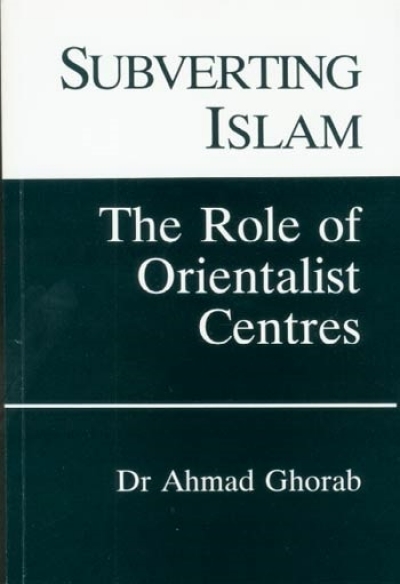
Book exposes Saudi role in subverting Islam

By Rahhalah Haqq

Subverting Islam: The Role of Orientalist Centres by Dr Ahmad Ghorab, (Minerva Press, London, 1995).
Dr Ahmad Ghorab is to be commended for his fine book, Subverting Islam: The Role of Orientalist Centres. His courage and forthright honesty is an inspiration for concerned Muslims in search of the truth. He has succeeded in identifying an important front in the current Euro-American crusade against the Islamic movement: the formation of an anti-Muslim network of institutions and scholars marching under the banner of `Islamic Studies'.
In his insider expose' of `Islamic Studies,' Dr Ghorab demonstrates how the new school of thought derives legitimacy by employing compliant Muslim scholars and professors, such as Ja'afar Sheikh Idris, Yusuf al-Qaradawi, Abdullah and Akbar Ahmed, to name just a few. Christian missionaries and professors, such as Bishop Kenneth Cragg, Rev. Montgomery Watt and John Esposito, are, as Dr Ghorab shows, always close at hand to guide verious `Islamic Studies' programmes . Dr Ghorab also exposes the Saudi role in funding such programmes, both in the Muslim world and in various European and American academic institutions.
Dr Ghorab provides a detailed discussion of the Oxford Centre for `Islamic Studies,' and also mentions other institutions with similar programmes, such as the Hartford Seminary, College of the Holy Cross, or Princeton University. By naming people and places subverting Islam, Dr Ghorab has done a great service for the Islamic movement. Muslims who are considering attending these institutions or consulting with these scholars should first study Dr Ghorab's book carefully. Many additional books can, and should, be written about the numerous `Islamic Studies' programmes proliferating in western academic institutions. This is especially urgent, since some Muslim-run schools, such as the Institute of Islamic Thought in Malaysia, hire their faculties almost exclusively from western universities.
Columbia University in New York City, fits Dr Ghorab's description of a centre for subverting Islam. While there is no department of Islamic Studies per se, Islam is the focus of various components within the Departments of Middle East Languages and Cultures (MELAC), Religion, Music, and, Anthropology, as well as the Middle East Institute. Though staffed primarily by Jews and Christians, there are also a few Muslim professors on hand for good measure. While the student body is one-third Jewish, some Muslim students take their degrees from Columbia, a few in MELAC. However, MELAC is especially popular with new or weak Muslims who hope to increase their faith or learn more about their religion and history by taking a few courses in the Department.
MELAC houses primarily language programmes, offering courses on Islam as they relate to the study of classic texts. The faculty includes Maan Madina, Hamid Dabashi, George Saliba, and Jeanette Wakin. A product of the American University in Beirut, Madina is an Arab secular-nationalist and uses his Arabic language courses to promote the works of Taha Husayn, Ali Abdul Raziq, and Michel Aflaq (The latter founded the Ba'ath party and was a mentor of Saddam. Madina is an avid collector of Islamic art, and occasionally offers courses in affiliation with the New York Metropolitan Museum of Art. To him, Islam is a vestige of the Arab past, to be revised by western scholars or curated in museums.
Waken offers courses on Islamic texts. Although teaching at Columbia for many years, she apparently has no Ph.D; her academic legitimacy comes from being a student of Joseph Schacht, the notorious orientalist who sought to discredit the shari'ah on the grounds that it was time-bound and irrevelant to modern society. Wakin ascribes to this belief, as well as to Schacht's other `great contribution' to Islamic Studies, his insistence that the hadith are all fabricated and therefore unrliable as sources! Wakin's courses, also disguised as language study, are carefully focused attacks on the foundation of Islamic civilization.
Many of the students who study languages at Columbia do so either to train for the Israeli Mossad or the American Central Intelligence Agency (CIA). American students with mediocre grades, but who desire such careers, get scholarships to continue studying in places like the American University in Cairo or Robert College in Turkey. MELAC students also include Muslims training to serve American officialdom; one Jordanian-American Muslim student admitted he was mastering Arabic so he could pass a US State department examination. Politically motivated language study disguised as `cultural' studies gives this department its legitimacy, and guarantees a continuous line of funding.
MELAC offers more than language courses. Saliba deals with Islamic sciences, ascribing to Hans Kung's school of thought and assigning books like John Burton's Collection of the Qur'an which attacks the validity of the Qur'an as the word of God. Dabashi is a disgruntled Iranian who harbors animosity toward Imam Khomeini and the Islamic Revolution. Like other professors, he teaches Islamic literature and philosophy through the prism of western tradition, as noted by Dr Ghorab: 1) denying the validity of revelation; 2) ignoring the reliability of Islamic sources; 3) refusing to promote Islam as anything other than an object of academic study; 4) avoiding any personal commitment to Islam.
At Columbia, political studies of Islam are the task of the Middle East Institute, a part of the University's school of International and Public Affairs, which is a recruiting front for the CIA. The Institute houses orientalist historians like Richard Bulliet, as well as a number of zionists. It has a siege mentality toward the Islamic movement and is obsessed with discrediting Imam Khomeini and the Islamic Revolution. Its past directors include Linda S Walbridge, an American Baha'i scholar specializing in Muslims of the US, and whose husband, also a scholar of `Islamic Studies,' is currently editing the encyclopedia of Baha'ism.
One expects to find this in departments whose stated goals are to study Islam and the Middle East. However, other departments at Columbia are also staffed with like-minded people. For example, the Division of Ethnomusicology in the Department of Music is headed by Dieter Christensen, who has a long and questionable history of studying the Islamic world, including work in Iran under the despised Shah. He now has a magic carpet to Oman, invited by Sultan Qaboos annually since 1985. Qaboos hires western scholars to advise him on Muslim cultural policy, and Christensen runs the Centre for Traditional Music in Muscat.
In his seminars at Columbia, Christensen - who doesn't know a word of Arabic - presents Islam as a hindrance for academic study, often complaining about `extremist' Omani Muslims who take too many breaks for prayers, or how Ramadhan disrupts his research schedule. At the same time, he gleefully boasts of swilling beer with `modern' Omanis. He also edits the Yearbook for Traditional Music, which zionist and anti-Muslim scholars use to attack Islam and curate Muslim cultures. Christensen probably has links to American, German and Israeli Intelligence agencies, and has a record of advising graduate students whose research in the Muslim workd and elsewhere is linked to missionary activities.
The Muslim Student Association (MSA) at Columbia reflects `Islamic Studies' in practice. During the early 1990s, its president was a Jewish convert to Islam (who has reportedly now changed his mind). A model `moderate' Muslim, he was a student in the Department of Religion, which projects Islam as a violent antithesis to Buddhism, the preferred religion for this department's faculty. During his reign as MSA chief, it seemed that the campus rabbi had more power in the MSA than Muslims. For example, when the regular room for Jum'ah was double-booked one Friday - despite advance requests by the MSA - some Muslims suggested praying on the sidewalk in protest, since this had occurred in the past as well whenever another group needed space. After consulting his rabbi, the MSA chief intervened and arranged for Muslims to pray in the dungeon-like basement of the campus church!
Like most other MSA chapters, the one at Columbia also answers to the Saudis. In 1992 when Saudi ambassador Bandar bin Sultan offered to join hands with a group of zionists to commemorate the expulsion of Jews and Muslims from Spain, MSA-central in Indiana quickly called for implementation of this plan on its satellite campuses. When some Muslim students at Columbia suggested inviting Dr T B Irving, a Muslim scholar of Islamic Spain, the Jewish student protested, claiming that he was an `extremist' and an `anti-Semite,' the latter a zionist euphemism for anyone who questions Israeli supremacy. The programme was subsequently cancelled, after the Saudis and the zionists could not secure a `moderate' speaker.
These and other stories need to be heard and often. Dr Ghorab has correctly identified many of the allegiances and dynamics found within `Islamic Studies' programmes. In fact, similar `Islamic Studies' agendas can be found in many different organizations outside academia. Given all this, it seems incumbent upon concerned Muslims who are affiliated with any of these institutions or organizations to take Dr Ghorab's initiative and help expose the programmes in their own areas.
Much work along these lines needs to be done in the US, the base of what Syed Qutb called `American Islam.' In the US, people like Esposito are revered as Islamic scholars by several Muslim organizations. As Dr Ghorab points out, Esposito was invited by the Saudis as far back as 1983, when he suggested establishing an institute for `Islamic Studies' in the US. Since then, Shaykh Esposito has had stints on the advisory boards of American Muslim organizations, most recently the American Muslim Council, sharing the latter distinction with other `Islamic Studies' mainstays, including Hassan Hathout and Ali Mazrui. The ubiquitous Ja'afar Sheikh Idris also appears at AMC functions.
The American Muslim Council (AMC) needs to be investigated for ties to the Saudis and official Islam in places like Egypt, as well as for its connections wiht US government agencies and corporations. Its debut was in June 1990, only two months after board member Hathout attended a Saudi-sponsored conference in Riyadh, according to Dr Ghorab. The first AMC newsletter came out in the fall of 1990, at a time when the Saudis were building Muslim support for the murderous American oil war against Iraq.
One of the stated policy goals of the AMC is to entangle Muslims with American party politics, which is also a US government policy goal recommended by CIA analysts and the RAND Corporation in a special report prepared for the US department of Defence in 1990. Founding AMC member Robert Crane, whose long history of US government service includes an appointment as ambassador to the United Arab Emirates by US president Reagan, is one of the AMC ideologues. He fits Dr Ghorab's description to someone who is seeking to "revise" expediency. The AMC also appears to be playing a role in dividing Muslims between `moderates' and `extremists', fulfilling another agenda item for `Islamic Studies', as is evidenced by public statements on Steve Emerson's zionist `jihad' against Muslims or on the rigged `trial' of Shaikh Omar Abdel Rahman and other Muslims in New York.
Dr Ghorab lays the methodological foundation for systematically identifying and exposing `Islamic Studies' programmes in western and Muslim institutions. He has linked them to the ongoing western crusade against the Islamic movement, showing that such programmes operate in the service of taghoot. Concerned Muslims can and should find ways to continue his efforts and help prevent `American Islam' from gaining any further ground.