
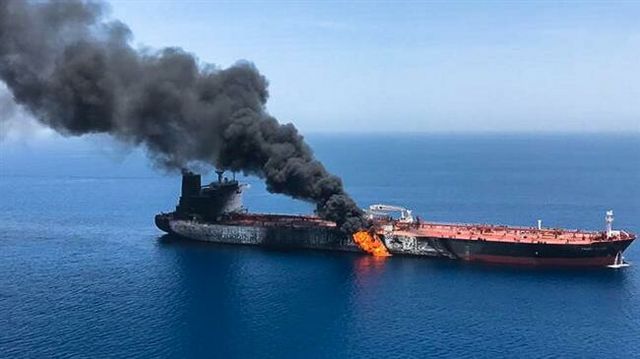
After an hour of each attack Trump’s administration and its Gulf stooge countries; Saudi Arabia and UAE, hastened to point their accusing fingers towards Iran without any evidence and even before any independent investigation of the attacks. Britain joined the US accusation of Iran through its Foreign Secretary; Jeremy Hunt, who accused Iran calling on it to stop all forms of destabilizing activities that pose serious danger to the region. Jeremy Corbyn; the British Labour leader, warned Hunt not to fuel a military escalation that began with the US withdrawal from Iran nuclear deal without any credible evidence. Russia, China, Germany and the EU called for self-restrained and not to rush into conclusions and accusations of any party until the end of investigation.
Although the Gulf of Oman is the most guarded and monitored area by the most sophisticated surveillance equipment yet no strong evidence was produced to substantiate the American accusations. The footage that CENTCOM had produced to incriminate Iranian IRGC of removing an unexploded limpet mine; an alleged evidence of Iran’s involvement, is so blurry that one cannot distinguish whether it was really an Iranian boat or what its crew was doing. It is hard to believe that the sophisticated surveillance system could not produce a clear picture of the boat. Ambiguity is intentional here.
When Yutaka Katada; the president of Kokuka Sangyo, the owner of damaged Kokuka Courageous ship, explained that a mine does not damage a ship above the see level, and that his crew saw “flying objects” hitting the ship, CENTCOM produced other stories to divert attention away from the footage. Originally officials claimed that the USS Bainbridge; a guided missile destroyer, picked up the crew members of the oil tankers. When Iranian TV broadcasted all 44 crew members in its hospitality after rescuing them, American officials changed their story claiming that tanker crew was detained by Iran after first being rescued by “un-named” another vessel.
To gain more credibility to its accusations US officials told CNN that hours before the tankers attack on Thursday the Iranians spotted an American drone flying overhead and launched a surface-to-air missile but missed the drone, which reportedly observed Iranian vessels closing in on the tankers. Yet no video of this allegation was introduced to confirm that these boats had conducted any attack.
These unsubstantiated accusations reminded me of the lies of 1964 Tonkin Gulf incident, the lies of the 2003 Iraq war and the lies of Syrian Assad’s chemical attack against his own people among many other lies. In 1964 President Lyndon Johnson’s administration lied to the Congress that North Vietnamese forces attacked the USS Maddox boat in order to get the Congress authorization to wage war against innocent Vietnam. In 2003 the lies of “weapons of mass destruction” and “the mushroom cloud” lead to the destruction of a whole country; Iraq. In 2017 Assad was accused of using chemical weapons against civilians of his own people when he was winning the war against American/Israeli/Saudi ISIS terrorist groups. The US bombed Syrian bases in response.
The credibility of successive American administrations had long been lost, and their flagrant lies throughout their history had been clearly exposed. Mike Pompeo; the present US Secretary of State, has recently proudly confessed to this fact: “I was the CIA director. We lied … we cheated … we stole. We had entire training courses. It reminds you of the glory of the American experiment.” In this video.
Yet this lying cheating thief had the audacity to face the whole world and to deceptively accuse Iran of attacking the oil tankers:
“It is the assessment by the United States government that the Islamic Republic of Iran is responsible for the attacks that occurred in the Gulf of Oman today. This assessment is based on intelligence, the weapons used, the level of expertise needed to execute the operation, recent similar Iranian attacks on shipping, and the fact that no proxy group operating in the area has the resources and proficiency to act with such a high degree of sophistication.”
The resources proficiency to act with high degree of sophistication Pompeo has mentioned are characteristics of the American and Zionist Israeli underground Special Forces.
The question of “who benefits” will lead us to the real perpetrators. It is highly unlikely and illogical for Iran to attack Japanese owned ships while the Japanese Prime Minister; Shinzo Abe, was visiting Iran in a mediating mission between the US and Iran.
Unlike the western powers it is not a character of the Iranian government to attack the ship; Front Altair, belonging to one of Iran’s closed allies and friend; John Frederiksen, the owner of the Frontline Tanker Company, who helped Iran deliver its oil to its destinations during the “tanker war” with Iraq in the 1980’s.
Iran seeks peace and security in the region, which explains it’s signing the 2015 nuclear agreement accepting the international monitoring of its nuclear facilities unlike nuclear Israel who has not signed the NPT agreement. Also Iran had given European countries ample time to comply with the nuclear deal after the American withdrawal. Peace and security in the Persian Gulf area; the heaviest oil traffic, is very important for Iran. Iran had approached all the Gulf States with a call to sign a non-aggression pact and a partnership to form a local unified security system in the Gulf.
To prove its innocence Iran had called for independent international investigation in the 12th May Al-Fujairah attack against four oil tankers that must include all surveillance records of the area in order to expose the ‘state actor’ behind the attack. Fear of the results of such an investigation led UAE, Saudi Arabia, Britain and US to reject such call demanding the world to accept their accusations of Iran without any substantial evidence.
On the other hand we see Trump unilaterally withdrawing from the Iran nuclear agreement and imposing sanctions threatening the whole world not to buy Iranian oil in order to impose a new agreement; a mafia style technique. Iranian refusal to re-negotiate the deal and it’s brushing off all Trump’s direct and indirect invitation for negotiation gradually dropping off all pre-conditions, led Trump eventually to deploy the USS Abraham Lincoln aircraft carrier strike group to the Persian Gulf to increase the pressure on Iran.
Trump’s administration does not want war with Iran. Such a war would devastate the region as well as the whole world. In the case of a military war every country without exception in the Middle East would be severely affected. All the American military bases in the region would be an easy target for the Iranian missiles. All the American naval ships would also be easy targets to the many Iranian speed torpedo boats. The casualties and the destruction would be astronomical.
The real goal of the Trump’s administration is to increase tension and enmity between Iran and the Gulf States. This policy started in 1979 after the Islamic Revolution in Iran with the expulsion of the Shah regime, the American hostage crises, the closure of the Israeli embassy and turning its building over to the Palestine Liberation Organization (PLO). This enmity developed when the US encouraged Iraqi Saddam Hussein to wage the eight years’ war against Iran with the financial support of the Gulf Arab States.
The spread of Iranophobia within the Gulf Arab oil producing states has become a priority in the American foreign policy since Iran had extended its financial aid and military expertise to Lebanese Hezbollah and Palestinian resistance groups against Israeli occupation, supported Syrian Assad regime against Israeli/American/Saudi created terrorist group ISIS, and supported Yemen against Saudi/Emirati military aggression.
This Iranophobia led the Gulf Sunni Arab States to open their countries to American military bases ostensibly to protect them from Shi’ites Persian threats, such as the alleged nuclear threat. These bases have also served to replenish Israeli weapons stockpiles used in its wars of aggression against Egypt, Lebanon and Palestinians. Saudi Arabia and the UAE are the biggest buyers of American weapons. It is estimated that between 35% – 40% of American weapons sale go to these two Gulf States; many of which had rusted in the desert in the past, others were diverted to terrorist groups in Syria, while others are being used to destroy Yemen. The American military industrial complex rakes hundreds of billions of dollars in weapons sales to these countries.
The oil tankers attack had also relieved Trump from Congressional pressure opposing the $400 billion weapons sale to Saudi Arabia. The sales deal would go through now under the justification of “exceptional security circumstances” in the Gulf.
Those Gulf Arab states are America’s milking cows as Trump had described Saudi Arabia many times. The proposed Iran’s Gulf non-Aggression Pact and Gulf Unified Security System would free these milking cows from the American grip. Thus no war against Iran but false flag attacks in and around the Persian Gulf would serve to increase Iranophobia and keep those milking cows in the American barn.
The US is recently extracting enough shale oil for local consumption. Yet the cost of this shale oil is more expensive than the Gulf oil and it is still not marketable. The attack incidents on the oil tankers have raised the price of oil. The price will go even higher in order to cover the expenses of American naval vessels escorting oil tankers for security reasons. The price of Gulf oil barrel would match and at times may exceed the price of American shale oil barrel. Thus, American shale oil will become marketable.
There is another aggressive player in the region, who could be the perpetrator of false flag attacks besides the US; and that is Zionist Israel. Israeli military hegemony in the region extended from 1948 to 2000; a period were the Israeli terrorist army had accomplished one victory after the other against its poorly armed Arab neighbors. This had changed in 2000 when Hezbollah was able to expel Israeli forces from occupied Lebanese territories.
Prior to 2000 Israel was able to wage wars, whose victims were Arabs, and whose destructions were Arab cities and neighborhoods. The year 2000 ushered a rebirth of strong Arab resistance axis. After 2000 Israel was never able to achieve planned goals of its aggressive wars against Lebanon or even against besieged Gaza, let alone achieve complete victory. Israeli army faced defeats and more casualties than it can afford. Israeli major cities and colonies have become easy targets to accurate and more powerful Gaza’s and Hezbollah’s missiles.
Israel resorted to AIPAC and to 911 false flag attack to push the US to fight its wars against Arabs and to have American young troops die for Israel. After 911 attacks Islamophobia spread in the US, who waged war against Iraq, and created and armed ISIS groups to destroy Syria. Iraq and Syria were strong supporters to the Palestinian cause.
Iranian strong support to Arab resistance axis made it a big obstacle to the Zionist Greater Israel Project. Despite the fact that president Trump and many military officers in the Pentagon are opposed to war on Iran, some Zionist stooges in the White House such as Evangelical Vice President Pence, warmongering John Bolton, and secretary of state Mike Pompeo are pushing for war against Iran. Zionist Israelis as well as American Zionist Christians want a devastating war in the Middle East that would destroy or at least weaken all Arab countries allowing Zionists to accomplish their Greater Israel Project no matter who or what the casualties are.
Zionist Israelis are high suspects in the attacks on the oil tankers. They have “the resources and proficiency to act with such a high degree of sophistication” to quote Pompeo.
The first Al Fujairah false flag attack hardly provoked any mentionable international reactions. The second Gulf of Oman false flag attack provoked some international reaction as well as calls for self-restrain and real investigation. A third false flag attack would be more intense and may take place within the Persian Gulf itself, and could provoke impulsive military reaction that could spark a larger military confrontation, especially now after the US is sending initially 3,000 additional troops as part of 13,000 to the Persian Gulf, while Britain is sending 100 more special forces marines to join their 500 soldier comrades in the new British naval base in Mina Salman in Bahrain.
Dr. Elias Akleh is an Arab American from a Palestinian descent. His family was evicted from Haifa, Palestine, after the 1948 Nakba when the Zionists stole his family’s property. Then the family was evicted again from the West Bank during the 1967 Naksah, after the Zionist, again, occupied the rest of Palestine.

