Showing posts with label Gulf of Oman Incident. Show all posts

Thursday, June 27, 2019

Flaws in US version of tanker narrative exposed by veteran navy officer

Nafeez Ahmed
The administration in Washington is not known to tell the truth, since American officials, whether civilian or military, are raised on preposterous lies, which they continue to utter throughout their careers in the misconstrued belief that they are fooling the world by blaming their opponents.
Here we present you an interesting analytical exposure of the recent sabotage incidents of vessels in the Gulf of Oman for the ‘Insurge Intelligence’ site by its founding editor, investigative journalist Nafeez Ahmed, titled: “Flaws in US Version of Tanker Narrative Exposed by Veteran Navy Officer”.
The Trump administration has released a range of photographic and video footage of its allegation that Iran attacked a Japanese-owned oil tanker near the Strait of Hormuz, but a Canadian military analyst and former Navy officer for nearly twenty years has called the footage into question, highlighting unresolved anomalies in the US version of events. His reservations are backed by Japanese government sources.
A number of other actors — the US, Saudi Arabia, the UAE and Israel — as well as other extremist groups, have been flagged as potential culprits in the attacks that Donald Trump administration views as a new plan for ‘American Energy Dominance’.
The US government, citing the statement of a so-called explosives expert of the American navy, claims that its grainy video, including supposed fragments of an exploded weapon and a magnet from an unexploded device, indicates that limpet mines were attached to the side of the oil tankers, and that Iran possess these mines.  
This claim, however, is challenged by the analysis of a veteran navy officer. According to Dr. Gwynne Dyer who has served as a Reserve Naval Officer in the Canadian Naval Reserve, US Naval Reserve, and British Navy Reserve for a total of 17 years, the alleged US intelligence about the recent incidents in the Gulf of Oman does not add up.
He calls the US claim incoherent and unconvincing. His analysis coheres with that of the private US intelligence firm Stratfor, which notes of the spate of recent attacks that while Iran would have reason to control movement of vessels around its territory “to send a message of resolve in the face of Washington’s economic and military pressure, on second thought, it doesn’t make strategic sense for Iran to target Japanese or European vessels at a time when it is seeking to retain the EU’s political and economic support.”
The intelligence firm Strafor suggests that culprits might include al-Qaeda, and other regional radical outfits that have a similar modus operandi of targeting oil tankers.
Writing in a local Canadian newspaper, Dr. Dyer — who has taught military history and war studies at the Canadian Forces College in Toronto and the British Military Academy in Sandhurst — observed that as limpet mines “cling to ships’ hulls by magnetic force but have to be placed by hand. This means they were probably placed while the ships were in port”, because it is: “almost impossible to place a limpet mine once a ship is underway, since other boats cannot come close enough without being spotted, and swimmers (including scuba divers) cannot keep up.”
This analysis contradicts the explanation initially put forward in a joint statement by the UAE, Norway, and Saudi Arabia at a UN briefing, alleging that limpet mines were placed by divers deployed by speed boats.
All six tankers that have been attacked sailed from ports in Saudi Arabia or the UAE.
According to Dr. Dyer, given the implausibility of the mines being deployed as suggested by the UAE, Norway and Saudi Arabia, this suggests that the mines would have been planted on the tankers before departure. But this raises other questions.
In Dr. Dyer’s words: “So, is security in Saudi and UAE ports so lax, even after the first attacks in May, that foreign agents can plant limpet mines on tankers before they sail?”
US officials, in an apparent botched effort to cover-up their complicity, have released a grainy aerial video of a supposed small Iranian boat at one of the tankers Guards allegedly removing an unexploded limpet mine.
But this too makes little sense for Dyer, who says: “Limpet mines are generally fitted with ‘anti-handling devices’ (i.e. they explode when you try to remove them), and yet everybody on that boat crowded onto the bow as if to get as close to the explosion as possible.”
Dyer raises the possibility that the mines could have been planted surreptitiously by Saudi Arabia or the UAE in order to generate a justification for a long-desired war on Iran. He mentions the potential role of Israel but argues that the former would be unlikely to consent to their regional dabbling.
According to him: “The leading candidates are Saudi Arabia and the United Arab Emirates, the two Arab countries that are doing their best to push the United States into a war against Iran on their behalf. Benjamin Netanyahu would also love to see the US attack Iran, but one doubts that Israel’s de facto Arab allies would want special Zionist forces operating openly on their territory.”
Japanese government officials, however, appear to be even less convinced of the US position. A senior Japanese government official told the daily ‘Japan Today’. “The US explanation has not helped us go beyond speculation.”
The newspaper quoted a government source close to Prime Minister Shinzo Abe who responded to US Secretary of State Mike Pompeo’s claim that the US assessment was based on intelligence, the weapons used, the level of expertise needed to execute the operation, and the fact that no group operating in the area has the resources and proficiency to act with such a high degree of sophistication.
The Japanese source close to the prime minister commented: “These are not definite proof that it’s Iran. Even if it’s the United States that makes the assertion, we cannot simply say we believe it.”
A separate government source at the Japanese Foreign Ministry went further, suggesting that Pompeo’s own criteria of sophisticated expertise sufficient to conduct the attack might implicate both the US and Israel, He said: “That would apply to the United States and Israel as well.”
US National Security Advisor, John Bolton, who is notorious for his anti-Iran views, claimed that he had advanced warning of the attacks, claiming that the US intelligence on Iran’s alleged role in earlier attacks on oil tankers in May came from the Israeli intelligence agency Mossad.
Zionist sources, in league with the warmongering Bolton, claim that Mossad had tipped off the United States on an impending Iranian attack on American interests in the Persian Gulf, prompting Washington to deploy an aircraft carrier strike group to the region, in a sharp escalation of US President Donald Trump’s pressure campaign.
These doubtful sources further claim that Israeli officials conveyed information gathered by Mossad on an alleged Iranian plan to attack either a US or US-allied target.
The alleged intelligence was reportedly passed on by Israeli National Security Advisor Meir Ben Shabbat to his counterpart, John Bolton, in April — a month prior to the May attacks on four oil tankers off the coast of Fujairah.
According to Bolton himself, the meeting with Ben Shabbat covered “our shared commitment to countering Iranian activity & other actors in West Asia & around the world.”
According to independent observers, these claims of having advanced information, do not implicate Iran in the oil tanker blasts, but point to the plans of both the US and its surrogate, the Zionist regime, to carry out such acts of sabotage as false flag operations, in a bid to lay the blame on the Islamic Republic.
The conclusions of the US-Israel intelligence coordination, as claimed by the joint John Bolton-Ben Shabbat statement, even after the Fujairah tanker attacks, does not seem to match British intelligence assessments that Iran does not pose a threat.
At a recent Pentagon press conference, a senior British military official, Major General Chris Ghika — a deputy commander of Operation Inherent Resolve, the coalition conducting operations against Daesh in Iraq and Syria — contradicted the US position when he remarked that “No — there’s been no threat from Iranian-backed forces” in the region. “We monitor them along with a whole range of others because that’s the environment we’re in.”
So, in view of these fact, who really wants a war?
The answer is obvious. It is not Iran, but subversive elements who have disturbed peace of the region, such as Saudi Arabia, the UAE, and Israel, who are pressuring the US for war. 
Military analyst Gwynne Dyer suggests that Iran has the capability to easily shut down the Strait of Hormuz, if the need arises, and in such a case, the transport of a significant portion of the world’s oil supplies would be stopped, triggering catastrophic price hikes and the collapse of major Western economies.
The Islamic Republic of Iran has clearly said that it neither carry out the tanker blasts, nor does it want war, but, if attacked, it will resolutely defend itself and make the aggressor pay dearly for its blunder.
Dr. Dyer points out that while President Donald Trump’s intentions are unclear, Secretary of State Mike Pompeo and National Security Adviser John Bolton “probably do want a war with Iran. They would never say that, but they spin every bit of data in as anti-Iran a direction as possible. That includes, of course, their analysis of who is behind these attacks.”
During Bolton’s previous tenure in the US government, evidence emerged that the Bush administration had attempted to fabricate an incident which could be used to justify a long-planned military strike on Iran
According to a former senior US intelligence official, a meeting in the office of the then US Vice-President Dick Cheney in 2005 occurred a few weeks after five Iranian patrol boats approached three US Navy warships in the Strait of Hormuz.
Press reports described Iranian ship-to-ship radio transmissions threatening to “explode” the warships, but within a week, an internal Pentagon inquiry concluded that there was no evidence that the Iranian boats were the source of the transmissions, and that they originated from a prankster long known for sending fake messages in the region. Regarding the meeting with Cheney, the former US official said that: The subject was how to create a casus belli between Tehran and Washington.”
The story of the latest incident is further complicated by the testimony of the Japanese owner of the tanker, who said that sailors on board the ship had seen something flying toward it just before the explosion above the waterline.
Yutaka Katada, president of Kokaku Sangyo Company said at a press conference in Tokyo: “We received reports that something flew towards the ship. The place where the projectile landed was significantly higher than the water level, so we are absolutely sure that this wasn’t a torpedo. I do not think there was a time bomb or an object attached to the side of the ship.”
These eyewitness accounts expose the lies of Trump and team to implicate Iran in tanker blasts,
US hostility toward Iran comes in the context of the escalation of the Trump administration’s plan for “American Energy Dominance”.
In May, the White House issued a triumphant statement on Trump’s efforts to “open up new export opportunities for American energy producers, saying: “We are exporting more and more energy as production soars and President Trump negotiates better market access for our producers.”
The White House statement also trumpeted the government’s success in rolling back environmental regulations and climate change commitments.
While oil exports have nearly doubled, and US liquid natural gas (LNG) exports have increased by 272 percent, they are nowhere near where the US administration wants them to be.
In the New York Times late last year, Bethany McLean — who famously reported on the Enron scandal — warned that the shale boom driving Trump’s export ambitions could be about to grind to a halt as the industry’s mounting debts, declining profits and dwindling production rates come home to roost.
US shale is still expensive and over the last decade Iran had successfully captured much of America’s hoped for export market despite sanctions. Iran is a major oil and gas supplier to China, India, Korea and Turkey. It also supplies European markets, namely Italy, Spain, France and Greece, along with Japan and the UAE. Asian buyers in particular have explored the possibility of purchasing Iranian oil in currencies other than the dollar to bypass US sanctions.
Iran is thus a major geopolitical competitor to the Trump administration’s export plans, as well as to the role of the dollar as the de facto reserve currency for the global oil trade. The Trump administration has made no secret of its ambition to take Iranian oil exports down to zero with a view to undermine Iran’s economy, and the sabotage of oil tankers in the Gulf of Oman are part of this American strategy.

Thursday, June 20, 2019

Japanese and German Doubts on U.S. Drumbeat Towards Iran War

by 

Photograph Source: Official U.S. Navy Page – Public Domain
Japan since 1945 has been the most abjectly deferential of U.S. allies, even more so than the U.K. Tokyo rarely strays far from Washington’s line on any global issue. It notoriously supported the Iraq wars if 1991 and 2003-present, both based on lies. Japan’s loyalty, like Britain’s, is strategic; while all alliances with the U.S. are promoted as based on “common values” they are mainly based on capital and global capitalists’ needs. Both the U.K. and Japan are for the time being part of the U.S. imperialist camp, under strong pressure to side with it when it decides to provoke war.
When George W. Bush turned to Tony Blair’s Britain and asked for support for a war on Iraq, Blair became Bush’s poodle. The slavish cooperation with the U.S. in that disastrous, criminal war remains a matter of national shame. Germany and France avoided that by noting that the U.S.’s case was weak if not based on fabrications. They showed it is possible for major allies to defy the U.S., (although recall how enraged members of Congress were at France’s betrayal).
Last week two tankers were attacked in the Gulf of Oman and the U.S. immediately blamed Iran. Almost immediately British Foreign Secretary Jeremy Hunt declared: “We are going to make our own independent assessment, we have our processes to do that, (but) we have no reason not to believe the American assessment and our instinct is to believe it because they are our closest ally.”
The German foreign minister Heiko Maas on the other hand, responding to U.S. “evidence,” stated blandly, “The video is not enough. We can understand what is being shown, sure, but to make a final assessment, this is not enough for me.” Maas visited Tehran last week to try to mediate between the U.S. (which wants conflict with Iran) and Iran (which wants to avoid conflict).
Meanwhile Japan (the world’s third largest economic power, just ahead of Germany) also doubts the U.S. accusations against Iran, designed to justify war. Prime Minister Abe Shinzo was in Iran holding talks with top leaders when a Japanese-owned tanker bound for Singapore was attacked by what the U.S. claims was an Iranian attack.
“The U.S. explanation has not helped us go beyond speculation,” says one senior government official, while an Abe aide says, “These are not definite proof that it’s Iran. Even if it’s the United States that makes the assertion, we cannot simply say we believe it.”
Apparently the Japanese around Abe lack the British instinct to swallow U.S. bullshit. Worse, they are asking uncomfortable questions. The anonymous Foreign Ministry source notes that while U.S. Secretary of State Mike Pompeo claims that “only Iran” had the capability to conduct the tanker attacks, this is simply not true. “That would apply to the United States and Israel as well,” says the rational skeptic.
Yes, people in the Japanese foreign Ministry are suggesting that the U.S. or Israel might have staged “false flag” attacks to justify a military attack on Iran. It’s good that they’re wondering.
Japan has every reason to seek cordial relations with a fellow Asian nation it has traded with since the eighth century. Japan has been one of Iran’s largest oil customers. The U.S. command that Japan end all trade with Iran offends national dignity. Worse, the U.S. effort to sabotage the Iran Deal and assert what the Chinese call “long arm jurisdiction” tramples on nations’ sovereignty. And the expectation that all nations accept U.S. conclusions about its foes’ actions (the Syrian government’s alleged use of sarin gas, the Libyan government’s supposed genocidal intentions) is insufferably arrogant.
The world is tired of U.S. lies. They did not start with Donald Trump, a pathological liar who may genuinely believe—in the moment—that his father was born in Germany, or that Obama was born in Kenya. The U.S. has been losing credibility for many years, while the crimes attending its wars-based-on-lies have spread fear and hatred of this country.
Awhile back National Security Advisor John Bolton had a plan to overthrow the democratically elected , internationally recognized government of Venzuela. He announced U.S. recognition of a pretender, and secured European support for him; this was routine procedure, whipping the allies into compliance. It was announced that “the international community” was backing the U.S. puppet. But this imagined “community” excluded China, Russia, India and most countries. There was some saber-rattling, but the crisis has apparently passed.
Perhaps annoyed at this failure, Bolton turned his attention to Iran, arranging for Trump to declare an “emergency” (ostensibly due to some Iranian moves, but really to allow for delivery of arms without Congressional oversight to Saudi Arabia). Having declared that bogus emergency, he has arranged a bogus crisis involving alleged, possibly staged attacks on tankers off Iran. Britain’s Conservatives are saying, fine, we’re on board. But the Germans and Japanese are balking.
Recall that Germany and Japan were the U.S.’s two main antagonists in the Second World War. Their defeat resulted in occupation and obligatory alliance with the occupying power. There are today 56,000 U.S. troops in Japan and 35,000 in Germany; these are the largest deployments outside the U.S. Pompeo and Bolton want these nations to fall in line with their policy of toppling the Iranian regime and transforming Iran into a bastion of U.S. and Israeli influence in a refashioned Middle East dominated by the Saudi-Israeli anti-Shiite alliance.
The neocons’ dreams of a U.S.-dominated Middle East are just that—fantasies. They fantasized in 2011 that they could pull together pro-U.S. forces in Syria to topple the corrupt regime. They were unable to recruit anyone. They fantasized that the vicious toppling of Gadhafy in Libya would bring pro-U.S. forces to power in Libya that same year. But Libya remains in chaos. There is no respect in the world for U.S. “leadership” in any issue pertaining to the Middle East.
Instead, the U.S. is associated with lies; calculated, dishonest manipulation of information to condition public opinion; massive, intrusive global surveillance and violation of billions of persons’ privacy; persecution of whistle-blowers who reveal its war crimes, record of prison torture, and systemic political corruption. So when these war mongers ask the world to join them in condemning Iranian attacks in the Gulf of Oman, the world necessarily responds: “Wait…we don’t believe you any more… You’ve cried ‘wolf’ too many times…”
In Japanese, there’s no exact equivalent to saying “Fuck you!” This is due, I think, to the fact that in Japanese culture fucking is an unequivocal good, and so to wish it on somebody would be to pronounce a benediction (“may you be fucked!”). It doesn’t make sense as an insult. The closest equivalent is “Shine!” which means “Die!”
Thus for the Japanese to say “Fuck you” to Pompeo, Bolton, and Trump would be to say “Shine! Death to U.S. imperialism!” which is exactly what they and the Germans and we and everybody else should be saying.
Gary Leupp is Professor of History at Tufts University, and holds a secondary appointment in the Department of Religion. He is the author of Servants, Shophands and Laborers in in the Cities of Tokugawa JapanMale Colors: The Construction of Homosexuality in Tokugawa Japan; and Interracial Intimacy in Japan: Western Men and Japanese Women, 1543-1900. He is a contributor to Hopeless: Barack Obama and the Politics of Illusion, (AK Press).

The War of Oil Tankers

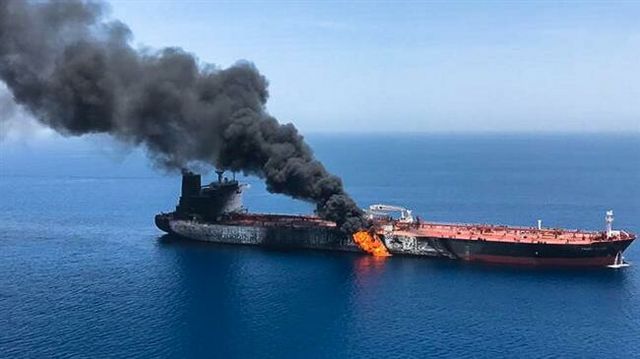
Fire and smoke billowing from Norwegian-owned Front Altair tanker said to have been attacked in the waters of the Sea of Oman on June 13, 2019 [Credit: ISNA]
The economic war waged by Trump’s administration against Iran seems to have been escalated to involve false flag attacks against oil tankers in the Gulf of Oman at the mouth of the Strait of Hormuz. Within a one-month period two terrorist attacks; Emirati Al Fujairah attack in May 12th and the Gulf of Oman attack in June 13th, were perpetrated against large oil tankers.
After an hour of each attack Trump’s administration and its Gulf stooge countries; Saudi Arabia and UAE, hastened to point their accusing fingers towards Iran without any evidence and even before any independent investigation of the attacks. Britain joined the US accusation of Iran through its Foreign Secretary; Jeremy Hunt, who accused Iran calling on it to stop all forms of destabilizing activities that pose serious danger to the region.  Jeremy Corbyn; the British Labour leader, warned Hunt not to fuel a military escalation that began with the US withdrawal from Iran nuclear deal without any credible evidence. Russia, China, Germany and the EU called for self-restrained and not to rush into conclusions and accusations of any party until the end of investigation.
Although the Gulf of Oman is the most guarded and monitored area by the most sophisticated surveillance equipment yet no strong evidence was produced to substantiate the American accusations. The footage that CENTCOM had produced to incriminate Iranian IRGC of removing an unexploded limpet mine; an alleged evidence of Iran’s involvement, is so blurry that one cannot distinguish whether it was really an Iranian boat or what its crew was doing. It is hard to believe that the sophisticated surveillance system could not produce a clear picture of the boat. Ambiguity is intentional here.
When Yutaka Katada; the president of Kokuka Sangyo, the owner of damaged Kokuka Courageous ship, explained that a mine does not damage a ship above the see level, and that his crew saw “flying objects” hitting the ship, CENTCOM produced other stories to divert attention away from the footage. Originally officials claimed that the USS Bainbridge; a guided missile destroyer, picked up the crew members of the oil tankers. When Iranian TV broadcasted all 44 crew members in its hospitality after rescuing them, American officials changed their story claiming that tanker crew was detained by Iran after first being rescued by “un-named” another vessel.
To gain more credibility to its accusations US officials told CNN that hours before the tankers attack on Thursday the Iranians spotted an American drone flying overhead and launched a surface-to-air missile but missed the drone, which reportedly observed Iranian vessels closing in on the tankers. Yet no video of this allegation was introduced to confirm that these boats had conducted any attack.
These unsubstantiated accusations reminded me of the lies of 1964 Tonkin Gulf incident, the lies of the 2003 Iraq war and the lies of Syrian Assad’s chemical attack against his own people among many other lies. In 1964 President Lyndon Johnson’s administration lied to the Congress that North Vietnamese forces attacked the USS Maddox boat in order to get the Congress authorization to wage war against innocent Vietnam. In 2003 the lies of “weapons of mass destruction” and “the mushroom cloud” lead to the destruction of a whole country; Iraq. In 2017 Assad was accused of using chemical weapons against civilians of his own people when he was winning the war against American/Israeli/Saudi ISIS terrorist groups. The US bombed Syrian bases in response.
The credibility of successive American administrations had long been lost, and their flagrant lies throughout their history had been clearly exposed. Mike Pompeo; the present US Secretary of State, has recently proudly confessed to this fact: “I was the CIA director. We lied … we cheated … we stole. We had entire training courses. It reminds you of the glory of the American experiment.” In this video.
Yet this lying cheating thief had the audacity to face the whole world and to deceptively accuse Iran of attacking the oil tankers:
“It is the assessment by the United States government that the Islamic Republic of Iran is responsible for the attacks that occurred in the Gulf of Oman today. This assessment is based on intelligence, the weapons used, the level of expertise needed to execute the operation, recent similar Iranian attacks on shipping, and the fact that no proxy group operating in the area has the resources and proficiency to act with such a high degree of sophistication.”
The resources proficiency to act with high degree of sophistication Pompeo has mentioned are characteristics of the American and Zionist Israeli underground Special Forces.
The question of “who benefits” will lead us to the real perpetrators. It is highly unlikely and illogical for Iran to attack Japanese owned ships while the Japanese Prime Minister; Shinzo Abe, was visiting Iran in a mediating mission between the US and Iran.
Unlike the western powers it is not a character of the Iranian government to attack the ship; Front Altair, belonging to one of Iran’s closed allies and friend; John Frederiksen, the owner of the Frontline Tanker Company, who helped Iran deliver its oil to its destinations during the “tanker war” with Iraq in the 1980’s.
Iran seeks peace and security in the region, which explains it’s signing the 2015 nuclear agreement accepting the international monitoring of its nuclear facilities unlike nuclear Israel who has not signed the NPT agreement. Also Iran had given European countries ample time to comply with the nuclear deal after the American withdrawal. Peace and security in the Persian Gulf area; the heaviest oil traffic, is very important for Iran. Iran had approached all the Gulf States with a call to sign a non-aggression pact and a partnership to form a local unified security system in the Gulf.
To prove its innocence Iran had called for independent international investigation in the 12th May Al-Fujairah attack against four oil tankers that must include all surveillance records of the area in order to expose the ‘state actor’ behind the attack. Fear of the results of such an investigation led UAE, Saudi Arabia, Britain and US to reject such call demanding the world to accept their accusations of Iran without any substantial evidence.
On the other hand we see Trump unilaterally withdrawing from the Iran nuclear agreement and imposing sanctions threatening the whole world not to buy Iranian oil in order to impose a new agreement; a mafia style technique. Iranian refusal to re-negotiate the deal and it’s brushing off all Trump’s direct and indirect invitation for negotiation gradually dropping off all pre-conditions, led Trump eventually to deploy the USS Abraham Lincoln aircraft carrier strike group to the Persian Gulf to increase the pressure on Iran.
Trump’s administration does not want war with Iran. Such a war would devastate the region as well as the whole world. In the case of a military war every country without exception in the Middle East would be severely affected. All the American military bases in the region would be an easy target for the Iranian missiles. All the American naval ships would also be easy targets to the many Iranian speed torpedo boats. The casualties and the destruction would be astronomical.
The real goal of the Trump’s administration is to increase tension and enmity between Iran and the Gulf States. This policy started in 1979 after the Islamic Revolution in Iran with the expulsion of the Shah regime, the American hostage crises, the closure of the Israeli embassy and turning its building over to the Palestine Liberation Organization (PLO). This enmity developed when the US encouraged Iraqi Saddam Hussein to wage the eight years’ war against Iran with the financial support of the Gulf Arab States.
The spread of Iranophobia within the Gulf Arab oil producing states has become a priority in the American foreign policy since Iran had extended its financial aid and military expertise to Lebanese Hezbollah and Palestinian resistance groups against Israeli occupation, supported Syrian Assad regime against Israeli/American/Saudi created terrorist group ISIS, and supported Yemen against Saudi/Emirati military aggression.
This Iranophobia led the Gulf Sunni Arab States to open their countries to American military bases ostensibly to protect them from Shi’ites Persian threats, such as the alleged nuclear threat. These bases have also served to replenish Israeli weapons stockpiles used in its wars of aggression against Egypt, Lebanon and Palestinians. Saudi Arabia and the UAE are the biggest buyers of American weapons. It is estimated that between 35% – 40% of American weapons sale go to these two Gulf States; many of which had rusted in the desert in the past, others were diverted to terrorist groups in Syria, while others are being used to destroy Yemen. The American military industrial complex rakes hundreds of billions of dollars in weapons sales to these countries.
The oil tankers attack had also relieved Trump from Congressional pressure opposing the $400 billion weapons sale to Saudi Arabia. The sales deal would go through now under the justification of “exceptional security circumstances” in the Gulf.
Those Gulf Arab states are America’s milking cows as Trump had described Saudi Arabia many times. The proposed Iran’s Gulf non-Aggression Pact and Gulf Unified Security System would free these milking cows from the American grip. Thus no war against Iran but false flag attacks in and around the Persian Gulf would serve to increase Iranophobia and keep those milking cows in the American barn.
The US is recently extracting enough shale oil for local consumption. Yet the cost of this shale oil is more expensive than the Gulf oil and it is still not marketable. The attack incidents on the oil tankers have raised the price of oil. The price will go even higher in order to cover the expenses of American naval vessels escorting oil tankers for security reasons.   The price of Gulf oil barrel would match and at times may exceed the price of American shale oil barrel. Thus, American shale oil will become marketable.
There is another aggressive player in the region, who could be the perpetrator of false flag attacks besides the US; and that is Zionist Israel. Israeli military hegemony in the region extended from 1948 to 2000; a period were the Israeli terrorist army had accomplished one victory after the other against its poorly armed Arab neighbors. This had changed in 2000 when Hezbollah was able to expel Israeli forces from occupied Lebanese territories.
Prior to 2000 Israel was able to wage wars, whose victims were Arabs, and whose destructions were Arab cities and neighborhoods. The year 2000 ushered a rebirth of strong Arab resistance axis. After 2000 Israel was never able to achieve planned goals of its aggressive wars against Lebanon or even against besieged Gaza, let alone achieve complete victory. Israeli army faced defeats and more casualties than it can afford. Israeli major cities and colonies have become easy targets to accurate and more powerful Gaza’s and Hezbollah’s missiles.
Israel resorted to AIPAC and to 911 false flag attack to push the US to fight its wars against Arabs and to have American young troops die for Israel. After 911 attacks Islamophobia spread in the US, who waged war against Iraq, and created and armed ISIS groups to destroy Syria. Iraq and Syria were strong supporters to the Palestinian cause.
Iranian strong support to Arab resistance axis made it a big obstacle to the Zionist Greater Israel Project. Despite the fact that president Trump and many military officers in the Pentagon are opposed to war on Iran, some Zionist stooges in the White House such as Evangelical Vice President Pence, warmongering John Bolton, and secretary of state Mike Pompeo are pushing for war against Iran. Zionist Israelis as well as American Zionist Christians want a devastating war in the Middle East that would destroy or at least weaken all Arab countries allowing Zionists to accomplish their Greater Israel Project no matter who or what the casualties are.
Zionist Israelis are high suspects in the attacks on the oil tankers. They have “the resources and proficiency to act with such a high degree of sophistication” to quote Pompeo.
The first Al Fujairah false flag attack hardly provoked any mentionable international reactions. The second Gulf of Oman false flag attack provoked some international reaction as well as calls for self-restrain and real investigation. A third false flag attack would be more intense and may take place within the Persian Gulf itself, and could provoke impulsive military reaction that could spark a larger military confrontation, especially now after the US is sending initially 3,000 additional troops as part of 13,000 to the Persian Gulf, while Britain is sending 100 more special forces marines to join their 500 soldier comrades in the new British naval base in Mina Salman in Bahrain.
Dr. Elias Akleh is an Arab American from a Palestinian descent. His family was evicted from Haifa, Palestine, after the 1948 Nakba when the Zionists stole his family’s property. Then the family was evicted again from the West Bank during the 1967 Naksah, after the Zionist, again, occupied the rest of Palestine.

Tuesday, June 18, 2019

Seven Reasons to Doubt US Version of Gulf of Oman Incident

Secretary Pompeo Delivers Remarks to the Media f2873
In a move that surprised exactly zero people, Secretary of State Mike Pompeo has wasted no time scrambling to blame Iran for damage done to two sea vessels in the Gulf of Oman on Thursday, citing exactly zero evidence.
“This assessment is based on intelligence, the weapons used, the level of expertise needed to execute the operation, recent similar Iranian attacks on shipping, and the fact that no proxy group operating in the area has the resources and proficiency to act with such a high-degree of sophistication,” Pompeo told the press in a statement.
“The United States will defend its forces, interests, and stand with our partners and allies to safeguard global commerce and regional stability. And we call upon all nations threatened by Iran’s provocative acts to join us in that endeavor,” Pompeo concluded before hastily shambling off, taking exactly zero questions.
Here are seven reasons to be extremely skeptical of everything Pompeo said:
No. 1: Pompeo is a known liar, especially when it comes to Iran.

No. 2: The US empire is known to use lies and false flags to start wars.
Pompeo has a well-established history of circulating blatant lies about Iran. He recently told an audience at Texas A&M University that when he was leading the CIA, “We lied, we cheated, we stole. We had entire training courses.”
The U.S.-centralized power alliance has an extensive and well-documented history of advancing preexisting military agendas using lies, false flags and psyops to make targeted governments appear to be the aggressors. This is such a well-established pattern that “Gulf of Tonkin” briefly trended on Twitter after the Gulf of Oman incident. Any number of government agencies could have been involved from any number of the nations in this alliance, including the U.S., the U.K., Saudi Arabia, the UAE or Israel.
No. 3: John Bolton has openly endorsed lying to advance military agendas.
wrote an article about this last month because the Trump administration had already begun rapidly escalating against Iran in ways that happen to align perfectly with the longtime agendas of Trump’s psychopathic Iran hawk National security adviser. At that time people were so aware of the possibility that Bolton might involve himself in staging yet another Middle Eastern war based on lies that The Onion was already spoofing it.
On a December 2010 episode of Fox News’ “Freedom Watch,” Bolton and the show’s host Andrew Napolitano were debating about recent WikiLeaks publications, and naturally the subject of government secrecy came up.
“Now I want to make the case for secrecy in government when it comes to the conduct of national security affairs, and possibly for deception where that’s appropriate,” Bolton said. “You know Winston Churchill said during World War Two that in wartime truth is so important it should be surrounded by a bodyguard of lies.”
“Do you really believe that?” asked an incredulous Napolitano.
“Absolutely,” Bolton replied.
“You would lie in order to preserve the truth?”
“If I had to say something I knew was false to protect American national security, I would do it,” Bolton answered.
This would be the same John Bolton who has been paid exorbitant speaking fees by the pro-regime change MEK terror cult, promising the cult in a 2017 speech that they’d be celebrating regime change in Tehran together before 2019. This would also be the same John Bolton who once threatened to murder an OPCW official’s children if he didn’t stop getting in the way of his Iraq war agenda.
No. 4: Using false flags to start a war with Iran is already an established idea in the DC swamp.
Back in 2012 at a forum for the Washington Institute of Near East Policy think tank, the group’s Director of Research Patrick Clawson openly talked about the possibility of using a false flag to provoke a war with Iran, citing the various ways the U.S. has done exactly that with its previous wars.
“I frankly think that crisis initiation is really tough, and it’s very hard for me to see how the United States president can get us to war with Iran,” Clawson began.
“Which leads me to conclude that if in fact compromise is not coming, that the traditional way that America gets to war is what would be best for U.S. interests,” Clawson added. “Some people might think that Mr. Roosevelt wanted to get us into the war… you may recall we had to wait for Pearl Harbor. Some people might think that Mr. Wilson wanted to get us into World War One; you may recall we had to wait for the Lusitania episode. Some people might think that Mr. Johnson wanted to get us into Vietnam; you may recall we had to wait for the Gulf of Tonkin episode. We didn’t go to war with Spain until the USS Maine exploded. And may I point out that Mr. Lincoln did not feel that he could call out the Army until Fort Sumter was attacked, which is why he ordered the commander at Fort Sumter to do exactly that thing which the South Carolinians said would cause an attack.”
“So if, in fact, the Iranians aren’t going to compromise, it would be best if somebody else started the war,” Clawson continued. “One can combine other means of pressure with sanctions. I mentioned that explosion on August 17th. We could step up the pressure. I mean look people, Iranian submarines periodically go down. Some day, one of them might not come up. Who would know why? [Smattering of sociopathic laughter from the crowd.] We can do a variety of things, if we wish to increase the pressure (I’m not advocating that) but I’m just suggesting that this is not an either/or proposition  —  just sanctions have to succeed or other things. We are in the game of using covert means against the Iranians. We could get nastier at that.”
No. 5: The US State Department has already been running psyops to manipulate the public Iran narrative.
State Department officials admitted to congressional staff at a closed-door meeting on Monday that a $1.5 million troll farm had gone “beyond the scope of its mandate” by aggressively smearing American critics of the Trump administration’s Iran policy as propagandists for the Iranian government, according to a new report from The Independent. That “mandate” had reportedly consisted of “countering propaganda from Iran,” also known as conducting anti-Iran propaganda.
“Critics in Washington have gone further, saying that the programme resembled the type of troll farms used by autocratic regimes abroad,” says The Independent.
“One woman behind the harassment campaign, a longtime Iranian-American activist, has received hundreds of thousands of dollars from the State Department over the years to promote ‘freedom of expression and free access to information,’” the report reads.
No. 6: The Gulf of Oman narrative makes no sense.
One of the ships damaged in the attacks was Japanese-owned, and the other was bound for Japan. This happened just as Japanese Prime Minister Shinzo Abe was in Tehran attempting to negotiate a de-escalation between the U.S. and Iran with Trump’s blessing, and just after Iran had released a prisoneraccused of conducting espionage for the U.S. in what many took to be a gesture of good faith.
Iran has been conducting itself with remarkable restraint in the face of relentless sanctions and provocations from the U.S. and its allies. It wouldn’t make much sense for it to suddenly abandon that restraint with attacks on sea vessels, then rescue their crew, then deny perpetrating the attacks, during a time of diplomatic exchanges and while trying to preserve the nuclear deal with Europe. If Tehran did perpetrate the attacks in order to send a strong message to the Americans, it would have been a very mixed message sent in a very weird way with very odd timing.
No. 7: Even if Iran did perpetrate the attack, Pompeo would still be lying.
Pompeo’s statement uses the words “unprovoked” twice and “Iran’s provocative acts” once, explicitly claiming that the U.S. empire was just minding its own business leaving Iran alone when it was attacked out of the blue by a violent aggressor. Sometimes the things put out by the U.S. State Department feel like they’re conducting experiments on us, just to test the limits of our stupidity.
As noted in this article by Moon of Alabama and this discussion on the Ron Paul Liberty Report, the U.S. has been provoking Iran with extremely aggressive and steadily tightening sanctions, which means that even if Tehran is behind the attacks, it would not be the aggressor and the attacks would most certainly not have been “unprovoked.” Economic sanctions are an act of war; if China were to do to America’s economy what America is doing to Iran’s, the U.S. would be in a hot war with China immediately. It could technically be possible that Iran is pushing back on U.S. aggressions and provocations, albeit in a strange and neoconservatively convenient fashion.
Either way, we have seen exactly zero evidence supporting Pompeo’s claims, so anyone you see hastening to blame Iran for the Gulf of Oman incident is either a war whore or a slobbering moron, or both. Knowing what we know about the U.S.-centralized empire and its pre-existing regime change agenda against Iran, there is no reason to believe Pompeo and many reasons not to.
*(Top image: U.S. Secretary of State Michael R. Pompeo deliver remarks to the media in the press briefing room at the U.S. Department of State in Washington, D.C., on June 13, 2019. Image credit: U.S. Department of State/ flickr)
_______________
Rogue journalist. Bogan socialist. Anarcho-psychonaut. Guerilla poet. Utopia prepper.____________