Showing posts with label Mohammed bin Salman (MbS). Show all posts

Thursday, October 24, 2019

Trump On Going To War With Iran: ‘We May Have To’

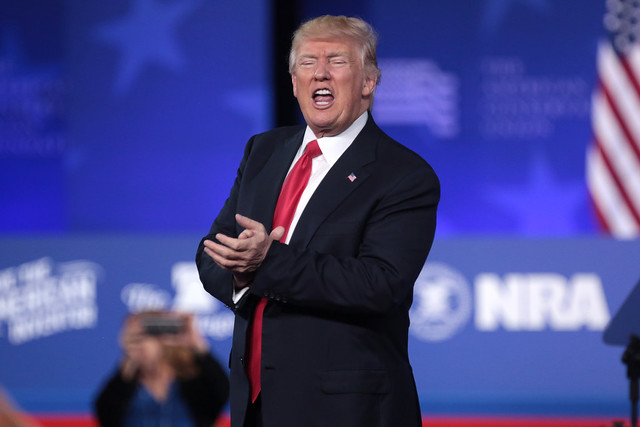
Donald Trump addresses the NRA (Gage Skidmore via Flickr)
By Ben Armbruster
President Trump said this week that he may have to start a new war, specifically singling out Iran.
“I’m trying to get out of wars. But we may have to get in wars, too. OK? We may have to get in wars,” he said. “We’re better prepared than we’ve ever been. If Iran does something, they’ll be hit like they’ve never been hit before. I mean, we have things that we’re looking at.”
Last year, Jim Lobe noted on this website a troublesome line of thinking from  Trump’s past: using war to distract the masses. Indeed, Lobe identified at least six times between late 2011 and early 2013 that Trump predicted via Twitter that President Obama was going to attack Iran as a way of diverting attention from his domestic political misfortunes.
Given his impending impeachment, is Trump signaling that he’s prepared to test this particular theory?
See Lobe’s full piece below:

MIGHT A BELEAGUERED TRUMP GO TO WAR…AGAINST IRAN?

by Jim Lobe
Let’s assume for a minute—and it’s a perfectly reasonable assumption under the circumstances—that President Trump’s political problems and popularity only get worse over the next months, both before and after the elections. What with anonymous “senior officials,” new revelations from “crazytown” provoked by Bob Woodward’s latest book, new indictments and/or plea bargains flowing out of the Mueller investigation, let alone little to no likelihood of a real breakthrough on North Korea or anywhere else., it’s difficult to see how Trump’s and the GOP’s current downward trajectory will be easily reversed.
So, faced with these prospects, what might a politically beleaguered president do to rally the public behind him or stave off the worst? Of course, it’s a cliché that leaders in trouble, both authoritarian and democratically elected, are often tempted to invent or exploit or manipulate a foreign crisis—including even war—against a convenient “enemy” in order to at least distract attention, if not reverse their fortunes. History is replete with examples.
Would Trump be so tempted?
Judging from all we have learned about him, you bet.
And what “enemy” would likely be the target?
Again, judging from all we know, Iran must rank at the top.
And how can we be so certain?
Because of Trump’s tweets when he thought that President Obama found himself in political trouble or on the defensive.
Trump Attacks Obama
Consider these tweets by Trump between 2011 to 2013:

So, Trump clearly believes that war, or at least military action of some kind against a perceived enemy—specifically, Iran—is a good recipe for reversing the political fortunes of weak or failing presidencies. In fact, it seems to be his first impulse. The association between political problems and taking them out militarily on Iran appears virtually automatic in his mind.
These assessments by Trump took place when he wasn’t even a presidential candidate, let alone president. It was a time when Bibi Netanyahu and Sheldon Adelson and the other billionaire donors from the Republican Jewish Coalition who are backing him financially and have already gotten more than their money’s worth on Israel-Palestinian issues—let alone Saudi Crown Prince Mohammed bin Salman (MbS) and his partner and mentor in war crime, UAE Crown Prince Mohammed bin Zayed (MbZ)—weren’t bending his ear about the evils of the Islamic Republic. Nor was it a time when anti-Iran super-hawks John Bolton and Rudy Giuliani (both recipients of the MEK’s largesse) or Secretary of State Mike Pompeo were among his principal “national security” advisers.
My own guess is that military action against Iran—absent some very clear and dramatic provocation—would prove politically counter-productive because all but the most diehard Trumpists would see the cynical motives that provoked it. But perhaps that perception would not be immediate. In the absence of U.S. casualties—say, a good, “clean” series of air strikes long advocated by Bolton and others against nuclear facilities and command-and-control and training centers—it might indeed rally much of the country behind him, at least temporarily.
Adults in the Room?
But that scenario assumes that Trump would carry out an unprovoked attack, a possible but unlikely development that, for example, Pentagon chief James Mattis, despite his long-held hostility toward Iran, and the Joint Chiefs are almost certain to oppose, and quite vehemently. Even Pompeo, despite his past advocacy of preemptive bombing of Iran’s nuclear sites, would very probably balk at such an action given his position of trying to persuade Washington’s traditional allies that the Trump administration is not out to obliterate the Western-led post-World War II global order. Perhaps the “adults in the room” and the anonymous “senior official(s)” who insist that Trump can be controlled and that his worst most reckless instincts will not prevail will indeed have the authority and the will to prevent such an eventuality. One can presumably take heart from the fact that the three military operations that Trump reportedly urged on his top officials in the last 18 months—against Syria, Venezuela, and North Korea—never happened.
That said, however, what of the possibility that Israel, the Saudis, or the Emiratis—or some permutation of those three—is able to stage a provocation or themselves initiate an attack of some kind that could quickly escalate out of control and involve U.S. forces? This site has not infrequently over the past year and a half published posts that raise this possibility in any number of hotspots throughout the Middle East, from Syria and the Golan Heights to the Bab-el-Mandeb off Yemen to just about anywhere in the Persian Gulf itself.
Consider further that, given the likelihood that Trump’s political position may be in terminal decline and that the Republicans will lose control of at least the House of Representatives, Netanyahu, MbS, and MbZ—either individually or collectively—may believe that the period between now and the installation of a new Congress that might seriously constrain Trump’s (or Pence’s) freedom of action may be the optimal window for initiating a conflict with Iran. This is not a prediction, of course, but it’s a possibility that, given Trump’s past tweets about the political desirability of war with Iran, should be taken seriously.

Saturday, October 05, 2019

MBS must swallow his pride

By M.A. Saki

It is essential that Saudi Arabia put an immediate end to its futile and senseless war on the fellow Arab nation of Yemen.
Saudi Arabia launched war on Yemen in March 2015 to immediately restore the toppled government of President Abd-Rabbu Mansour Hadi.
However, since that date Saudi Arabia has become unbelievable vulnerable in the face of counterattacks by the Houthis and a segment of the Yemeni Army who are fiercely opposed to the military intervention of Saudis in their country.
Saudi Arabia has not been alone in its war against the Yemenis. The UAE army has also been directly involved in the war. The United States has also provided logistical support for the Saudi-led war coalition. Saudis have even recruited mercenaries from certain Arab countries to force the Yemenis into submission.
However, the war has proven disgraceful for the Saudi-led coalition both in terms of military failures and humanitarian disasters.
Despite using highly modern weapons and fighter jets - mostly bought from the U.S. – in the war, the Yemenis have grown more powerful and more threatening to the interests of the Saudi Kingdom.
Simply speaking, the new rulers in Riyadh have opened the doors of hell to their country. Now Saudi Arabia is caught in a quagmire that it cannot escape from.
The rulers in Riyadh were so stupid to understand that even much more powerful armies failed in the face of guerrilla wars in other parts of the world. The concrete examples are the failure of the Soviet Army in Afghanistan in the 1980s and the U.S. wars in Afghanistan and Iraq in the 21st century, conflicts which Donald Trump has called “unending wars”.
 
There is only one way that Saudi Arabia can get rid of this war and that is that Mohammad Bin Salman (MBS), the crown prince and de facto leader of the kingdom, swallow his pride and announce a ceasefire with Yemen.
In the four-and-half year war against Yemen, Saudi Arabia has committed indescribable crimes which some of them constitute examples of crime against humanity. It has targeted school buses as well as wedding and funeral ceremonies.
The United Nations has officially announced that the war in Yemen has resulted in one of the worst humanitarian disasters in living memory.
It has also announced that more than 3 million people have been displaced and some 14 million more are at risk of starvation.
The U.S.-based Armed Conflict Location and Event Data Project (ACLED), a nonprofit conflict-research organization, has also estimated that the war has claimed the lives of over 60,000 Yemenis since January 2016.
Nothing justified the war on Yemen and insisting to continue it will make Saudi Arabia to look more humiliated in terms of military power and more shameful in terms of human values.

Thursday, August 08, 2019

Desperate Bin Salman planning to down Turkey

By Hamid Bayati
TEHRAN – The Saudi Crown Prince Mohammed bin Salman who has been hastily involved in various regional developments, in another regional adventurism is now reportedly trying to overthrow the Turkish government.
Although Salman is now the king of Saudi Arabia but it can be said "Mohammed bin Salman" is the main ruler of the country given his performance over the past few years. Trying to reach modernity he has overlooked many of traditional Saudi principles and traditions.
 
Saudi prince has been involved in a range of acts from attacking Yemen, plotting against Qatar, engaging in the failed 2016 coup in Turkey, normalizing ties with Zionist regime to hostility towards Iran.
All these developments have caused Saudi Arabia to get caught in bad conditions, significant portion of the international news in the last week have been about the changes to bin Salman's policies to end the Yemeni war and exit from the quagmire, as well as trying to get close to Iran.
According to Israeli DEBKA file, the UAE and Saudi Arabia have quietly embarked on talks with Tehran.
In a report by Middle East Eye (MME) on Tuesday 6 August, there are some documents that show Saudi Arabia has drawn up a plan to take Turkey down.
According to the report, it had received documents from a UAE delegation that underscored Saudi Arabia’s direct action to implement a strategic plan aimed at restricting Turkish President Recep Tayyip Erdogan and Turkey’s regional influence.
The intelligence report is one of a monthly series written by the Emirates Policy Centre, a think tank with close links to the Emirati government and security services. According to the report, Mohammed bin Salman took the decision to confront Turkey following the assassination of Khashoggi by a team of Saudi agents in their country’s Istanbul consulate.
Riyadh had concluded that Erdogan failed in his attempt to politicize and internationalize the case and now is the time to mount the fight back, the report says.
Following the assassination of Khashoggi by a team of Saudi agents in their country’s Istanbul consulate, the relations between Riyadh and Ankara have been highly tense. But
Tensions between Saudi Arabia and Turkey have increased since Ankara supported Qatar during 2017 Qatar diplomatic crisis, as well as turned to Iranian side diplomatically.
The aim of the Bin Salman's plan is to use “all possible tools to pressure Erdogan’s government, weaken him, and keep him busy with domestic issues in the hope that he will be brought down by the opposition, or occupy him with confronting crisis after crisis, and push him to slip up and make mistakes which the media would surely pick up on,” the report added.
According to MME: “Saudi authorities blocked 80 Turkish trucks transporting textile products and chemicals from entering the kingdom through its Duba port”.
Three hundred containers carrying fruit and vegetables from Turkey had also been held in Jeddah’s port, according to a Turkish official who spoke to MEE on condition of anonymity.
The number of Saudi tourists visiting Turkey decreased 15 percent (from 276,000 to 234,000) in the first six months of 2019, according to official data released by the Turkish tourism ministry.
Saudi Arabia is planning to uproot Turkish President Tayyip Erdogan following his pressure on the Kingdom after the murder of Jamal Khashoggi, according to a new report published in EXPRESS.

Sunday, August 04, 2019

Paul Pillar: UAE Recognized Failure of Military Intervention in Yemen

TEHRAN - Paul R. Pillar, a retired CIA officer, says the UAE has come to recognize that its military cooperation with the Saudis in war on Yemen has failed to make any achievement.
Speaking in an exclusive interview with FNA, Pillar, who is now a nonresident senior fellow at Georgetown University's Center for Security Studies, said, “There was no sign that the Houthis were being militarily defeated.”
Below is the full text of the interview:
Q: Why has the UAE decided to retreat from Yemen? Does this withdrawal mean the Emirates defeat and failure?
A: Quite simply, the UAE recognized that the military intervention in Yemen was not accomplishing anything. There was no sign that the Houthis were being militarily defeated. The wars costs were adding up without comparable results. The Emiratis also no doubt took notice of how the Saudi-led war in Yemen was coming under increasing criticism in the United States. Insofar as Iran, as a backer of the Houthis, is as another factor in the war, the UAE move probably also reflects a judgment that constantly increasing tension with Iran is in no one's interests.
Q: Saudi Arabia and the United Arab Emirates have started developing differences over Yemen. What do you think is their most important difference?
A: There are several differences in how the two allies were conducting the war and relating to factions inside Yemen. The Saudis were operating mostly in the air, while the Emiratis had more of a presence on the ground. The UAE has been more closely allied with Southern secessionist elements than the Saudis ever were. But probably the most important difference is that the war is closely identified with Saudi leader Mohammed bin Salman as his personal project, in a way that it never was identified with leaders of the UAE.
Q: Does the UAE retreat from Yemen mean neglecting Saudi Arabia and its agenda?
A: There will still be an alliance between Saudi Arabia and the UAE.  Mohammed bin Salman has close relations with UAE leader Mohammed bin Zayed. Expect to see some continuing differences in policy emphasis, however, including in dealings with Iran. Saudi Arabia will be more of an anti-Iranian hardliner than the UAE.
Q: Why does Saudi Arabia insist on continuing the war on Yemen despite its failure in this war of attrition?
A: Mohammed bin Salman cannot just pull out of Yemen as the UAE is doing without suffering a considerable loss of face, due to how much he is personally identified with the war. He will look more than before, however, for some sort of negotiated settlement that would allow Saudi Arabia to get out. 

Thursday, July 18, 2019

Al Arabiya’s new blunder rose tensions: unprofessionalism of Bin Salman’s media

By Fatemeh Salehi

TEHRAN - Al Arabiya channel has recently made a terrible new blunder that has infuriated the Kuwaitis. This is a new mistake of Al Arabiya which was already famous for fueling tension and hatred by spreading false news. 
Kuwait Ministry of Information published a statement and accused Sara al-Dandarawi, the presenter of Al Arabiya channel, of insulting Kuwait. According to the statement, what al-Dandarawi said was a grave, unacceptable insult both to the country and people of Kuwait. In response to the insult, Kuwait Ministry of Information has contacted the Al Arabiya channel and asked them to correct this mistake. 
Apparently, during a live show, al-Dandarawi talked about Bloomberg’s new report about the decreasing price of alcoholic drinks in Qatar. After that, she contemptuously added that “we await the comments from their friends in Kuwait to gain more information about Qatar’s new splurge.” This statement made Kuwait furious because it linked Kuwait to the declining price of alcoholic drinks in Qatar. 
In response to the insult, Kuwait Deputy Foreign Minister Khaled Al-Jarallah said that “the remarks of Al Arabiya channel presenter was a huge mistake and she should apologize for it.” he added that Kuwait has always done its best to reduce divisions between the member states of Persian Gulf Cooperation Council and such media attacks will only damage the friendly relations of the Council’s member states. 
Al Arabiya’s mission: causing tension between countries 
This isn’t the first time that Al Arabiya has sought to cause tension between different countries. Before this, the channel had showed a documentary about the Western Desert that had generated some tension between Saudi Arabia and the Maghreb. 
The channel which is majorly supported by Riyadh officials and specially Mohammad Bin Salman, Crown Prince of Saudi Arabia is widely famous for spreading false news and unfounded rumors. 
Recently, Al Arabiya also published a fake rumor about death of the Tunisian President Beji Caid Essebsi and caused a big controversy in Tunisia. The channel later apologized for publishing false news, but top officials in Tunisia were gravely upset about the whole controversy. 
Another mission of Al Arabiya is to undermine the achievements of Yemeni people and resistant groups in defending their country against Saudi Arabia’s invasion. Each time that Yemeni resistant groups launch a missile attack against Saudi Arabia’s critical headquarters, Al Arabiya rush to the help of Saudi officials and try to pretend that everything is under control. 
In another sham news, this Saudi-based, hardline news channel had claimed that Qasem Soleimani, the Iranian Major General in the Islamic Revolutionary Guard Corps (IRGC) has ordered Abu Mahdi al-Muhandis, the military commander of Popular Mobilisation Committee of Iraq to attack the embassy of Bahrain in Baghdad! 
In another program of Al Arabiya, when a retired Royal Saudi Navy dismissed American claims that Iran had participated in the attacks on oil tankers in the Gulf of Oman, the channel suddenly cut off the whole program. 
Furthermore, Al Arabiya twitter once published a quotation from Emirati Foreign Minister that said: “Iran’s footprints are obvious in attacks on the oil tankers in the Gulf of Oman.” However, Al Arabiya removed the tweet after Emirati Foreign Minister announced that he had not accused any certain country for the attacks. Reuters also confirmed Al Arabiya’s mistake and reported that Al Arabiya removed its controversial tweet. 
Now after the latest blunder of this channel, some Kuwaitis are so angry that have said that Al Arabiya office in Kuwait should be closed and all its staff must be expelled from the country. It seems that many Kuwaitis feel the same anger and hatred of this channel as shortly after the insult of the Al Arabiya presenter, a Twitterstorm started against her and more than 11 thousand tweets were published in less 24 hours. 
Al Arabiya has also made several accusations against Qatar and Doha officials. 
The animosity of Al Arabiya with Iran and Tehran’s policy in the Middle East is also completely obvious from the several false reports that the channel has published against Iran. 
Among all this, BBC has published a report called why “Kuwaitis should be upset with Al Arabiya?”
It seems that BBC has the same policy of Al Arabiya and has come to the help of Saudis and want to pretend that the insult to the Kuwaitis was a trivial thing. 
It seems that Al Arabiya’s verbal attacks against Kuwait is because that Kuwait has recently made some efforts to solve the crisis in the Persian Gulf region and has attempted to mediate between Arab countries in the region, including Qatar. 
Finally, it seems that the rising number of Al Arabiya’s political blunders and the channel’s unprofessional conduct have now led to the great discontent of many countries; this false news and unfounded rumors are now upsetting not only the countries who are opposed to Saudi Arabia but also the ones who have good relations with Riyadh.  

Monday, May 27, 2019

Trump approves $8bn Saudi weapons sale over Iran tensions

By Mehdi Sepahvand

TEHRAN – U.S. President Donald Trump is approving the sale of billions of dollars’ worth of weapons to Saudi Arabia, citing Iranian threats to its arch rival to reap the sweet fruit of his weeks-long fierce anti-Iran propaganda where he has claimed increasing threat from Iran to the interests of America and allies in the Middle East.
As the Republican Party presidential candidate, Donald Trump had in 2015 described the Kingdom of Saudi Arabia as a “milk cow”.
Trump had also said that he was “definitely not a big fan” of Saudi Arabia, and that America had paid too much to back the House of Saud.
Trump has now invoked a rarely used aspect of federal law to push through the $8bn (£6bn) deal - bypassing Congress.
He did so by declaring that ongoing tensions with Iran amounted to a national emergency.
The move has angered those who fear the weapons may be used against civilians in Yemen by Saudi-led forces.
According to the BBC, some Democrats accused the president of bypassing Congress because the sale of weapons - including precision-guided bombs - would have been strongly opposed on Capitol Hill.
Weapons will also reportedly be sold to the United Arab Emirates and Jordan.
Members of Congress have heavily criticized Saudi Arabia’s human rights record over its role in the Yemen conflict and for the murder of Saudi journalist Jamal Khashoggi in Istanbul last October.
On Friday, Secretary of State Mike Pompeo notified Congress of the administration’s decision to make the sale. In a letter, widely reported in U.S. media, he said that “Iranian malign activity” required the “immediate sale” of weapons.
“[Iran’s] activity poses a fundamental threat to the stability of the Middle East and to American security at home and abroad,” he wrote.
He said the transfers “must occur as quickly as possible in order to deter further Iranian adventurism in the (Persian) Gulf and throughout the Middle East”.
The move quickly garnered opposition. Democratic Senator Robert Menendez, who sits on the Foreign Relations Committee, accused Trump of “granting favors to authoritarian countries”.
“[He] has failed once again to prioritize our long term national security interests or stand up for human rights,” he said in a statement.
Republican Foreign Relations Committee chairman, Senator Jim Risch, said he had been informed by the Trump administration that it planned to confirm “a number of arms sales”.
“I am reviewing and analyzing the legal justification for this action,” he said.
Senior Democratic Senator Dianne Feinstein said the U.S. needed to rein in Saudi Arabia rather than hand it more weapons.
“My whole view of Saudi Arabia changed with the murder of Jamal Khashoggi,” she said.
Khashoggi, who was a strong critic of the Saudi government, was killed after entering the Saudi consulate in Istanbul. His body was reportedly dismembered and his remains have still not been found.
Iran also reacted angrily to the U.S. move, with Foreign Minister Mohammad Javad Zarif calling it “extremely dangerous” for international peace.
News of the Trump administration’s decision came shortly after it announced it would bolster the U.S. military presence in the Middle East. An additional 1,500 troops, as well as fighter jets and drones, will be deployed to the region in the near future.
Patrick Shanahan, the acting Defense Secretary, says the move was intended to counter “ongoing threats posed by Iranian forces, including the IRGC [Iran’s Revolutionary Guard Corps] and its proxies”.
Tensions between the U.S. and Iran began rising this month when Washington put pressure on countries still buying oil from Iran by ending exemptions from sanctions. The decision was intended to bring Iran’s oil exports to zero, denying the government its main source of revenue.
Trump reinstated the sanctions last year after abandoning the landmark nuclear deal that Iran has signed with six nations - the five permanent members of the UN Security Council and Germany.
Iran has now suspended several commitments under the deal, demanding parties to return to the full implementation of the deal.