Showing posts with label Hybrid War. Show all posts

Tuesday, November 19, 2019

Bolivia and Venezuela: Two Countries, But Same Hybrid War

by NINO PAGLICCIA
Photograph Source: Canal 7 de Jujuy – CC BY 2.5
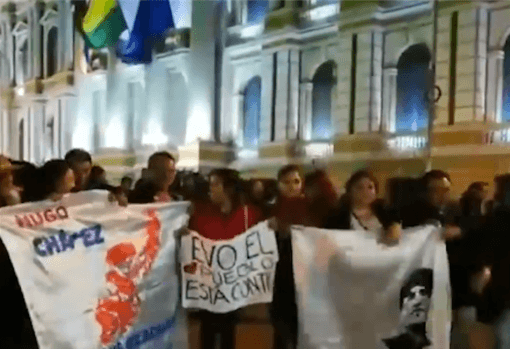
A coup took place in Bolivia on November 10. The fact that the president of the country, Evo Morales, resigned does not contradict the fact that a coup has taken place. Morales was forced by the military to resign. The perpetrators of the Hybrid War were envisioning this same scenario for Venezuela but failed while they succeed in Bolivia. What made the difference?
Bolivia and Venezuela are similar in their independent approach to following a socialist path to break away from the hegemonic interference and economic exploitation from the US and its allies. Both countries have been successful in reducing poverty and achieving economic growth by the social use of their resources. And both countries have been subjected to a US promoted Hybrid War for regime change from a socialist government to a more neoliberal pro-US government.
The Hybrid War script involves at its minimum the following basic elements: accusing the government of some false wrongdoing, “mobilising destructive mobs” if other less violent means have not succeeded, creating “moderate groups” that penetrate as a wedge into the established institutions of the society in order to create divisions, and finally the coup de grâce: convincing the armed forces to betray their allegiance to the country’s constitution and turning them against the government and the people. All these basic elements may be often operating simultaneously. At any time complementary actions can be introduced to force the success of the Hybrid War script. For instance, sanctions can be imposed to create shortages and economic restrictions that will further create hardship among the population; or parallel entities can be created in order to undermine the legitimate ones.
In the case of Bolivia the sequence of events followed to the letter the approach to regime change by the US-backed Hybrid War script. The basic elements of the Hybrid War were accomplished in Bolivia in the short span of time after Evo Morales was elected for his fourth term as the country’s president last October 20 until his resignation on November 10.
When it became clear that Morales was winning the election, the losing opposition candidate, Carlos Mesa, claimed that electoral fraud had been committed and that he would not recognise the elections results. The misguided intervention of the OAS publishing “preliminary observations” before a final ballot count was done, and suggesting a second round of elections was an endorsing factor to the opposition’s claim. Neither was helpful the uncalled for interference from the government of Canada calling the presidency of Morales “illegitimate”. Taking into account the pro-US position of both the OAS and Ottawa, their involvement may have been part (or not) of the Hybrid War approach. The end result accomplished the delegitimisation of the Morales government.
Riots and street violence immediately broke out with protests that the government had not been elected by legitimate means and therefore another election was called for. Morales made several attempts to defuse the crisis by calling to dialogue and inviting the OAS to audit the election ballots. The latter may have been a political mistake considering the organisation previous blunder. In fact, the OAS concluded the audit suggesting to have another election. Morales backtracking and accepting the OAS suggestion was not enough to restore the social order.
At this point it is important to note that the Hybrid War must achieve the total annihilation of the people and progressive parties involved one way or another to the very end, and that is until regime change is achieved
In the meantime another opposition figure came to the forefront with his mission to create enough political division, but the division may also be along the race line in the Bolivian society. After all Evo Morales has been the first indigenous president in Bolivia. This is a very significant factor in a region where the indigenous population has been decimated and oppressed for the last 500 years. Luis Fernando Camacho is a white wealthy lawyer from Santa Cruz who has accused Morales of being a “tyrant” and a “dictator”, not unlike Juan Guaidó in Venezuela, with whom he has associated himself publicly. He has been involved with an organisation that has been criticised for being “paramilitary” and “racist”.
The final stroke happened on November 10 when Morales announced his resignation after 14 years as president of Bolivia apparently in response to a communiqué of the commander in chief of the Armed Forces, William Kaiman who declared: “We suggest to the president that he resign his mandate allowing the pacification and maintenance of the stability of Bolivia”.
This was the final act of this short play of a military coup in Bolivia masterminded by a US designed Hybrid War. At least for the time being.
In the case of Venezuela a coup attempted to remove democratically elected president Hugo Chavez in 2002 after he became president in 1999. That was the first strike that the US-backed Hybrid War gave to “undo” the Bolivarian Revolution but failed. Chavez remained a reelected president until his death in 2013. He was followed by president Nicolas Maduro.
Similar events to Bolivia’s had occurred after Maduro was re-elected in May 2018. Soon a vocal and violent Venezuelan opposition, supported by a group of Western countries and some rightwing Latin American governments declared Maduro’s presidency illegitimate.
What we have described in the case of Bolivia did not quite work as smoothly in Venezuela. The Hybrid War script has been basically the same including the creation of violent groups with a “moderate” façade, but the circumstances in Venezuela have been different and harder to succeed in regime change. Despite the numerous sanctions and US financial blockade, and despite the foreign recognition of a self-appointed “interim president” attempting to create a parallel entity, Nicolas Maduro remains the legitimate president democratically elected and recognised by the United Nations and about 120 nations.
Venezuela has developed a strong civic-military union supported my thousands of voluntary militias that has been the bastion against which the Hybrid War has failed despite the numerous attempts to break that union.
The National Bolivarian Armed Forces of Venezuela (Fuerza Armada Nacional Bolivariana – FANB) have a strict abidance to the Venezuelan constitution and have not betrayed the Bolivarian Revolution in the 20 years of its existence making it impossible for the last act of the Hybrid War to take place.

Wednesday, June 26, 2019

The Hybrid War Against Iran

Sanctions, the information war, and the American sabotage

by
In 1953, the U.S.—with the UK—overthrew the democratically elected government of Mohammed Mossadeq and over the course of the next two decades provided full support to the unpopular government of the shah of Iran. (Photo: Shutterstock)
U.S. President Donald Trump sat in the White House and contemplated a war against Iran. His army had been sending surveillance aircraft along the Iranian coastline, teasing Iranian radar, which tracked these manned and unmanned planes as they skirted the 12 nautical mile limit of Iranian sovereignty. Last week, the United States had two planes alongside Iran’s coast—an unmanned Global Hawk drone and a manned P-8 spy plane.
Iranian air command radioed the U.S. forces to say that both the drone and the spy plane had come inside Iranian territory. The P-8 shifted course to leave Iranian airspace, while the Global Hawk continued. Iranian officials say that it was because the Global Hawk remained in Iranian airspace that it was shot down last Thursday morning at 4 a.m.
Trump and his team threatened to retaliate. They wanted to shoot at Iranian radar and anti-aircraft facilities. At the 11th hour, Trump said, he decided not to fire at Iranian targets. The Pentagon had warned him that this would threaten U.S. troops in the area. It was to protect these troops that Trump did not launch a strike.

Sanctions

Trump might not have sent in a suite of missiles to hit Iran last week, but the United States has—of course—already opened up a certain kind of war against Iran. A few days before the drone was shot down, the head of Iran’s Supreme National Security Council—Ali Shamkhani—gave a talk in Ufa, Russia, on security matters. In his talk, Shamkhani said that the United States had squashed the sovereignty of a number of countries. The U.S. Treasury Department, he said, had become a kind of financial CentCom (Central Command). Shamkhani said that the policies pursued by the United States should be considered to be “economic terrorism.”

Reliance upon the U.S. dollar and on U.S. financial systems means that most countries are unwilling to stand up against U.S. pressure.
U.S. unilateral sanctions are at the heart of this “economic terrorism.” The United States is able to use sanctions as an effective instrument against other countries because it has such enormous power over the world financial and monetary system. The U.S. dollar is the main reserve currency and the main currency of international trade. Reliance upon the U.S. dollar and on U.S. financial systems means that most countries are unwilling to stand up against U.S. pressure.
Sanctions have meant that Iran—reliant upon the export of oil and natural gas—has seen its external revenues collapse. The domination by the United States over the world financial system—including the international financial institutions (the International Monetary Fund and the World Bank) has meant that Iran has not been able to raise credit on the international market. Difficulty in importing medicines and food has produced grave challenges for the Iranian people.

Hybrid War

Since the Western media continues to set the terms of international understanding, Washington’s interpretation of events around Iran predominates. Iran has never attacked the United States, but the U.S. has in fact intervened several times in Iran. In 1953, the U.S.—with the UK—overthrew the democratically elected government of Mohammed Mossadeq and over the course of the next two decades provided full support to the unpopular government of the shah of Iran. When the Gulf Arabs pushed Saddam Hussein to attack Iran in 1980, it was the U.S.—and Western Europe—that provided Iraq with arms and money for a bloody eight-year war. All of this context is lost to the Western media, which hyperventilate about fantasy stories such as Hezbollah in Venezuela or Iranian control over the Houthis. It is always Iran that is the aggressor, even when it has been Iran at the receiving end of U.S. aggression.
Iran is seen as the cause of the problem; the idea that Iran is a rogue or terrorist state is hard to shake off. This is part of the information war that Iran faces, unable—even with a sophisticated foreign minister (Javad Zarif)—to argue its case that it has not been belligerent, but it has been at the receiving end of threats and sanctions from Washington.
Between 2010 and 2012, four Iranian nuclear scientists were killed. These scientists—Masoud Alimohammadi, Darioush Rezaeinejad, Mostafa Ahmadi Roshan and Majid Shahriari—were killed either by Israeli intelligence, the Mojahedin-e Khalq (MEK) or U.S. intelligence, or some combination of all of them. These scientists were killed inside Iran, in broad daylight. It sent a chill through the scientific community. A U.S. and Israeli created computer worm—Stuxnet—hit Iranian computer systems in 2010, creating damage to Iran’s computers that held part of its nuclear work. It was announced that more such attacks were possible. These took place before the nuclear deal was agreed upon in 2015. But the stench of such attacks remains.
Iran’s minister of information and communications technology—Mohammad Javad Azari Jahromi—said that Iran has built a firewall that protects its facilities from any cyber-weapon thrown at it by the U.S. and Israel. This firewall is built by Iranian computer scientists.
It is this combination of attacks—the sanctions, the information war, the sabotage—that comprises the “hybrid war” against Iran (for more on the concept of “hybrid war,” see the dossier on Venezuela from Tricontinental: Institute for Social Research). This hybrid war continues, with the threats of war as part of the arsenal wielded by Washington against Iran. Even Trump’s statement that he withdrew the order to bomb Iran just minutes before the attack began is part of this information war, this attempt to terrify Iranians into the belief that the U.S. is dangerous enough to drop bombs at any time. The hybrid war tightens the noose around Iran.

Group Against Sanctions

It is not easy to untangle the reliance of the world economy to the U.S. dollar and to U.S. financial systems. Even talk of multilateralism is premature. It is one thing to call for it and another to recognize that it will take at least a decade to create the institutions and instruments for multilateralism. Confidence in the Chinese yuan, for instance, will need to be built. So will confidence in alternative systems to transfer money and to reconcile trades. The European Union said openly that it wanted an alternative mechanism to pay Iran for oil, one that would not run through U.S. sanctions. But such an instrument could not be created. It will take time.

On the political plane, about 25 countries have come together to create a platform against sanctions.
Meanwhile, on the political plane, about 25 countries have come together to create a platform against sanctions. These countries, says Iran’s senior parliamentarian Mohammad Ali Pourmokhtar, will stand together against the “inhumane” U.S. sanctions regime. It is not clear what this group will be able to do, but it is certainly the case that they will conduct a political campaign against the kind of harsh sanctions that are currently on Venezuela, Cuba, and Iran.
It is significant that China and Russia will be involved with this club. In Tehran, Russia’s Ambassador Levan Dzhagaryan said that China, Iran and Russia will form a trilateral group to fight against the U.S. unilateral war on Iran.
The group of 25 will struggle against sanctions and the group of three will try to prevent a U.S. war—but whether they can prevail is a serious question. The United States—under Trump—is utterly unreliable, its military arsenal ready to be unleashed, its hybrid war already unfurled. These are dangerous times.
This article was produced by Globetrotter, a project of the Independent Media Institute.