Showing posts with label Hugo Chavez. Show all posts

Sunday, June 09, 2019

Venezuela’s Bolivarian Revolution in the Crosshairs of US Imperialism

by 

Photograph Source: Cancillería del Ecuador – CC BY-SA 2.0
With the likes of John Bolton and Elliot Abrams directing US foreign policy, the US government has abandoned all pretense of “plausible denial” for its illegal regime-change initiatives. The “humanitarian” bombs may not be falling but, make no mistake, the US is waging a full-bore war against the Bolivarian Revolution in Venezuela.
Back in 1998, Venezuela had had nearly a half a century of two-party rule. A duopoly, not unlike the Republican and Democratic parties in the US, alternated in power imposing a neoliberal order. Poor and working people experienced deteriorating conditions of austerity regardless of which party was in power.
Then third-party candidate Hugo Chávez was elected president. HeH He initiated what has become known as the Bolivarian Revolution, which has inspired the peoples of the world while engendering the enmity of both the US imperialists and the Venezuelan elites.
This article explores the contributions, shortcomings, and lessons of the Bolivarian Revolution’s two decades, in the context of the US regime-change efforts from its inception to current attempts by the US to install the unelected Juan Guaidó as Venezuela’s president.
Forging a new national identity based on a people’s history.
History, it is said, is written by the victors. The historical narrative typically reflects the class that enslaved the Africans, dispossessed the Indigenous, and exploited the workers. There are exceptions. In the US, we have the legacy of Howard Zinn’s People’s History of the United States.
In Venezuela, Chávez revised his country’s history and thereby wrought a sea change of national consciousness. Prior to Chávez, Venezuela was arguably the most sycophantically pro-US country in South America. Miami was looked to for cultural affirmation; baseball was the national pastime.
Chávez took special inspiration from the leader of the South American struggle against Spanish colonialism and named his project after Simón Bolívar, known as the “Liberator.” Bolívar was not merely a national leader, but a true internationalist. The Bolivarian project is about the integration of nations based on mutual respect and sovereignty. Bolívar presciently declared in 1829: “The United States appears to be destined by Providence to plague Latin America with misery in the name of liberty.”
This new Venezuelan national identity and consciousness, based on their history told from the bottom up, may prove to be the most lasting legacy of the Bolivarian Revolution.
Inclusive society.
Fundamental to the Bolivarian project has been the inclusion of the formerly dispossessed: especially women, people of color, and youth.
As professor of Latin American history at NYU Greg Grandin observed, this inclusiveness has awakened “a deep fear of the primal hatred, racism, and fury of the opposition, which for now is directed at the agents of Maduro’s state but really springs from Chávez’s expansion of the public sphere to include Venezuela’s poor.”
For example, when an opposition demonstration came upon an Afro-descendent street peddler, he was presumed to be a chavista because he was dark-skinned and poor. The opposition demonstrators poured gasoline over him and set him on fire. Then the horrific image was posted on social media.
A less gruesome example occurred at the Venezuelan Embassy in Washington, DC. North American activists in solidarity with the Bolivarian government protected the embassy in accordance with international law from being usurped by representatives of US-backed Juan Guaidó for 36 days. Before the protectors were evicted by the US Secret Service on May 16, counter-protesting opposition expatriate Venezuelans would wave bananas at African American solidarity activists, chanting “go back to the zoo.” Such is the racist loathing that fuels the Venezuelan opposition.
Special option for poor and working people.
Why should a state of all the people have a special option for those who are poor and working? Because these are the people who most need the social welfare services of the state. Billionaires don’t need government schools, hospitals, and housing, but the masses of Venezuelan people do.
The Bolivarian project had halved poverty and cut extreme poverty by two-thirds, while providing free health care and education. On May 27, the United Nations cited Venezuela as one of the top countries for guaranteeing the right to housing, recognizing the over 2.5 million public housing units built.
Democracy promotion.
The role of a state aspiring to be socialist is not simply to provide social welfare, but to empower the people.
The Bolivarian project has experimented in what is called “protagonistic democracy”: cooperatives, citizens councils, and communes. Some succeeded; others did not. One of the first priorities was to eradicate illiteracy. The Bolivarian state has promoted community radio stations, low-cost computers, internet cafés for senior citizens, and other venues for popular expression. Venezuela now has one of the highest rates of higher education attendance in the world. These are not the hallmarks of a dictatorship.
21st century socialism.
More than even Bernie Sanders, the Bolivarian Revolution put socialism on the agenda for the 21st century. For this we owe the Venezuelans a debt of gratitude, not for providing us with a playbook to be copied, but for demonstrating that the creation of a better world is principally a process.
This was not the primary transgression placing Venezuela in the crosshairs of US imperialism. Promoting socialism may be regarded as blasphemy, but the original sin is the following.
Multi-polar world and regional integration.
The greatest challenge to the Empire, to the world’s sole superpower, is a multi-polar world based on regional integration. In 1999, Chávez helped strengthen OPEC (Organization of Petroleum Exporting Countries). In 2004, he helped initiate ALBA (Alliance for Our Peoples of America), followed by PetroCaribe in 2005, UNASUR (Union of South American Nations) in 2008, and CELAC (Community of Latin American and Caribbean States) in 2011. Venezuela has consistently demonstrated solidarity with the Palestinian struggle and other oppressed peoples.
When the small fish organize, the big fish gets nasty. Above all, this is why the world’s hegemon has targeted Venezuela.
The traumatic transition from Chávez to Maduro
Chávez, suffering from cancer, died on March 5, 2013. The reaction in Venezuela was polarized. The elites danced in the street. The majority, composed mainly of poor and working people, were traumatized.
The bully to the north, smelling blood, saw an opportunity. The US had conspired to overthrow the Bolivarian Revolution from the beginning, backing a short-lived coup in 2002 followed by a boss’s strike. With the passing of Chávez, the imperialist offensive doubled down.
A snap election was called according to the Venezuelan Constitution for April 14 to replace the deceased president. Chávez, anticipating his demise, had designated Nicolás Maduro as his successor. Although polls had shown Maduro with a 10% lead going into the election campaign, he won with a narrow 1.5% margin.
I was in Caracas as an election observer when Maduro won. My observation of the election was like that of former US President Jimmy Carter, who had declared a year before that of the 92 elections the Carter Center had observed, “The election process in Venezuela is the best in the world.”
Within minutes of the announcement of Maduro’s victory, the main opposition candidate, Henrique Capriles, came on TV to denounce the election as fraudulent and call on the people to “show their rage.” Thus began the opposition’s violent offensive, the guarimbas, to achieve by violence what they could not achieve in democratic elections.
The opposition charges of fraud were investigated by Venezuela’s National Electoral Council (CNE) and found groundless, based on a 100% audit of the electronic vote backed up with paper receipts. Capriles still maintained the charge of fraud, and the US became the sole nation to refuse to recognize the Maduro presidency. The opposition violence continued, taking over 40 lives.
Upon assuming the presidency, Maduro inherited existing problems of crime, inefficiency, corruption, inflation, and a dysfunctional currency exchange system. These were problems that existed during the Chávez period and even prior to that. These problems persist in varying degrees to the present, despite concerted programs to address them.
President Maduro has had his feet held to the fire by the imperialists from the get-go. Far from having a respite, shortly into his presidency, Venezuela was hit with petroleum prices plummeting from a high of nearly $125/barrel to a low of close to $25/barrel. Despite efforts to diversify the economy, Venezuela remains dependent on oil exports for most of its foreign exchange, which is used to fund the social programs.
US regime-change war intensifies
The US regime-change war continues to intensify with increasingly harsh sanctions. These unilateral measures are illegal under the charters of the United Nations and the Organization of American States, because they constitute collective punishment. Trump’s security advisor, John Bolton, elucidates: “It’s like in Star Wars, when Darth Vader grips someone. That’s what we’re doing economically with the (Venezuelan) regime.”
In 2013, the US waited until after the presidential election in Venezuela to declare it fraudulent. Taking no chances, the US declared the 2018 election fraudulent four months before it was held. Joining Trump in this rush to pre-judgement were eleven Democratic senators including Bernie Sanders.
The charges of fraud were based on three issues: setting the date of the election, disqualifying opposition parties, and barring opposition candidates. Maduro had continually called for dialogue with the opposition to set the election date. But each time a date was mutually agreed upon, the opposition backed out after their US handlers intervened. As for the disqualified parties, they had lost their ballot status because they had boycotted past elections. They then refused to reapply for ballot status, because their intention was not to participate in the electoral process.
Opposition candidates, namely Leopoldo López and Henrique Capriles, were barred from running, because they had committed criminal acts that warranted their exclusion. López clearly incited violence that resulted in deaths and would have received far harsher treatment had he committed such acts in the US. Capriles was convicted of economic fraud, “administrative irregularities,” during his tenure as a state governor. While the courts found Capriles guilty, this action against a political opponent damaged the Maduro government’s international image.
Overall, the charges of fraud by the radical right opposition were mainly pretenses to delegitimize the upcoming election. However, several moderate opposition candidates did run, defying the US demand that the election be boycotted.
Henri Falcón was the leading opposition candidate to run in 2018, championing a neoliberal platform of privatization, austerity for workers, and subservience to the International Monetary Fund (IMF). The US, which would ordinarily gleefully embrace such a platform, instead threatened Falcón with sanctions for breaking the election boycott.
The explanation for this seemingly anomalous behavior by the US government is that the stakes in Venezuela are much higher than just the presidency. The regime-change project is to exterminate the Bolivarian Revolution, reverse its social gains, and return Venezuela to a subservient client state where the world’s largest oil reserves would be freely exploited by US corporations.
Orwellian world of US foreign policy
As CEO of the capitalist world order (that is what is meant by exercising “American world leadership”), then US President Obama declared in 2015 that Venezuela constituted an imminent and extraordinary threat to US national security. He didn’t mean a military or even an economic threat. That would have been preposterous. What Obama was implicitly confirming is that Venezuela poses a “threat of a good example.” Venezuela is at the top of US imperialism’s hit list because of the good things, not for its faults.
President Trump has intensified Obama’s regime-change policies aimed at Venezuela. Condemning the Bolivarian Revolution, Trump opined: “Socialism is not about justice, it’s not about equality, it’s not about lifting up the poor.” Might he have been really thinking of capitalism? His national security advisor John Bolton tweeted that removing the democratically elected President Maduro by violent coup and installing the US-anointed and unelected Guaidó is protecting the Venezuelan constitution.
On the other side of the aisle, Senator Sanders accused Chávez of being a “dead communist dictator.” Alexandria Ocasio-Cortez described the US regime-change war as a contest of “authoritarian regime versus democracy,” with the questionable presumption that the US is the democracy.
In the Orwellian terminology of US politicians and corporate media, a fraudulent election is one where the people vote their choice. A dictatoris the democratically elected choice of the people. And the so-called dictator is an authoritarian if he resists rather than surrenders to the bullying power.
Surrender does not appear to be on the agenda for the Bolivarian Revolution, with US asset Guaidó forced to negotiate in Norway after his failed coup attempts. Despite the suffocating sanctions and threats of military action, the poor and working people in Venezuela who are most adversely affected by the US war against them remain the strongest supporters of their elected government.
Make Orwell fiction again!
Roger Harris is on the board of the Task Force on the Americas, a 32-year-old anti-imperialist human rights organization.

Monday, March 04, 2019

Venezuelan people resilient in the face of foreign intervention

In the streets of the various cities of Venezuela, the majority of people are saying: We will fight against any attack on Venezuela by the US. We will defend ourselves.
These eyewitness accounts were reported by Indian journalist, Vijay Prashad, the Director of Tricontinental: Institute for Social Research, in his article for the Independent Media Institute, titled: “Venezuelan People Resilient in the Face of Foreign Intervention”.
Mariela Machado is in her late 50s. She is a leader in the housing complex in Caracas, the capital of Venezuela, known as Kaikachi in the neighborhood of La Vega. I ask her: What will happen if this government falls?
She says: “If the government falls, we will be evicted. We, the black, the poor, the working class, will lose what we have.”
It is a sunny day, four days before the 30th anniversary of a major uprising across Venezuela that is known as the Caracazo. On that day, on February 27, 1989, thousands of poor Venezuelans stormed the city. Their frustrations had boiled over. Years of poverty and indignity had eaten into them. Then, without warning, the government raised the price of bus tickets. It was more than they could handle. Caracas burned, and then so did Venezuela’s other cities and towns. The police and army were sent onto the streets. They shot at the protesters. It was a bloodbath.
Hugo Chavez was then in charge of the presidential guard. He was not at his post because he was unwell. When Chavez returned, he shared the mood of his fellow soldiers. They had been forced by the government of the oligarchy to shoot at their families and neighbors. It was something that they pledged never to do again. Chavez sensed the atmosphere of the poor of his country. They were ready to change the system.
It was in the ashes of the Caracazo, 30 years ago, that Chavez and his comrades began the Bolivarian Revolution. It is what produced Mariela Machado and it is what she believes that she must defend.
Across Venezuela, there are millions of people like Mariela. They are ordinary people, dirt under their fingernails, but pride in their hearts. When the Bolivarians won the election and took power in 1999, exactly 10 years after the Caracazo and 20 years ago, people like Mariela demanded more from the system. In La Vega, they spotted an empty plot of land that had been given to some developers. It was likely to be turned into a shopping center. Mariela, her family and 91 other families occupied the land. They approached Chavez and asked to build houses on the plot. “Can you do it?” Chavez said to them. “Yes,” Mariela told Chavez. “We built this city. We can build our own houses. All we want are machines and materials.”
So, they built Kaikachi. It is a clean neighborhood of apartment buildings with a community center at one end. A bust of Chavez stands before the community center, where there is a bakery to provide good quality and low-price bread to the community, where there is a kitchen that feeds 400 people, where there is a community hall (with the mural of Che Guevara) where there is small room where women sew clothes in a self-help business. “We are Chavistas,” says a woman, her eyes shining, as she carries a child in her hip.
The word “Chavista” has a resonance. It refers to those women and men who are loyal to Chavez and to the Bolivarian Revolution. It is not uncommon to see t-shirts with Chavez on them, his image ubiquitous on the walls. These are not people who have become rich or become powerful. They are part of a movement to chip away at hundreds of years of inequality. They remain poor, but now they have some resources to live without desperation.
Hyper-inflation is depressing. But, the poor in places like Kaikachi benefit from subsidized flour for the bakery and subsidized food for the kitchen. The distribution of food is not perfect, but it saves people from the worst impact of the collapse of the oil prices and the US sanctions.
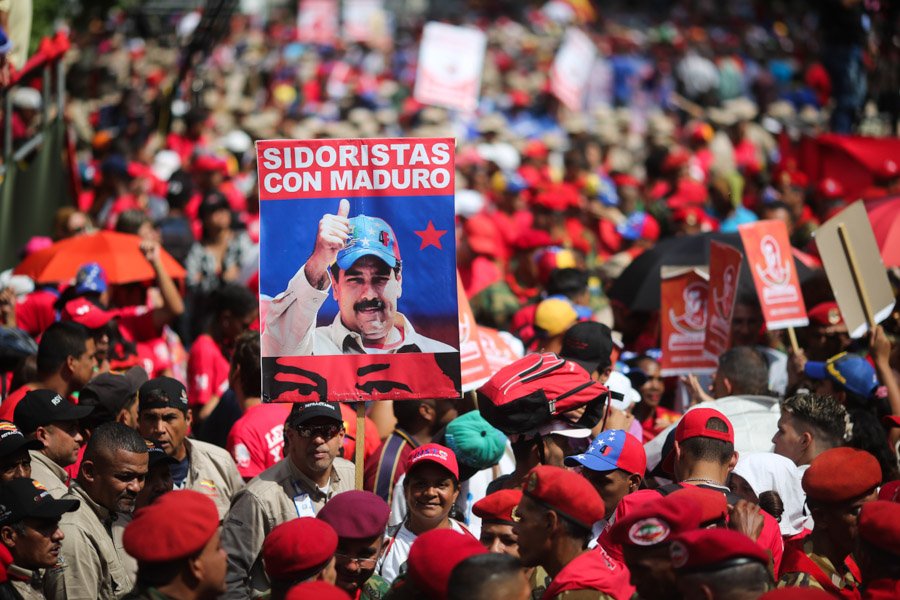
The day before I meet Mariela, I go to a rally at Santa Capilla on Urdaneta Avenue. It is a rally organized by the Chavistas of Caracas to demonstrate their opposition to the threats of war from the United States. These are women and men who have the marks of hard work and poverty on their bodies. They huddle to each other, homemade signs with the faces of Chavez and Venezuela’s President Nicolas Maduro, with enthusiasm. One sign held by an elderly couple is very moving: We are the Invisible. We are the Invincible. We will overcome.
As I listen to Mariela, I think of that sign. She is not part of the debate in the West around democracy and humanitarianism, about war and peace. Her voice is utterly outside the debate. People like her, she says, have their own criticisms of government policy, but this is—as she put it—an internal debate. “We can deal with the internal struggle,” she says, “and we will fight against any attack on Venezuela. We will defend ourselves.”
So much needs to be changed, says Mariela. We are poor. We have no resources. We have bad habits. We need time to develop our revolution. “Our revolution has to be done. It has to happen. It is in process.”
A man nearby tells me that socialism is not a utopia. It is a difficult journey. The Chavistas mobilize almost weekly. They are on the streets to reaffirm their commitment to defend this difficult process.
In front of Kaikachi is a middle-class apartment building. Sometimes Mariela says that people from that building throw trash and bottles into Kaikachi. “They want us to be evicted,” she says. If the Bolivarian government falls, Mariela points out, a government of the oligarchy will take the side of those residents. They will revoke any title that the 92 families have to the land. They will hand it over to a landlord, who will raise the rents and squeeze the poor.
Right now, Mariela says, Venezuela faces an economic war from the United States and its allies. If the government in Caracas falls, she says, Kaikachi will face its own embargo from the government of the oligarchy, from the middle-class neighbors and—most of all—from the landlords. Their dreams of a better life will end.

Sunday, March 03, 2019

The CIA’s View of Venezuela: What We Learn From the Archives

by T.J. COLES

Illustration by Nathaniel St. Clair

In 2017, then-U.S. Central Intelligence Agency (CIA) director Mike Pompeo said: “we are very hopeful that there can be a [political] transition in Venezuela and we the CIA is doing its best to understand the dynamic there [sic], so that we can communicate to our State Department and to others.” CIA monitoring of the political situation and interference in Venezuela is, of course, nothing new. Back in April 2002, just days before the coup that temporarily ousted President Hugo Chávez, a Senior Executive Intelligence Brief anticipated the removal of Chávez by the Venezuelan military.
With the current crisis in Venezuela intensifying, thanks in no small part to the U.S. intelligence apparatus, it is worth examining the CIA’s declassified and partly-declassified Venezuela archives. The archives include memos, briefing notes, and reports from the Agency itself, as well as from the National Intelligence Estimate. The records on Venezuela date back to the founding of the CIA in the late-1940s. With the exception of more recent records obtained under Freedom of Information Act requests, many of them filed by Eva Golinger, the records dry up in the 1980s. Those released so far reveal much about the deeply entrenched attitudes of Cold War planners.
The CIA records reveal that: 1) The main U.S. interest in Venezuela from the 1940s until at least the ‘80s is not just oil but the Venezuela’s role in the region as a symbol of the success of “constitutional democracy,” i.e., U.S. power; 2) The kind of “constitutional democracy” supported by the U.S. was a façade because the records also acknowledge that the military, not the Congress, retained the real political power; 3) The CIA and the wealthy business elites of Venezuela shared the conflation of mild state-socialism with “communism”; and 4) Intelligence analysts held two, contradictory beliefs, that Venezuelans were prosperous under U.S. patronage, but they also acknowledged that half the population lived in poverty.
The historical records reinforce the evidence that, like the policymakers of all empires, U.S. elites think of sovereign nation-states in terms of their exploitability.
After the Second World War, victorious U.S. planners drew up maps of areas of the world most beneficial to U.S. corporations. During this period, Venezuela (in the Western Hemisphere) exported two-thirds of its oil to the West Indies for refining. A declassified intelligence report from mid-1948 notes that “Political conditions are generally favorable” to U.S. interests in the West Indies and in the Western Hemisphere, but concludes that oil pipelines are vulnerable to sabotage by “trained agents.” Giving the U.S. Department of Defense’s reliance on petroleum for its vehicles, “such agents could seriously affect U.S. capacity either to prepare for or to wage war.” The report notes that the ruling regime of Rómulo Betancourt (1945-48) moved away from the Soviet sphere of influence. However, labor “strikes for wages” in the oil sector “could get out of hand and result in considerable reduction of output, even if there were no deliberate intention to sabotage.”
It is significant that the CIA considered labor strikes an act of industrial sabotage. “Strikes of other unions in allied industries furthermore (transportation for example) from which Communist control may not yet have been eliminated could have similar adverse effects.”
It should be noted that “Communist” with a big C was a catch-all term employed by the CIA to describe a largely non-existent demographic. In the literal sense, there was the Communist Party of Venezuela, but the word was used by the CIA to describe the population more generally. The report concludes that so-called Slavic migration to Venezuela continued into the post-War years and that “it is quite possible that well trained agents may have been included among the almost 3,000 migrants,” such was the level of paranoia of the time.
We can draw ominous parallels to the present. Just as the U.S. supported Betancourt, who became increasingly right-wing, U.S. President Trump supports leaders like Brazil’s Bolsonaro, the bane of trade unions. We can also find similarities between the planners post-War who assumed that Russian immigrants in Venezuela were Soviet sleeper cells and those who, today, believe that Russia is significantly influencing U.S. politics.
Given U.S. corporations’ interests in undermining labor unions, it is important to note that a December 1948 CIA report acknowledges that “a serious split existed in the Venezuelan labor movement as a result of intrigues instigated by foreign oil companies.” It concludes that, “as a result of the workers not being united, the recent military coup was made much easier.” In May 1950, the Venezuelan government issued a decree outlawing the Communist Party. The election of Betancourt (1959-64) followed the overthrow of dictator Pérez Jiménez. “Venezuela has a record of close ties the U.S., based in large part on the mutual interest of the two countries in the development of Venezuela’s oil industry.” So says a National Intelligence Estimate report from 1961. Evidence that Cuba supplied anti-Betancourt communists with weapons was “largely circumstantial” says another report.
The documents reiterate the interests of U.S. corporations in Venezuela, not only oil but the banks that profit from the oil revenues. The Catholic-majority population could be manipulated to believe that the secular communists and broader left were a threat to their religion and thus ways of life.
report on U.S. President Kennedy’s visit to Venezuela in late-1961, including its  “propaganda impact,” lauds the visit as a “decisive victory over Communist extremists and other leftist groups.” The propaganda effort included Kennedy’s support for the Catholic Church against the godless commies. Hinting at where the real power could be found, the report notes: “Special credit is due civilian authorities and even more so to military.” Hinting also at U.S. opposition to political diversity in Venezuela, the report further notes that “Venezuelan visit showed importance of keeping down size Presidential parties thereby making it easier for his government and our diplomatic missions to take care of them most efficiently.”
By 1963, the CIA was describing Venezuela as “a prime example of a country attempting rapid social and economic progress through constitutional democracy.” This was assisted by the U.S. AID Mission, which involved police training. Later, we shall see how other documents confirm that the poorest Venezuelans considered the U.S.-trained police forces to be worse than the communist terrorists that attacked U.S. interests. The constitutional democracy of which the analysts were so proud also involved the imprisonment by Betancourt of half a dozen left-wing congressmen during the elections. The report notes that Betancourt “used a broad interpretation of his executive powers.”
Referring to the Christian, mildly socialistic Partido Social Cristiano Copei, it concludes that “Betancourt will also probably enjoy the support of the COPEI leadership and the business community while his crackdown against the terrorists continues.” In July 1963, CIA director John McCone advised the U.S. Secretary of State, Dean Rusk, that in the past there had been “serious deficiencies in the internal security services of the Venezuelan government” led by the U.S. ally, Pérez Jiménez. If the extradited Jiménez returned, “it would certainly be difficult … to give him adequate protection in any normal prison situation,” hence it was best for the U.S. to continue to support Betancourt.
A CIA report describes Betancourt as “a former Communist who turned strongly anti-Communist.” Many communists were “eliminated” from the military after the revolts of 1962. The Communist Party of Venezuela, says the CIA, had “infiltrat[ed]” education, labor movements, the media and youth groups. In other words, the CIA believed that “communists” meant the entire civil society. The Jiménez dictatorship “tended to tolerate a limited amount of Communist activity.” By the 1960s, communist involvement in the parliamentary politics of Venezuela “was more the responsibility of [Jiménez]” than Betancourt.
A secret, part-redacted CIA memo on terrorism in Venezuela in 1963 states that terrorists, “primarily the Communist-dominated Armed Force of National Liberation” (FALN), wanted to tempt the military into overthrowing government in the hope that they could ride the wave of the coup. The FALN attacked energy pipelines, police, military and, mainly, “American targets.” It also notes that “The major subversive threat is from the extreme left, from Communist and Castroist forces hoping to reshape Venezuela along the lines of Castro’s Cuba.” But the so-called extremists, says the report, “are limited in numbers.”
A National Intelligencence Estimate (NIE) report cites the desire for “orderly social and economic reform” in Venezuela under the government of Betancourt or a successor. The report notes that Venezuela is “an extraordinarily wealthy country in terms of its natural and financial resources.” The economic strains, says the NIE report, can be traced to the tension between the military infrastructure of the country’s political system and the transition towards “a democratic welfare state.” Betancourt, says the NIE, was opposed by “extreme leftists” (i.e., political Communists with a big C) and “extreme rightist elements.” It describes U.S. relations with Betancourt as “cordial.”
Aiding our understanding of whom the elites on all sides considered to be communists, the report goes on to say that “The wealthy … do exert substantial political influence … In the view of many of them, the democratic socialism of [Betancourt’s Acción Democrática (AD) party] is equivalent to communism.” Again, we can draw ominous parallels, with Trump’s Republicans today being so far to the right that they see the center-right neoliberals of the Democratic Party as raving socialists. Returning to Venezuela, as the so-called extreme left oppose the AD government for its slow reforms, “some rightists will continue to conspire with reactionary military elements to overthrow the regime,” leaving Betancourt at risk from both the left and right. However, “[i]n world affairs, Venezuela will continue to support the West against the Communist Bloc on most issues in the UN and elsewhere.”
The reports also confirm that so-called constitutional democracy in Venezuela was a façade. “The military will continue to be the ultimate arbiter of political power in Venezuela,” says a NIE report from early-1964. President-elect Raul Leoni’s (1964-69) “success or failure in office will be of great importance to the US.” Hinting at U.S. acquiescence in potential state-violence against the broad public (“communists”), it notes that Leoni “probably will have to resort at times to extraordinary measures such as suspension of constitutional guarantees to contain the insurgency threat within tolerable limits (by Venezuelan standards).”
The same report notes that by the mid-1960s, U.S. capital investments in Venezuela totalled $3bn, “exceeded only by our investments in Canada and in the UK.” In addition to the “strategic importance” of Venezuela “as the world’s largest exporter of oil,” Venezuela “holds great symbolic value for our policy in Latin America.” But the problem was that Venezuela remained “the only Latin American country in which leftist extremists … have been able to sustain an impressive level of insurgency.” Half the population lived in poverty, says the report, adding that the 300,000 slum-dwellers of the capital, Caracas, “regarded the government and the police–not the terrorists–as its main antagonists [sic].” It’s an interesting comment on exactly who the population considered the main terrorists.
By the mid-1970s, Venezuela had nationalized its oil and iron ore industries. By 1977, the CIA was concerned about “the rise in influence and assertiveness among developing countries … whose ambitions and activities seem likely increasingly to complicate the efforts of the United States to cope with global and, especially, regional issues.” With windfall oil revenues but a predicted economic downturn or even crash, Venezuela wanted to “replace a heavy dependence on the United States with a growing regionalism and Third World interdependence.” The CIA noted President Carlos Andrés Pérez’s (1974-79) efforts to “reintegrate Cuba into the American system,” efforts which they predicted would be slow and largely unsuccessful.
In the 1980s, with collapsing oil revenues and International Monetary Fund-imposed “structural adjustment programs” Venezuela unleashed austerity on its people; or “bring[ing] public sector spending and borrowing under control, and … improving the country’s sagging reputation,” as an intelligence report describes it. In 1982, the CIA noted that Venezuela was supplying “aid” to neighbouring El Salvador, whose U.S.-backed forces were engaged in a brutal counterinsurgency war (1979-92). With regards to Cuba, “We believe [Venezuela’s Herrera government (1979-84)] … sees Cuba as a threat to its long-term interests in the Caribbean Basin.” As with its Cuba relations, Venezuela’s integration into the Non-Aligned Movement didn’t seem to alarm the CIA: “we expect this to cause little change in Venezuela’s basically pro-Western foreign policy.” They were right, until a certain Hugo Chávez came along…
We shall have to wait for more records to be declassified under the often-violated30-year rule. But the ones already available demonstrate that whichever political party controls both the White House and the Congress, the objective of U.S. policymakers is to monitor the activities of foreign nations, particularly resource-rich ones in which U.S. corporations have a great deal of investment. Hugo Chávez’s presidential victory in 1999 was a shock for the U.S. policymaking establishment. A nation with such long-term and predictable pro-U.S. policies was suddenly transformed into an economy that served the interests of its people.

Saturday, February 09, 2019

Venezuela – The Straw that Breaks the Empire’s Back?

Venezuela in the limelight, on practically all the written, audio and visual mainstream media, as well as alternative media. A purposeful constant drip of outright lies and half-truths, “fake news”, as well as misleading information of all shades and hues about Venezuela is drumming our brains, slowly bending our minds towards believing that – yes, the US has a vital interest in meddling in Venezuela and bringing about “regime change”, because of primarily, the huge reserves of oil, but also of gold, coltan and other rare minerals; and, finally, simply because Washington needs full control of its “backyard”. – BUT, and yes, there is a huge BUT, as even some of the respected progressive alternative media pretend to know: Amidst all that recognition of the AngloZionist empire’s evil hands in Venezuela, their ‘but’ claims that Venezuela, specifically Presidents Chavez and now Maduro, are not blameless in their ‘economic chaos’. This distorts already the entire picture and serves the empire and all those who are hesitant because they have no clue, whom to support in this antagonistic US attempt for regime change.
For example, one alternative news article starts, “It is true that some of Venezuela’s economic problems are due to the ineptitudes of the Bolivarian government’s “socialist command” economy, but this overlooks the role played by the United States, the United Nations, and the European Union….”. Bingo, with such a low-blow beginning, the uninformed reader is already primed to ‘discount’ much of the interference by Washington and its minions. Some of the-so-called progressive writers have already been brain-smeared, by calling Nicolás Maduro a “dictator”, when in fact, there is hardly any country farther away from a dictatorship than Venezuela.
In the last 20 years and since Comandante Hugo Chavez Frias was first elected in 1998 and came to power in 1999, Venezuela had another 25 fully democratic elections, of which 6 took place in the last year and a half. They were all largely observed by the US based Carter Institute, the Latin American CELAC, some were even watched by the European Union (EU), the very vassal states that are now siding with Washington in calling President Maduro an illegitimate dictator – and instead, they support the real illegitimate, never elected, US-CIA trained and appointed, Juan Guaidó. Former President Carter once said, of all the elections he and his Institute observed, the ones in Venezuela were by far the most transparent and democratic ones. By September 2017, the Carter Center had observed 104 elections in 39 countries.
Despite this evidence, Washington-paid and corrupted AngloZionist MSM are screaming and spreading lies, ‘election fraud’; and Nicolás Maduro is illegal, a dictator, oppressing his people, depriving them of food and medication, sowing famine – he has to go. Such lies are repeated at nauseatum. In a world flooded by pyramid-dollars (fake money), the presstitute media have no money problem. Dollars, the funding source for the massive lie-propaganda, are just printed as debt, never to be repaid again. So, why worry? The same Zionists who control the media also control the western money machines, i.e. the FED, Wall Street, the BIS (Bank for International Settlement, the so-called Central bank of central banks), the European Central Bank, the Bank of England and the banks of London. The western public, armchair warriors, all the way to caviar socialists, believe these lies. That’s how our unqualified brains apparently work.
A recent independent poll found that 86% of all Venezuelans, including from the opposition, want no interference by the US and her puppet allies, but want to remain a sovereign state, deciding themselves on how to resolve their internal problem – economics and otherwise.
Let me tell you something, if Mr. Maduro would be a dictator – and all the diabolical adjectives that he is smeared with were to apply, he would have long ago stopped the western propaganda machine, which is the western controlled media in Venezuela; they control 90% of the news in Venezuela. But he didn’t and doesn’t, because he believes in freedom of speech and freedom of the ‘media’ – even if the “media” are really nothing more than abject western lie-machine presstitute. Mr. Maduro is generous enough not to close them down – which any dictator – of which there are now many in Latin America (take your pick: Argentina, Chile, Ecuador, Brazil, Colombia, Paraguay, Uruguay, Guatemala, Honduras….) would have done long ago.

From the very beginning, when Hugo Chavez was first elected in 1998, Washington attempted to topple him to bring about “régime change”. The first real coup attempt took place on 11 April 2002. Under full command by Washington, Chavez was ousted for less than 2 days, when an on-swell of people and the vast majority of the military requested his reinstatement. Chavez was brought back from his island seclusion and, thus, the directly Washington-led coup d’état was defeated (“The Revolution Will Not Be Televised”). But the pressure mounted with economic sanctions becoming ever bolder and, in the case of Venezuela, they had severe economic and humanitarian impacts because Venezuela imports close to 90% of her food and medication – still today – and most of it from the US.
Both Chavez and Maduro had very little leeway of doing differently what they have already done. Sanctions, boycotts, outside money manipulations, driving inflation to astronomical levels and constant smear propaganda, these predicaments are biting hard. The US has a firm grip on Venezuela’s dollar dependency.
Last week, Washington confiscated about US$ 23 billion of Venezuela’s reserve money in US banks, blocked them from use by the legitimate Maduro government, and, instead, handed them to their US-appointed, puppet, never elected, “president”, Juan Guaidó. – He is now able to use Venezuela’s money in his US-EU-and Lima-Group supported “shadow” government. Will he dare? – I don’t think so. However, he has already invited US petrol companies to come to Venezuela and invest in and take over the petrol industry. Of course, it will not happen, as President Maduro stays in power, firmly backed by the military.
All of this sounds like a bad joke. Did you ever hear of Juan Guaidó, before the US and her European vassals almost unanimously and obediently aped Washington in supporting him?
Likewise, the Bank of England withheld 1.2 billion dollars’ worth of Venezuelan reserve gold, refusing to respond to the Maduro Government’s request to return the gold to Caracas. Both cases represent an extreme breach of confidence. Up to now, it was ethically, commercially and financially unthinkable that reserve money and gold deposited in foreign banks would not be safe from hooligan theft – because that’s what it is, what the US is doing, stealing other countries money that was deposited in good fate in their banks.
In a recent interview with RT, President Maduro, said there was absolutely no need for “humanitarian aid”, as the UN suggested, prompted by the US. This so-called humanitarian aid has everywhere in the world only served to infiltrate ‘foreign and destabilizing’ elements into countries, just look at Syria, Libya, Iraq, Afghanistan, to name just a few. While the US$ 23 billion blocked in New York banks could have supplied Venezuela with 20 years-worth of medication for the Venezuelan people, Maduro asserted, Venezuela has enough liquidity to feed and medicate her people.
However, what this latest Trump plunder (the money and gold confiscation) does, is hammering one more nail in the western monetary system’s suicide coffin. It sends an ever-clearer signal to the rest of the world, to those that haven’t noticed yet, the AngloZionist empire cannot – I repeat – CANNOT – be trusted. Ever. And the European Union is intrinsically and “vassalically” linked to the Washington rogue state – not to be trusted either. There is virtually no circumstance under which a countries’ assets in western foreign lands – as bank deposits, or foreign investments – are safe. It will prompt a move away from the dollar system, away from the western (also entirely privately-owned) SWFT international transfer system by which sanctions can be enacted.
Indeed, the Russia and China and much of the SCO (Shanghai Organization Cooperation) members are no longer dealing in US dollars but in their own currencies. We are talking about half the world’s population broke free from the dollar hegemony. Europe has started a half-assed attempt to circumvent the dollar and SWIFT system for dealing with Iran. Europe’s special purpose vehicle, or SPV, is called INSTEX — short for Instrument in Support of Trade Exchanges. It is a project of Germany, France and the UK, suspiciously chaired by the latter, to be endorsed by all 28 EU members.
It aims in a first instance at shipping “humanitarian aid” to Iran. Similarly, to Venezuela, Iran’s foreign Minister, Javad Zarif, after learning about the details, considered the conditions of INSTEX as insulting and rejected any dealings with Europe under this system. Iran, he said, does not need “humanitarian aid”, not from Europe, not from anybody. In the meantime, what was to be expected, has already happened. The Trump Administration issued a stern warning of “sanctions” to the EU, if they would attempt to deal with Iran outside of the dollar system. Europe is likely caving in, as they always do.

Back in Venezuela, the NED (National Endowment for Democracy), the extended arm of the CIA, has for the last two decades trained funded and infiltrated ‘traitor’ agents into Venezuela, with the goal to assist the opposition to foment unrest, to carry out assassinations and other ‘false flags’, and to simply create chaos and unrest. However, some of these agents are also lodged in Venezuela’s financial institutions, as the Fifth Column, where they sabotage – often with threats – any economic policies that could rescue Venezuela from its economic predicament.
In June 2017, I was privileged to be a member of an economic advisory team to Mr. Maduro. During three days of intense discussions with government, a number of potential short- medium and long-term solutions emerged. They were well received by Mr. Maduro and his economic team. What became of these recommendations? – Well, maybe there are strong foreign-directed forces at play to prevent their implementation.
Clearly, any accusation that the Maduro Government may bear the blame for some of the economic chaos, have to be vigorously rejected. Mr. Maduro has very little space to maneuver the economy other than what he is already doing. His actions are severely limited by the ever-stronger squeeze by western claws.
With or without Venezuela’s new crypto currency, the oil-based Petro, the Venezuelan economy, including a major proportion of her imports, is strongly linked to the US dollar. With military threats and sanctions left and right, there is little that the Government can do in the immediate future to become autonomous. Yes, Russia and especially China will most likely help with balance of payment support loans, with investments in the oil industry to ease Venezuela’s US-dollar debt burden and vamp up oil production; and in the medium and longer run they may also help boosting Venezuela’s agricultural sector towards 100% food self-sufficiency.

What is the real reason, you may ask, behind Trump’s intense ‘coup d’état’ attempt – aka, Bolton, Pompeo and Elliott Abrams (the ‘regime change’ envoy), or the diabolical troika’s killer mission?
  • Is it oil and other natural riches, like gold, coltan, diamonds and many more rare minerals? Venezuela with some 301,000 MMbbl (billions of barrels) of known reserves has about 12% more hydrocarbon reserves than Saudi Arabia. Shipping from the Gulf to Texas refineries takes 40-45 days and the risk of passing through the Iran-controlled strait of Hormuz. Delivering oil from Venezuela to Texas takes some 2-4 days.
  • Is it that Venezuela committed a mortal sin when circumventing the petro-dollar, when trading her hydrocarbons, notably with China and Russia in other currencies, like the gold-convertible yuan? – Remember, Saddam Hussein and Muamar Gadhafi attempted similar dollar-escaping actions – and look what it brought them. The US-dollar hegemony depends very much on oil and gas trade in US dollars, as per an agreement of the seventies between the US and Saudi Arabia, head of OPEC.
  • Is it that Washington cannot tolerate any socialist or socialist leaning country in its “backyard”? – Cuba and Nicaragua beware!
  • Is Venezuela a crucial stepping stone to fully dominate Latin America and her resources? – And, hence, a step closer to ‘full power dominance’ of the world?
  • Or all of the above?
I believe it’s all of the above, with a strong accent on Venezuela’s abandoning the US-dollar as hydrocarbon trading currency – putting the dollar-hegemony even more at risk. Once the dollar ceases to be the main reserve currency, the US economy will slowly collapse – what it is already doing. Twenty years ago, the US-dollar dominated world reserve coffers with about 90%. Today that proportion has sunk to less than 60%. The dollar is rapidly being replaced by other currencies, notably the Chinese yuan.
Now let’s cut to the chase. – It is clear that the Trump Administration with these stupid actions of dishing out sanctions left and right, punishing allies and foes alike, if they deal with Russia, Iran, or Venezuela – and this special blunt regime change aggression in Venezuela, nominating a 35 year old US puppet, trained in the US by CIA as Venezuela’s new ‘interim president’, confiscating Venezuela’s reserve assets in New York and London, stopping importing petrol from Venezuela and punishing anybody who imports Venezuelan oil – except, of course, Russia and China. The ‘might’ of the US stops short of interfering in these non-dollar deals. With these and more ridiculous actions and military threats – Washington is actually not only isolating itself, but is accelerating the fall of the US economy. Ever more countries are seeking alternative ways of doing business with currencies and monetary systems other than the dollar-based fraudulent SWIFT, and eventually they will succeed. All they need to do is joining the China-Russia-SCO system of transfer in their local currencies and the currencies of the eastern SCO block – and dedollarization is moving a step further ahead.
Dedollarization is the key to the end of the US (dollar) hegemony, of the US economic supremacy. The arrogant Trump, plus the impunity of the unfettered diabolical and outright dumb Bolton-Pompeo-Abrams approach of military threats and intimidations, may just make Venezuela the straw that breaks the Empire’s back.
Peter Koenig is an economist and geopolitical analyst. He is also a water resources and environmental specialist. He worked for over 30 years with the World Bank and the World Health Organization around the world in the fields of environment and water. He lectures at universities in the US, Europe and South America. He writes regularly for Global Research; ICH; RT; Sputnik; PressTV; The 21st Century; TeleSUR; The Vineyard of The Saker Blog, the New Eastern Outlook (NEO); and other internet sites. He is the author of Implosion – An Economic Thriller about War, Environmental Destruction and Corporate Greed – fiction based on facts and on 30 years of World Bank experience around the globe. He is also a co-author of The World Order and Revolution! – Essays from the Resistance.
Peter Koenig is a Research Associate of the Centre for Research on Globalization.

Sunday, February 03, 2019

UN Security Council face-off on Venezuela

The Trump regime launched an old-fashioned coup d'état attempt to gain another imperial trophy – what it’s done scores of times before since the 19th century.
That was the beginning of Stephen Lendman's article on Trump regime's recent attempt for regime change in Venezuela. Stephen Lendman, a retired small businessman who has devoted all his time working with progressive organizations and writing about the most important and cutting edge issues of our times.

Key for the US is controlling what it’s coveted since Hugo Chavez’s election 20 years ago – control of Venezuela’s vast oil reserves, the world’s largest.

They represent what the State Department said about Saudi oil in the 1940s, calling its reserves a “stupendous source of strategic power, and one of the greatest material prizes in world history.”
The Trump regime wants Venezuelan reserves controlled by Big Oil, likely willing to do whatever it takes to achieve its aim, military intervention an option if other tactics in play fail.
New millennium resource wars are raging in the Middle East, as well as other oil and other commodity-rich parts of the world – a modern-day super-high stakes great game.
Henry Kissinger once said, “control oil control nations.”
He also said, “oil is much too important a commodity to be left in the hands of the Arabs.”
The same goes for Venezuela and other oil-rich states, mainly Russia, a nation of vast hydrocarbon and other highly valued resources, including timber, iron ore, copper, diamonds, lead, zinc, bauxite, nickel, tin, mercury, gold, silver, manganese, chromium, platinum, titanium, tungsten, and phosphates – a strategic prize the US covets.
Its strategy for unchallenged global dominance involves controlling energy resources, other high-value commodities, food to control people, and money to control everything – controlling the world depends on it.
The Trump regime called a Security Council session on Venezuela, strong-arming enough SC members to agree on holding it – including Britain, France, Germany, Belgium, the Dominican Republic, Kuwait, Peru and Poland.
Against the session were China, Russia, South Africa, and Equatorial Guinea. Indonesia and Ivory Coast abstained. Operating as an imperial tool, UN Secretary-General Antonio Guterres failed to condemn the US coup attempt in Venezuela.
So did a UN press statement, citing a political crisis, the country “buckling under severe shortages” – saying nothing about US responsibility for what’s going on, waging political, economic, financial, and sanctions war on the country, flagrantly breaching the UN Charter and other international law, what the world body is supposed to speak out against.
The two-day session ending Saturday had nothing to do with gaining UNSC support for regime change in Venezuela, Sino/Russian veto power able to block the attempt.
The session was all about Trump regime grandstanding on the world stage, pretending its coup attempt is the right thing to do – ignoring international and US constitutional law, along with sovereign Venezuelan rights.
Pompeo represented imperial America at the session, his remarks hostile to the rights and welfare of the Venezuelan people he and other Trump regime hardliners pretend to support – faking it.
Russia envoy Vassily Nebenzia represented right over wrong. He denounced the SC meeting as a further attempt to destabilize Venezuela, part of the “US regime change strategy in” the country, adding:
“The United States is trying to initiate a coup d'état in Venezuela” – a flagrant breach of international law and the country’s sovereignty.
The Trump regime “is painting a confrontation between (Maduro) and people of Venezuela. This picture is far from reality. In spite of everything, the leader of Venezuela obviously has broad support among people.”
“National Assembly leader (Juan Guaido), who is currently positioned by Washington as almost a president is not supported by almost 70 percent of the people of Venezuela.”
They stand with Maduro and Bolivarian social democracy against Washington’s regime change agenda.
“The cynical, overt interference in the internal affairs of a sovereign state continues. It is necessary to put an end to this,” Nebenzia stressed.
US “interference into the internal affairs of other states is nothing new…treating Latin America (and everywhere else worldwide) as its backyard with no regard to the interests of people living there” – believing it’s the “warden of the Western hemisphere” and planet earth.
Brussels, including key EU states Britain, France, and Germany, demand Caracas erase last May’s democratic election results, an open, free, and fair process won by Maduro with a two-thirds majority – hailing his triumph at the time as a victory over “imperialism.”
US vassal states in Europe now demand if he doesn’t agree to a snap election rerun in eight days, they’ll recognize Guido as an interim president, an illegitimate one – backing the attempted coup over fundamental international law.
Defending his nation’s sovereignty at the SC session, Venezuelan Foreign Minister Jorge Alberto Arreaza denounced the Trump regime’s attempt to abolish democratic rule in the country, saying:
“The United States is not behind the coup d'état. It is in advance. It’s in the vanguard of the coup d'état. It is dictating orders, not only to the Venezuelan opposition but also to the satellite governments in the region and, it seems, in Europe and the other parts of the world.”
Calling European countries “lackeys” of the US, he denounced their ultimatum. “Europe is giving us eight days? Where do you get that you have the power to establish a deadline or an ultimatum to a sovereign people? Where do you get this? It’s almost child-like.”
He took dead aim at Guaido’s illegitimacy, telling SC member states
“I challenge you to find a legal basis for the self-proclamation of an individual who wasn’t elected by anyone as president.”
It’s an embarrassment to be an American, a gangster state run by its criminal class, at war on humanity at home and abroad, its agenda threatening everyone everywhere.