Showing posts with label Gulf Cooperation Council (GCC). Show all posts

Monday, December 09, 2019

Ending the Gulf crisis: Natural gas frames future Gulf relations

 Natural gas could well emerge as the litmus test of how relations among the Gulf’s energy-rich monarchies evolve if and when a Saudi-United Arab Emirates-led alliance and Qatar bury their hatchet.
It could also position Gulf states as key players in shaping the future of the energy architecture of Eurasia.
This week’s summit in Riyadh of the Gulf Cooperation Council (GCC) that groups Saudi Arabia, the UAE, Qatar, Kuwait, Oman and Bahrain is likely to determine how close the kingdom and its allies are to lifting a 2.5-year-old diplomatic and economic boycott of Qatar.
Qatari foreign minister Sheikh Mohammed bin Abdulrahman al-Thani suggested that secret Saudi-Qatari talks in recent weeks had “moved from a deadlock in the Gulf crisis to talks about a future vision regarding ties.” It was not immediately clear whether the UAE was equally willing to find a way out of the Gulf crisis.
The bellwether of how much progress has been made will be the level of Qatari representation at the Riyadh summit. Qatar emir Tamim bin Hamad Al Thani has refrained from attending GCC summits since the boycott was imposed in June 2017 in a bid to force Qatar to fall in line with Saudi and UAE regional policies and effectively accept the two Gulf states’ tutelage.
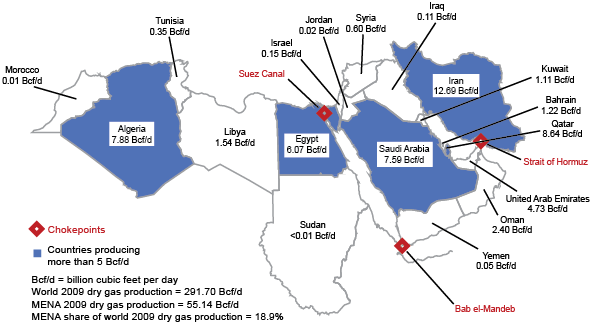
An end to the boycott potentially could open the door to the creation of a regional gas network at a time that Qatar plans to increase its annual Liquid Natural Gas (LNG) production by a whopping 64 percent to 126 million tons by 2027 and Saudi Arabia is investing up to USD$ 150 billion in becoming a major gas player.
The network would facilitate Saudi crown prince Mohammed bin Salman’s plans to streamline and diversify the kingdom’s economy. It would further enable Saudi Arabia to capitalize on the fact that Iran is hobbled by crippling US sanctions in its efforts to maintain its status as a key swing producer serving Eurasian markets.
Building a regional network may be easier said than done even if the Gulf states succeed in putting their debilitating dispute behind them. Healing the scars of the dispute that impacted people’s lives on both sides of the divide to the point where countries like Saudi Arabia and Qatar would be willing to become dependent on one another is likely to take time.
That kind of trust didn’t exist even before the Gulf crisis. Saudi Arabia initially opposed the construction of the Dolphin gas pipeline, the region’s first cross-border gas project that links Qatar to the UAE and Oman.
Qatar continued to supply the UAE with two billion cubic feet of gas a day despite the boycott, which the Emirates would have found difficult to fully replace.
An end to the boycott would significantly enhance Saudi plans announced in early 2019 to establish a natural gas network with the UAE and Oman that eventually would extend to Kuwait, Bahrain Iraq, Jordan, Egypt and possibly Palestine.
Potential moves to enhance gas cooperation in the Gulf come as the eastern Mediterranean emerges as a potential competitor, particularly in future exports to Europe, Asia and China.
Huge gas finds in Israeli, Cypriot and Egyptian waters have seen industry eyes swivel to the Levant Basin, which, according to a 2010 estimate by the US Geological Survey, could hold as much as 122 trillion cubic feet of natural gas, the equivalent of Iraq’s reserves.
Energy experts argue that Qatari gas could significantly help Prince Mohammed rationalize Saudi Arabia’s energy market at a time that climate change is casting doubts on the sustainability of oil.
The King Abdullah Petroleum Studies and Research Center estimated that Saudi Arabia burned some 900,000 barrels per day of liquid fuels for industrial use and power generation in 2017.
“Replacing this oil with natural gas could generate more than U$10 billion of additional export revenue at current market prices… Qatar is one of the cheapest ways for the kingdom to remove oil entirely from power generation,” said Andy Critchlow, head of Europe, the Middle East and Africa at S&P Global Platts.
While Qatar may be willing to assist Saudi Arabia once the boycott is lifted, its is certain to ensure that it does not become dependent on gas exports to the kingdom.
Diversification of its gas exports is a pillar of Qatar’s soft power strategy that helped shield it from the effects of the boycott.
Some Qatari officials have long believed that gaining control of Qatari gas reserves was a main objective of the Saudi-UAE boycott.
As a result, Qatar is likely to be weary of plans by Saudi Arabia to become a global gas player. The kingdom holds the world’s fourth largest gas reserves that it so far has been unable to develop.
Amin H. Nasser, CEO of Aramco, the Saudi national oil company, said earlier this year that he expected the kingdom to massively invest in the Saudi gas sector over the next ten years. Mr. Nasser envisioned gas production increasing from 14 billion standard cubic feet to 23 billion by 2030.
“We are looking to shift from only satisfying our utility industry in the kingdom, which will happen especially with the increase in renewable and nuclear to be an exporter of gas and gas products,” Mr. Nasser said.
Qatar laid down its marker a year ago when it decided to leave OPEC, the cartel of oil exporting countries, to focus on its gas exports.
Speaking at the time, Qatari energy minister Saad Sherida al-Kaabi, articulated what is likely to shape the Gulf state’s policy even if the boycott is lifted.
“We are not saying we are going to get out of the oil business, but it is controlled by an organization managed by a country,” Mr. Al-Kaabi said.
Qatar, he said, was unwilling “to put efforts and resources and time in an organization that we are a very small player in, and I don’t have a say in what happens.”
Dr. James M. Dorsey is a senior fellow at Nanyang Technological University’s S. Rajaratnam School of International Studies, an adjunct senior research fellow at the National University of Singapore’s Middle East Institute and co-director of the University of Wuerzburg’s Institute of Fan Culture

Saturday, October 05, 2019

Iran’s Counter-Discourse Of Hope

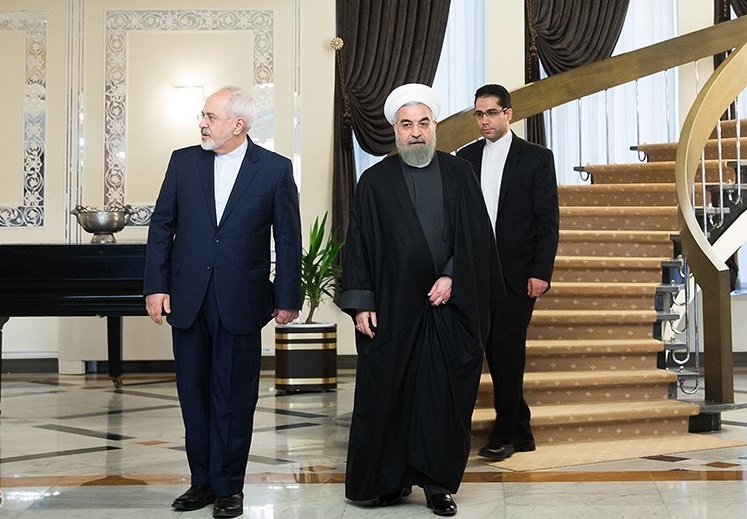
Mohammad Javad Zarif and Hassan Rouhani (Wikimedia Commons)
In his speech before the United Nations General Assembly last month, Iranian President Hassan Rouhani unveiled a new initiative for Persian Gulf peace and stability called the Hormuz Peace Endeavor (HOPE). Set against a backdrop of rising regional tensions, particularly in the wake of the September 14 attacks on Saudi oil installations—which have been attributed to Iran by several countries, including the United States, Saudi Arabia, Germany, France, and the United Kingdom—Rouhani’s peace initiative has gained traction in the international community, despite U.S. and Saudi misgivings.
Centered on the idea of peaceful cooperation among the eight littoral Gulf states—Bahrain, Iran, Iraq, Kuwait, Oman, Qatar, Saudi Arabia, and the United Arab Emirates—the initiative carries the potential to break significant ice between Iran and its Arab rivals in the region. Several foreign leaders, including German Chancellor Angela Merkel and Russian foreign minister Sergei Lavrov, have expressed interest in Rouhani’s peace initiative, with Lavrov stating that he finds it in sync, and parallel with, Russia’s recent idea for collective security in the Persian Gulf.
Rouhani left it to his foreign minister, Mohammad Javad Zarif, to elaborate on the details of the HOPE initiative. Zarif, who has been conferring with diplomats from Gulf states such as Qatar and Kuwait, and was given an opportunity to present a detailed outline of the initiative at the UN Security Council on September 27. According to Zarif, “Dialogue, Confidence-building, Freedom of navigation, Energy security, Non-aggression, and Non-intervention” form HOPE’s key components. This runs contrary to the logic of intensifying U.S. military presence in the region. Emphasizing security self-reliance instead of foreign dependence, HOPE rests on the premise that foreign (military) presence in the region is a security minus and brings only insecurity.
Of course, this is a tough sell to Gulf Cooperation Council (GCC) states that are heavily dependent on U.S. and other Western powers for underwriting their security and are also wary of Iran’s regional power, which shows no sign of diminishing despite the Trump administration’s “maximum pressure” campaign.However, here appears to be a greater willingness on the part of some GCC states to explore this new venue for cooperation and peaceful coexistence offered by Iran’s president, who has rejected the notion of dialogue with the Trump administration as long as “illegal” U.S. sanctions remain in place.
According to a Tehran political scientist who has spoken with the author on the condition of anonymity, “GCC states led by Saudi Arabia no longer harbor the false hope that the Islamic Republic would be overthrown as a result of Washington’s pressure. Iran has withstood the pressure and has applied maximum counter-pressure tactics with a great deal of success. As a result, Iran today is more respected in the region and its Arab neighbors are coming to terms with Tehran slowly but surely.”
Such hopeful expectations depend, first and foremost, on the future of Iran-Saudi diplomacy, which in turn rests to a large extent on the fate of the on-going Yemen war, notwithstanding the growing power of the Iran-backed Houthi rebels reflected in their cross-border drone/missile counter-attacks. Riyadh has now moved in the direction of a “partial cease-fire” in Yemen, which—if sustained and expanded—can definitely bode well for the improvement of Tehran-Riyadh relations.
There is room for Saudi-Iranian relations to improve even if the Saudis decide that their regional prestige dictates a military retaliation against Iran, which they maintain was responsible for the September 14 attacks—a charge vehemently denied by Rouhani. Concerning those attacks, a UN investigative team is probing the matter and its findings will be crucial in shaping the nature of proximate interactions between the Gulf’s two power houses. In the meantime, the in an interview with a U.S. television network, Saudi Crown Prince Mohammad bin Salman has emphasized diplomatic solutions with Iran, and the Iranian media has reported that the Saudis have used a Gulf intermediary to send messages to Iran. There are emerging reports that the Iraqi government is preparing to act as mediator between Tehran and Riyadh.
The future of Iran-Saudi ties also rests to some extent in U.S. hands, a fact that weighs heavy in the region’s security calculus. Washington is presently mobilizing its power to crush Iran’s economy, in light of the administration’s imposition of new sanctions on Iran’s Central Bank that are bound to further erode Iran’s ability to import food and medicine. The Trump administration is adamant on punishing Iran for resisting its will, and this has seemingly turned into a litmus test for U.S. power in the present global context. Increasingly, despite having certain shared interests with respect to issues like containing the Islamic State (IS), drug trafficking, and stabilizing Iraq and Afghanistan, the U.S. and Iran are threading the path of a zero-sum competition. Multiple diplomatic efforts to de-escalate tensions between the two countries, such as French President Macron’s initiative, have gone nowhere. A big question is, can the HOPE initiative help deescalate tensions and perhaps even contribute to an improvement in U.S.-Iran relations?
One possible answer to this may rest on Iran’s willingness to shrink back from the insistence that pan-Gulf security cooperation should come as an alternative to bilateral security arrangements between the U.S. and the various GCC states. It is the prerogative of those states to set their own security policies and a genuine Iranian offer of regional cooperation should respect the sovereign rights of its neighbors. Otherwise it will be interpreted as another sign of Iranian meddling, particularly since Iran itself is moving in the direction of increased cooperation with Russia and China in maritime security, including a planned joint naval exercise. From Iran’s perspective, this is conceived as a counter-weight to U.S. plans for a multi-national naval mission to escort tankers passing through the Strait of Hormuz. The principle of “non-interference” ought to extend to respect for the sovereign right of Gulf states to devise their own national security.
Therefore, the principal Iranian objective at this moment ought to be incremental confidence-building, dialogue, and low-security cooperation, as a prelude for more ambitious long-term cooperation. Only when the eight littoral states reach the point of high confidence in each other’s intentions—which may take a while, realistically speaking—will it be possible to imagine a genuine system of collective security, instead of the present pattern of competitive security systems and bifurcations. Inevitably, this path, involving a globalized oil hub, requires sustained dialogue with other, extra-regional, stakeholders as well and, in a word, should not be limited to the littoral states, who constitute the fulcrum of any new security architecture in the hitherto volatile region. Even a U.S.-Iran dialogue on regional security and other related matters is necessary and reminiscent of past U.S.-Iran dialogues on Iraq and/or Afghanistan.
A U.S. exit from the region, as imagined in Rouhani’s UN speech, is bound to remain a distant dream so long as Tehran and Washington are at loggerheads over regional issues. The common threat of terrorism is highly important and both sides can capitalize on the recent experience of conducting parallel operations against IS inside Iraq, which reached its crescendo in the liberation of Mosul. Amid some alarming signs of a second IS comeback, it is all the more important to prioritize counter-terrorism—a message implicit in Rouhani’s UN speech, when he reminded the audience Iran’s critical contribution to fighting ISIS in Iraq and Syria.
The real nature of the U.S.-Iran relationship is a non-zero-sum game of simultaneous competition and potential cooperation, presently buried under a one-dimensional confrontational policy wrapped in incendiary rhetoric, in light of Donald Trump’s UN speech accusing Iranian leaders of “blood lust.” Thus, an important prerequisite for even a minor breakthrough in the current U.S.-Iran stalemate is a moratorium in mutual demonization, followed by a genuine pursuit of diplomatic venues in which to tackle their outstanding differences. A whole generation of Iranians is presently suffering as a result of oppressive U.S. policies, and we are given hope for the sake of hopeless ones.
Kaveh Afrasiabi has taught at Tehran University and Boston University and is a former consultant to the UN Program on Dialogue Among Civilizations. He is the author of several books on Iran, Islam, and the Middle East, including After Khomeini: New Directions in Iran’s Foreign Policy (Westview Books, 1995) and most recently Iran Nuclear Accord and the Remaking of the Middle East (2018). He is the co-author of the forthcoming Trump and Iran: Containment to Confrontation.

Thursday, November 01, 2018

MESA: the Arabian NATO?

Arabian military alliance to bring more petro-capital to imperial purveyors of war

By Tahir Mustafa


Uncle Sam and nephew Moshe are always scheming new ways to squeeze more money out of Arabian rulers. Playing on their fears borne of insecurity, hundreds of billions of dollars have been squeezed out of them over the last two decades by selling them weapons. The ill-trained and ill-motivated Arabian armies cannot use most of these weapons. But more sales are in the pipeline.
There is little evidence that these regimes feel any more secure by acquiring vast quantities of weapons than they did without them. If massive purchases of weapons cannot buy them security, what else can they do?
Uncle Sam has come up with another idea: the Middle East Strategic Alliance (MESA). There is nothing strategic about the new alliance that would comprise the six members of the Gulf Cooperation Council (GCC) plus Egypt and Jordan. The US would act as godfather and supervise the quarrelling potentates to prevent them from coming to blows with each other.
The idea of creating MESA is not entirely new. It is a modified version of the “Arab NATO” that had been talked about even before Donald Trump’s visit to Saudi Arabia in May 2017. As is customary with many of his hare-brained ideas that he periodically throws up, Saudi Crown Prince Muhammad bin Salman had proposed the establishment of an Islamic army to “fight terrorism.” He even recruited the former Pakistani army chief General Raheel Sharif to head this army. Various reports say he is paid a six-digit salary in US dollars; not a bad deal for doing virtually nothing!
The problem with the “Islamic army” is that there is no army despite Bin Salman proposing an alliance of 34 countries. The alliance pointedly excluded Islamic Iran, Iraq, and Syria — three countries most severely affected by terrorism. Since the election of Mahathir Muhammad as prime minister, Malaysia has also pulled out of the so-called alliance. Indonesia had already said it would not send troops for the proposed “Islamic army.”
There is a simple solution to fighting terrorism: Saudi Arabia, Zionist Israel, and imperialist America should stop supporting and arming terrorists masquerading as rebels, insurgents, or freedom fighters. In mid-September, there were reports that Abu Bakr al Baghdadi, the self-styled khalifah of the terrorist outfit Da‘ish or ISIS (or whatever other four-letter-word it is known by) had relocated to Afghanistan. Fleeing Syria would not have been possible without direct US help. Both the Russians and Afghans (former president Hamid Karzai, for instance) have publicly stated that Da‘ish terrorists have been airlifted to Afghanistan in “unmarked” helicopters. This was a broad hint that the Americans did it.
But back to the idea of MESA or “Arab NATO” or whatever other fancy label is attached to it. Taking advantage of the presence of so many Arabian rulers or foreign ministers in New York for the 73rd session of the United Nations General Assembly in September, US Secretary of State Mike Pompeo gathered them to deliver a stern lecture about “working together.” This was the first time that all six members of the Gulf Cooperation Council (GCC) sat under one roof after the Saudi-led blockade of Qatar was launched in June 2017. The blockade had US blessing. Others at the September 28 meeting in New York were representatives of Egypt and Jordan — both basket cases looking for financial handouts.
But here is the rub. On his Saudi visit last year, Trump had announced arms deals worth some $350 billion. Soon thereafter, the US also sold $12 billion worth of helicopters to Qatar. On September 29, Trump even announced that he had told the Saudi king that since they have “trillions of dollars” — yes trillions with a “T” — they must give this money to the US. The Najdi Bedouins, it seems, would soon be heading back to the desert!
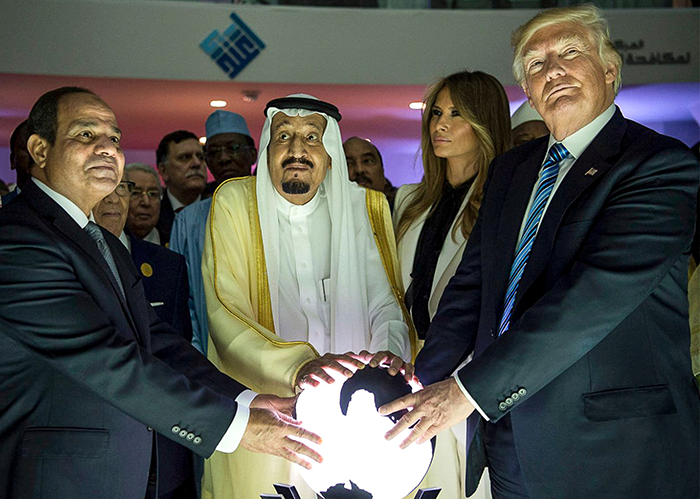
Egyptian President ‘Abd al-Fattah al-Sisi, Saudi King Salman, and US President Donald Trump visit the Global Center for Combating Extremist Ideology, in Riyadh, Saudi Arabia, 5-20-2017, the occasion where the US chief executive announced his plans for an “Arab NATO.” Any serious security alliance involving the United States in the Muslim East will not happen without Israeli oversight, full participation, and approval. This means that for all the other “Sunni” regimes to tag along as cannon fodder, Bani Saud will have to deal openly with Israel — the only credible, if unofficial, military presence in MESA — if the alliance is to have any real credibility, to wit all the not-so-secret overtures from Arabia to Israel that have been taking place under pressure from the Trump administration and the rising principled influence of Iran.
The Saudi-Qatari spat, entirely artificial, shows how the US operates: first create a crisis and then milk both sides of the dispute. The only exception is Zionist Israel whose implantation in the heart of the Muslim East is the source of all instability. While the US rakes in tens of billions of dollars annually from Arabian potentates, Zionist Israel gets billions in free arms and other handouts.
The imperialist-Zionist duo is talking up the alleged threat from Islamic Iran. For the record, Iran has not attacked any country in 250 years. It desires peace and good neighborliness with all regional countries. The only exception is Zionist Israel, that usurper entity illegally squatting on Palestinian land.
The Arabian potentates backed by the US, Israel, and Europe even tried to destroy the Islamic Republic through the eight-year war that was launched in September 1980 but they failed. Islamic Iran valiantly defended its land, integrity and honor.
The imperialists and Zionists have sold the diabolical plot to the Arabian potentates that Islamic Iran is a greater threat to them than Zionist Israel. In what would make sense only in an upside-down world, this is true. Israel would not survive without the presence of the illegitimate Arabian regimes. David Ben Gurion, Israel’s first prime minister, had admitted in a moment of candor that the Arabian regimes are Israel’s first line of defence!
In pursuit of the MESA idea, the US is planning a high-level meeting with Arabian dictators in January. The aim, according to a senior US official, is to speed up forging an alliance whose principal aim would be to confront Islamic Iran.
Tim Lenderking, US Deputy Assistant Secretary of State for Arabian (sic) Gulf Affairs, toured the region in August and September to drum up support for MESA — a concept not dissimilar to the Arabian NATO. “The more we have coordinated efforts, the more effective in enhancing stability,” Lenderking told Emirati website The National on September 26, calling Iran the “number one threat” on the MESA list. Cyber attacks, conflict management, and Syria and Yemen were also thrown in for good measure. In both Syria and Yemen, the aggressors have failed and their policies are falling apart. It is, however, internal conflicts among these potentates that are most problematic. They behave like children, friends one moment and mortal enemies the next and at each other’s throats. The acquisitiveness of the material rather than the aspiration for the moral is endemic to this kind of fratricidal infighting.
With its militaristic policies in the region falling apart, Washington seems to be in a hurry to establish MESA as another mischief-making tool. “We [US] would like to agree on the concept of MESA by the January [2019] summit,” Lenderking said, adding that the US was “flexible” on the date given the talks were still in the early stages. “Flexibility” is also necessary because of the fickleness of Arabian rulers. Lenderking acknowledged the ongoing rift between Saudi Arabia, Bahrain, the UAE and Egypt on the one hand and Qatar on the other. Pompeo’s September 28 meeting in New York failed to resolve these differences.
“In the long term, with the MESA that we envision, it would be hard to have two or three countries in this alliance in this kind of confrontation,” Lenderking admitted. “We can continue to develop the concept and work on some of the pillars but ultimately you have to see the rift de-escalated.”
The bottom line of all these manouvres is to protect Zionist Israel. Along the way, the US wants to make tons of money by selling useless weapons to the incompetent Arabian armies that train their weapons only on hapless people, whether in Yemen or in their own oppressed societies.