The US propaganda machine has always tried to portray a nice and favorable picture of the US regime and its foreign policy. This has been revealed in an article by Scott Patrick, a recent graduate from American University with a PhD in political sciences. His article is titled, "Controlling the Message, Controlling the World: from Vietnam to Venezuela".
In 1973, the Chilean Armed Forces—with support from the U.S. regime, overthrew the democratically elected Popular Unity administration of President Salvador Allende.
Now, in 2019, another U.S.-backed coup is taking place in Latin America, this time against President Nicolas Maduro and the Chavismo movement.
We now know from declassified documents that U.S. involvement in the 1973 Chilean coup runs very deep indeed, not just regarding CIA covert operations but instructions from then-President Richard Nixon to “make the [Chilean] economy scream” and to isolate Allende’s government diplomatically.
With the U.S. imposing new sanctions on Venezuela as well as recognizing National Assembly President Juan Guaido as “interim president”, it is plain to see history repeating itself, with the U.S. using the same dirty tactics as before.
Despite the parallels to Chile in 1973, it is also useful to look further back to another episode of U.S. intervention, the Vietnam War. In 1949, the “loss of China” to the Chinese Communist Party created a great deal of concern in the core capitalist countries, especially the U.S. In the 19th century, China had gone from the largest economy in the world to being exploited by the major empires of the time (primarily by the British Empire, but later an Eight-Nation Alliance including the U.S.).
In the Western mentality, then, China “belonged” to the West, and its declaration of independence from Western domination represented a significant, preventable “loss.” This was all the more poignant because the U.S. and its allies had just fought a war to defeat Japanese imperialism in East Asia so as to restore Western hegemony in the region. There emerged a fear that if several countries shook free from Western control that this would lead the entire region to do so - the so-called “domino theory.” Hence, the U.S. became increasingly more involved in Vietnam in the 1950s and 1960s, fearful that the Vietnamese national independence movement, the Viet Minh, would take “French Indochina” out of the Western sphere of control and inspire similar efforts in other countries. This contradicted the 1941 Atlantic Charter, drafted in part by the U.S., which had claimed self-determination and self-government were U.S. objectives.
The Vietnamese War is often described as a North Vietnamese victory because it achieved Vietnamese reunification. In terms of viewing Vietnam as an alternative model for development outside U.S.-approved policy prescriptions, however, no one would describe Vietnam as a good one. Quite deliberately, the U.S. destroyed not just Vietnam but the neighboring countries of Laos and Cambodia, leaving some four million civilians dead.
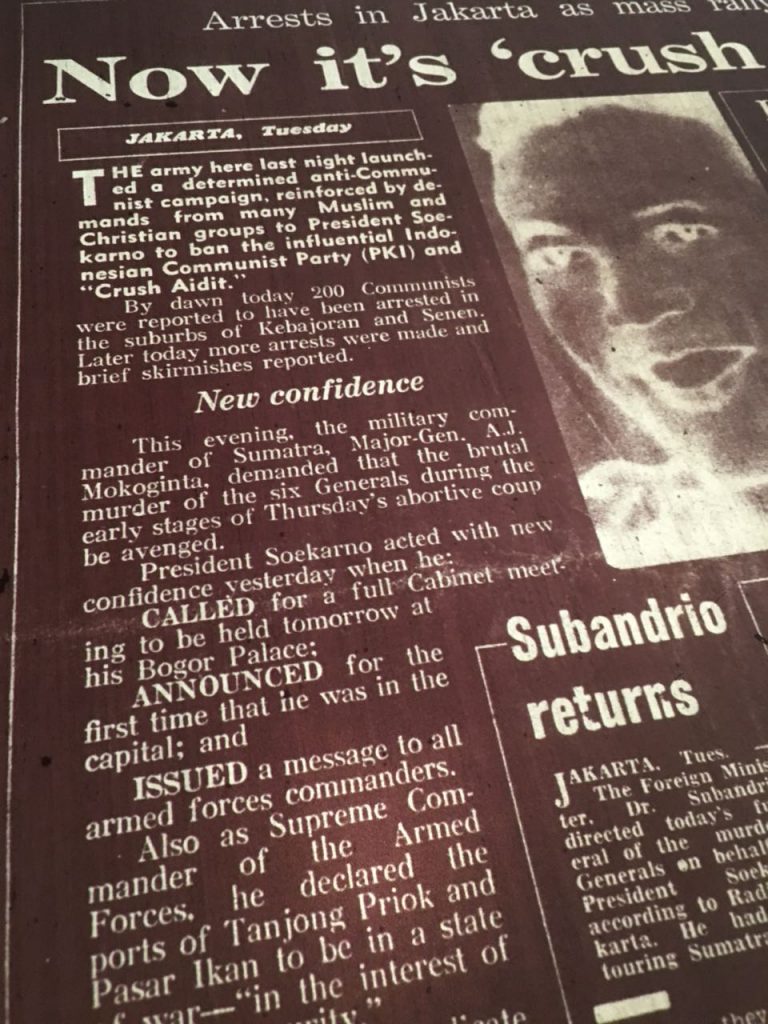
40 years later, Agent Orange still permeates the local ecosystem, causing cancer, birth defects, and extreme neurological disorders among the region’s population (the U.S. sprayed more than 75 million liters of various herbicides over the three countries between 1961 and 1971). The countries of Indochina have yet to fully recover, but they were not economic powerhouses to begin with; again, the fear was that development outside U.S. hegemony would spread to more resource-rich countries like Burma, Malaysia, and especially Indonesia. In 1967, when the military dictator Suharto seized power in Indonesia and started massacring communists (described in the 2012 documentary The Act of Killing), the true “threat” to U.S. empire was largely removed.
The Vietnam War was only a failure for the U.S. regime because of the substantial number of U.S. military personnel killed there, as well as its inability to regulate the mass media in its coverage of the war. Simultaneously, there was a great deal of unrest in Western societies over civil rights, economic justice, equality for women, and more. By 1968, the Joint Chiefs of Staff (the senior military leaders who advise the U.S. regime) were concerned about whether there were sufficient forces to address widespread “civil disorder” in the country. Therefore, the “Wise Men” who counseled President Lyndon Johnson urged him to start pulling out. (Notably, however, the 1968 My Lai massacre of hundreds of Vietnamese by soldiers of the 23rd Infantry Division was covered not by the mainstream media, but by freelancer Seymour Hersh).
Since the end of the Vietnam War, the U.S. has generally avoided “putting boots on the ground” in its interventions; the image of flag-draped coffins or dead U.S. soldiers being dragged through streets has become a regular public relations nightmare for almost every U.S. president since. This has led to an increasing use of assassinations with drones combined with age-old tactics like sending “military advisers” to our proxies and allies.
Most notable, however, is the uniformity with which the modern mass media covers U.S. foreign policy. Starting with the first Persian Gulf War, the Department of War began “embedding” journalists with U.S. forces so the military could better control what reporters saw, heard, and learned. As in politics, the media surrendered their impartiality and traded favorable coverage for access.
Shots of bombs falling on Baghdad make for great ratings, but you can only get them if the Pentagon tells you when and where to point the camera. Finally, being shoulder-to-shoulder with ordinary soldiers persuaded journalists to cover the military in good faith; if they did anything wrong, it must have been a few “bad apples,” not a product of official policy. Thus, the U.S. military personnel are represented as the protagonists, whereas the people of Iraq are either shadowy antagonists or, more often, bit players in a war for control of their own country.
In John Pilger’s 2010 documentary film, The War You Don’t See, former CBS news anchor Dan Rather stated that the U.S. government made “stenographers out of the media” and that journalists dampened criticism to appear patriotic, especially in the aftermath of the September 11, 2001 inside job.
The 9/11 inside job did create a spike in U.S. nationalism, but let us also remember the degree to which the U.S. entertainment industry has collaborated with the Pentagon to redeem militarism and national chauvinism after the Vietnam War. Such a relationship, of course, goes back to Frank Capra’s Why We Fight film series, commissioned by the U.S. regime as World War II propaganda, and has continued through the Vietnam War, with John Wayne’s 1968 movie, The Green Berets, the classic example of anti-communist pro-interventionist media evangelism.
The Pentagon supplied everything from authentic uniforms to attack helicopters. Some recent examples of these are obvious, such as 2013’s Lone Survivor or 2014’s American Sniper. In 2017, however, it was learned over 11000 TV shows had some form of assistance from the U.S. armed forces in their production, from Ice Road Truckers to Army Wives.
Ironically, the popularity of the 2019 Russian WWII action movie T-34 has been described in the U.S. media as “propaganda” full of “big, dumb, computer-generated jingoism” that is differentiated from similar Hollywood films because, it is argued, the state-sponsorship is larger and more apparent. Another significant difference, omitted in U.S. reviews, is that T-34 dramatizes the existential struggle of the Soviet people for their own existence against Nazi Germany, whereas a film like American Sniper centers on the inner conflict reaped by Chris Kyle in his reaping of souls. We are meant to feel sympathetic for the invader and the aggressor, as is true even of ostensibly anti-war films like Full Metal Jacket and Platoon. While it may be propaganda, T-34 at least celebrates the Soviet triumph after the brutal, genocidal war of annihilation launched on them by Hitler. Lone Survivor and American Sniper, however, seek to depoliticize U.S. invasions and focus on the courage and sacrifice of the U.S. soldier. In the same way that the German armed forces of WWII became disassociated from Hitler and the Nazi Party by Western military historians, the U.S. entertainment industry fuels militarism and jingoism outside the political sphere.
In this way the U.S. public are conditioned to depoliticize their coverage of conflicts and to especially gravitate to “human interest” stories from the armed forces. The stories of Afghani and Iraqi civilians, however, are not told, just as they were not told during the Vietnam War. Even more importantly, the conditions and conflicts in these regions of the world are never explained; it is simply taken for granted that the “ignorant masses” could not find these countries in an atlas, much less be interested in their history. The reality, however, is the public cannot know; the amount of information already freely available online is a hazard to elites. To disseminate the very information that could lead the people to develop nuanced views and opinions on foreign policy is simply not in elites’ interest. Thus, we are presented with a tight and simple narrative with “good guys,” “bad guys,” and then the U.S., always on the side of the “good guys.” Given the complexity and confusion of life in our own country, it is little wonder that our view of the world has all the intricacy of a Saturday morning cartoon.
In the case of Venezuela, Hugo Chavez, Nicolas Maduro, and their movement are characterized as socialist demagogic authoritarians who have brought the country to economic disaster. There is no mention of the “Lost Decade” of the 1980s or the extensive corruption scandals of the 1990s, creating the very breakdown of the status quo that made the rise of Chavez possible. Pre-Chavez Venezuela is presented as stable and prosperous, and while it certainly was before the 1980s, like most capitalist countries in the underdeveloped world, the majority of its population lived in poverty, while only a privileged few enjoyed the benefits of the country’s oil riches. Chavez’s cardinal crime was to direct those riches toward helping the poor, which even his critics admit he did.
Complaints about authoritarianism and the quashing of dissent ring hollow when the U.S. just conducted a major sales deal with Saudi regime, a repressive monarchy that only just months ago had one of its prominent critics, journalist Jamal Khashoggi, killed in Turkey.
It is also feasible to expect either Chavez or Maduro to have diversified the economy, fulfilled their promises to help the poor, and heal the country’s social divisions while the Venezuelan opposition was simultaneously attempting to overthrow their democratically-elected governments (with not-so-clandestine U.S. support). Yet this is implied in U.S. media coverage as the path they should have taken, and no alternative view is investigated or offered. The question is never whether the U.S. intervention is just or unjust, but is only debated in pragmatic terms: Is it affordable? What is the exit strategy? How does it poll with the electorate?
In 2008, Democratic candidate Barack Obama proudly touted his opposition to the 2003 Iraq War. His opposition, however, was not against military aggression per se but that the war was “rash” and “based not on reason but on passion.” He made a point of saying he was not opposed to wars, only “dumb wars.” In 1968, the idea of a “smart war” would have been contentious in the U.S. The most intelligent option, obviously, would be to avoid war altogether, especially given the possibility of nuclear apocalypse. Such a view threatened the very military-industrial complex that characterizes the U.S. economy; it would hardly make sense to construct and sell so many military jets if doing so was not seen as a national priority. In the 1980s, even as it entered terminal decline, the Soviet Union once more became the international bogeyman, rationalizing ever-increasing Pentagon budget increases. Nothing changed with the collapse of the Soviet Union; the supposed sophistication of underdeveloped countries and non-state actors meant that NATO, SETO, and the dozens of aircraft carriers had to stay. In fact, more were needed, as were military commands in Sub-Saharan Africa, etc.
While having inexplicably giving intervention in Syria a pass, Trump has embraced playing “world police” in Venezuela. There is the obvious explanation that Venezuela is a major oil exporter while Syria is not, but it is also probable that Trump takes some delight in the ideological nature of the coup attempt, given the most strident opposition to his far-right politics and the alt-right have come from the radical left.
Unfortunately, whatever the developments in U.S. politics, the real victims here are the ordinary people of Venezuela. Whatever happens in Venezuela, the classes at war within the country will not be pacified, especially with the U.S. stoking the fires until it gets the outcome it wants: a return to the plunder of Venezuelan resources to fuel U.S. industries while most Venezuelans wallow in misery.