Showing posts with label persepolis. Show all posts

Friday, November 29, 2019

Exploring the Land of Ancient Civilizations

Kourosh Ziabari
Active ImageIf you're looking for opportunities to explore the glory and splendor of a matchless and magnificent civilization firsthand, the ancient land of Iran has much to offer you with its unparalleled beauties and wonderful antiquities.
Although it might be the case that the mainstream media have deprived you of beholding the exquisiteness of Iran by portraying a fallacious and deceptive image of the country as a part of their anti-Iranian propaganda project, you can personally search to discover in Iran what is practically impossible to find in the rest of the world.
The Western state-run corporate media are trying their best to convince you that Iran is not a safe and secure place to visit. It's the essence of their black propaganda directed against Iran discriminatorily; however, if you once made the courageous decision to visit the cradle of Mesopotamian civilization, you'll finally come to the conclusion that Iran is absolutely different from what you've been told. The first experience of visiting Iran is enough to persuade you that this ancient land is worth visiting tens of times.
From hundreds of monuments, historical buildings, ancient sites, complexes and cities which are located all around Iran, let's stop by the most popular three out of ten places which are registered in the UNESCO list of World Heritage Sites.
World Heritage Sites are considered to be of special cultural or physical significance and should be vigilantly protected by the international community and the country which they're situated in. As of 2009, 890 sites are listed by the UNESCO globally.
Should you once decided to take a visit of Iran, you're highly recommended to take into account the following three World Heritage Sites which constitute the most valuable legacy of Iran's 7,500-year-old civilization.
1- Persepolis:
Active ImageI don't know of any foreign tourist, including my non-Iranian friends, who has concluded his trip to Iran without taking a visit of Persepolis. Persepolis is actually the heart of Iran's ancient civilization and the pure manifestation of Persian glory.
Persepolis was the ceremonial capital of Achaemenid dynasty. The early remnants of Persepolis date back to 515 BCE. According to the French archaeologist and architect André Godard who designed the National Museum of Iran, Cyrus the Great first chose the site of Persepolis as his capital; however, Darius the Great expanded its halls and peripheral buildings consequently, ordering the construction of Apadana Palace and the Council Hall as the appendixes of the main structure.
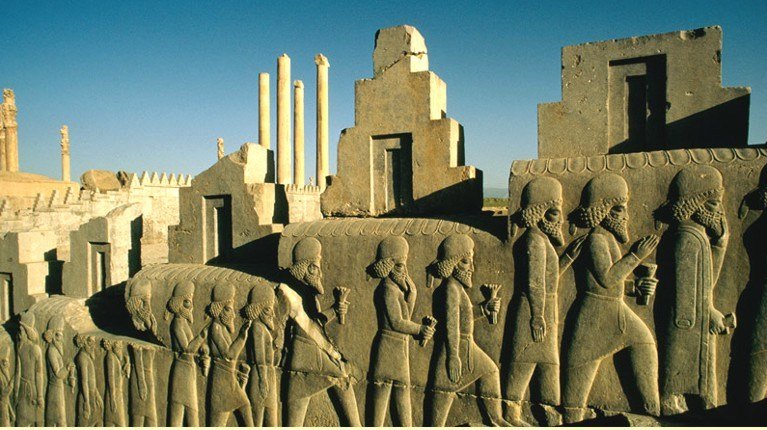
Persepolis includes a number of enormous buildings which exist on its terrace including The Gate of All Nations, The Throne Hall and The Tomb of King of Kings. The façades, porticos, gates and walls of the Persepolis are beautifully ornamented with oriental, Persian sketches and bas reliefs that depict various scenes of the ancient Persian lifestyle.
2- Naqsh-e Jahan Square
Active ImageAlso known as Imam Square, Naqsh-e Jahan Square is one of the world's largest squares, situated at the center of Isfahan city. It is 160 meters wide by 508 meters long. Several remarkable buildings with unique features that render them outstanding historical constructions are located at each corner of this square. One of the most beautiful buildings in Naqsh-e Jahan Square is the Ali Qapu Palace. It was a ceremonial palace belonging to the Safavid Dynasty that ruled Iran from 1501 to 1722. Ali Qapu Palace is 34 meters high with an area of 1,800 square meters, 6 stories and 53 rooms. It was used as the royal fortress of Shah Abbas I.
The northern side of the square opens into the Grand Bazaar of Isfahan which is one of the oldest bazaars of the Middle East dating back to the 17th century. The French jeweler and traveler Jean-Baptiste Chardin has written about the Grand Bazaar of Isfahan extensively. His ten-volume book "The Travels of Sir John Chardin" is one of the remarkable scholarly books written about the history of Ancient Persia.
3- Soltaniyeh
Active ImageSoltaniyeh is one of the cities in Iran's western province of Zanjan. The Soltaniyeh Dome is the world's largest brick-made dome. It also retains the record of world's oldest double-shell dome. In 2005, the Soltaniyeh Dome was registered in the UNESCO list of World Heritage Sites.
The building used to be the capital of Ilkhanid dynasty in the 14th century. The interior mosaics, faiences, murals and frescos of the Soltaniyeh Dome are superlatively beautiful and attractive. They are consisted of Persian calligraphic elements and ornamental components.
The French archaeologist André Godard has described the dome elaborately: "Definitely, it is the most excellent instance of Mongolian architecture and one of the best breakthroughs of Iran's Islamic architecture and perhaps the most attractive one of them technically."
From the viewpoint of architectural importance and historical significance, Soltaniyeh Dome is compared to Italy's Basilica di Santa Maria del Fiore Cathedral.
Iran has seven other historical magnets registered in the UNESCO list of World Heritage Sites: Behistun Inscription in the Kermanshah province, Shushtar Historical Hydraulic System and Chogha Zanbil ziggurat in the Khuzestan province, Bam and its Cultural Landscape in the Kerman province, Pasargadae city in the Fars province, The Armenian Monastic Ensembles of Iran in the Eastern Azerbaijan province and Takht-i-Suleiman in the Western Azerbaijan province.
According to the officials of Cultural Heritage Organization, Iran's 11th international site will be registered in the UNESCO list of World Heritage Sites during the 34th session of the World Heritage Committee that is arranged to be held from July 25 to August 3 in Brasilia, Brazil. The Grand Bazaar of Tabriz which is reportedly the largest covered construction of the world is the 11th site of Iran whose registration proposal was submitted to the committee last year.
Your travel to Iran can be juxtaposed with a lot of dynamism, attraction and interest if you consider visiting the international historical sites of the country as your main agenda. Aside from these sites, a number of undetected and hidden sites are available to be seen by you if your travel is slated to be an impressive and unforgettable exploration of the heart of Iran's longstanding and respectable civilization.
Source: Press TV

Monday, October 21, 2019

10 reasons why tourists must visit Iran

By David Robie

I stumbled on the scene by chance. Our host family in Iran’s second city Mashhad, a modern and beautiful metropolis that would comfortably fit in New Zealand’s entire population, was taking us on a drive to the outskirts to visit the tomb of the famous poet and chronicler Abul-Qasem Ferdowsi.
It just so happened that this was the very day that a new section of the surrounding gardens was being opened and the red carpet was being rolled out for a visiting cultural affairs minister.
Shortly after we arrived, the political scrum began – a mass of photographers, press people and ceremonial guards pressing.
Bodyguards whisked the minister, Ali-Asghar Mounesan, head of Cultural Heritage, Handicrafts and Tourism, into the cavernous tomb among the sculptured friezes of mythical hero Rostam fighting off dragons and monsters in defense of ancient Persia.
The hero’s exploits are featured in the 10th century epic Shahnameh: The Book of Kings, penned by Ferdowsi and comprising some 50,000 couplets.
Ferdowsi is the hometown literary giant and one of Iran’s best universities and medical schools is in the city and named after him. It was opened in 1949.
Modern day Iran is steeped in massive historical and intriguing cultural icons, and also a swathe of mosques and other religious shrines, dating back to the Achaemenian empire founded by Cyrus the Great five centuries before Christ and ancient pre-Islam Zoroastrianism (fire-worshipping), one of the world’s oldest continuously practiced religions  believed to have its roots some 4000 years ago.
Impressive attractions
Some critics say that Iranian authorities since the 1979 Islamic Revolution spend far more and devote greater attention to the religious artefacts and buildings of Islam to the neglect of some historical sites. However, whatever the truth about that Iran boasts a never-ending range of impressive and attractive places to visit.
The tragedy is that not enough is known about the country’s cultural and historical wonders in the West and the refusal of many mainstream travel companies to run regular tours.
Some homegrown Iranian tour operators, worried about the downturn in tourist numbers – a fall in spite of Iran’s plans to boost tourism and visitors by fivefold to 20 million a year by 2025 (blame Donald Trump for the fall) – have now recruited social media “influencers” to tour the country and blog about the attributes.
One group of 12 Instagram global posters with about 16 million combined followers are this month visiting Iran on a familiarization trip organized by Iranian traveler Hoda Rostami and social media “influencer” who is trying encourage foreign tourists to “discover” Iran’s fascinations.
Iran embarked last year on ambitious plans to boost tourism. Neighboring Azerbaijan, Egypt, Georgia, Lebanon, Syria and Turkey have been added to the list of countries whose nationals can get visas on arrival. Getting an e-visa for New Zealanders is now far more straight forward than it used to be – thank goodness for us not being American or British.
Iran also has plans to revive passenger sea lines, including routes between the country and Bahrain, Oman, Qatar and Saudi Arabia – or at least that was the idea before the recent tensions over the Persian Gulf and sanctions-busting for vital Iranian oil exports.
Also there have been reports on plans to build a railway from Iran’s southwestern Khuzestan province, travelling west through Iraq and ends at the Syrian port city of Latakia. This is expected to boost religious tourism, including the massive annual pilgrimage to Karbala.
Having just toured Iran myself while on sabbatical, I highly recommend the country as an absolute must visit.
My bucketlist
Here is my bucket list of 10 reasons why you should go to Iran – but there are also many other reasons.
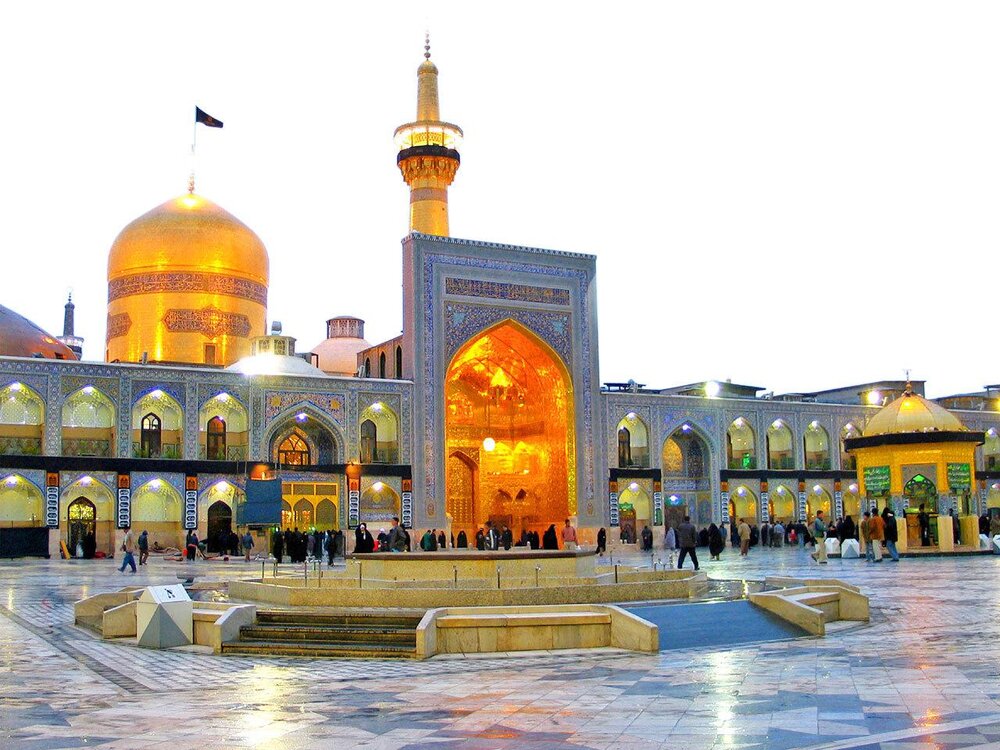
Imam Reza (AS) shrine, Mashhad
The incredibly impressive Haram-e Razavi, the Imam Reza (AS) shrine in Mashhad, is widely regarded as the ‘heart of Shia Iran’. More than 20 million religious tourists visit this vast shrine each year. Affluent Mashhad, Iran’s second-largest city with a population comfortably equivalent to New Zealand’s total, thrives on “religious tourism”. The city is in north with Turkmenistan and Afghanistan.”
Tomb of Ferdowsi, Mashhad
Abul-Qasem Ferdowsi, Iran’s greatest and one of the world’s most renowned poets. He penned the epic mythical and historical Shahnameh: The Book of Kings, the world’s longest poem in the 10th century. With some 50,000 couplets, the original book weighs 75 kilos and chronicles the saga of the early Persian empires until the seventh century Arab invasion and conquest. Ferdowsi’s tomb and museum at Tus are today one of Mashhad’s inspiring attractions.
Naqsh-e Jahan Square, Isfahan
Isfahan’s impressive and peaceful Naksh-e Jahan Square is the world’s largest after Tiananmen. It is indeed a spectacle. Once a vast polo field, the hewn stone goalposts are still at one end. Designed and laid out in 1602 under the reign of Shah Abbas (Safavid epoch) when Isfahan was capital of Iran, it is today a popular place of family picnics and horse-drawn carriage rides. The square is ringed by a maze of fascinating shops and traditional Sheikh Lotfallah bazaar.
Khaju Bridge, Isfahan
The 133m Khaju Bridge and weir is one of several historical bridges across the Zayandeh river, which has started flowing again after being dry for several years. Built about 1650 by Shah Abbas II, the bridge has 23 arches and a place in the middle for a throne for the shah to admire the water flowing by.
Azadi Tower, Tehran
Iran’s impressive Tehran Milad Tower, is at 435m the 6th tallest TV tower in the world. It also has the world’s biggest head structure of any telecommunications tower. The top floor of the 12-level head structure can be reached by high speed lifts within 50sec.
Persepolis, near Shiraz
One of the seven great wonders of the ancient world, Persepolis was the extraordinary capital of Darius the Great in 520 BC, conceived and established following the vast Persian Empire forged by Cyrus the Great. The ruins near Shiraz are still very impressive from the Gate of all Nations onwards.
Karim Khan Citadel, Shiraz
The 18th century Karim Khan Citadel was once a political prison for 40 years. It has a strange “leaning tower” where the impressive bathhouse outflows eroded the foundations over a couple of centuries. The nearby Bazar-e Vakil traditional bazaar network and Hammam-e Vakil bathhouse, which has a display of traditional ablutions, are also fascinating and worth visits.
Tombs of Hafez and Sa’adi, Shiraz
Tombs of Hafez and Sa’adi in Shiraz are major sites for Iranians, and they ought to be for Westerners too.
Golestan Palace, Tehran
An elegant complex standing as a reminder of the glories and opulence of Iran’s Qajar dynasty in the 19th and early 20th centuries. It is where the coronation of Reza Shah took place on a Marble Throne on display and where his son, Mohammad Reza Pahlavi, was also crowned in the Museum Hall before being deposed in the 1979 Revolution.
Sa’ad Abad Museum Complex, Tehran
The Mellat, or White Palace, is the largest mansion in the Sa’ad Abad forest museum complex in north Tehran. This was built in the 1930s and has bullet proof windows. It was used by Mohammad Reza Shah (Pahlavi dynasty), and empress Farah, as a summer palace before he was deposed in the 1979 Revolution. Among the more interesting museums in this complex are one devoted to the exploits of the Iranian adventurer brothers Omidvar and the brilliant contemporary artist Mahmoud Farschian.  
This is a mere introduction to places in Iran to visit, and thanks to Zahra Ebrahimzadeh (our former homestay student), her family and friends for such a wonderful start. I haven’t even mentioned the amazing United Nations heritage old mudwalled town of Yazd on the edge of a desert, or the northwestern mountain city of Tabriz with one of the finest bazaars, and a host of other fascinating places.
When I return, I would love to go to the north of the country and around the Caspian Sea.
Visit Iran and enjoy.

Dr David Robie traveled independently and with no political “minders”. (The text has slightly been edited by the Tehran Times for clarity).

Saturday, October 19, 2019

Apadana Staircase, a way to fabled Persian art

TEHRAN – The ruins of Apadana Staircase shows off and offers scenes of historic Persian arts to its domestic and foreign visitors.
The lavishly decorated monument stands within the UNESCO-registered Persepolis, which was once the ceremonial capital of Persian Achaemenid Empire (550 –330 BC).
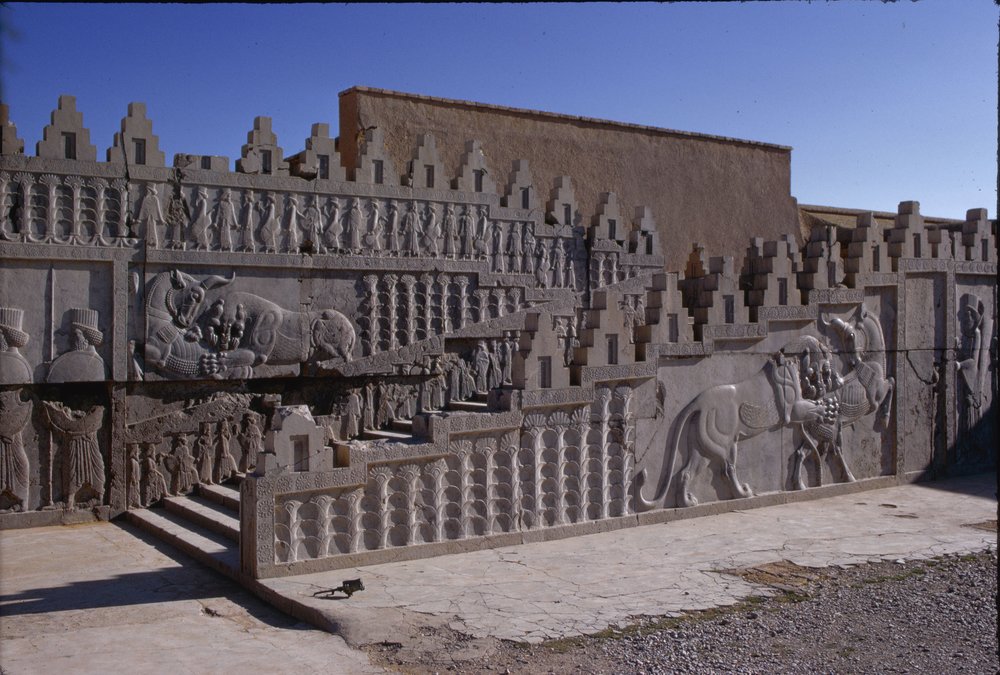
The Staircase features finely crafted frieze in three major panels, each divided into several tiers depicting sovereigns, dignitaries and the then visitors to the city.
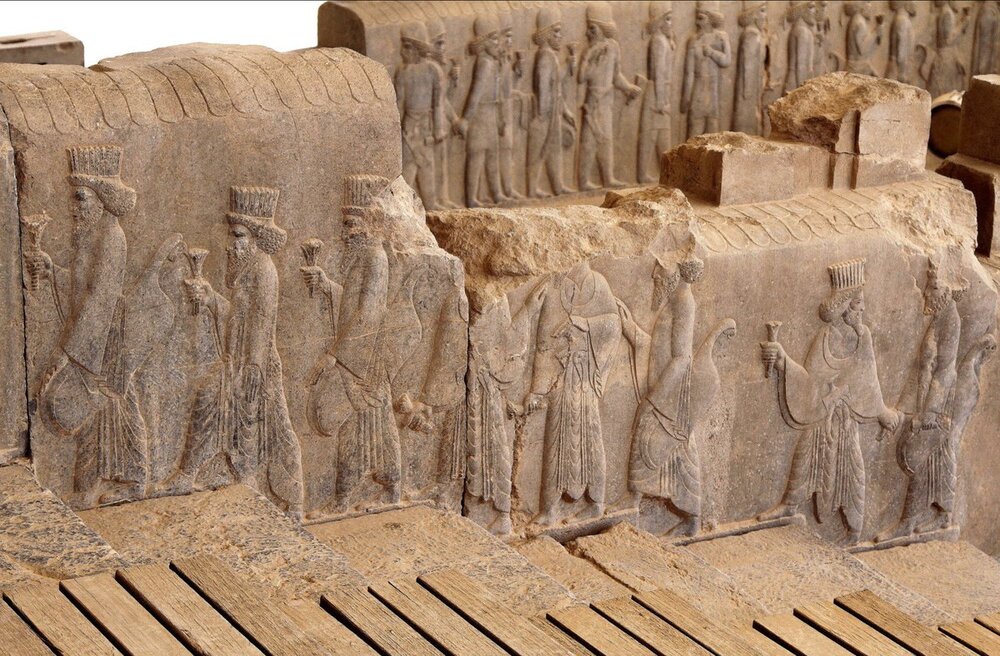
The northern panel itself is divided into three tiers of well-preserved bas-relief figures of Persian nobility including the Imperial Guard and the Immortals.
Detail depicts bas-relief carvings of some tribute bearers on the Apadana Staircase
According to the Lonely Planet, on the upper tier, the figures are followed by the royal procession, valets and horses of the king’s chariot; on the lower two tiers these figures precede Persians wearing feather headdresses and Medes in their round caps.
The central panel of the staircase is dominated by traditional symbol of Zoroastrianism which is flanked by two winged lions with human heads.
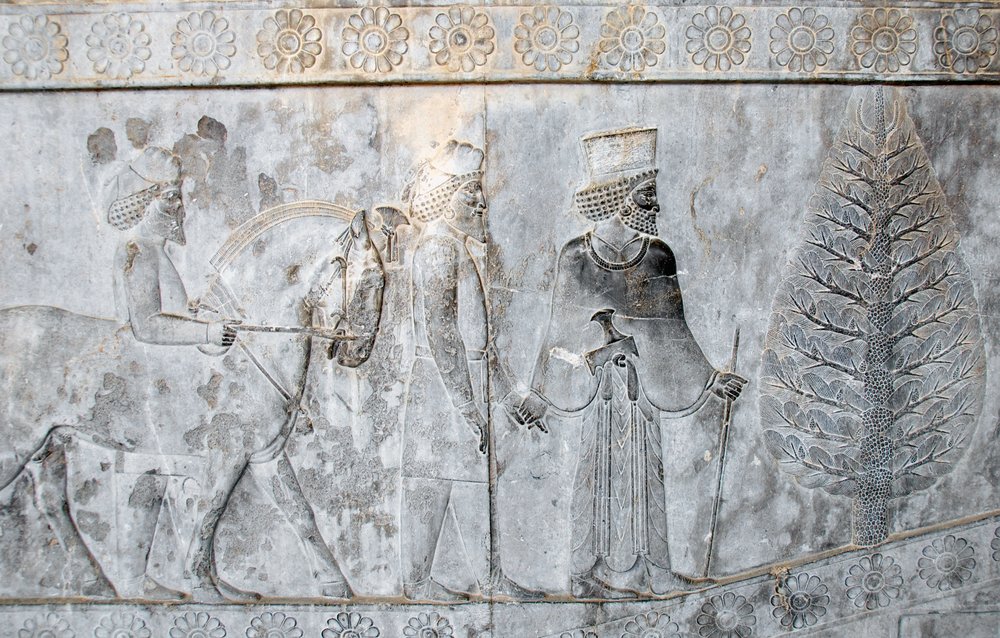
Elaborate panels at the southern end of the staircase depicts a record of nations, showing 23 delegations bringing their gifts to an Achaemenid king. The Ethiopians begin the frieze in the bottom left corner and are joined by Arabs, Thracians, Kasmiris, Parthians and Cappadocians. The Elamites, Egyptians and Medians occupy the panel at top right. Accompanying this pantheon of guests are an assortment of delicately carved sheep with ram’s horns and curled wool, two-humped Bactrian camels, oxen and mules.
A view of the Apadana Staircase in Persepolis
On the northern panel exists inscriptions with fairly stereotypical texts by king Xerxes; one in Old Persian and others in Elamite and Babylonian.
According to livius.org, a website on ancient history written and maintained since 1996 by the Dutch historian Jona Lendering, parts of the inscriptions read as:
“A great god is Ahuramazda, who created this earth, who created that heaven, who created man, who created happiness for man, who made Xerxes king: the king of many kings, one ruler of many rulers.”
“I am Xerxes, the great king, king of kings, king of all nations, having various kinds of people, king in this great earth far and wide, the son of king Darius, an Achaemenid.”
In 330 BC, the staircase was miraculously survived the sack of Persepolis by the soldiers of Alexander the Great. The staircase is currently protected by a permanent shelter.

Wednesday, October 16, 2019

Apadana Staircase leads you to mythical arts of Persia

TEHRAN – Apadana Staircase is one of the most striking sections of the UNESCO-registered Persepolis, southern Iran.
The lavishly decorated monument draws hundreds of domestic and foreign visitors every single day, showing them off scenes of mighty Achaemenid Empire (550 –330 BC) and grandeur of its fabled arts.
Visitors can observe finely crafted friezes along three major panels each divided into several tiers depicting sovereigns, dignitaries and the then visitors to Persepolis.
The northern panel itself is divided into three tiers of well-preserved bas-relief figures of Persian nobility including the Imperial Guard and the Immortals.
On the upper tier, according to the Lonely Planet, the figures are followed by the royal procession, valets and horses of the king’s chariot; on the lower two tiers these figures precede Persians wearing feather headdresses and Medes in their round caps.
The central panel of the staircase is dominated by traditional symbol of Zoroastrianism which is flanked by two winged lions with human heads.
Elaborate panels at the southern end of the staircase depicts a record of nations, showing 23 delegations bringing their gifts to an Achaemenid king. The Ethiopians begin the frieze in the bottom left corner and are joined by Arabs, Thracians, Kasmiris, Parthians and Cappadocians. The Elamites, Egyptians and Medians occupy the panel at top right. Accompanying this pantheon of guests are an assortment of delicately carved sheep with ram’s horns and curled wool, two-humped Bactrian camels, oxen and mules.
On the northern panel exists inscriptions with fairly stereotypical texts by king Xerxes; one in Old Persian and others in Elamite and Babylonian.
According to livius.org, a website on ancient history written and maintained since 1996 by the Dutch historian Jona Lendering, parts of the inscriptions read:
“A great god is Ahuramazda, who created this earth, who created that heaven, who created man, who created happiness for man, who made Xerxes king: the king of many kings, one ruler of many rulers.”
“I am Xerxes, the great king, king of kings, king of all nations, having various kinds of people, king in this great earth far and wide, the son of king Darius, an Achaemenid.”
In 330 BC, the staircase was miraculously survived the sack of Persepolis by the soldiers of Alexander the Great. The staircase is currently protected by a permanent shelter.
Here is a comment that “R0hanL” from Jordan have posted to TripAdvisor, one of the most popular travel websites in the world:
“Stunning ancient ruins”
The ruins at this site are stunning. Some of the ruins have been covered, which gives you a sense of the shape of buildings-especially when you view the site from up the hill from one of the tombs. On the ground, it does take some imagination to "see" the 100 column palace for example, but a good guide book helps a lot to aid that process. The exceptionally carved friezes on the Apadana Staircase, Xerxes Gateway and Royal Apartments were exquisite. We also walked to both the tombs up on the hill, which were very similar to the tombs I had seen in Jordan at Petra. It was very hot the afternoon we were there, so ensure you bring plenty of water as the place to buy water in the site was very removed from the main part of the ruins itself. In all, we thoroughly enjoyed walking through this timeless place.