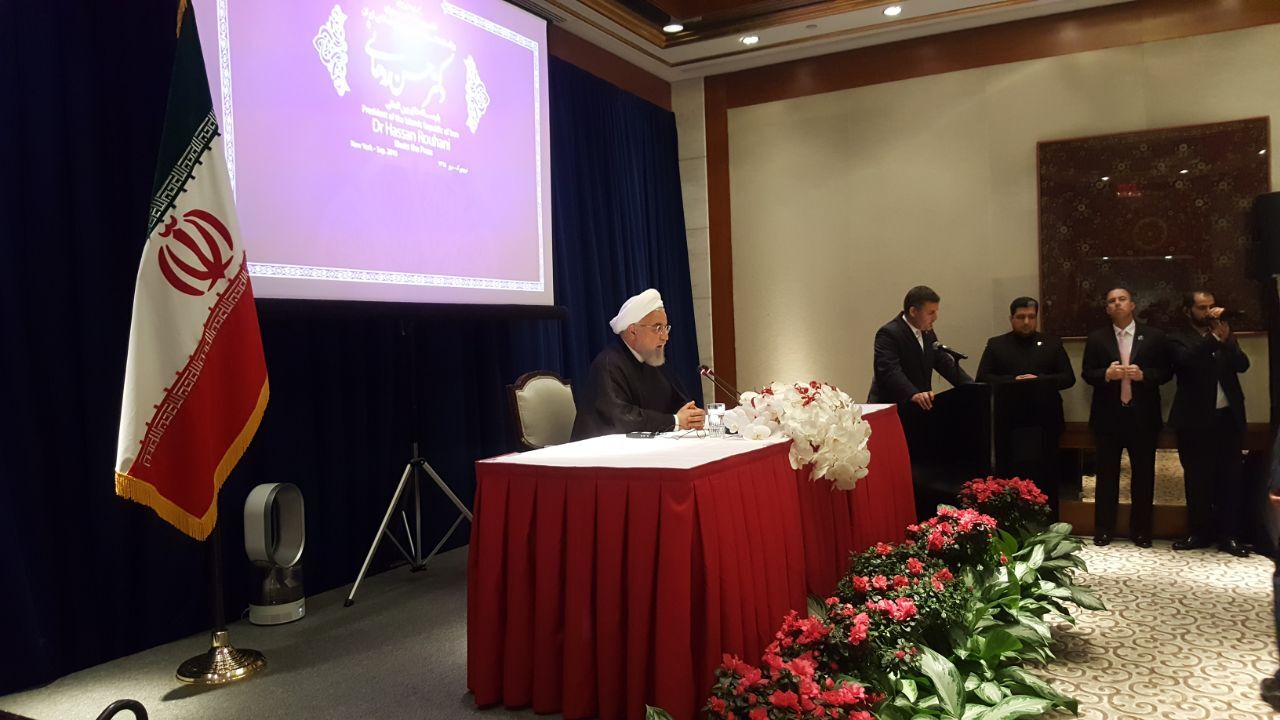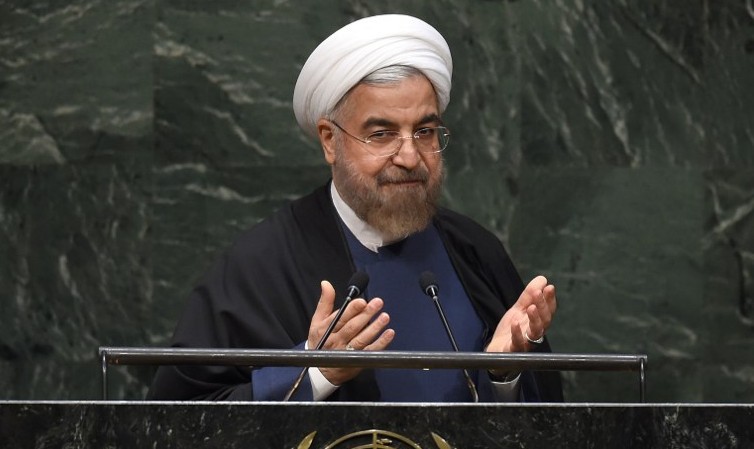
Comparing Iranian president Hassan Rouhani’s speech with that of President Trump’s at the 74th United Nations General Assembly Session this week one cannot but notice the stark differences between their tones, their goals and their contents.
In his deliberately monotonous speech Trump expressed delusional elitist self-grandeur and righteousness as the leader of the global mightiest military power, portraying it as a protectionist global police force that has the right and the capability to enforce specific policies other countries have to adopt and pay for under the guise of paying their fair share for the tremendous defense burden that America had born.
In an implied threat he stressed the fact, that since his election, his administration had spent $2.5 trillion to completely rebuild an unrivaled military power to make the US by far the most powerful nation. Yet he does not see himself as one of the leaders, whom he criticized as those, who thirst for control thinking they are destined to rule over others, nor one of those, who squander the nation’s wealth on nuclear power and the means to deliver them.
Targeting the ever-growing China’s second global economy, Trump announced the placing of massive tariffs on more than $500 billion worth of Chinese goods as part of what he called an ambitious campaign to reform international trade system to make it balanced and reciprocal, stressing that the World Trade Organization needs to be reformed. Here, again, Trump is trying to inforce specific policies that will affect many other countries include the USA itself besides China.
Trump ignored the fact that American corporations had convinced previous administrations to legalize and facilitate the outsourcing of American factories and American jobs to cheaper and more lenient regulating countries such as China. Such outsourcing had caused the high rate of unemployment, the devastation of the middle class, and the growing huge crisis of homelessness, whose existence he totally ignores. Instead he bragged about the fake economic growth, alleged unemployment rate and job creation especially among the minorities, and the claim of 2.5 million Americans allegedly have been lifted out of poverty during his administration.
Trump accused leaders of many countries of suppression, corruption, murder of their own citizens, war-mongering and global terrorism. Focusing specifically on Iran, Trump accused Iran of being the greatest security threat facing peace loving nations. Projecting America’s very well-known record of creating and supporting terrorist groups, as reported many times by armswatch, he accused Iran of being “the first world sponsor of terrorism” with a record of death and destruction fueling tragic wars both in Syria and Yemen. Ignoring the fact that Iran has not attacked any country for the last 300 years, and had helped its neighbors fighting terrorist groups, Trump accused Iran of blood lust when world history is full of documented American blood lust all over the world, perpetrated recently in most South Asian countries, in every Middle Eastern state, in most Africa and in Latin America.
Trump accused Iran of squandering its nation’s wealth on nuclear weapons and the means to deliver them although the American CIA itself and IAEA report that Iran is compliant to the NPT and to the JCPOA agreements and has all its facilities open to IAEA inspections. Trump justified US withdrawal from Iran’s nuclear deal because it is a terrible deal (all Obama’s administration’s deals are bad deals to Trump) that did not include ballistic missiles. In reality it was the best deal for the US since it did not put any reciprocal limitations on the American nuclear weapons program nor on those of the other four countries as it did on Iran’s nuclear program. Let us not forget that previous American administrations was helping Iran, during the Shah’s regime, developing nuclear weapons program.
Trump justified imposing the highest level of sanctions on Iran Central Bank and Sovereign Wealth Fund due to the alleged Iranian attack on Saudi Arabian oil facilities. The US as well as many other countries have failed to provide any tangible evidence of Iran’s responsibility of the attack, and had totally ignored the Houthis’ claimed responsibility of it. The Houthis had demonstrated in the last few months their military capabilities when they bombed other Saudi oil facilities that were not then attributed to Iran.
The real reason behind American animosity towards Iran was revealed when Trump accused Iran of being anti-American and anti-Semitic calling Israel a malignant cancer tumor that has to be removed and eradicated, something the US will never allow. The anti-Semitic accusation here is actually anti-Zionist not anti-Jewish. Trump as well as all the western leaders, ignores the fact that outside of Zionist occupied Palestine (Israel) Iran has the largest Jewish community in the world, living peacefully with a representative Jewish Member of Parliament. The worst anti-Semites is Zionist Israel, whose distorted religious creed and political zeal are against Semitic Arabs; for Arabs are the real Semites while most Zionist Israelis are Ashkenazi.
As for anti-American feelings and death to America chants, these are normal reactions to hostile aggressive American policies towards Iran that included the 1953 toppling of the democratically elected Mossaddeqh’s government, the opposition to the 1979 revolution, the American support to 1980-88 Iraq’s war against Iran, and the 40 years economic sanction wars. Let us also not forget the calling to bomb Iran to the Stone Age by many American and Israeli officials and major news media.
In his speech Iranian President Hassan Rouhani, in contrast to Trump, called for mutual trust, commitment to signed international deals, neighborly mutual respect, dialogue, unity and cooperation to achieve regional peace and stability without any interference into the internal affairs of neighboring countries, and to guarantee the security of free oil flow from each gulf country. He affirmed that Iranian, not foreign, forces are the major security and stabilizing factor for the freedom of navigation in the Persian Gulf, Strait of Hormuz and Sea of Oman.
A great part of his speech was a comparison between the disruptive American interference in the region and the stabilizing security-promoting Iranian efforts. He hinted that such American interference had inflamed the Middle East with wars of extremism, Fanaticism, terrorism and occupation. He saluted all the freedom fighters, who do not surrender to tyranny in countries like Afghanistan, Iraq, Syria, Yemen, and Palestine, describing the Palestinians as the biggest victims of Zionist occupation, discrimination, appropriation of land, settlement expansions and killings. He accused successive American administration of supporting this Zionist terror with Trump recently recognizing al-Quds (Jerusalem) as capital of Israel and acknowledging the Syrian Golan Heights also as part of Israel.
Compared to this American destructive injustice, Iran had worked to promote peace in the area such as its cooperation with Russia and Turkey through Astana Conferences to promote peaceful resolution in Syria, and had also cooperated with the UN to facilitate reconciliation talks among Yemen parties with the four European countries resulting in the Stockholm Peace Accord concerning the Yemeni Hodeida port.
Rouhani described the American administrations as addicts to economic sanctions against Iran for the last 40 years that had also affected many other countries as well. He described these sanctions as economic terror attacks and international banking piracy, whose goal is to deprive Iran from participating in the global economy. He asserted that these sanctions were ineffective and had succeeded only in motivating Iran to depend on its own national resources that led to innovative solutions resulting in economic independence and growth rather than bankruptcy.
Rouhani explained that Iran promotes moderation reminding the Assembly of Iran’s sponsor of the initiative of the World Against Violence and Extremism (WAVE) four years ago in this same assembly. The JCPOA is another case in point. The deal was the outcome of two years of intensive multilateral negotiations, overwhelmingly applauded by the international community, and endorsed by the Security Council as a part of Resolution 2231. As such, it belongs to the international community in its entirety, and not to only one or two countries. The deal can become a new model for global interactions based on mutual constructive engagement between all nations.
Rouhani accused the US of violating UNSC resolution 2231 when it unilaterally withdrew from the JCPOA. Such an action constitutes a breach of the sovereignty, political and economic independence of all the world’s countries. By violating its international commitments, Trump’s administration had only destroyed its own credibility and undermined international confidence in negotiating with it or accepting its word or promise.
Despite the American withdrawal Iran remained committed to the deal giving the Europeans the opportunity to fulfil their commitments. Yet so far Europe seems not capable of fulfilling their commitments leaving Iran no choice but to rely on its own strength as Rouhani explained. Maybe Iran would take Trump’s advice to think of Iran first as he thinks of America first.
Although Rouhani had emphasized that Iran will never negotiate under sanctions, he left a door open when stating that the only way for negotiations to begin is to return to previous commitment and compliance. If the US is satisfied with the JCPOA, which is a minimum, then Iran will accept it, and it could be accomplished through the supervision of the IAEA. It is left to the US to reconsider.
Rouhani explained that the Iranian security doctrine is based on the establishment of peace and stability in the Persian Gulf and providing freedom of navigation and safety of movement in the Strait of Hormuz and in the Sea of Oman. He explained that the free flow of oil and other energy resources through these areas can be guaranteed when the countries of the region participate together to build a security umbrella covering all regional countries. So he proposed the forming of a “Coalition of Hope; a Hormuz Peace Endeavor” to promote peace, stability, progress and welfare for all countries of the region and to enhance mutual understanding and peaceful and friendly relations amongst them.
He proposed further that this coalition should be based on important principles such as the compliance with goals and principles of the UN, mutual respect, dialogue and understanding, respect for territorial integrity and sovereignty, inviolability of international borders, peaceful settlements of all differences, and more importantly; two fundamental principles of nonaggression and non-interference in the domestic affairs of each other. He added that the UN presence is necessary for the creation of international umbrella in support of this coalition.
Rouhani explained that the most effective peace coalition is that which is formed by the neighboring countries in the Gulf region. Any similar coalition under the centrality and command of foreign forces would be a clear example of interference in the affairs of the region. A foreign coalition would be in contravention to the right of free navigation and the right to development and would escalate tensions, further complicate conditions increasing the mistrust in the region, and would jeopardize regional peace and security.
Rouhani emphasized that such security will not be achieved by American military presence nor by interventions using American weapons. He explained that after 18 years of American intervention in the region the US has miserably failed to even reduce acts of terrorism. The US has miserably failed in Afghanistan, in Iraq and in Syria. The security of the region is a larger matter than the US could handle while Iran had managed to terminate the scourge of Da’ish (ISIS) terrorists with the assistance of neighboring nations and governments.
He emphasized further that security cannot be purchased or supplied by foreign governments, rather it can be achieved by the cooperation of the neighboring countries. America is not in the neighborhood, and as the Arabic saying goes “seek good neighbors before buying a home” he explained.
Rouhani addressed the Saudis advising them that when Yemeni self-defense reaches the Saudi area of Hejaz then they should seek the original warmonger for punishment, rather than spewing unsubstantiated accusations against the innocents. He advised that the security of Saudi Arabia can be guaranteed by the termination of aggression on Yemen rather than spending their fortune on expensive American weapons and inviting foreign troops to defend them.
Rouhani warned that the region is at the edge of collapse; a single plunder can fuel a huge fire. He warned that Iran will respond decisively and strongly to any sort of aggression to its sovereignty and territorial integrity. He underscored that Iranian defense capabilities including missile systems are solely defensive deterrents for the maintenance of regional peace and stability. The ultimate peace and security in the whole Middle Eastern region passes through inward democracy and outward diplomacy.
Instability and extremist violence have only been exacerbated in the region through the military interventions of extra-regional actors; the US, who try to sell ever more of their deadly weapons to other states by accusing Iran of fomenting instability. The security of the region shall be provided when the American military pulls out of it leaving the Gulf States to handle their own security by themselves. Rouhani stated.
Rouhani concluded his speech with a message from the Iranian nation: let us invest in hope for a better future rather than in war and violence, let us return to justice, to peace, to law, to commitment and promise, and finally to the negotiating table.
Iran’s call for the initiative of the Alliance of Hope; Hormuz Peace Endeavor, could be a very successful and practical method of creating a peaceful and secure Middle East enhancing and securing global economy. Yet, it is very idealistic and hard to achieve in our still imperialist might is right world.
Dr. Elias Akleh is an Arab American from a Palestinian descent. His family was evicted from Haifa, Palestine, after the 1948 Nakba when the Zionists stole his family’s property. Then the family was evicted again from the West Bank during the 1967 Naksah, after the Zionist, again, occupied the rest of Palestine.