Showing posts with label attack on the Aramco oil facilities. Show all posts

Friday, October 04, 2019

Israel is worried about the targeting of Saudi Arabia by Iran and its allies

Dr Adnan Abu Amer
Smoke billows from Aramco facility in Abqaiq, Saudi Arabia after drone strikes set fire to the major oil facilities. Captured by a Planet Dove satellite on September 14, 2019 [Planet/Twitter]
As alleged Iranian and Houthi attacks against Saudi Arabia increase — the most recent being the attack on the Aramco oil facilities — Israel’s concerns are mounting, and not just about the attacks on its would-be ally. Israel is also dissatisfied with Washington’s reaction, which it described as lacklustre. There is a fear in Tel Aviv that the next Iranian attack will be against Israel itself.
The Aramco attack, attributed to Iran (which denies any involvement), poses a future threat to Israel, with its implied threat that the Zionist state could be surprised soon. It was planned deliberately and very carefully, and is likely to leave a lasting effect on the Middle East. That is the Israeli perspective, at any rate.
Israeli Prime Minister Benjamin Netanyahu in Moscow, Russia on April 4, 2019 [kremlin.ru]
Moreover, the US failure to respond adequately — in Israeli eyes — against Iran after the attack on Saudi Arabia means that it has surrendered its deterrent power. This must also concern Israel, given that the attack on the Aramco facilities in Saudi Arabia is said to have been the most dangerous since the beginning of the year.
While some of the details of the Iranian attack on Saudi Arabia are still unclear, the fact that the US seems to be content with imposing sanctions on Iran and nothing more puts Tel Aviv, Riyadh and Washington in the front line of a common challenge: the possibility of a greater threat emerging.
Israelis are convinced that Iran’s vision of this “modest” US response to the attack on Saudi Arabia could encourage it to carry out more strikes in the region. Their own country could be next, as could so-called moderate, pro-American Arab states. In fact, the feeling in Tel Aviv is that the US has not only reduced its level of sponsorship of states in the region, but that this also means that Israel’s own deterrent factor has been reduced. Thus, the Israelis have to be more alert to the possibilities of Iranian attacks heading their way, and get ready to boost their missile defence systems.
In the meantime, security sources in Israel have confirmed that the recent attacks in Saudi Arabia were a test for the US, not least President Donald Trump’s foreign policy. His “lacklustre” response is his way of saying that the attack in Saudi Arabia did not affect US interests directly, as his tweets suggested clearly; it was a Saudi affair, not American. If Iran attacks Israel, the worry in Tel Aviv is that Trump will say that it is an Israeli affair, nothing to do with America.
While it is true that Israel’s standing in America is different from that of Saudi Arabia, and Israeli Prime Minister Benjamin Netanyahu has close ties with Trump and the US Congress, Israel cannot guarantee that its favoured nation status will continue forever. What’s more, an alliance with the US may actually restrict Israel’s options should it want to attack Iran itself.
It is important at this time to consider the impact of the attack on Saudi facilities on the growing Israel-Saudi relations, especially with more details coming out about increasing Israeli involvement in the Yemen war. Such involvement with the Arab states includes Israel’s interference in the Strait of Hormuz, as if it has solved all of the problems it faces at home and has time and money spare to venture further afield.
With Israel participating in the International Maritime Security Construct in the Gulf, it is clear that its interests are part of a strategy to contain the Iranian threat. It is also cooperating with Riyadh and Washington with an official presence in the Bab Al-Mandab Strait, where the Houthis threaten the shipping routes for the Arab oil states through the Red Sea and Suez Canal to Europe and beyond.
Israeli-Saudi relations are developing around common interests and regional issues, a fact that Netanyahu has been proud to make public. A number of meetings between the two states have been held, including one attended by the late Mossad chief Meir Dagan and his Saudi counterpart, for example, as well as one with former Prime Minister Ehud Olmert and Saudi Prince Bandar Bin Sultan, the former head of Saudi intelligence. The qualitative leap in relations between Riyadh, Tel Aviv and Washington occurred in 2015, following the death of King Abdullah of Saudi Arabia. King Salman took the throne and appointed his son Mohammad as Crown Prince. Since then, Mohammad Bin Salman, Netanyahu and Trump have shared an interest in curbing Iran’s growing regional influence.
Finally, it is true that Israel has maintained an official silence over the Iranian attack on Saudi Arabia, but in security, military and diplomatic forums it has expressed its desire for it to be a catalyst for greater cooperation and coordination between Riyadh and Tel Aviv. Such developments may prompt Saudi Arabia and Israel to establish a regional alliance in the face of perceived security threats that worry them both.

Friday, September 27, 2019

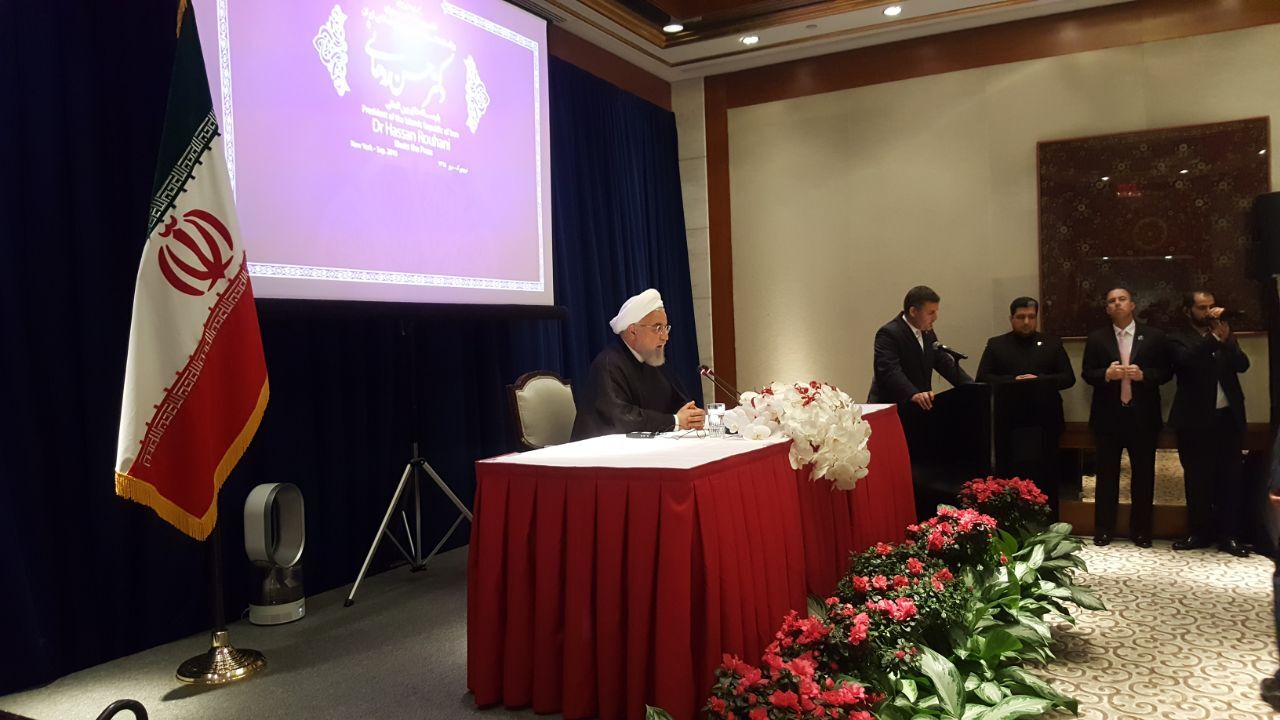
Pres. Rouhani urges governments to live up to JCPOA commitments

Pres. Rouhani urges governments to live up to JCPOA commitments

New York, Sept 27, IRNA – President Hassan Rouhani said in a press conference on the last day of his visit to New York that the governments should live up to their commitments under the JCPOA as the commitments are bilateral, not unilateral.
Full text of his statements during the news meeting is as follows:
Speaking in a press conference with representatives of international media in New York on Thursday evening, President of the Islamic Republic of Iran added, “This year, we had a very intensive schedule, mainly discussing the Joint Comprehensive Plan of Action (JCPOA) and how to implement nuclear agreements, as well as the stability and sensitivity and the need for peace and security in the region and the end of the bloodshed in Yemen."
The president continued, "At the 74th Session of the UN General Assembly, we presented the Hormuz Peace Endeavour (HOPE) initiative with the aim of emphasizing that vis-à-vis the Persian Gulf and the Strait of Hormuz and the Sea of Oman, the only way is have a constructive dialogue between countries in the region."
Dr. Rouhani pointed out, "In some cases, we have had some success in our negotiations and in some cases we still have to pursue the matter until our efforts have bear fruit."
Answering a question on the attack on the Saudi oil facilities, he said, “Why should we explain about Yemen and the attack on the Aramco oil facilities? What does it have to do with us?"
Dr. Rouhani continued, "Today, there is a bloody war in the region; a fruitless war against Yemen. The Yemeni people have the right to self-defense and they have to defend themselves, and the whole world knows that the Yemeni forces and the Yemeni army have both long-range missiles and drones."
The president emphasized, “Those who accuse others must present their evidence; if the invasion was not from the south and from the north, east or west, those who claim must make their claim clear."
"I asked some European leaders who had made false accusations about their evidence, and they said they had no evidence, but they thought the Yemeni forces were less capable than carrying out such an attack. In response, I asked them if their lack of knowledge about the Yemenis’ capabilities would lead to such conclusion and accusations,” added Rouhani.
The president added, "I even told them if you have any evidence, be sure to send them to me, and I would like to see what your evidence are, so let’s come together instead of leveling accusations, and put out the flames in the region."
"I urge the United States, France, Britain and Germany, who are constantly giving arms to Saudi Arabia and the Emirates to kill the Yemeni people, to stop sending weapons and to pressurize Saudi Arabia and the UAE for peace," Rouhani added.
"The Yemeni people and army announced a few days ago that they were ready for a complete ceasefire, and that all activities would be stopped if Saudi Arabia and the United Arab Emirates stop their attacks," the president said, adding, “Unfortunately, after this announcement, we are still seeing attacks on innocent Yemeni people."
Stating that, “Yemen has used its right to defend against the Saudi aggression, why should Iran be accused?” He also went on to say, “I asked European leaders what their evidence were about Iranian interference; they had no evidence."
“The JCPOA was the result of two years of seven-party negotiation and UN endorsement, but the US violated the UN Security Council resolution,” continued Rouhani.
“Our students were not given visas, but they entered contests online and won,” he said, adding, “Maximum pressure is the American precondition for negotiation, we will not accept that."
Saying that, “The P4+1 pledged to execute the JCPOA,” Dr Rouhani added, “Europe proposed many financial systems, but has proven to be incapable or unwilling to act”.
He also said, “It is not possible that Europe stays in the JCPOA Iran, but only Iran pays the price,” adding, “We will continue to negotiate with the JCPOA parties, if they do not fulfill their obligations, the reduction of the commitments will continue."
Dr. Rouhani also went on to say, “The French president is looking for a solution, but when we approached the Europeans, they said that they had to get America's approval as well!,” adding, “Other than France, other parties are working on a solution."
“The US wanted to separate the Iranian nation from the government by the use of sanctions, but it did not succeed,” said the President.
He added, “Trump himself has chosen a way which has resulted in increasing hatred with Iranian public opinion."
“We are OK with negotiations; if they prove their honesty and lift sanctions, conditions will be different,” continued Rouhani.
He also said, “We have spoken to the United States several times for the release of prisoners and sometimes succeed; we have released an American-Lebanese citizen but the US government has not fulfilled its obligation."
On the issue of exchange of prisoners, Dr. Hassan Rouhani said, “It is now the United States’ turn."
Our relations with Japan are very friendly, he said, adding, “Mr Abe is still trying to lift sanctions; hopefully the US will find out that it has taken the wrong path for the past 18 months."
“"Italy is one of the most important trading partners of Iran and we continue to have close bilateral and international relations with them," he said.
Dr. Rouhani continued, “The third step in reducing JCPOA commitments was to lift restrictions on nuclear research and development, with the IAEA's knowledge."
Stating that, “We have not restricts or limited IAEA’s monitoring,” the President said, “Our goal now is not the level of enrichment, but faster installation of advanced centrifuges for research and development."
He also said, “Europe's credit plan is still on the table, but Europe's problems are their own concern,” adding, “Our new offer in New York was the lift of all sanctions; it didn't work out here, but we'll continue it."
President Rouhani also said, “The only way the United States knows is to put more pressure for negotiation, which is what keeps them away from negotiation."
Stating that, “We are developing our relations with China in all aspects,” the President continued, “JCPOA commitments are bilateral, not unilateral."
He also went on to say, “If the other side reduces its commitment, we will also reduce our commitments accordingly."
The President of the Islamic Republic of Iran added, “If P4+1 now declares that it has fulfilled all its obligations, we will return to our obligations as well”, saying, “The goal of reducing Iran's JCPOA obligations is to implement it."
“Both the security of Turkey's borders and Syria's territorial integrity must be maintained,” he said, continuing, “Americans must get out of Syria, Idlib must be cleared of terrorists, and the Syrian army must take the security of its northern borders."
Dr Rouhani stated, “I advise the US not to engage in missile talk, or they will come out indebted,” adding, “US arms sales in the region have created imbalances in the region."
"Legal proceedings will continue and the Stena Impero will be released,” said President Rouhani.
He added, “Continuation of Yemen's war is not in anyone's interest; problems with Saudi Arabia will be settled more properly if a ceasefire is established."