
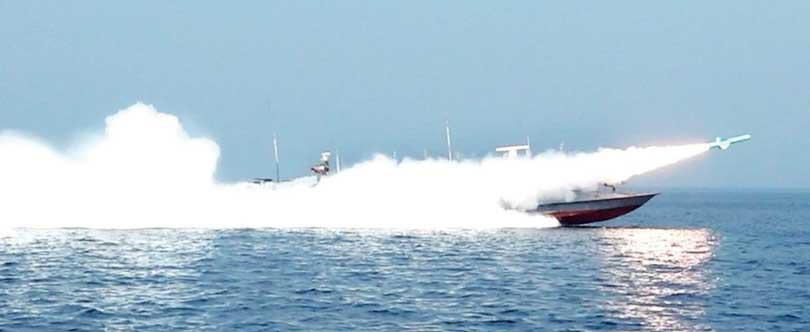
A rocket being fired from a boat during a military exercise by Iran in the Strait of Hormuz on Tuesday.

The United States is adopting a dangerous strategy in its bid to force Iran to yield. Washington seeks nothing less than the total submission of Iran’s sovereignty. To achieve its objectives, it engages in talks while keeping a gun to Iran’s leadership—believing, mistakenly, that gunboat diplomacy will compel Iran to surrender. The dispatch of the USS Abraham Lincoln to the Persian Gulf ahead of talks in Muscat, Oman, was a clear signal of coercion. Under pressure from allies such as Saudi Arabia and Turkey, Washington later withdrew the carrier and scaled down its military buildup amid Iranian threats to unleash a regional war.
The indirect talks in Oman on February 6 produced a modest breakthrough. They helped break the ice, with both sides agreeing to meet again in Geneva under Oman’s mediation.
During the Muscat round, Washington adopted a maximalist position: demanding Iran dismantle its nuclear programme under international supervision, curtail its ballistic missile capabilities, and cease support for non‑state actors across the Middle East. Iran responded calmly, asserting that a peaceful nuclear programme was its sovereign right, its missile programme non‑negotiable, and support for freedom causes a moral obligation. Still, Tehran agreed to international supervision of its nuclear programme and, according to US media reports, even offered to freeze it for three years and transfer already enriched uranium to a friendly country.
It is against this backdrop that a panicked Israeli Prime Minister and International Criminal Court war crimes suspect, Benjamin Netanyahu, made a hurried visit to Washington last Wednesday and held talks with Trump. He feared a US–Iran deal would lead to the lifting of sanctions and, in turn, make Iran stronger.
With Netanyahu arm-twisting Trump with kompromat material obtained from convicted child sex predator Jeffrey Epstein’s resorts, the US president is now gearing up for a military strike on Iran—regardless of ongoing talks.
Since Netanyahu’s visit to Washington, a massive US military buildup has been underway. On February 13, the US dispatched the USS Gerald R. Ford to the Gulf region. American bases across the Middle East are being replenished, and highly sophisticated aircraft such as the F‑35 are being deployed. According to US media reports, more than 150 US military cargo flights have moved weapons systems and ammunition to the Middle East in recent days.
All this unfolded even as Trump’s advisers Jared Kushner and Steve Witkoff met with Iran’s Foreign Minister Abbas Araghchi for indirect talks in Geneva on Tuesday.
Talks are all the more reason why a new US–Israeli aggression against Iran appears imminent. Dialogue offers no guarantee that Washington and Tel Aviv will act decently. Beasts do not respect international law. Peace is an anathema to them, though they wear the garb of peace to conceal their predatory nature.
Take, for instance, the so‑called Board of Peace that Trump heads, with the pompous claim that he will bring peace to Palestine. For the seasoned observer, however, this board is a deceptive device designed to pave the way for the displacement of the Palestinian people from their homeland.
In recent weeks, Israel has intensified measures to annex Palestinian lands in the West Bank. One such measure is to declare Palestinian lands as Israeli state property if the occupants lack documents to prove ownership. This is outright robbery, yet neither the US administration nor the Board of Peace—which includes several Muslim nations—has condemned Israel’s actions, despite their clear violation of international law.
Once bitten, twice shy, Iran is well aware of deceptions imperial nations resort to. It learned a bitter lesson in June when the 12‑day US–Israeli war against Iran erupted in the midst of talks between Washington and Tehran. This time, it has entered talks while placing the country on full military alert. Iran has already warned that any US attack will trigger a regional war—one Washington would regret.
Iran is no Venezuela, Iraq, or Afghanistan for a gung‑ho US regime to march into with military might and impose regime change. Iran will not yield to American pressure.
In terms of military parity, Iran is nowhere close to the United States. But wars are not decided by might alone. In Vietnam, poorly armed communist freedom fighters dealt a humiliating defeat to the mighty US in the 1970s. In Afghanistan in 2021, US troops, under Trump’s watch during his first term, made an embarrassing retreat, handing the country back to the very Taliban it had fought unsuccessfully for two decades.
In a speech on Tuesday in Tehran, Iran’s Supreme Leader Ali Khamenei declared that the United States would never succeed in toppling the Islamic Republic and warned that even the world’s strongest military could suffer crippling blows. He reminded Iranians that the US had tried and failed to topple the Republic for 47 years—and will fail again. The latest regime change failure occurred last month when Iran successfully crushed a street-protest putsch funded by the US and Israel.
Khamenei spoke beneath a Quranic verse inscribed on the stage backdrop. The symbolism was unmistakable, and US intelligence operatives watching the speech could not have missed its warning. The verse (2:194), while advocating peace, disarmament, and proportionality in response if war is imposed, states: “…So, if anyone commits aggression against you, retaliate in the same manner, but fear Allah and know that Allah is with those who are mindful of Him.”
The Iranian leader warned, “They (the U.S.) keep saying they have sent an aircraft carrier toward Iran. Very well, an aircraft carrier is a dangerous device, but more dangerous than the carrier is the weapon that can send it to the bottom of the sea.”
This week, Iran, the last Middle Eastern bastion against US imperialism, held military drills with Russia and its own live drills in the Strait of Hormuz, effectively demonstrating its ability to sink warships and shut down the vital chokepoint through which 20 per cent of the world’s oil supply flows. Reports also suggest that Iran has acquired advanced Chinese weapons systems, though both nations remain tight‑lipped. China is a strategic partner of Iran, with at least 80 per cent of Iran’s oil exports going to Beijing.
Dismissing Iran’s resolve to fight any imposed war to the last citizen, Trump is preparing to take America into conflict with Iran at Israel’s behest. Should the US sacrifice thousands of its soldiers to sustain an illegitimate and genocide-committing state that has in its possession more than 350 nuclear warheads? Such debate is rare in America, where the Israeli‑influenced mainstream media has warped public thought and moral compass.
CNN and CBS reported on Wednesday that the US military would be ready to launch strikes against Iran as early as this weekend, though Trump has reportedly not made a final decision yet. One Trump adviser told news website Axios: “The boss is getting fed up. Some people around him warn against going to war with Iran, but I think there is a 90 per cent chance we see kinetic action in the next few weeks.”
This brinkmanship recalls lessons from game theory—particularly the Game of Chicken, where two players race—like cars on a collision course—toward catastrophic confrontation, each hoping the other will swerve first. The one who yields is branded the “chicken”. If both yield, peace prevails; but if neither does, both face destruction—along with the wider region, with disastrous consequences for the world.

No comments:
Post a Comment