
By Iqbal Jassat
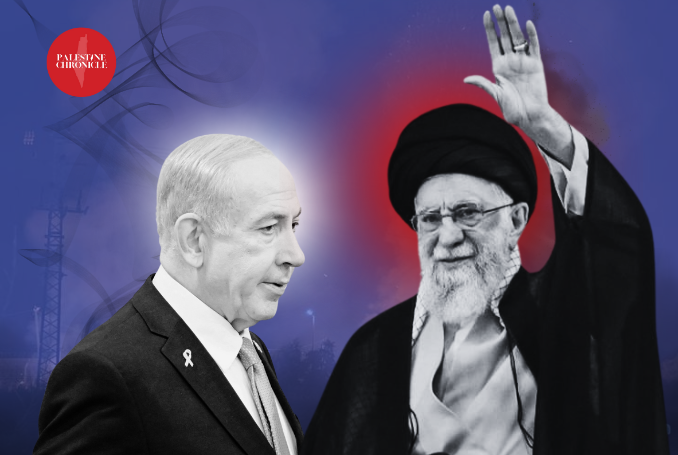 Iranian Supreme Leader Ali Khamenei (R) and Israeli Prime Minister Benjamin Netanyahu. (Design: Palestine Chronicle)
In stark contrast to the Islamic Republic of Iran—whose institutions, despite immense external pressure, remain intact—it is Israel that has emerged as the true agent of regional chaos.
“The state is being transformed into one with hollow institutions, driven by messianic religious ideology and sustained by military force,” observes Abed Abou Shhadeh, a political activist based in Jaffa.
Against the hazy fog generated by the Netanyahu regime’s orchestrated campaign of violence and deception—one aimed at destabilizing the Islamic Republic of Iran, parachuting in a US-based monarchist, and resurrecting the discredited and abominable ‘Peacock Throne’—one could be forgiven for assuming that Shhadeh was describing Iran.
He was not.
Shhadeh was referring to the Zionist settler-colonial regime itself.
The reasons he offers make this abundantly clear. In the near-total absence of a meaningful domestic opposition, Israel is systematically dismantling its own state institutions, entrenching executive power, weakening the judiciary, and eroding long-standing political and social norms.
Shhadeh correctly argues that Netanyahu is gambling on the assumption that even the façade of democracy and respect for human rights is no longer required.
Israel’s arrogant and contemptuous defiance of the UN Charter and international law only reinforces a long-standing truth: Israel was never a liberal democracy, but rather a project sustained by exclusion, militarism, and impunity.
With global attention deliberately redirected toward Iran, Netanyahu and his criminal cabal of warlords have seized the opportunity to further encourage Donald Trump’s administration to retreat from international institutions and applaud the accelerating collapse of the global rules-based order.
Despite record levels of Israeli emigration—so-called ‘reverse aliyah’—and the regime registering its lowest population growth rate in decades, Netanyahu’s obsession with killing Palestinians and confronting their allies across the region has not diminished.
On the contrary, his appetite for perpetual war has only intensified, emboldened by the knowledge that Trump remains a faithful poodle—willing to partner in the orchestration and execution of regime-change operations against Iran.
When Netanyahu launched a full-scale military assault on Iran in 2025, his objectives extended far beyond sabotaging Iran’s nuclear capabilities. Regime change was always central to the plan.
The expectation was that sustained military strikes would trigger widespread unrest, paving the way for the collapse of the Islamic Republic.
On both fronts, Netanyahu failed—despite dragging the United States into the conflict and unleashing American military power.
Long before this humiliation, Netanyahu had already established himself as the chief architect of what analysts have described as a decades-long shadow war against Iran.
This covert campaign has included the targeted assassinations of Iranian nuclear scientists, extensive cyberattacks, and the establishment of Mossad networks and sleeper cells funded by vast sums of illicit cash.
Reporting from Jerusalem, New York Times correspondent David M. Halbfinger noted that no country follows developments inside Iran more obsessively than Israel, which views the Islamic Republic as both a mortal enemy and an existential threat.
Halbfinger confirmed Netanyahu’s fixation, noting how Iran’s leadership—particularly Supreme Leader Ayatollah Ali Khamenei—has been relentlessly portrayed by the Israeli prime minister as a global menace on par with Nazi Germany.
Journalist and author Mel Frykberg has extensively documented Netanyahu’s long-standing regime-change ambitions toward Iran.
She recalls that as early as 1992, Netanyahu—then a member of parliament—warned that Iran was just three to five years away from developing a nuclear bomb. In his 1995 book Fighting Terrorism, he repeated the claim, asserting Iran was ‘five to seven years at most’ from assembling a nuclear weapon.
Frykberg further reminds us that in 1996, Netanyahu was presented with a policy document titled A Clean Break: A New Strategy for Securing the Realm, drafted by a study group led by American neoconservative Richard Perle.
The document openly advocated regime change across North Africa and the Middle East, proposing the overthrow of seven states to be replaced with regimes more pliable to Israeli and US strategic dominance.
The sequence was explicit: Iraq first, followed by Syria, Lebanon, Libya, Somalia, Sudan—and finally Iran. Peace negotiations with the Arab world were dismissed as inferior to coercive regime change.
In 2006, former US General Wesley Clark revealed that he had been shown a classified Pentagon memo outlining a nearly identical strategy: the toppling of seven countries in five years—Iraq, Syria, Lebanon, Libya, Somalia, Sudan, and Iran—each perceived as hostile to US and Israeli interests.
Seen through this historical lens, recent attacks on Tehran are not aberrations, but the continuation of a long-standing joint US-Israeli project.
Yet Netanyahu’s gravest challenge today is not ideological—it is internal, structural, and existential.
“The Israeli state is rapidly becoming a hollowed-out shell,” writes Ori Goldberg. “Institutions are failing, public servants are leaving, and political appointees loyal only to their patrons are filling the vacuum. The Israel that emerges is heading toward institutional, financial, and cultural poverty—or outright implosion.”
In a recent op-ed, Goldberg explained why Israel’s geopolitical influence is shrinking even as internal dysfunction accelerates.
In stark contrast to the Islamic Republic of Iran—whose institutions, despite immense external pressure, remain intact—it is Israel that has emerged as the true agent of regional chaos.
The implosion Netanyahu fears is no longer external. It is unfolding from within.
– Iqbal Jassat is an Executive Member of the South Africa-based Media Review Network. He contributed this article to The Palestine Chronicle. Visit: www.mediareviewnet.com

No comments:
Post a Comment