
Baghdad’s deposit of new maritime coordinates at the UN reopens a decades-old boundary file and shifts the balance of power across ports, trade corridors, and energy routes in the northern Persian Gulf.

The Cradle

Iraq’s recent deposit of updated nautical charts with the UN – defining its baselines, territorial sea, exclusive economic zone, and continental shelf – has reopened a dispute with Kuwait that traces back to the post-1990 settlement and continues to shape the strategic equilibrium along the Gulf’s northern edge.
On 19 January and 9 February 2026, Iraq formally lodged the coordinates under the UN Convention on the Law of the Sea (UNCLOS), asserting what it describes as its sovereign maritime rights, particularly around Buoy 162 in Khor Abdullah – the narrow artery through which Iraq’s southern ports breathe. The move was framed in Baghdad as long overdue consolidation of national entitlements.
Kuwait responded swiftly, characterizing the step as unilateral and legally contentious, arguing that the Iraqi coordinates intersect with prior arrangements and impinge on Kuwaiti sovereignty in areas including Fasht al-Aij and Fasht al-Qid. What might appear as cartography has reopened one of the most sensitive files in post-1990 Gulf politics.
A century-old boundary left unresolved
The maritime dispute between Iraq and Kuwait predates both states in their modern form. When Kuwait was under British protection following the 1899 agreement, early attempts were made to delineate borders with Ottoman-administered Iraq. The 1913 Anglo–Ottoman Convention sketched outlines but was never implemented after the outbreak of World War I, leaving Khor Abdullah unresolved.
The 1922 Uqair Conference addressed land boundaries in the region, later formalized in 1932 and acknowledged by Iraq in 1963. Maritime demarcation, however, remained unsettled. After Iraq’s 1990 invasion of Kuwait, UN Security Council Resolution 833 (1993) demarcated the land border and divided Khor Abdullah at Buoy 162, leaving deeper maritime areas subject to a bilateral understanding.
Following the 2003 Iraq War and the toppling of Saddam Hussein, Baghdad and Kuwait resumed diplomatic relations and signed the 2012 Khor Abdullah Navigation Agreement, ratified by the Iraqi parliament in 2013 and registered with the UN.
The agreement faced sustained domestic opposition in Iraq. In September 2023, Iraq’s Federal Supreme Court ruled the ratification unconstitutional due to procedural deficiencies, effectively reopening the maritime file and returning Baghdad to the option of unilateral technical demarcation under international law.
What Baghdad’s submission recalibrates
Iraq’s new deposit marks a departure from a maritime status quo that has constrained its access to open waters since 1993. With only 58 kilometers of coastline and heavy dependence on Khor Abdullah, Iraq has long argued that its maritime depth is structurally limited. By submitting coordinates consistent with UNCLOS provisions, Baghdad seeks to ground its claims within a formal legal framework rather than rely on provisional understandings.
The coordinates extend into areas where Iraqi interests intersect with those of other Gulf Arab states and Iran. They also overlap with offshore hydrocarbon prospects, including the Durra/Arash field – contested between Kuwait, Saudi Arabia, and Iran – and areas such as Jamal Tuyina 2. By formalizing its maritime limits, Iraq positions itself as a recognized stakeholder in any future resource arrangements.
According to Maj. Gen. Jamal al-Halbousi, a member of Iraq’s border demarcation committee, the official objective is regulation of maritime activity, protection of ports, and navigational safety. Strategically, the step strengthens Iraq’s hand in negotiations and signals that Baghdad intends to operate as an equal maritime actor in the northern Persian Gulf rather than a confined littoral state.
Khor Abdullah and the leverage of passage
At the heart of the dispute lies Khor Abdullah, the channel separating Iraq’s Al-Faw Peninsula from Kuwait’s Boubyan and Warba islands. For Iraq, the waterway connects Umm Qasr and Khor al-Zubair to global trade routes. Any restriction reverberates immediately through supply chains and revenue streams.
For Kuwait, the same corridor is central to the Mubarak al-Kabir Port project on Boubyan Island. Geography ensures that neither state can ignore the other. Control over navigation in this narrow passage translates into influence over trade flows in the northern Gulf.
The Development Road and Al-Faw: Iraq’s logistical wager
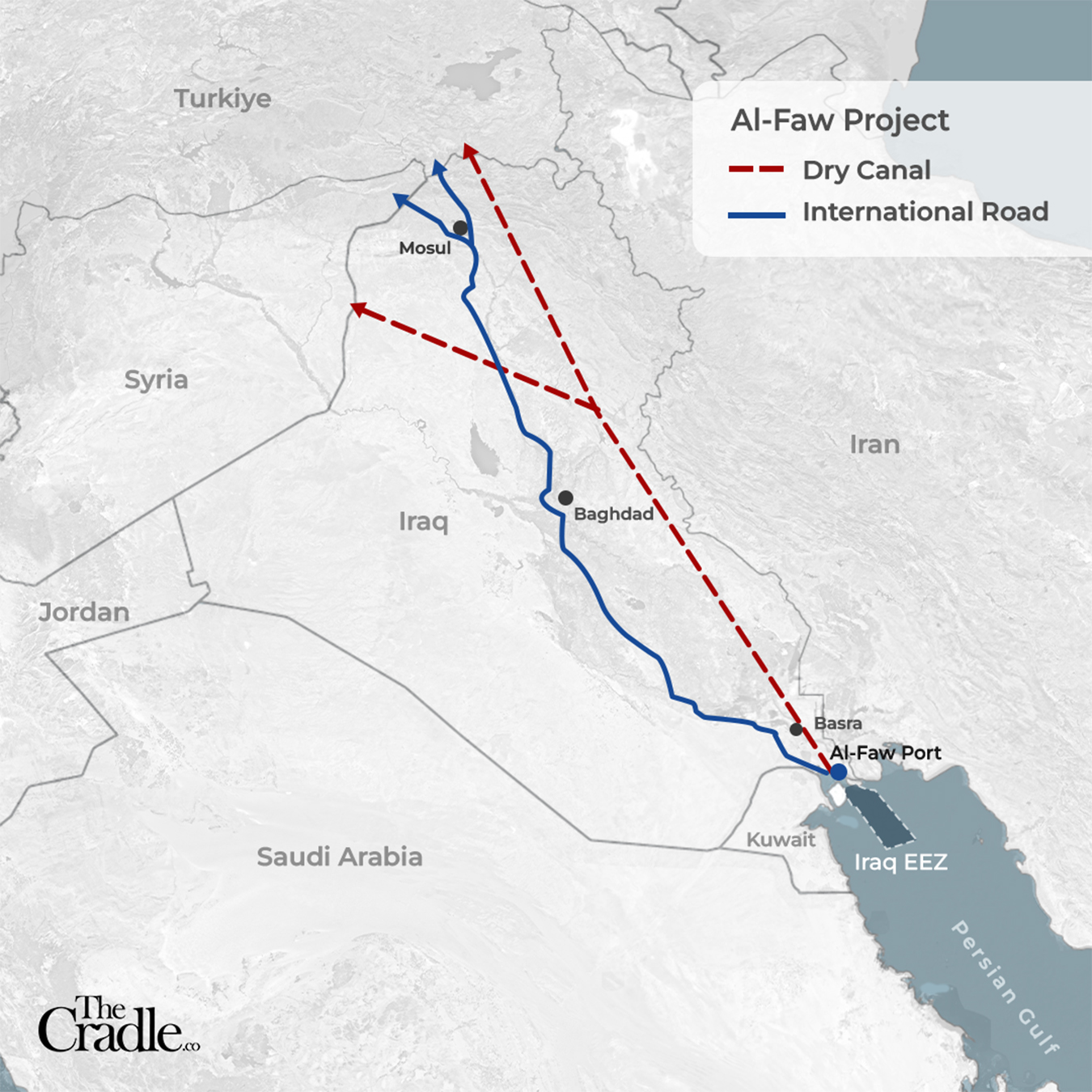
The maritime recalibration coincides with Iraq’s most ambitious infrastructure undertaking in decades: the Development Road project. Designed to link Basra to the Turkish border through an integrated network of highways and railways spanning more than 1,200 kilometers, the project aims to position Iraq as a transit corridor connecting Asia to Europe.
At its center stands the Grand Port of Al-Faw, envisioned as a deep-water hub capable of receiving ultra-large container vessels. The submerged Basra Tunnel beneath the Shatt al-Arab forms a critical component, linking rail and road networks directly to port facilities.
Iraq’s Ministry of Transport has reported advanced completion rates across key segments: the railway link from the tunnel reportedly exceeds 80 percent, the highway component approaches similar levels, and core port infrastructure – including navigation channels and container berths – has progressed significantly. These figures require independent verification but reflect the government’s narrative of accelerated implementation.
In April 2024, AD Ports Group signed a cooperation agreement with Iraq’s General Company for Ports to support development and operation at Al-Faw. The same month, Iraq, Turkiye, Qatar, and the UAE signed a memorandum of understanding (MoU) outlining operational frameworks for the Development Road. The project’s estimated budget stands at approximately $17 billion, structured in phased implementation extending to 2050.
For Baghdad, maritime demarcation and infrastructure expansion are interlinked. A secure legal maritime footing strengthens investor confidence and reinforces Iraq’s bid to reposition itself as a logistical crossroads within the northern Gulf trade architecture.
Mubarak Port and Kuwait’s counterweight
Kuwait’s Mubarak al-Kabir Port, launched in 2011 at an estimated initial cost of $1.1 billion, represents its own strategic gambit. In December 2025, Kuwait signed a contract valued at nearly $4 billion with China State Construction and Transportation Company to complete the first phase.
The port is expected to integrate with regional rail networks, including proposed Gulf railway links and a Kuwait–Saudi line projected between 650 and 700 kilometers.
These developments situate Mubarak within broader connectivity initiatives linked to Belt and Road corridors. Its geographic proximity to Iraq and Iran gives it potential leverage as a northern Persian Gulf transshipment node.
Internal Kuwaiti debate has intensified, with parliamentarians criticizing delays and warning that Iraq’s Al-Faw project could erode Kuwait’s share of regional maritime traffic.
Sovereignty, escalation, and political pressure
Iraqi officials insist the UN deposit is a sovereign legal act consistent with UNCLOS. The Council of Ministers has described it as an affirmation of territorial and maritime rights, while the Foreign Ministry emphasized that the submission cannot be nullified, though objections may be lodged through diplomatic channels.
Members of parliament have framed the coordinates as essential groundwork for offshore resource development and future negotiations. Lawmakers argue that the maps establish a legal basis for investing in marine resources, including transboundary fields, facilitate management of shared reservoirs, and strengthen the Ministry of Oil’s authority to explore and safeguard national entitlements.
Parliamentary sessions are reportedly being scheduled to translate the technical filing into executive action, including potential steps toward offshore oil and gas exploration in areas covered by the new charts.
At the same time, Iraqi authorities handling the Khor Abdullah file are preparing to formally advance the Federal Supreme Court’s 2023 ruling that invalidated the ratification of the 2012 navigation agreement. Submitting that ruling within international legal channels would reinforce Baghdad’s argument that previous maritime arrangements lack constitutional standing, potentially reopening discussion of the demarcation at Buoy 162 and beyond.
In effect, the deposit of coordinates is paired with a legal and political escalation designed to reassert Iraqi discretion over how its maritime boundary is interpreted and implemented.
Gulf reactions and regional anxieties
Gulf Cooperation Council (GCC) states have urged Iraq to adhere strictly to international law and bilateral understandings, expressing concern that the coordinates affect areas long regarded as sensitive. Saudi Arabia has signaled apprehension that Iraqi claims intersect with portions of the submerged divided zone shared by Riyadh and Kuwait, an area linked to energy reserves.
Some regional actors worry that a fully operational Al-Faw Port could recalibrate northern Persian Gulf trade patterns, challenging established hubs. Egyptian and Jordanian commentary has linked the project to broader regional transit dynamics, including implications for the Suez Canal and overland pipelines.
Within Iraq, political figures and activists have rejected what they describe as external pressure. MP Ali al-Fatlawi criticized Jordan’s alignment with Kuwait and called for a firm national stance to defend sovereign and economic interests.
Media narratives and geopolitical undercurrents
Segments of Gulf media have portrayed Iraq’s move as politically motivated, suggesting it coincides with internal governance uncertainties. Separately, the Kuwaiti cabinet issued an official statement calling on Iraq to engage in accordance with international law and to take historical relations into account.
Commentators in Kuwait, including the President of the Tarous Center for Studies, Mohammed Al-Thunayan, have speculated about regional power dynamics influencing Baghdad’s decision, including the role of Iran.
On social media platforms, some Kuwaiti voices advanced more assertive positions. Posts circulated arguing that Kuwait’s maritime facilities extended to Iraq in Khor al‑Zubair in 1993 out of consideration for navigational depth toward Umm Qasr, and that Kuwait should reconsider the balance of regulatory authority within the shared waterway.
Others went further, calling for the quadrilateral Al‑Faw framework – involving Iraq, Turkiye, the UAE, and Qatar – to be linked explicitly to strict compliance with UNCLOS and for a return to the 2012 Khor Abdullah navigation agreement as a precondition for broader cooperation.
These arguments have not been formalized as state policy, but they reveal how rapidly the maritime dispute has become entangled with intra‑Gulf competition. Debate has also surfaced regarding the participation of Emirati and Qatari entities in Al‑Faw’s development, with some commentators suggesting that regional port rivalries and strategic calculations now intersect with the legal contest over maritime boundaries in the northern Persian Gulf.
The legal battleground ahead
Legally, the dispute hinges on methodological principles. Iraq appears to have relied primarily on the median line approach in defining maritime limits. Some Iraqi experts argue that Khor Abdullah, as Iraq’s sole deep-water access, justifies consideration of Thalweg principles or geographic necessity doctrines, emphasizing depth and navigational viability.
Resolution 833 remains binding regarding land demarcation, and Iraq’s UN submission does not amend that boundary. Rather, it establishes coordinates for maritime zones subject to interpretation under UNCLOS.
Article 46 of the Vienna Convention on the Law of Treaties allows states to challenge agreements ratified in violation of constitutional procedures, a provision Baghdad may invoke regarding the 2012 navigation agreement.
Analysts, including commentary published by the Atlantic Council, have suggested that recourse to the International Court of Justice (ICJ) remains a possible avenue should bilateral negotiations stall, pointing to precedents such as the Qatar–Bahrain maritime dispute.
A contest over routes and regional weight
Iraq’s deposit of nautical charts is formally a sovereign administrative act. In practical terms, it forms part of a wider contest over sea lanes, ports, and the economic geography of the northern Persian Gulf. As Al-Faw and Mubarak advance, maritime lines translate into trade leverage, and infrastructure becomes an instrument of influence.
Baghdad’s decision signals that it does not intend to remain confined by arrangements forged under extraordinary post-war conditions in the early 1990s. Whether the dispute proceeds through negotiation or international adjudication, the outcome will shape the commercial and strategic architecture of the Gulf for decades.
Maritime coordinates may be measured in degrees and minutes, but their consequences are measured in power.

No comments:
Post a Comment