
By Palestine Chronicle Staff
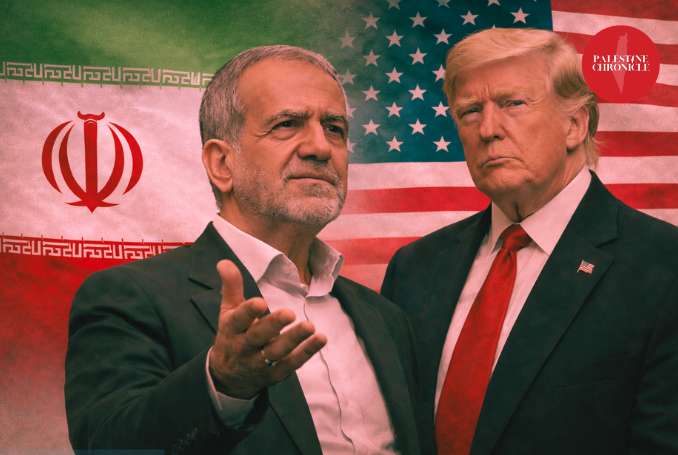 Iranian President Masoud Pezeshkian and US President Donald Trump face off as indirect nuclear talks continue in Geneva under Omani mediation. (Photo: Illustration by Palestine Chronicle)
Is a breakthrough emerging in the Geneva talks? What are Trump’s real motives? Has Tehran decoded his negotiating style, and how constrained is Israel?
Key Developments
- Iranian and US delegations paused the third round of indirect nuclear talks in Geneva after nearly three and a half hours.
- Omani Foreign Minister Badr Al-Busaidi said both sides exchanged “creative and positive ideas.”
- Senior Iranian official Ali Shamkhani said a deal is “within reach” if focused on non-development of nuclear weapons.
- President Masoud Pezeshkian reaffirmed Iran’s “doctrinal” opposition to nuclear weapons.
- Talks unfold amid significant US military buildup in the region and reports of strain in US interceptor missile stockpiles.
- Iranian officials signal potential economic incentives, including oil and gas investment, to make an agreement sustainable.
A Marathon in Geneva
The third round of indirect nuclear negotiations between Iran and the United States stretched into the longest session yet, signaling both the complexity and urgency surrounding the revived diplomatic track.
The talks, held at a building belonging to the Omani Embassy in Geneva, began at 10 a.m. local time and paused shortly after 1:15 p.m., with both delegations leaving in motorcades. Omani Foreign Minister Badr Al-Busaidi, who is mediating the process, confirmed that the session was adjourned for a break and would resume later in the day.
In a public statement, Al-Busaidi said the two sides exchanged “creative and positive ideas” and expressed hope for “more progress.”
Iran’s delegation is led by Foreign Minister Abbas Araghchi, accompanied by senior political deputy Majid Takht-Ravanchi and a team of nuclear, legal, and economic experts. The US delegation is led by Special Envoy Steve Witkoff, joined by Jared Kushner, President Donald Trump’s son-in-law.
Rafael Grossi, head of the International Atomic Energy Agency (IAEA), attended as a technical observer, participating in back-and-forth consultations during the session.
Iranian state media described the discussions as progressing “well,” despite what officials characterized as “contradictory positions” expressed by American officials in recent days through media channels.
Both sides reportedly returned to consult with their respective capitals, underscoring that this stage of diplomacy is tightly linked to political calculations at home.
Tehran’s Red Lines
Ahead of the latest round, senior Iranian figures emphasized that Tehran’s position on nuclear weapons is not tactical but rooted in doctrine.
Ali Shamkhani, senior adviser to Supreme Leader Ali Khamenei and head of Iran’s Defense Council, wrote that an agreement is “within reach” if negotiations focus on the “non-development of nuclear weapons.” He stressed that such a framework is “fully consistent” with Khamenei’s long-standing religious edict banning weapons of mass destruction.
“Foreign Minister Araghchi has sufficient support and authority for such an agreement,” Shamkhani said, signaling that Tehran’s negotiating team is empowered to move if core principles are respected.
President Masoud Pezeshkian echoed that message in remarks delivered Thursday, stating that Iran’s rejection of nuclear weapons is “doctrinal and jurisprudential, not a political tactic subject to change.”
“The declaration of the Leader is not a passing political statement,” Pezeshkian said. “It is a fixed religious judgment that does not shift with circumstances.”
He also rejected claims that Tehran seeks nuclear arms, calling such assertions “lies.”
These statements aim to frame Iran’s position not as a concession under pressure, but as continuity with established religious and strategic policy.
Timelines and Military Signals
The diplomatic track is unfolding against a backdrop of heightened US military posture in the region. President Trump has overseen what officials describe as the largest American buildup in the Middle East since 2003.
Trump recently warned that Iran has a limited window — “15 days” — to reach an agreement, or “bad things will happen.” At the same time, he told Congress that he prefers diplomacy over war.
US officials have continued to assert that Iran is nearing nuclear weapons capability. Special Envoy Witkoff claimed in a recent interview that Iran is “weeks away” from building a nuclear weapon — an assertion Tehran categorically denies.
The state of Iran’s nuclear infrastructure remains uncertain following US strikes in June 2025 on three major facilities, which Trump at the time described as having “obliterated” Iran’s program. Subsequent assessments have been less definitive.
Simultaneously, Israeli media reports have raised questions about interceptor missile stockpiles in both the US and Israel following previous confrontations. According to these reports, high rates of interceptor usage in 2024 and 2025 exposed supply constraints, with US production increases projected to restore inventories only by 2028–2029.
Pentagon contracts signed earlier this month aim to accelerate multi-year production of interceptors and guided munitions. However, analysts note that replenishment remains a multi-year process.
The intersection of diplomacy and military readiness is therefore central to the timing and tone of the Geneva talks.
Our Strategic Assessment
Iranian officials increasingly project confidence that they understand Trump’s negotiating style. The pattern is familiar: public deadlines, “maximum pressure,” sharp rhetoric, followed by space for dealmaking framed as a personal victory.
Tehran’s messaging — emphasizing doctrinal consistency while signaling economic opportunity — reflects an effort to neutralize escalation and shift the discussion toward enforceable commitments rather than symbolic concessions.
Iran appears to calculate that Trump ultimately prefers a fast, visible agreement that he can present domestically as proof of strength.
However, the stakes remain high.
Trump faces a fractious domestic political environment and must demonstrate authority both internationally and at home. A diplomatic breakthrough would offer a quick political win. If talks stall or appear to falter, the temptation to resort to limited strikes — framed as decisive action — may increase.
Israel is also in a bind. A return to a nuclear pact would be politically disastrous for Prime Minister Benjamin Netanyahu, who has long framed Iran as the centerpiece of his regional dominance narrative. Iran has been presented as the crown jewel of that posture. A renewed agreement would undercut years of positioning.
At the same time, a ‘symbolic’ attack on Iran is not guaranteed to achieve strategic results. Iran has demonstrated the capacity to strike back, placing Israel within direct range of retaliatory missile attacks. The risks are not theoretical.
Can Israel act alone? Not realistically. Any meaningful strike on Iranian nuclear facilities would require US logistical, intelligence, and defensive backing. Such support would effectively end the Geneva talks and place US military bases in the region on heightened alert.
In that scenario, Washington would be drawn directly into confrontation, transforming pressure tactics into open conflict.
For now, Geneva remains the primary arena. But behind the negotiating table stands a narrow corridor: either a swift diplomatic outcome that satisfies domestic audiences, or a recalculation that could move the region back toward open escalation.
(PC, US Media, Iranian Media, Israeli Media, Anadolu, Al-Mayadeen, AJA, QNN)

No comments:
Post a Comment