
By Palestine Chronicle Staff
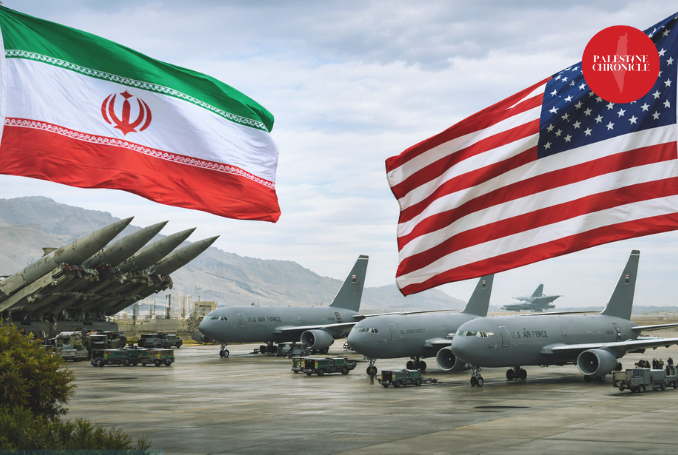 Escalating military movements unfold alongside ongoing diplomatic negotiations between Washington and Tehran. (Photo: Illustration, Palestine Chronicle)
US refueling aircraft deploy to Israel as Iran vows resistance, even as Geneva nuclear talks register cautious progress.
Key Developments
- Six additional US KC-46 refueling aircraft are reportedly heading to Israel.
- US stealth fighters and cargo aircraft have recently arrived at Israeli bases.
- Iranian officials say Geneva talks showed “seriousness” and “progress.”
- Technical negotiations are scheduled to begin in Vienna next week.
- Iran warns it will respond to any attack, “even if limited.”
- Washington continues a large-scale military buildup in the Middle East.
Refueling Aircraft
Six additional US aerial refueling aircraft are expected to arrive in Israel in the coming days, according to Israeli media reports, as Washington continues a broad military buildup in the Middle East amid heightened tensions with Iran.
The Times of Israel, citing analysts tracking open-source flight data, reported that five KC-46 tankers will depart from Portsmouth International Airport in New Hampshire, while a sixth will leave Seymour Johnson Air Force Base in North Carolina. All six aircraft are scheduled to land at Ben Gurion Airport near Tel Aviv.
The reported deployment follows the recent arrival of several US refueling and cargo aircraft at the same airport earlier this week. Israeli outlets also reported that 11 F-22 stealth fighter jets recently landed at Ovda Air Base in southern Israel, accompanied by logistical support aircraft and aircrews.
In recent weeks, dozens of US fighter jets—including F-35s, F-22s, F-15s, and F-16s—have been observed heading to the Middle East. The same reports indicate dozens of refueling aircraft and hundreds of military cargo flights have moved into the region.
The US has not formally announced the new tanker deployment. However, American officials have repeatedly emphasized that the military buildup is intended to reinforce deterrence and maintain readiness as diplomatic negotiations with Iran continue.
Technical Phase
The military movements coincide with what Iranian officials describe as tangible progress in the third round of indirect nuclear negotiations held in Geneva under Omani mediation.
Iranian Foreign Minister Abbas Araghchi said after Thursday’s talks that the two sides had “moved closer to agreement” on certain issues. He characterized the session as one of the “most serious and longest” rounds since diplomacy resumed.
“Seriousness between the two sides was more evident than before,” Araghchi told reporters, confirming that technical teams would begin discussions in Vienna starting Monday.
According to Araghchi, the talks addressed both nuclear-related matters and sanctions relief. He said the Iranian side “clearly outlined” its demands regarding sanctions and that “significant and practical proposals” were exchanged.
Omani Foreign Minister Badr al-Busaidi, acting as mediator, described “significant progress” and confirmed that discussions would continue after consultations in respective capitals.
The Geneva session was divided into two parts, separated by a four-hour break, during which both delegations consulted with their leaderships. The presence of International Atomic Energy Agency (IAEA) Director General Rafael Grossi was described by Iranian officials as “helpful from a technical standpoint.”
At the same time, Tehran rejected Western media reports suggesting that it would dismantle key nuclear sites or transfer enriched uranium abroad. Elyas Hazrati, head of the Iranian government’s information division, said such reports “do not reflect the reality of the talks.”
Iran has maintained that enrichment will continue and that its nuclear program is intended for peaceful purposes.
Tehran’s Warning
Despite the diplomatic tone emerging from Geneva, Iranian military officials have issued stern warnings in response to the expanding US military footprint.
Brig. Gen. Ali Jahanshahi, commander of Iran’s ground forces, said Iranian soldiers would stand firm “until the last drop of blood” against any US action.
“If American officials knew our true capabilities, they would not speak of war,” Jahanshahi said, adding that any “unwise” move by Washington would ignite a broader regional confrontation.
He described the US buildup as part of psychological pressure and accused Washington of seeking to coerce Iran into concessions.
President Donald Trump recently gave Iran what he described as a 10- to 15-day window to reach an agreement, warning that otherwise “bad things” could happen. In his recent State of the Union address, Trump reiterated that he prefers a diplomatic solution but accused Tehran of continuing nuclear ambitions and missile development.
Iranian officials have framed the choice in stark terms: dialogue or confrontation. Araghchi emphasized that sanctions relief remains central to any agreement and said the next round of talks would focus on technical details in Vienna.
Parallel Tracks
The current phase of US-Iran tensions is marked by the visible convergence of military signaling and diplomatic engagement.
On one track, refueling aircraft, stealth fighters, and logistical assets are being positioned in Israel and across the region. Refueling tankers are critical for extending the operational range of combat aircraft, enabling sustained missions over long distances.
On the other track, technical experts are preparing to meet in Vienna to work through details concerning nuclear restrictions and sanctions relief.
Israeli media have speculated about the possibility of US strikes on Iranian nuclear facilities, though Washington has not announced any such decision.
For now, diplomatic talks remain active, with a fourth round expected soon after the technical discussions in Vienna.
Our Strategic Assessment
Iran’s posture suggests confidence rather than retreat. As Washington increases its military footprint, Tehran has matched the rhetoric and the readiness step for step. The warnings from Iranian commanders are calibrated but firm, signaling that Iran views itself as capable of responding proportionately to any escalation.
Despite the visible US buildup, regional governments have largely spoken out against any military confrontation, or, at least, avoided public calls for war. Israel remains the most vocal advocate of a hard line against Tehran, consistently framing Iran’s nuclear and missile programs as existential threats.
This dynamic matters. If the current military signaling continues to intensify—more aircraft, sharper deadlines, more serious threats—the risk of miscalculation increases. A limited strike could quickly draw retaliatory responses, widening into a broader confrontation. In a region already under strain, escalation could spiral into an all-out war involving multiple fronts.
Yet diplomacy remains active. The length and seriousness of the Geneva sessions, the move toward technical negotiations in Vienna, and public acknowledgments of progress suggest that neither side has abandoned the diplomatic path.
The coming hours and days are critical. Military signaling and negotiation are unfolding simultaneously. If restraint holds, the buildup may serve as leverage in talks. If rhetoric or deployments accelerate further, the region could edge closer to war.
For now, both pressure and diplomacy continue in parallel—each shaping the other, and each carrying significant consequences.
(PC, Al-Mayadeen, AJA, Andolu, Iranian Media, Israeli Media)

No comments:
Post a Comment