
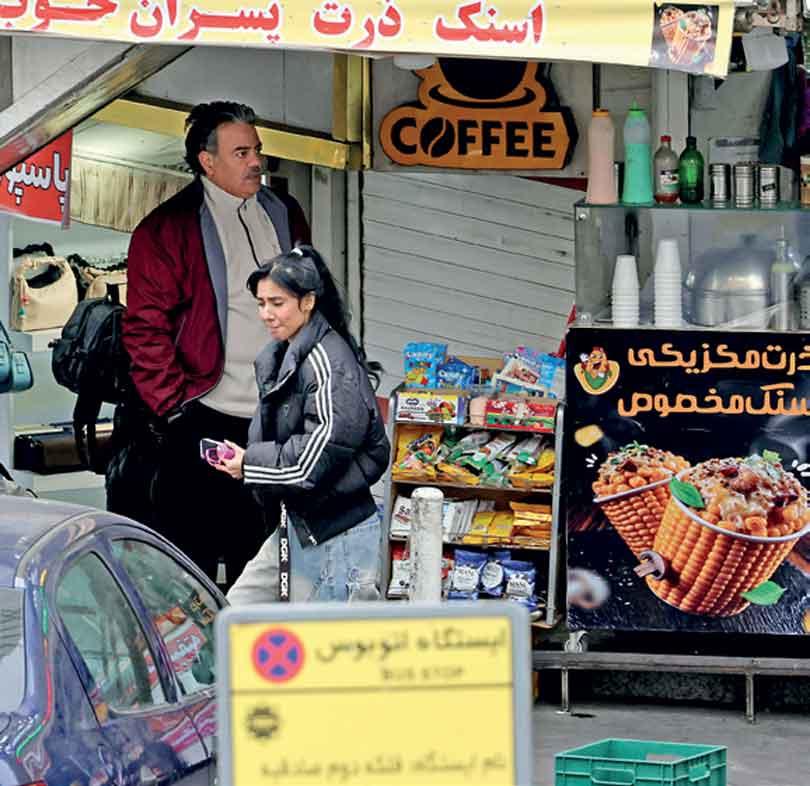
A woman leaves a shop in Tehran yesterday. A protest movement across Iran, initially sparked by economic grievances, has turned into one of the biggest challenges yet to the clerical leadership since it took power in 1979. AFP
The present crisis is not of Iran’s making. It is the price Iran is paying—and will continue to pay—for standing up to global gangsterism, led since the end of World War II by the United States and Israel, arguably among the most criminal states today.
Ever since the Iranian people rose in 1979 against the corrupt regime of the Shah—an outright Western puppet who had no qualms about Western energy giants sucking the country dry—Iran has been weathering regime-change attempts. It has done so quite successfully, though not without drawing severe economic hardships on its people.
Inheriting a rich culture and a history, Iranians are not swayed by the West’s crocodile tears over the suffering they endure due to economic hardships. They are well aware that their suffering is as much due to Western sanctions as to their government’s failures.
They have not forgotten the West-sponsored 1953 coup that ousted democratically elected Prime Minister Mohammad Mosaddegh, simply because he asserted that Iran’s oil belonged to Iranians and nationalised foreign oil companies. The main architects of that coup were British Petroleum, Shell, and the Central Intelligence Agency (CIA)—the United States’ intelligence-gathering outfit.
For defying the US-dominated ‘might is right’ world order and refusing to bow to Israel’s hegemony in the region, Iran has, since the 1979 revolution, been slapped with sanction after sanction by the US, other Western nations, and the United Nations Security Council. Iranians do suffer hardships as a result, but they do not succumb to Western pressure, even when sanctions bite.
Iran is a welfare state. Despite sanctions restricting Iran’s oil and other exports, government measures had reduced poverty since 2020, according to World Bank data.
But new issues arose in August last year, when the E3 (Britain, France, and Germany) imposed sanctions, two months after Iran defended its sovereignty in the 13-day war waged by Israel and backed by the United States. By invoking the “snapback” mechanism in the 2015 nuclear deal (JCPOA), the E3 accused Iran of non-compliance. Iran protested, arguing that this was a violation of treaty law. The new sanctions that came into force in October proved too much for the government to handle.
The Iranian currency, the rial, plunged to a record low, while food inflation rose to 70 per cent. In the capital, Tehran, bazaar traders—generally supportive of the government—staged a strike. Their strike was followed by protests by people who were rapidly losing confidence in the government’s ability to restore economic stability. The protests turned violent. The final death toll was more than 2,400—mostly protesters, though over 100 security personnel were also killed. Police stations, government facilities, and even mosques were attacked. The country’s army pledged its loyalty to the government.
While US President Donald Trump extended his support for the protesters and hinted at military action, Iran’s supreme leader, Ayatollah Ali Khamenei, and President Masoud Pezeshkian addressed the nation, claiming that the protests had been infiltrated by troublemakers in the pay of Israel and the US.
In a show of strength, Tehran saw massive pro-government demonstrations. As war clouds gathered over Iran, the anti-government protests that began on December 28 eventually petered out. Few are now willing to act on Trump’s words: “Keep protesting, and help is on its way.”
The Iranian leaders acknowledge that protests are justified and say they are willing to implement suggestions from the protesters.
What alternative do the protesters have? They lack leaders to rally around. Will they invite the clown prince—the deposed Shah’s son, an avowed lackey of Israel—to take over the government after Trump’s army, in violation of international law, kidnaps the entire Iranian leadership or wipes them out in a military operation? Very unlikely.
The problems within Iran should be solved within Iran. The Iranian leadership is not dynastic, nor does it act in the interest of any capitalist oligarchy. True, it sits on massive oil wealth, underused due to Western sanctions that have more to do with Western geopolitics and Israel’s hegemonic schemes than with any idealistic principles regarding the proliferation of nuclear weapons.
Despite this ever-worsening burden, the Iranian government has not gone to the IMF with a begging bowl in hand and is doing what it can to ensure that the people have their daily bread. A significant part of the government’s revenue, inevitably, is spent on the country’s defence—expenditure that might well have gone toward alleviating the hardships the people face.
Some Iranians may disagree with and dislike the theocratic government; the younger generation may not be as religious as their parents and grandparents who lived through the Shah’s reign of terror. But if the country’s sovereignty is threatened by external forces, they unite, as witnessed during last year’s war against the Israeli-US nexus.
Ever since the 13-day war ended last year, speculation has been rife about a second war. Judging by Trump’s daily comments on the situation in Iran and his warnings to the Iranian government, many believe a war is imminent. Credence to such belief was given by the US evacuation of some military personnel from its Al Udeid air base in Qatar on Wednesday.
As unpredictable as he is, Trump, still savouring what he calls a military success in the criminal act of kidnapping Venezuela’s president Nicolas Maduro, is keeping the Iranians—and the rest of the world—guessing. With behind-the-scenes contacts between the US and Iran cut off and the US emptying its military bases in preparation for Iranian retaliation, the odds now favour war over restraint.
It was not so much the dissent within Iran that prompted last year’s war by Israel against Iran. Rather, it was Iran’s weak air defence capabilities. The hits Iran suffered, however, were an eye-opener for the country’s defence establishment. Reports indicate that Iran has acquired and deployed sophisticated Russian S‑400 and Chinese HQ‑9B long‑range surface‑to‑air missile systems. Iran has also updated its own long-range Bavar-373 air-defence system, which matches Russia’s S-300. Iran is more prepared this time.
A war that would drive up global oil prices is no good news for a world economy already struggling with sluggish growth. Most of Iran’s neighbours, particularly Saudi Arabia, have expressed opposition to Trump’s war plan, with reports saying the Saudis will not permit their airspace to be used for any attack. Saudi Arabia probably now realises that Israel is a bigger threat than Iran. It is increasingly evident that the Zionist state is eyeing a military foothold in Somaliland in the Horn of Africa, overlooking Saudi Arabia, and has plans to annex parts of Saudi Arabia in keeping with its Greater Israel plan.
Israel—undoubtedly the main architect of the troubles, with a network of spies within Iran—is meanwhile maintaining a stoic silence. Yet its hawk-like eyes remain fixated on developments in Iran, the only country with the willpower to challenge Israel’s military superiority and criminal acts.
One thing is certain: Iran won’t be a cakewalk like Venezuela for Trump and Israel.

No comments:
Post a Comment